Shirika la Afya Duniani hufanya Survey/Tafiti kila baada muda kadhaa ambayo wao huiita GSRRS yaani (Global Status Report on Road Safety) ambayo latest kwa mukatadha wa Tanzania ni ya Mwaka 2023.
Kwa mujibu wa GSRRS Report ya Mwaka 2023 ni kwamba Country Profile ya Tanzania ambayo ili cover kipindi cha 2021/22 na kuwa published hiyo 2023 inaonesha Tanzania ilikua na wastani wa vifo 10,052, sawa na takriban 28 kwa siku vilivyotokana na ajali za barabarani.
Tanzania kwa data za 2025 kupitia tafiti ilifanyika kama joint task kati ya Jeshi la Polisi na NBS kuangalia hali ya uhalifu Nchini wakagundua pamoja na mambo mengine, kuna vyanzo vikuu vitatu vya vifo vitokanavyo na ajali za barabarani ambavyo ni;
Mosi; Makosa ya binadamu yaani udereva wa uzembe au hatari, makosa ya waendesha pikipiki, kupita magari bila tahadhari, mwendo kasi na ulevi ambavyo kwa mujibu wa NBS uli cover 96.2% ya vifo vyote reported.
Pili, ilikua ni hitirafu za magari ambazo zili account 2.2% ya vyanzo vya vifo vya barabarani na Mwisho miundombinu ya barabara ambayo ili account 1.6% ya vifo vyote vinavyotokana na ajali za barabarani & this is what happened.
Sasa ikawa hivi, Post survey ya 2025 ilifanya tuanze kufikiri upya on how tunaeza andaa kanuni ambazo ni 100% a punitive natural part ya sheria zetu. Yaani Tuwe na sheria KALI SANA kwa ajili ya kuepusha ajali 96% za barabarani ambazo zinatokana na MAKOSA YA KIBINADAMU na yanayoepukika & There came idea ya kuwa na kanuni za Points katika leseni!
Tukaweka mchakato wa kuwa na kilichopeleka peak ya what happened kama mgomo yaani Tangazo la Serikali No. 420 la 2026 kuleta kanuni za “Points System” ambazo usually meant to serve WATU yaani victim wa ajali zinazotokana na UZEMBE tu but then something happened. Tuna nchi ambayo ni ya kisiasa sana!
Tuna Nchi ambayo kila siku tunaeza epuka ajali kabisa kwa 96% kama tu kila mtu barabarani atakua responsible na kufuata sheria BUT at the same time tuna Nchi ambayo kila kitu kinabeba route ya kisiasa hata kama kipo scientifically proved & well researched na hakitaki SIASA!
Leo PM Dkt. Mwigulu ameimaliza hili suala KIMASTA SANA tunashukuru limeisha na sasa tuendelee na focus ya mambo mengine ikiwemo ulazima wa kupunguza kuleta siasa hata katika masuala ambaya yanahusu kuboresha maisha yetu na vizazi vyetu ambayo Serikali inakua ime project!
JUST IN: On the invitation of President Vladimir Putin, President Samia Suluhu Hassan of Tanzania is scheduled to undertake a state visit to Russia in or between June 2–6, 2026.
UPDATE: On March 26, Tanzania signed a Memorandum of Agreement between the University of Limerick and the Ministry of Education, Science and Technology (moest) of the United Republic of Tanzania regarding
Samia Scholarship on Data Science, AI and allied Sciences (sse ds/ai+).
After the signing of this agreement TOP 32 science students nationwide departed to Ireland for the studies.
The Samia Scholarship Extended for Data Science, Artificial Intelligence, and Allied Sciences (DS/AI+) is a fully funded Tanzanian government initiative.
It supports top-performing Form Six science graduates and Master's students in pursuing advanced tech studies at elite top 100 global universities on STEM to drive the nation's digital transformation.
This initiative operates alongside the "ordinary" Samia Scholarship, which supports around 1,000 students annually studying priority fields at local universities.
The extended DS/AI+ track represents a strategic, multi-billion TZS national investment to build a robust pool of tech experts capable of leading Tanzania's economic and digital innovation by 2050.
To further the mission, total of 93 top students are set to start Undergraduate programs in the coming FY on AI/DS and STEM across 6 selected Universities namely;
MIT in US, University of California, Berkeley (USA), Stanford University (USA), Carnegie Mellon University (CMU) (USA), National University of Singapore (NUS) and ETH Zurich (Switzerland).
BREAKING: On July 25, 2025, Tanzania and Rwanda signed a Memorandum of Understanding for the establishment and operationalization of the Tanzania Ports Authority’s liaison office in Kigali, Rwanda.
The office will enable Rwandan cargo clients using the Port of Dar es Salaam to access prior cargo clearance services directly from Kigali, including procedures that previously required physical presence at the port, with over 90% of Dar Port services now digitized.
The move is aimed at reducing cargo clearance time by more than 80% compared to competing regional ports, further positioning the Port of Dar es Salaam as one of Africa’s most efficient trade gateways. The agreement signed in 2025 is expected to take full legal effect during the 2026/27 financial year.
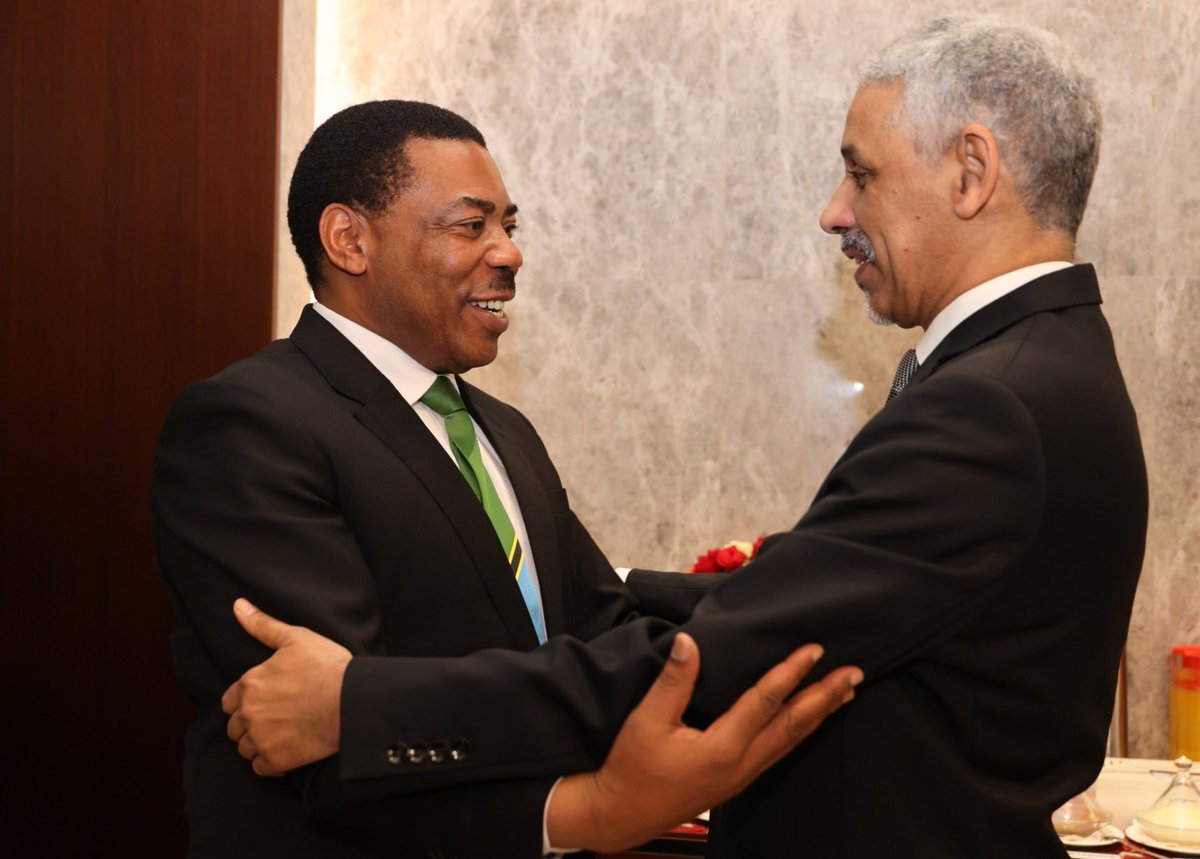
JUST IN: Tanzania’s Prime Minister, Dr. Mwigulu Nchemba, has held talks with AfDB President Dr. Sidi Ould Tah on the sidelines of the ongoing 61st Annual Meeting of the African Development Bank Board of Governors in Brazzaville, Republic of Congo.
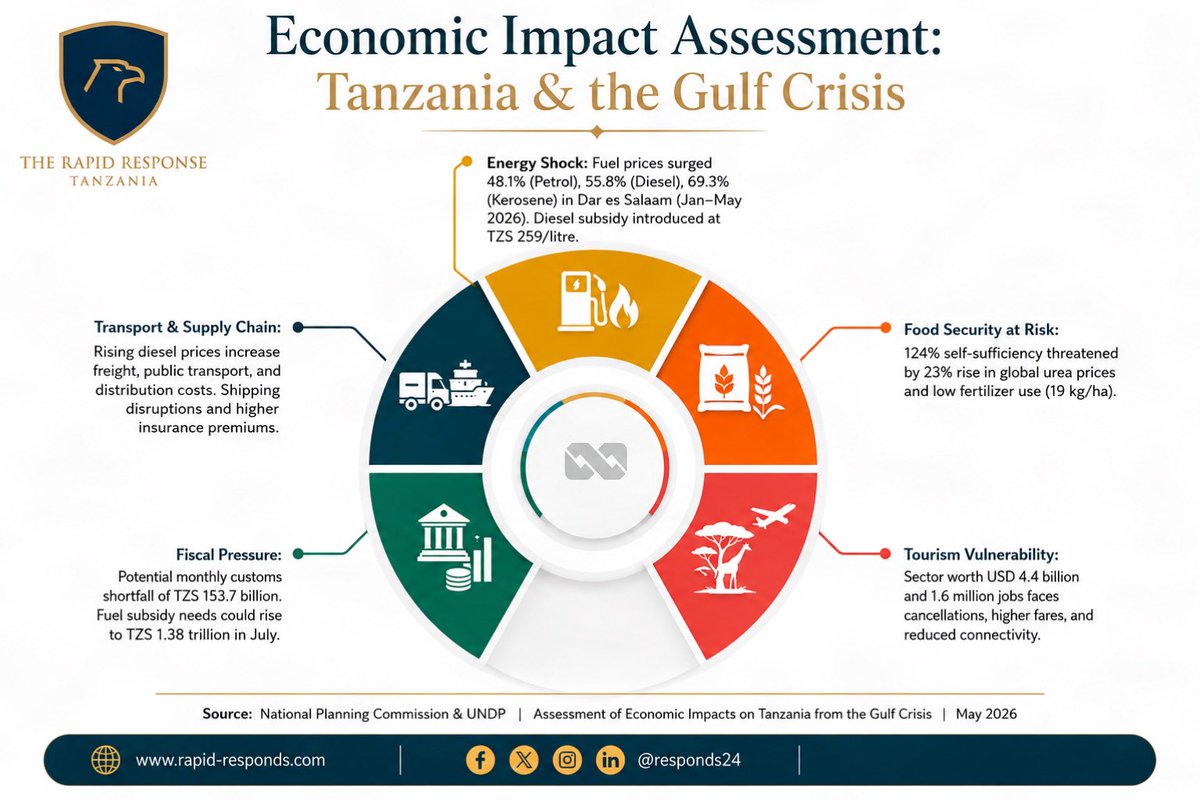
BREAKING: The latest Economic Impact Assessment report released by Tanzania’s National Planning Commission in collaboration with UNDP shows that while the Gulf Crisis is creating serious global economic pressure, Tanzania still maintains strong macroeconomic resilience and strategic opportunities for growth.
The report highlights major impacts already being felt across fuel, transport, tourism, food systems, and public finances. Between January and May 2026, fuel prices in Dar es Salaam rose sharply, with petrol up 48.1%, diesel 55.8%, and kerosene 69.3%. Government responded by introducing a diesel subsidy of up to TZS 359 per litre.
Food security also faces growing pressure despite Tanzania maintaining 124% food self-sufficiency. Rising global fertilizer prices and low fertilizer usage remain key concerns for agricultural productivity and affordability.
Tourism, a sector worth USD 4.4 billion and supporting 1.6 million jobs, is facing risks from higher airfares, reduced connectivity, and possible booking cancellations linked to instability in global transport corridors.
The assessment also warns of growing fiscal pressure, including a possible monthly customs revenue shortfall of TZS 153.7 billion and rising fuel subsidy costs that could reach TZS 1.38 trillion in July.
Despite these challenges, Tanzania still holds important economic buffers. Foreign exchange reserves remain at USD 6.3 billion, inflation is stable at around 3.2%, natural gas reserves stand at 57 trillion cubic feet, and gold earnings are projected at USD 3.5 billion in 2025. The country also maintains sovereign ratings of B+ and B2.
The report recommends targeted support for vulnerable households, stabilization measures for productive sectors, and accelerated investment in domestic gas, LNG, CNG, minerals value addition, ports, logistics, tourism recovery, and regional food supply chains.
To strengthen coordination, the assessment proposes a dedicated Gulf Crisis Economic Coordination and Monitoring Framework supported by a weekly national dashboard tracking fuel stocks, prices, freight rates, food costs, tourism arrivals, exchange rates, customs revenue, and household hardship indicators.
JUST IN: Tanzania has officially integrated the Port of Dar es Salaam with the Standard Gauge Railway (SGR) network, directly linking the port to the inland logistics hubs of Nala Dry Port in Dodoma and Kwala Dry Port in the Coast Region.
The new connection is expected to accelerate cargo movement by up to 80% compared to transit timelines currently experienced across competing regional trade corridors.
The country’s long-term logistics strategy aims to position Dar es Salaam as the fastest and most efficient maritime gateway in East and Central Africa.
By 2028, the SGR line is expected to extend to Isaka Dry Port in Shinyanga, while full rail connectivity to the borders of Rwanda and Burundi is targeted by 2030.
Once completed, Tanzania intends for transit cargo moving through Dar Port to reach destinations across the East African Community (EAC) corridor in less than 48 hours.
The transformation follows more than $1 Billion in modernization and expansion investments at Dar es Salaam Port led by DP World. As a result, annual cargo throughput capacity has now increased from a minimum of 27.7 million tonnes toward a projected 50 million tonnes.
Performance figures for the 2025/26 financial year already indicate strong growth momentum across the port ecosystem. Container volumes surged by 55%, roll-on/roll-off (RORO) traffic increased by 20%, general cargo rose by 25%, while dry bulk cargo expanded by 22%.
JUST IN: In a collaborative approach between Tanzania PPP Centre and Tanzania Railways Corporation (TRC), Tanzania is advancing plans for an $8 billion Dar es Salaam Metropolitan Commuter Rail Network under the Public-Private Partnership (PPP) framework.
The 160-kilometer metro-style urban transit system is envisioned to connect Dar es Salaam with surrounding municipalities and emerging satellite towns, introducing a modern mass transit ecosystem comparable to major metropolitan rail networks globally.
Structured under the DBFOMT (Design, Build, Finance, Operate, Maintain and Transfer) PPP model, the project has officially been opened for competitive bidding, signaling Tanzania’s continued push to attract global private sector participation into strategic infrastructure development.
The railway network is expected to significantly reduce urban congestion while delivering faster, cleaner, more reliable, and more affordable passenger transportation across East Africa’s leading commercial gateway.
JUST IN: Under its expanding Public-Private Partnership (PPP) framework, Tanzania is set to establish a $135 million world-class Centre for the Fifth Industrial Revolution Excellence (C5IRE) at The University of Dodoma, aimed at positioning the country as a regional hub for advanced industrial innovation.
The state-of-the-art facility will manufacture advanced hardware while integrating frontier technologies including Artificial Intelligence (AI), Internet of Things (IoT), Blockchain, Robotics, Big Data Analytics, and Automation into key industrial sectors as Tanzania advances its long-term industrial transformation agenda.
BREAKING: Tanzania is set to begin the Liganga and Mchuchuma integrated iron ore, coal, and steel projects within three months after investor negotiations passed 90%.
The US$2 billion to US$3 billion projects in Njombe aim to produce 2.9 million tons of crude steel annually and create 6,500 formal jobs.
The projects are being developed and implemented by Tanzania China International Mineral Resources Limited (TCIMRL), a Joint Venture Company (JVC) between the Government through NDC (20% non-cash) and Sichuan Hongda Group from China (80%).
JUST IN: With over $80 billion in infrastructure financing required, Tanzania is accelerating Public-Private Partnership (PPP) frameworks as a strategic engine for capital mobilization, positioning the private sector at the center of its long-term transformation into a projected $1 trillion economy by 2050.
JUST IN: Tanzania is expected to start nuclear electricity generation by 2030 as the country accelerates its uranium and nuclear energy ambitions.
On July 31, 2025, Tanzania commissioned a $1.2 billion pilot uranium plant under the Mkuju River Project in partnership with Rosatom, becoming the only East African country with such a facility.
The plant is expected to be fully operational by 2029, producing up to 3,000 tonnes of uranium annually over a projected 22-year lifespan. The Mkuju River project hosts an estimated 58,500 tonnes of uranium reserves, placing Tanzania among the world’s top 10 uranium reserve holders.
During the Nuclear Energy Innovation Summit in Kigali, President Samia Suluhu Hassan also met with Rafael Mariano Grossi, where Tanzania reaffirmed its commitment to advancing peaceful nuclear energy development.
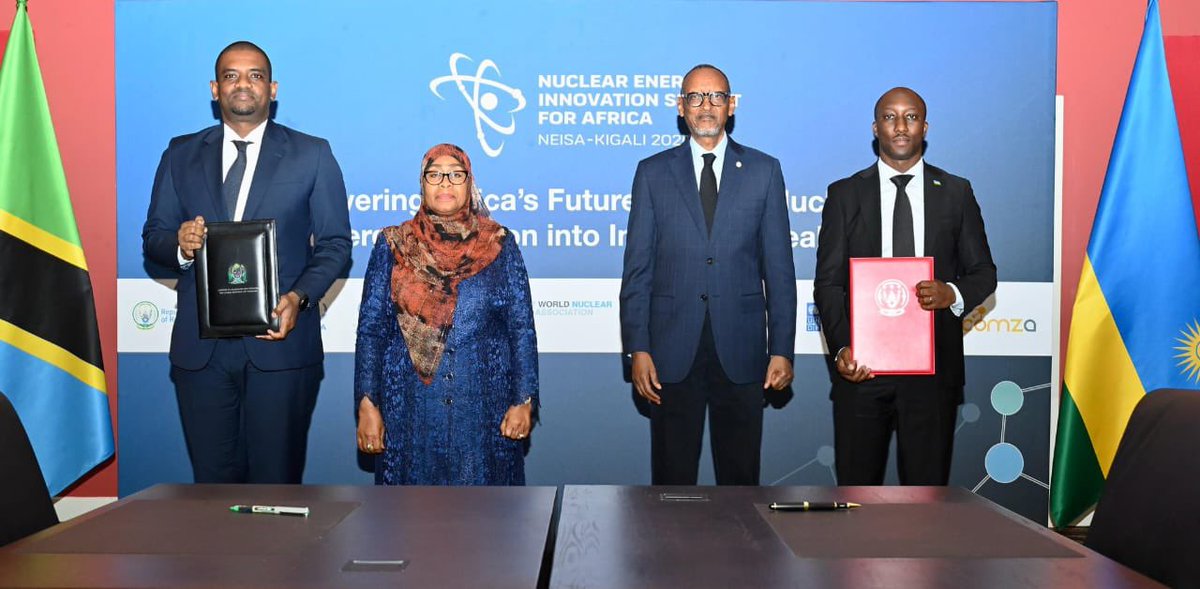
UPDATE: President Samia Suluhu Hassan and his Rwandan counterpart Paul Kagame, on Tuesday, May 19, witnessed the signing of a Memorandum of Understanding (MoU) between the two countries, aimed at strengthening cooperation in the energy sector.
The agreement was signed on the sidelines of the Nuclear Energy Innovation Summit for Africa 2026, held at the Kigali Convention Centre from May 18-21.
JUST IN: On the invitation of President Vladimir Putin, President Samia Suluhu Hassan of Tanzania is scheduled to undertake a state visit to Russia in or between June 2–6, 2026.
UPDATE: “Africa can never transform through ‘chapoo kind of investments’ or limited financing approaches. The continent needs bold, large-scale financial backing to unlock its true potential in infrastructure, energy, industry, and trade.
if the world genuinely understands what Africa is positioned to become over the next 100 years, then cheap or inadequate financing should never define the continent’s development path.”
Farewell remarks by Nathan Belete, former World Bank Country Director for Tanzania, Malawi, Zambia, and Zimbabwe, on one message consistently emphasized by Dr. Mwigulu Nchemba during his tenure as Finance Minister and now Prime Minister
JUST IN: Speaking at the Nuclear Energy Innovation Summit in Kigali, President Samia said Tanzania is positioning itself as a future nuclear energy economy, backed by 58,500 tonnes of uranium reserves and the $1.2 billion Mkuju River Project led by Rosatom as the country pushes toward its 70,000 MW electricity ambition.
The summit today also adopted the Dar es Salaam Energy Declaration launched in Tanzania in January 2025, a continent-wide plan endorsed by 30 African Heads of State targeting electricity access for 300 million Africans by 2030 with over $50 billion in pledged support.
JUST IN: President Samia Suluhu Hassan has departed for Kigali, Rwanda to attend the Nuclear Energy Innovation Summit taking place from 18–21 May 2026.
Tanzania enters the summit with growing strategic relevance in Africa’s emerging nuclear energy landscape. The country holds an estimated 58,500 tonnes of uranium reserves, ranking among the world’s top 10 uranium resource holders.
At the center of this ambition is the $1.2 billion Mkuju River Project in southern Tanzania’s Ruvuma region, developed by Russia’s state nuclear giant Rosatom. The project is expected to position Tanzania as one of Africa’s future uranium suppliers while supporting the country’s long-term target of generating 70,000 MW of electricity, including through nuclear energy development.
Global momentum behind nuclear energy is also accelerating. In 2025, the World Bank officially lifted its long-standing ban on financing nuclear power projects, while at COP28, governments jointly called on international financial institutions to include nuclear energy within future climate and energy investment portfolios.
The Kigali summit is expected to bring together governments, financiers, energy agencies, and nuclear technology stakeholders to discuss the future of clean baseload power, uranium supply chains, and next-generation nuclear innovation.
JUST IN: Gazprom is interested in implementing comprehensive gas projects in Tanzania, according to the report issued by the Russian Ministry of Economic Development.
It says Gazprom in addition to selling natural gas, LNG, and petrochemical products, the company is ready to supply technologies and equipment for gas production, processing, transportation, and sales.
Report further says Gazprom is continuing its work on a pilot project launched last year to supply two mobile gas tankers to Tanzania.
JUST IN: Russian energy giant NOVATEK Russia’s second-largest natural gas producer and one of the world’s biggest LNG companies — has expressed interest in entering Tanzania’s gas sector.
The company is currently awaiting details on Tanzania’s fifth exploration licensing round while also exploring possible acquisition of already explored gas field blocks, including the strategic Ntorya gas field.
NOVATEK leads multi-billion-dollar LNG projects such as Yamal LNG, making its potential entry a major boost for Tanzania’s ambitions to become a leading regional gas and energy hub.
JUST IN: Russia’s plan to officially make Tanzania the African gateway of the International Transport Corridor (ITC) “North-South” is now taking shape following the first successful container shipment by Russian logistics giant FESCO to the Port of Dar es Salaam.
The cargo shipment travelled from Novorossiysk through India’s Nhava Sheva Port before arriving in Tanzania — marking the beginning of operational logistics integration between Russia and Tanzania under the ITC North-South framework.
The development follows years of negotiations between the two countries, which were officially finalized in St. Petersburg in March 2026 through signed transport and logistics cooperation agreements.
Tanzania was represented by Minister for Transport Prof. Makame Mbarawa, while Russia was represented by Deputy Minister of Transport Andrey Nikitin.
Under the arrangement, Tanzania is expected to serve as Russia’s primary logistics and trade gateway into Africa, leveraging the strategic position of the Port of Dar es Salaam to connect Russian trade flows with East, Central and Southern African markets.