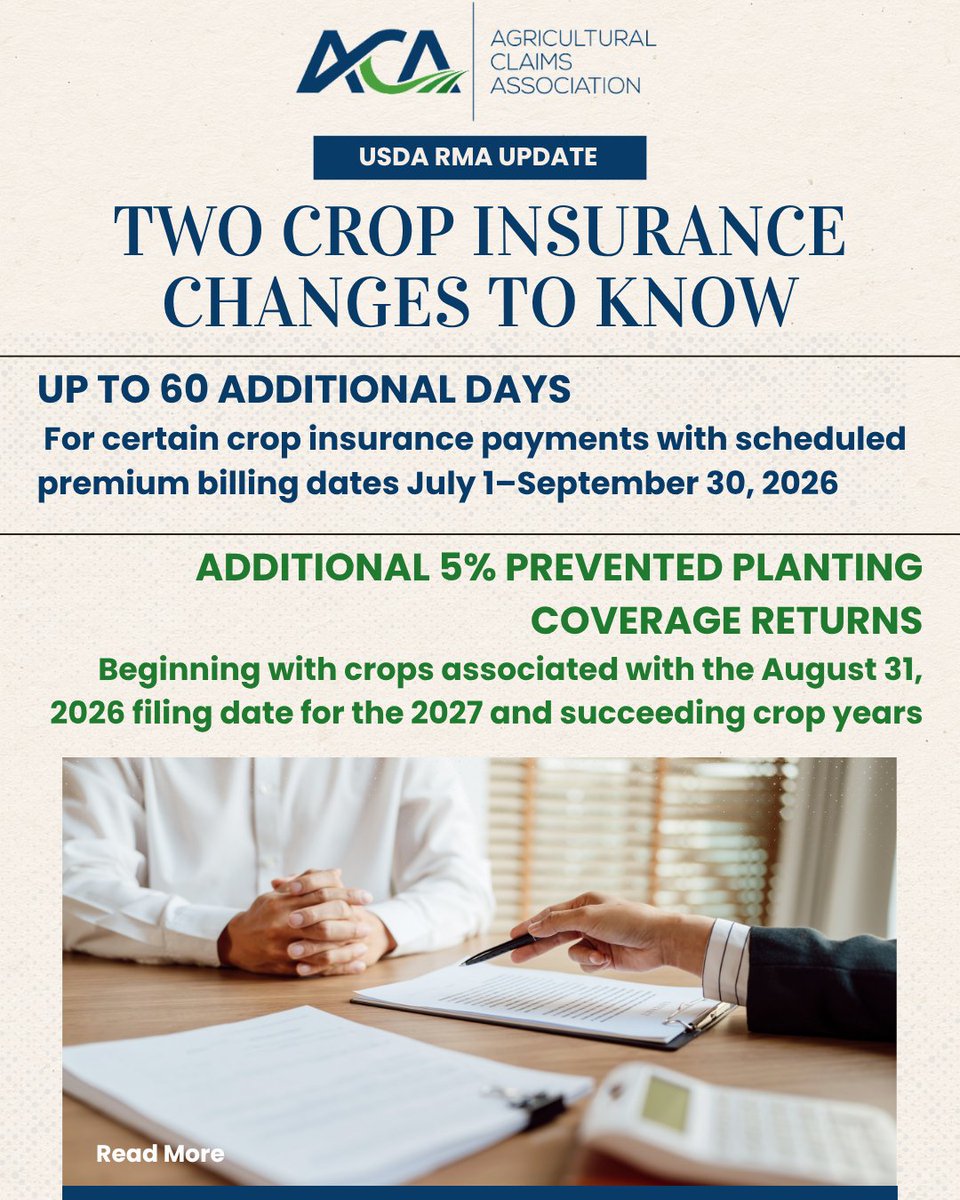
USDA has announced two crop insurance updates affecting payment timing and prevented planting coverage.
RMA is authorizing Approved Insurance Providers to give producers **up to 60 additional days** to pay certain crop insurance premiums, administrative fees, and Written Payment Agreement amounts when scheduled premium billing dates fall between **July 1 and September 30, 2026**. During that additional period, AIPs may also waive interest charges.
RMA is also reinstating the option for insured producers to purchase an **additional 5% of prevented planting coverage**, beginning with crops associated with the **August 31, 2026 filing date for the 2027 crop year**.
For agricultural insurance professionals, these changes may affect conversations with producers around payment deadlines, policy servicing, and coverage decisions for the upcoming crop year.
ACA breaks down the updates and what they mean for the agricultural insurance industry.
Read the full ACA article:
https://t.co/7GtoAxDrsc
#AgriculturalInsurance #CropInsurance #AgInsurance #PreventedPlanting #RiskManagement #USDA #Ag #RMA #Agriculture
We’re grateful to have SWA Claims Management as a Platinum Sponsor of ACA.
SWA supports insurance industry clients nationwide with agricultural, property, liability, catastrophe, appraisal, TPA, and other specialized claims services.
One message from SWA that really resonates with us is: “Tomorrow belongs to those who prepare today.
That mindset fits closely with what we believe at ACA. Strong agricultural claims work is built through preparation—continuing to learn, building industry connections, strengthening your knowledge, and having the right resources available when they are needed.
We truly appreciate SWA’s continued support of ACA and the professionals we serve.
Take a moment to check them out and learn more about their team and services:
https://t.co/bAZn07fspz
#AgriculturalInsurance #AgClaims #ClaimsAdjusting #Agribusiness #ACASponsor #Ag #Agriculture #InsuranceAdjuster #AgClaimsAssociation
Strong agricultural claims work starts with having the right knowledge, resources, and people within reach.
ACA brings those pieces together through practical education, claims resources, expert connections, and a community of professionals who understand agriculture and the work behind each claim.
The upcoming Crop Liability Certification Course is one opportunity to build that knowledge through practical, scenario-based training. Attendees will work through corn and soybean liability claims from assignment to closing, including field investigation, documentation, and covered-peril evaluation.
September 29–October 1
Clarksville, Tennessee
CE credits available
Limited to 21 attendees
Whether you are building new skills or expanding the types of claims you handle, ACA can help connect you with the training, resources, and people you need along the way.
Learn more & register for the course:
https://t.co/vPJSxx4rFO
#AgriculturalInsurance #AgClaims #CropLiability #ClaimsTraining #Agribusiness
The U.S. Drought Monitor is updated every Thursday, providing a new look at where drought conditions are developing, improving, or intensifying across the country.
For agricultural claims professionals, the map can provide useful regional context when reviewing drought-related crop conditions. It is best considered alongside local rainfall totals, field observations, production records, photographs, and other claim-specific documentation.
The Drought Monitor reflects broad-scale conditions, so impacts may still vary considerably within a state, county, or individual operation.
View the latest map and regional summaries:
https://t.co/QIxxVk7v1i
#AgriculturalInsurance #AgClaims #Drought #CropClaims #RiskManagement
#DroughtMonitor #AgClaims #AgClaimsAssociation
A friendly reminder for producers with fall-planted crops: the next major crop insurance sales closing dates are **September 1 and September 30**.
These deadlines are the final opportunity to apply for coverage or make changes to an existing policy for the 2027 crop year. Because dates vary by crop and location, producers should connect with their crop insurance agent soon to confirm what applies to their operation.
Taking time now to review coverage options, verify important dates, and make any needed updates can help avoid last-minute questions as the deadline approaches.
RMA also offers online tools to help producers look up crop- and location-specific dates.
Read the full RMA reminder:
https://t.co/UhnTnkCasW
#CropInsurance #AgriculturalInsurance #RiskManagement #USDA #AgClaims #RMA #AgClaims #RiskManagement #AgClaimsAssociation
Three days. Realistic crop liability scenarios. Practical skills you can carry into the field.
The ACA Crop Liability Certification Course gives attendees hands-on practice with corn and soybean claims, including field investigation, documentation, covered-peril evaluation, and the decisions that move a claim from assignment to closing.
Beyond the course, ACA continues to support agricultural claims professionals through industry resources, expert connections, ongoing education, and a community that understands the work.
September 29–October 1
Clarksville, Tennessee
CE credits available
Limited to 21 attendees, don't wait.
Learn more and register:
https://t.co/vPJSxx3TQg
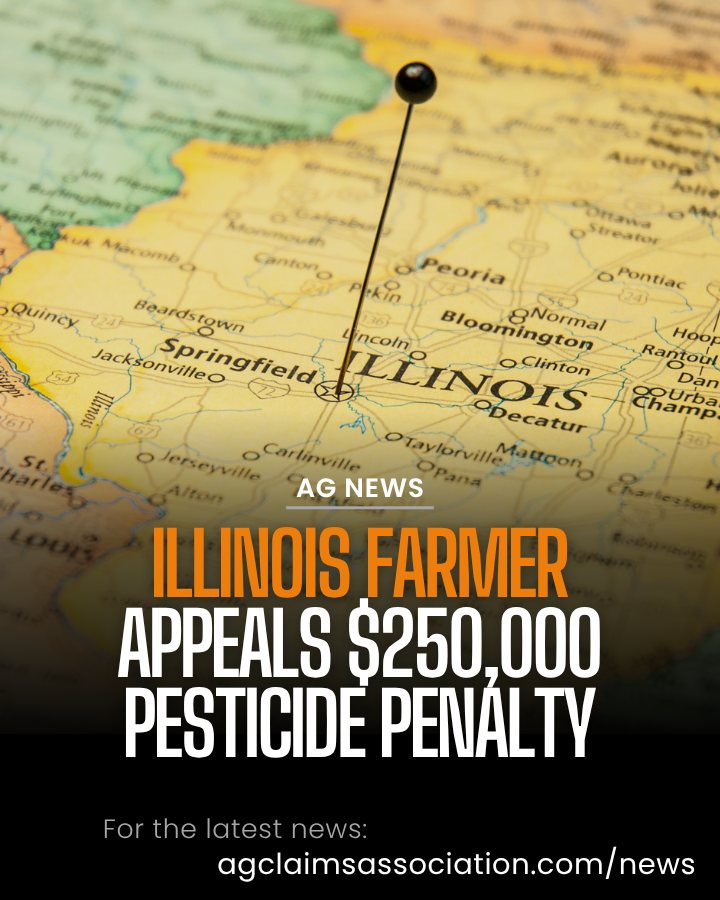
An Illinois farmer is appealing a proposed $250,000 pesticide penalty after an application near a school led to a human-exposure investigation involving approximately 200 people.
According to Farm Progress, the April application involved metribuzin and trifluralin. Wind gusts reportedly reached up to 19 mph, exceeding the listed application conditions for the products involved.
Illinois Department of Agriculture investigators arrived the following day, interviewed witnesses, and collected items from the school property for testing. Of the 14 items tested, 12 reportedly contained metribuzin, trifluralin, or both.
Under Illinois law, pesticide use inconsistent with the label that results in human exposure involving five or more people may carry a penalty of $1,250 per person. With approximately 200 people present, the proposed penalty reached $250,000.
The farmer has requested an administrative hearing, so the penalty is not final.
For agricultural claims professionals, this case shows how quickly a pesticide matter can move beyond crop or property damage. Product labels, application records, weather data, witness statements, reported symptoms, physical samples, and regulatory records may all become critical to determining what occurred and the full scope of the loss.
Read the full ACA article:
https://t.co/sUMgpgHQIB
#AgriculturalInsurance #AgClaims #PesticideClaims #CropLiability #Agribusiness #AgNews #Pesticide #AgClaimsAssociation
A vacuum truck explosion in Spartanburg, South Carolina, shows how quickly one chemical transportation incident can move beyond the vehicle and affect nearby people, property, business operations, and the surrounding environment.
On August 5, a vacuum truck carrying approximately 2,300 gallons of a spray-foam chemical exploded in a restaurant parking lot. According to the truck company, the material being transported reportedly reacted with water and began expanding inside the tank.
No injuries were reported, but the effects extended well beyond the truck. Four restaurant employees were decontaminated at the scene, chemical product was found on the building and surrounding parking areas, and the restaurant temporarily closed while emergency crews contained the release and a specialized contractor responded for cleanup.
Officials also reported that some of the material was released toward a storm drain. Crews protected the drains with absorbent booms, and none of the chemical entered the drainage system.
While this incident did not occur on a farm or involve an agricultural chemical, the claims picture is highly relevant to agribusiness. A similar loss involving a farm, cooperative, applicator, supplier, contractor, or transporter could involve vehicle and equipment damage, third-party property contamination, environmental cleanup, potential employee or public exposure, business interruption, and liability.
For agricultural claims professionals, documentation gathered early may be critical. Safety Data Sheets, tank cleaning and load history, maintenance and transfer records, driver and witness statements, surveillance footage, photographs, emergency-response reports, environmental testing, and cleanup records may all help establish what happened, who was involved, and how far the loss extended.
The incident may have started inside one tank, but the resulting claims exposures reached the vehicle, nearby property, employees, business operations, and the surrounding environment.
Read the full report from FOX Carolina:
https://t.co/FDn4g7m61z
#AgriculturalInsurance #AgClaims #Agribusiness #LiabilityClaims #RiskManagement #News #AgNews
The biggest crop insurance loss story of 2025 was the swing between too much water and not enough.
As of late June 2026, reported crop insurance losses for the 2025 crop year had reached approximately $11.15 billion.
Among individual plans of insurance, 37% of losses were connected to excess moisture, flooding, and rain, while 32% were connected to drought, heat, and wildfires.
Together, these opposing weather extremes accounted for 69% of individual-plan losses.
For agricultural insurance and claims professionals, that can create two very different claim environments within the same crop year. One region may require documentation of saturated fields, flooding, and prolonged moisture, while another is evaluating drought conditions, heat stress, and reduced production.
The data reinforces the importance of understanding local field conditions, preserving timely documentation, and recognizing how differently the same crop year can affect agricultural operations across the country.
Read more in the full ACA article:
https://t.co/amy39mnYMT
#CropInsurance #AgriculturalInsurance #AgClaims #Agriculture #RiskManagement
Calling all agricultural claims adjusters and industry professionals!
Are you new to crop liability claims? Looking to expand the lines you adjust? Seeking practical training in corn, soybeans, field investigation, documentation, and covered-peril evaluation?
Then this course is for you.
The ACA Crop Liability Certification Course is designed to teach the crop liability claims process from assignment through closing, with scenario-based activities that allow attendees to put what they learn into practice.
September 29–October 1, 2026
Clarksville, Tennessee
Seats are limited, so don't wait to reserve yours!
Learn more and register:
https://t.co/vPJSxx4rFO
Four important USDA deadlines fall in August, beginning today.
August 3: Final day to submit nominations for eligible candidates interested in serving on their local FSA county committee.
August 7: Deadline for eligible specialty crop producers to apply for Assistance for Specialty Crop Farmers. Payments are based on reported 2025 planted acres.
August 12: Deadline for both stages of the Supplemental Disaster Relief Program, which provides assistance for qualifying crop, tree, bush, and vine losses caused by natural disasters in 2023 and 2024.
August 31: Deadline for eligible landowners to review potential ARC and PLC base-acre increases. This is the first opportunity to increase base acres in more than two decades.
Eligibility, application, and documentation requirements vary by program. Producers should contact their local FSA office now to review available assistance, obtain the correct forms, and confirm whether action is required.
Read the full USDA announcement:
https://t.co/iChW6XUKwA
#USDA #FarmServiceAgency #FarmPrograms #DisasterAssistance #CropInsurance #Agriculture #AgClaimsAssociation #AgClaims #Ag
#Innovation #Leadership
High nitrate levels can create concerns in the field—and serious risks at the feed bunk.
End-of-season corn stalk testing can help indicate whether a corn crop received too little, an appropriate amount, or more nitrogen than it needed. When nitrates accumulate in hay, silage, corn, or other forage, testing can also help identify a potential livestock hazard before or after a loss occurs.
For agricultural claims professionals, these laboratory results may provide important supporting information when investigating:
• Questions involving fertilizer application or crop performance
• Feed quality and storage concerns
• Livestock illness, breathing difficulty, weakness, or collapse
• Unexpected livestock deaths
Testing does not determine the outcome of a claim by itself, but it can provide objective documentation that helps separate possible causes and identify what additional records or experts may be needed.
Our latest ACA article explains how nitrate testing may support crop and livestock claim investigations.
Read more: https://t.co/sMqSCnRJ4P
#AgriculturalClaims #LivestockClaims #CropClaims #NitrateTesting #AgriculturalInsurance #RiskManagement
*Learn how to investigate and adjust crop liability claims—from assignment to closing.*
Our Crop Liability Certification Course is a three-day, in-person course for ag insurance professionals who want to begin handling crop liability claims, expand the types of claims they adjust, or strengthen their agricultural claims knowledge.
Through practical instruction and scenario-based activities, participants will learn about:
• Crop liability fundamentals
• Corn and soybean claims
• Field inspections and investigations
• Documentation and evidence gathering
• The supporting role of crop insurance
• Resources used throughout the adjustment process
• Two hours of ethics training
The goal is to help participants better understand the full crop liability claims process and feel more prepared when a real assignment arrives.
This pilot course is limited to 21 students, allowing participants to learn and work through the material in a focused setting. Continuing Education credits are currently in development, so stay tuned for updates.
September 29–October 1, 2026
DoubleTree by Hilton | Clarksville, Tennessee
For registration information or questions, reach out to us at: [email protected]
https://t.co/vPJSxx3TQg
#CropLiability #AgriculturalClaims #ClaimsTraining #ClaimsAdjuster #AgriculturalInsurance #AgClaimsAssociation #AgTraining #InsuranceClaim
A field can look green and healthy from the road while still hiding areas of crop stress that may affect final yield.
USDA’s latest ratings show most of the nation’s corn and soybeans remain in good-to-excellent condition, but roughly one-third of each crop is rated fair, poor, or very poor. Conditions also vary significantly by location. Iowa is reporting particularly strong crops, while drowned-out acres and weather-stressed areas in parts of Illinois may tell a different story when harvest begins.
For agricultural claims professionals, appearance alone may not provide the full picture. Early photographs, field maps, scouting records, aerial imagery, preharvest estimates, and calibrated yield-monitor data can help document where damage occurred and explain why final production may differ from what was visible at the field edge.
Read the full ACA article:
https://t.co/sBelhPi6PY
#AgClaims #CropInsurance #Corn #Soybeans #Agriculture #ClaimsProfessionals #AgNews #AgClaimsAssociation
Ruveon has withdrawn its petitions seeking antidumping and countervailing duties on glyphosate imports from China after corn, soybean, and wheat groups warned that new duties could raise input costs for farmers already facing tight margins.
No duties had taken effect, and the withdrawal does not guarantee lower glyphosate prices. It does remove an immediate source of potential cost pressure while Ruveon continues its current pricing model tied to generic glyphosate prices.
The decision comes as glyphosate remains part of a much larger conversation. A recent University of Illinois analysis estimates that a hypothetical ban in the state could cost corn and soybean growers between $300 million and $609 million annually through higher weed-control costs and potential yield losses.
The U.S. Supreme Court has also ruled that federal pesticide law preempts certain state failure-to-warn claims requiring warnings different from an EPA-approved label.
Our latest ACA article looks at what these developments mean for farm costs, management decisions, pesticide liability, and the records that may become important when a loss is investigated.
Read the full article:
https://t.co/mpl7XOTaIr
#AgClaims #AgInsurance #Agriculture #RiskManagement #Glyphosate #AgNews #AgClaimsAssociation #Agribusiness
Registration is now open for ACA’s Crop Liability Certification Course!
Join us September 29–October 1, 2026, in Clarksville, Tennessee, for three days of practical, scenario-based training designed for adjusters and other insurance professionals and earn CE credits.
Participants will learn how to investigate and adjust corn and soybean liability claims from assignment through closure, including:
• Liability fundamentals and the supporting role of crop insurance
• Field inspections and investigations
• Resources and processes for corn and soybean claims
• Scenario-based adjusting activities
• Ethics training
Whether you are beginning a career in adjusting, expanding the lines you handle, or pursuing professional development, this course will help you build practical crop-liability skills.
Only 21 seats available
Continuing Education credits are currently in development.
For more Info & Registration:
https://t.co/vPJSxx3TQg
#CropLiability #ClaimsAdjusting #AgriculturalClaims #InsuranceTraining #ProfessionalDevelopment #AgClaimsAssociation
We are excited to share that the ACA’s Executive Director, Julie Overdeer, will be speaking at the IRMI Emmett J. Vaughan Agribusiness Conference, AgriCon, in Nashville.
Join her on August 31 at 2:00 p.m. for her session, “Crop Liability Claims in Agriculture Insurance.”
The session will help agents recognize crop liability losses and better guide insureds through reporting, mitigation, documentation, and cooperation throughout the claims process.
AgriCon will take place August 31–September 2. We hope to see you there! Don’t be shy—come say hello and connect with us.
More Details on AgriCon: https://t.co/sYHqz1S5f0...
#AgriCon #AgClaims #AgInsurance #CropLiability #Agribusiness #ClaimsProfessionals #AgClaimsAssociation
We are proud to recognize MW Claims as a Gold Sponsor of the ACA!
MW Claims is a full-service property claims adjusting company serving residential, commercial, farm and ranch, and commercial agriculture losses.
Their specialized agricultural services include crop liability and overspray investigations, crop yield verification and damage assessment, cattle theft investigations and valuations, disputed claims and appraisal services, estimate review, and millwright consulting and estimating.
Their team works to bring clarity to the claims process through responsive investigation, adjusting, communication, and claim management.
We appreciate MW Claims’ continued support of the ACA and the agricultural claims professionals we serve.
Learn more: https://t.co/gTtKgOGDxj
#AgClaims #AgInsurance #AgriculturalClaims #ClaimsAdjusting #CropLiability #AgClaimsAssociation
A grain-bin rescue is rarely as simple as pulling someone out.
Research cited in a recent AgWeb article found that removing a 180-pound person from grain may require 700 to 1,000 pounds of force—enough to cause severe spinal or internal injuries. Air quality may be an even greater threat, with oxygen displacement and invisible gases contributing to many grain-bin fatalities.
Even partial entrapment can become deadly. Grain packed around the chest can restrict breathing, and victims may still be in danger even when their head remains above the surface.
Successful rescues can take four to six hours and involve 50 to 100 responders. For agricultural claims professionals, these incidents may include multiple injuries or fatalities, necessary damage to the bin during rescue, equipment involvement, emergency-response costs, and difficult liability and documentation questions.
The safest immediate response is to call 911, stop and secure all machinery, keep one person outside to guide responders, and prevent anyone else from entering the bin.
Read more: https://t.co/EEKb1orZCT
#AgClaims #AgInsurance #GrainBinSafety #FarmSafety #Agriculture #RiskManagement #AgClaimsAssociation
A big hello and thank you to our Gold Sponsor, NOHR Wortmann Engineering!
Their team provides engineering design, evaluation, investigation, and reporting services for agricultural, industrial, commercial, and insurance clients.
From grain bins, silos, elevators, feed mills, fertilizer facilities, and bulk-material handling systems to farm structures, machinery, accidents, and structural failures, NOHR Wortmann helps bring clarity to the technical questions that can arise during an agricultural claim.
Their services include cause-and-origin and failure investigations, structural evaluations, testing and analysis, repair and replacement opinions, and detailed engineering reports. They are licensed in 25 states and have completed professional work in more than 30 states.
We are grateful for NOHR Wortmann Engineering’s continued support, involvement, and willingness to share their knowledge with the professionals we serve. Many in the ACA community may also recognize Chris Wortmann, PE, from our live training events, where he has delivered valuable engineering insight and practical expertise to agricultural claims professionals.
Thank you to the entire NOHR Wortmann Engineering team for supporting the ACA and the agricultural claims community!
Learn more: https://t.co/2seRSeO4sr
#AgClaims #AgInsurance #AgriculturalEngineering #ForensicEngineering #RiskManagement #ClaimsProfessionals #AgClaimsAssociation