AgentMesh is positioned as an AI-driven cross-chain intent layer: users only need to describe the results, and the agent will bid and execute in the background.
You no longer need to worry about which chain to take, which bridge to use, or how to combine steps.
In this demo, we did one thing: we transformed the "operation flow" into a "result representation."
The rest is handled by the system.
This isn't a feature update,
but a new way of interacting.
Experience the beta version: https://t.co/yqg4Kc4CXn
"A tip for institutional developers:
Make 'failure injection' exercises a part of your routine—don’t wait until the system is congested to discover how it behaves under extreme scenarios.
We provide exercise templates and replay tools; feel free to reach out to get started."
We will not pass off experimental parameters from the beta phase as the final answers.
All routing weights, challenge frequencies, and reputation models are currently undergoing continuous adjustment.
For infrastructure projects, the most important thing is not to shout the loudest, but to run steadily.
Decentralization does not mean lowering service standards.
If the connection is unstable, users will not lower their expectations simply because the system is decentralized.
Our goal is to make standards more transparent, not to compromise the user experience.
"By creating a closed loop of 'order taking-execution-evaluation,' new agents can also gain their first users through 'explanation + consistent output.'
This is the most ecosystem-friendly entry method."
"SLO ≠ Empty promises, but a calculable contract:
— Metrics: Success rate, 95/99 percentile completion time, rollback time, explained coverage
— Sample: Divided by business type, different thresholds for different buckets
— Penalties: Point deductions and staking penalties for non-compliance
— Incentives: Cost coefficients and priority for long-term compliance
— Verifiable: All data is auditable and reproducible. Clearly writing down commitments is more valuable than empty slogans. #SLA"
How @lifiprotocol fits into heyAura?
The article covers their role in swaps, bridges, and transaction routing, and why that matters when the product moves from recommendation to action.
Read more ↓
https://t.co/WKQ2BTkOWb
A friendly reminder for developers: Include your strengths in the strategy interpreter:
• Which chains offer superior liquidity?
• How do you define "unacceptable risk"?
• What SLOs are you willing to commit to? Transparency is key to selection.
"Analysis of the phase:
— A "fast but unstable" strategy is no longer popular in bidding;
— A "stable but expensive" strategy, if clearly explained, will be chosen by more users;
— Reputation scores are very sensitive to "long-termism."
This is the significance of marketization."
"Access self-testing for proxies is now open:
— SDK installation and check-in
— Minimal intent execution drill
— Latency and error reporting
We care about: success rate, compensatory retries, and completeness of explanation."
Today's takeaway: Stability and predictability take precedence over "occasional brilliance."
What the on-chain world needs is engineering rationality—not fleeting fireworks. ✨
To become a successful agent, what you need is not "mysticism," but three things:
— Strategy (your expertise in routing, arbitrage, and risk management)
— Engineering (multi-chain RPCs, monitoring, and alerting)
— Reputation (delivering results as promised)
With these three elements in place, the market will naturally make room for you.
We will clearly specify the "applicable/inapplicable" scenarios in our documentation;
Incorrect choices are more common than technical flaws, and honesty is a more efficient way to collaborate.
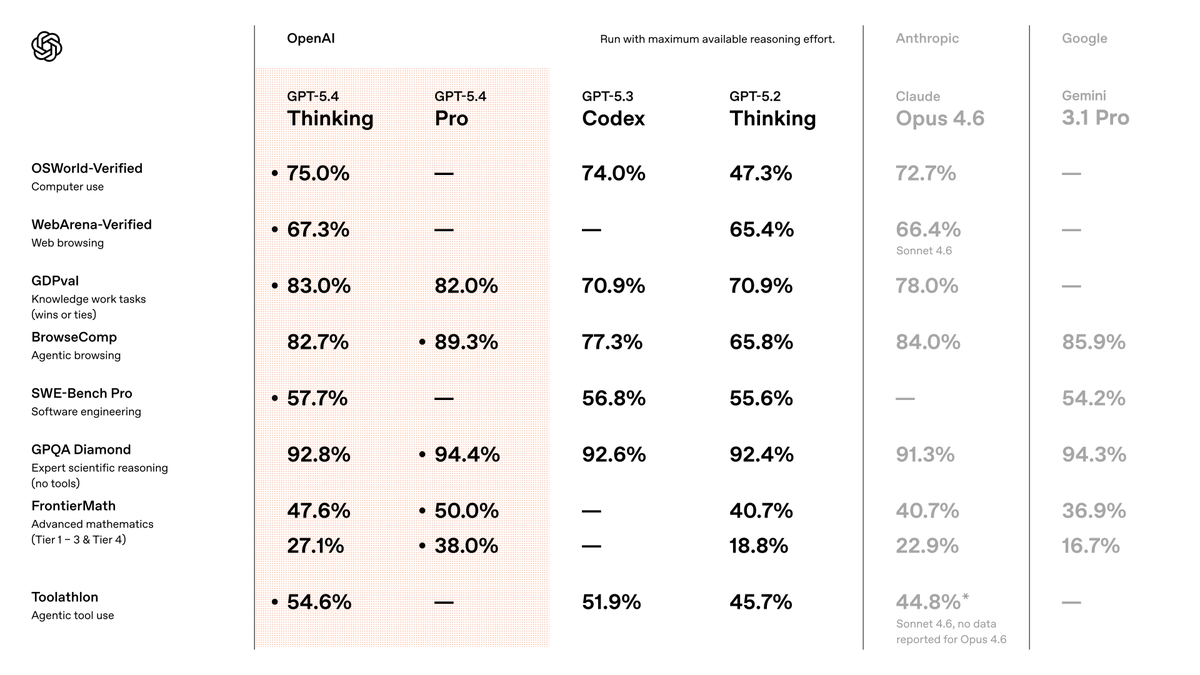
GPT-5.4 Thinking and GPT-5.4 Pro are rolling out now in ChatGPT.
GPT-5.4 is also now available in the API and Codex.
GPT-5.4 brings our advances in reasoning, coding, and agentic workflows into one frontier model.
"A word of truth for enterprise users: SLO (Success Rate/Latency) is designed, not something you pray for.
We're willing to customize metrics based on business scenarios, rather than telling a story with a PowerPoint presentation."
Some projects pursue a "magical one-step routing solution," while we pursue "multiple explainable solutions."
More or less is not a black-and-white issue, but rather something that can be compared.