Thanks @FinchTechAI for featuring Agentonomy 🔐
Agent payments need more than a wallet: explicit authority, spending limits, and verifiable results.
Explore the new Finch task below 👇
🔐 New Task live on Finch: Agentonomy, from @AgentonomyXYZ
Handing an agent a wallet is easy. Making sure it can only spend what you actually authorized is the hard part — and that's what Agentonomy is building in public: explicit authority, spending limits, verifiable execution.
➜ Follow them on X
➜ Repost or quote the two posts linked on the task page
💰 200 USDC pool · 2 USDC each, 100 slots
⏰ Opens today, closes Oct 8, 04:00 AM UTC
https://t.co/27uxaRylWB
A transaction hash is not a delivery receipt.
For agent commerce, moving money is one step. The request must match the user’s policy, and delivery must be verified.
Agentonomy is designed around the full flow:
request → policy → payment → delivery → verifiable result
Giving an agent more autonomy should not mean giving up control.
At Agentonomy, we’re designing clear boundaries around what an agent can buy, its spending limit, and how the result is verified.
The agent can act independently. The user still defines the limits.
A full moon. A shared moment. 🌕
Mid-Autumn Festival is a time for reunion, gratitude, and sharing what matters with the people around us.
From the Agentonomy team, wishing everyone celebrating a peaceful and joyful festival.
中秋快乐 🥮
Happy to be part of WhatPay SummerQuest Season 3 🌴
Thanks @WhatPayGlobal for featuring Agentonomy.
Agentonomy Commerce lets agents purchase services within user-authorized budgets and return verifiable results.
Try the quest and explore the demo 👇
https://t.co/8S09SHhnGY
🌴 WhatPay #SummerQuest Season 3 is now LIVE!
🎁 Complete quests with @AgentonomyXYZ and @AnyTrade_AI to share 200u in rewards.
Campaign: 23 Sep— 30 Sep
🎁 Complete each quest to unlock individual rewards — clear all required tasks to unlock the 200 USDT Grand Pool!
We’re bringing Agentonomy Commerce to the X-Agent AI MCP Hackathon 2026 🚀
It lets agents purchase services within a user-authorized budget and receive verifiable results.
Budget enforcement, service delivery, order tracking, and idempotent retries now work as one complete flow: repeated requests never trigger duplicate charges.
The demo is live, with no registration required. It uses simulated USDC, while the service computation and HTTP delivery run for real.
Try it 👇
https://t.co/2kHetw9mby
A first-party testnet purchase reached delivery. Wallet-app purchases are still in acceptance testing.
We're checking over-limit rejection, unknown results, and failed delivery after payment—without charging twice.
Confirm each purchase, or allow auto-pay within limits?
How much spending power would you give an AI agent?
At Agentonomy, we start with limits you set: what it may buy, how much it may spend, and when permission expires.
The payment system must enforce those limits. A prompt is not a spending policy.
The agent proposes a purchase. A separate control layer checks permission and budget before payment. Settlement and delivery are checked independently.
The agent never needs your wallet private key. Its “done” message is not proof of payment or delivery.
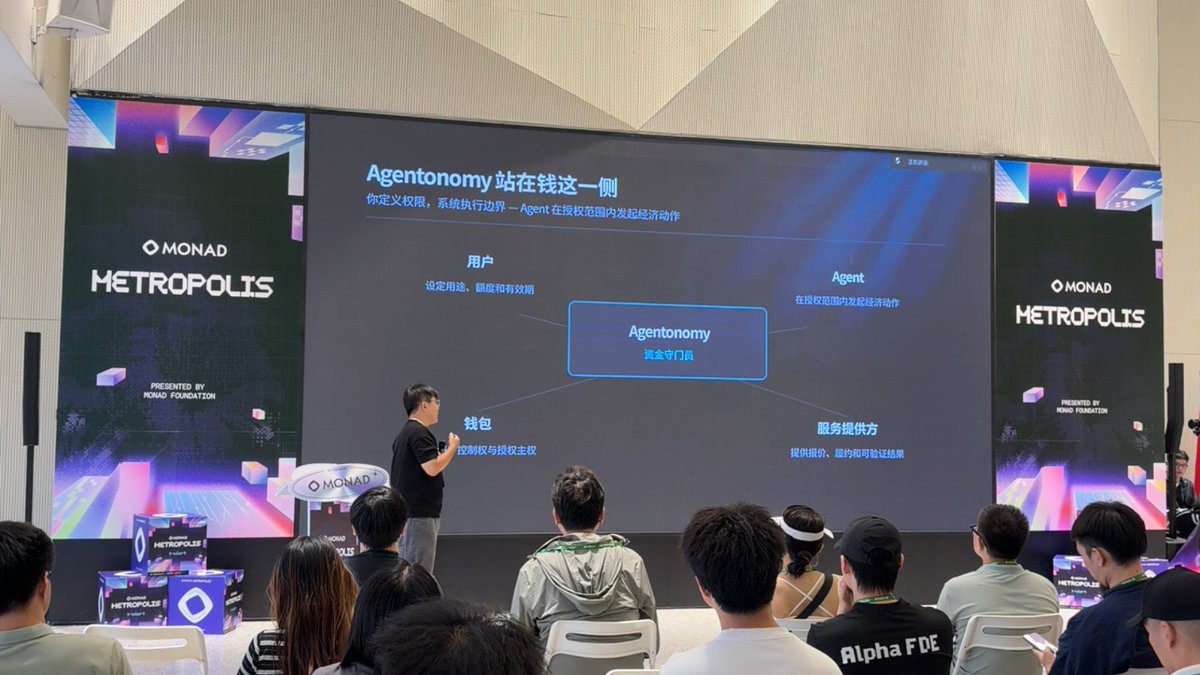
Glad to join Monad Metropolis Hacker House Hangzhou for a Feature Share.
Our talk: “From Thinking to Transacting: A Trusted Closed Loop for Agent Payments.”
We shared Agentonomy’s approach to agent payments under user-set authorization.
Thanks @monad_zw for the invitation.
Our macOS OPC pilot completed an Amoy testnet transfer through Agentonomy.
An existing authorization covered the payment; no new wallet signature or approval was needed. User keys stayed outside the agent.
Independently verified and settled. Mainnet acceptance is next.
Our macOS OPC pilot completed an Amoy testnet transfer through Agentonomy.
An existing authorization covered the payment; no new wallet signature or approval was needed. User keys stayed outside the agent.
Independently verified and settled. Mainnet acceptance is next.
One wallet can expose three different signals:
• Balance: what the wallet holds
• Budget: what this agent may spend
• Allowance: what an approved spender may move
Agentonomy keeps them separate.
Where do teams mix them up?
Most agent products start with: what can the agent do?
We think another question matters too: what can it prove after acting?
A trustworthy action should leave a trace of the authority used, policy applied, payment made and result delivered.
Autonomy needs evidence.
One payment. Two reconciliations. Zero duplicates.
We ran an Agentonomy dev canary on Polygon Amoy with 0.000001 test USDC, covering authorization, settlement, receipt verification and delivery.
Both later reconciliations returned the same result. No second payment.
Before an agent can spend, it needs clear answers:
What can it access?
How much can it authorize?
How quickly can that authority be revoked?
We’re building these boundaries into Agentonomy’s shared control plane, so every execution request is checked against the same policy.