The brain uses dimensionality reduction as a built-in feature of its wiring.
Network geometry shapes the transformation of task representations across the human cortex
https://t.co/8ztNt5yHSG
#neuroscience
Looking for a PhD program where you can study computational neuroscience? NYU has a fantastic array of researchers covering the field, and we'd love to consider your application:
https://t.co/B2GlQXFG8y
Our recent work presents a 1-gram wireless mesoscope for cortex-wide imaging at single cell resolution in naturally behaving mice, published in @Nature . It's interesting to see large-scale neural activities in multiple mice within a very natural habitat. https://t.co/Nbp67KFTDc
Our new paper in @NatureNeuro!
Psilocybin remodels synapses differently in healthy and stressed brains, promoting new connections and limiting stress-induced loss.
We also identify distinct mechanisms for plasticity and hallucination-like behavior. #Zuolab
https://t.co/JNfPKSlMg3
(1/5) Proud to share LightSuite, our new preprint led by Dimokratis Karamanlis in the El-Boustani lab at the University of Geneva!
From single cells to whole-brain maps: fast cell detection and atlas registration on a standard workstation.
https://t.co/emBSGvHzzB
Our paper is out in Nature, congrats to Qiyu, An et al!
By stimulating ~20 motor cortex neurons carefully selected based on their activity, we could induce learned population activity and, sometimes, the movement itself, depending on the brain's state.
https://t.co/sdVjsSrhtw
We posted a preprint on all-to-all functional mapping of a cortical microcircuit in vivo. https://t.co/enxvQaV5wW
Yitong Qi developed molecular tools, optics, and protocols for massively parallel optogenetic stimulation and voltage imaging during animal behavior.
After learning of his Nobel Prize in Physiology or Medicine early Monday morning, Karl Deisseroth spent hours answering calls, giving interviews and being photographed by journalists. His young children were asleep upstairs and had yet to discover that their father's life and work had just drastically changed with one phone call from Sweden.
But life continues – he took a break at 6:30 in the morning to make lunch for his kids as they would be waking up soon and leaving for school.
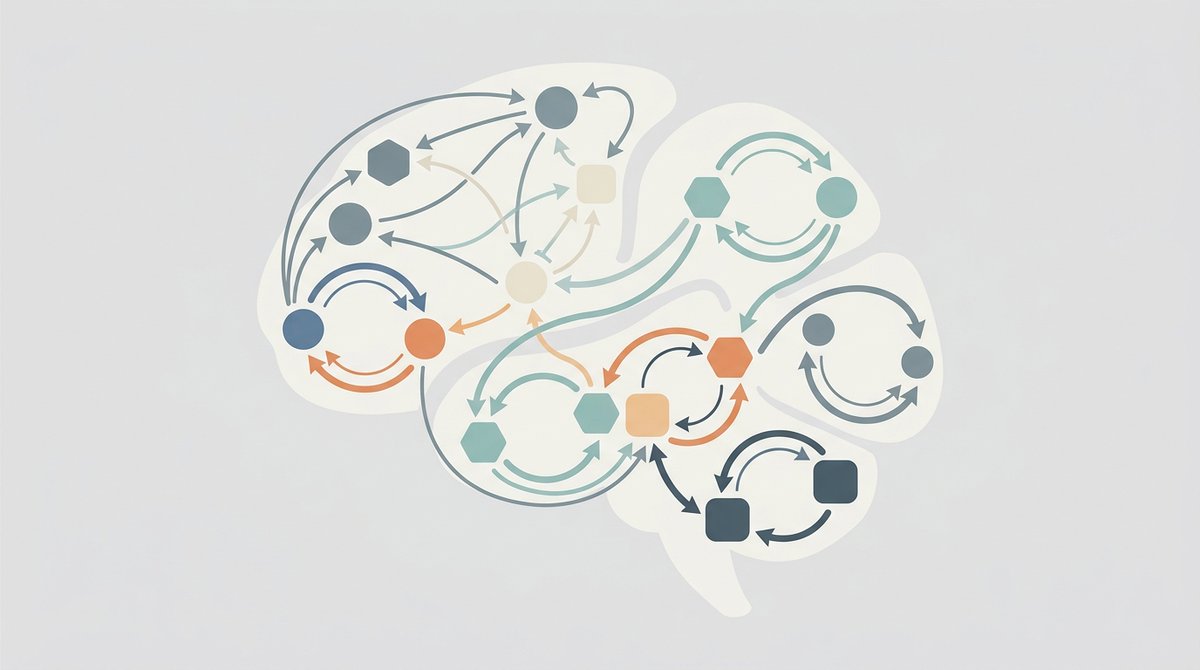
The brain does not operate as a stable hierarchy where cortical systems govern subcortical mechanisms, but as a heterarchy where control shifts dynamically between structures like the thalamus and prefrontal cortex depending on the specific task phase. Local asymmetries of influence remain real, yet because neural elements constrain one another across concurrent processes, these relations form cycles that resist any single, fixed ranking.
https://t.co/N6xWAu8q3k