Vetting early warning scores is not for the faint of heart. Health system leaders: check out our latest blog post to avoid some of the common pitfalls.
https://t.co/KsZMcPBQoz
Listen to @JAMAplusAI interview with @agilemd co-founder @dpedelson on the current state of hospital early warning systems, results of a recent head-to-head study with Yale, and a look into why sepsis scores are failing us. Find here on Apple podcasts. https://t.co/kt02lSv9ev
Within a matter of hours following Hurricane Helene, UNC Health used @agilemd clinical pathways to address a large-scale IV fluid shortage while ensuring high-quality care. Congrats to our partners! https://t.co/GVj1S6XeBX
#sepsis prediction models are inherently flawed. Read key takeaways from our recent @SepsisAlliance webinar exploring how to identify patients at risk of sepsis with the fewest false alarms.
https://t.co/lRA5WfkTgJ
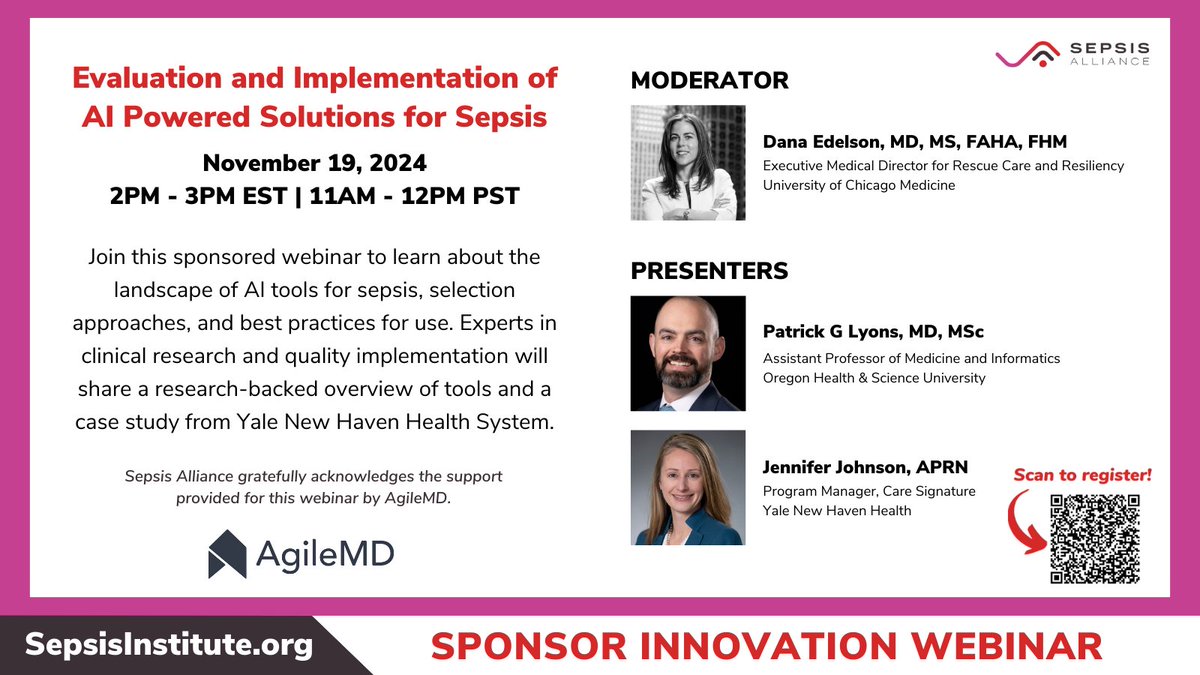
Why do general deterioration risk scores outperform #sepsis scores? Join us Tuesday with @SepsisAlliance
as we hear the latest research on sepsis early warning and a case study from Yale New Haven Health. Tuesday, November 19, 2-3pm EST / 11am-12pm PST.
https://t.co/ocuo5yPLjc
From @JAMANetworkOpen: eCART outperformed the other #AI and non-AI early warning scores, identifying more deteriorating patients with fewer false alarms and sufficient time to intervene.
https://t.co/DPh3Fqk9TO
Join us for an upcoming @SepsisAlliance webinar covering #sepsis early warning and management, the research comparing predictive tools, and what it’s been like to implement them in the real world at Yale New Haven Health. REGISTER HERE: https://t.co/jjerac9q6A
Does an AI/ML model provide more accurate warning of clinical deterioration than older models (logistic regression or point-based) among >360,000 hospitalized patients in 7 hospitals?
Yes. eCART (@AgileMD) performed best; EPIC (EDI) was one of the worst.
https://t.co/mfGZ0Ub5Tv by @dpedelson and colleagues
Editorial https://t.co/rBrWde86UO by @AmolAVerma
New research shows eCART outperforms other commonly-used early warning scores. The study included nearly 400,000 inpatient encounters from seven @ynhhealth hospitals and showed that eCART led to tens of thousands fewer false alarms compared to other leading early warning scores.
In this cohort study of inpatient encounters, eCART outperformed the other #AI and non-AI early warning scores, identifying more deteriorating patients with fewer false alarms and sufficient time to intervene. https://t.co/oweBBOKsiF
How can AI predict complications in hospitalized patients? Medical Grand Rounds is LIVE. @MarkPochapin, @DrHLofton & @KHochmanMD are talking with @dpedelson@UChicagoMed Call us at 877-698-3627. https://t.co/vuGRUcZrG6
We are proud to announce that eCART has received #FDA clearance to support frontline teams in identifying the highest-risk hospitalized patients. We are grateful for the opportunity and excited to make an even bigger impact moving forward! Learn more here: https://t.co/nP8x3JdFcl
As part of the COVID-19 Pandemic Response initiative, MATTER chose three #MATTERstartups as recipients of the COVID-19 Support Startup Grants.
Member @agilemd is focusing on better aggregating data to improve clinical decision-making.
Read more: https://t.co/H9bPZ8hswT
Thank you to @MATTERhealth for your consistent support as we partner with health systems to predict which patients will need critical interventions and guide clinicians on best practices to address #COVID19.
[status] Monitoring: AgileMD has restored the affected databases and all related systems. Clinical pathways and all other applications are now fully functional. Thank you for your patience while we worked with our infrastructure provid… https://t.co/XAOoEjRXse