@ldejesus_ @LatinXChem The BAE method of synthesis is effective in limiting the particle size growth, therefore an average partible size of les tan 5 nm is expected.
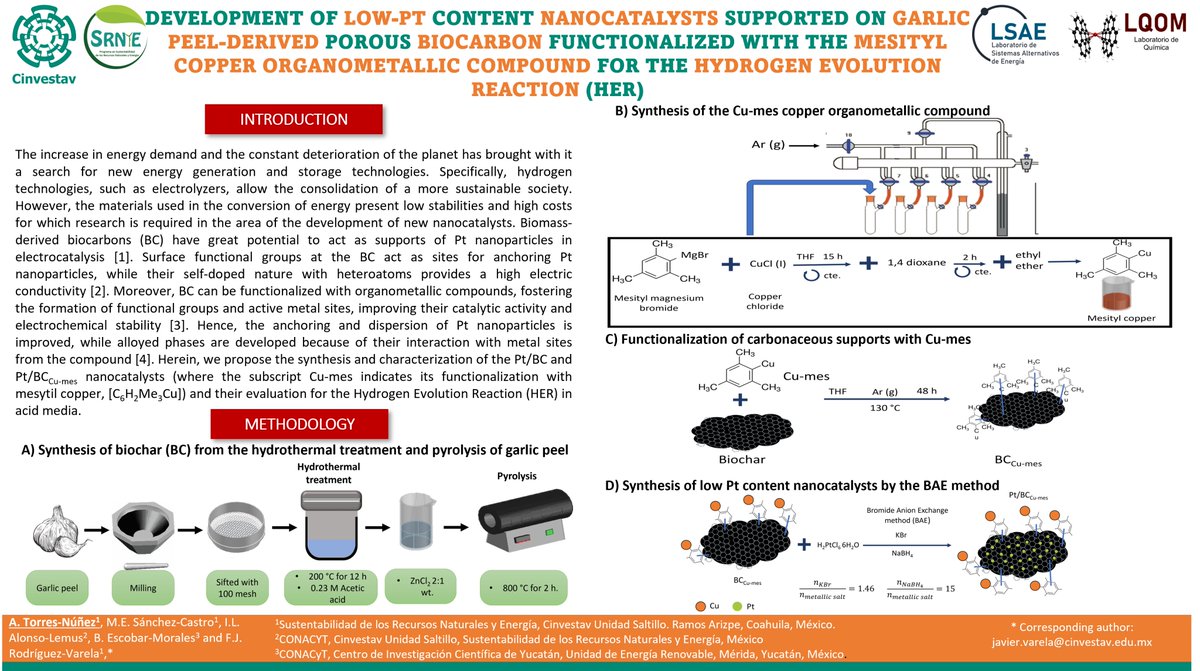
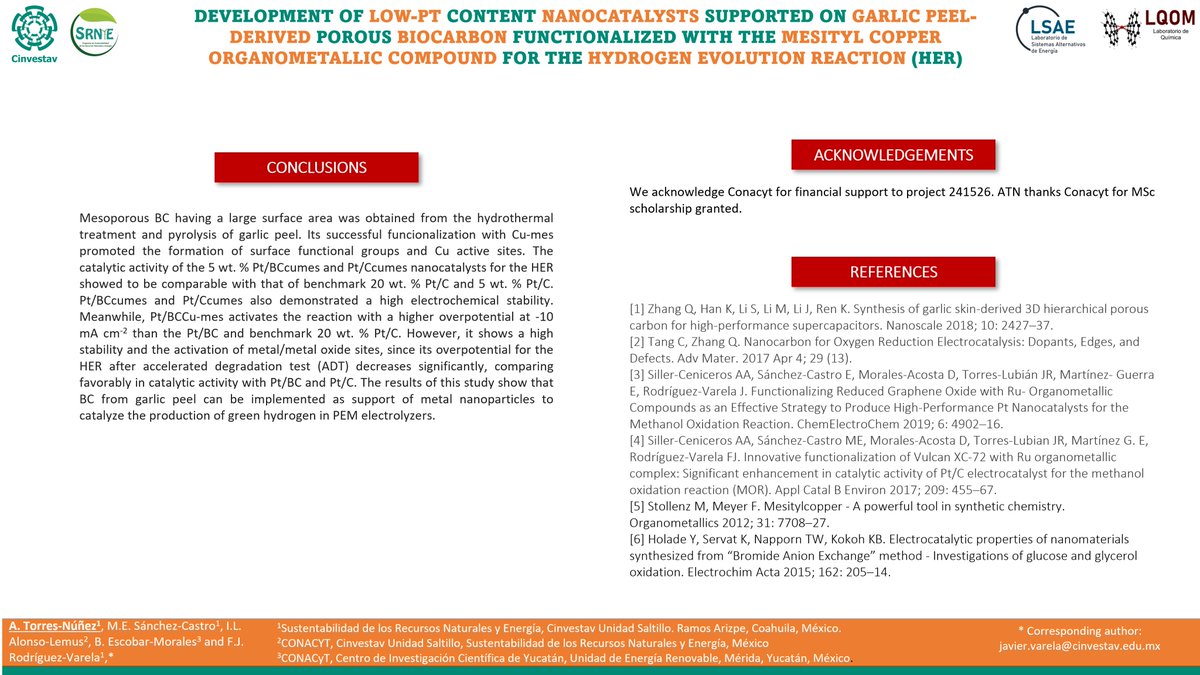
Hi @LatinXChem, this is my work "Development of low-Pt content nanocatalysts supported on garlic peel-derived porous biocarbon functionalized with copper organometallic compound for the Hydrogen Evolution Reaction", #LatinXChem#LXChemMat#Mat073#Biochar#Organometallic#HER
@ldejesus_ @LatinXChem From the functionalization, the Cu sites act as anchoring and growth zones for the Pt nanoparticles, promoting a high dispersion on the support, thus increasing the electrochemically active surface and therefore the catalytic activity of the reaction.
@ldejesus_ @LatinXChem ...that Pt-Cu alloyed phases have been formed.
In conclusion, the deconvolution of XRD patterns and XPS spectra is expected to show de formation of the alloy.
@ldejesus_ @LatinXChem Moreover, XPS spectra just received last week are being deconvoluted. Shifts in the binding energy of Pt(0) in the Pt 4f7/2 region, related to monometallic Pt/C, can be correlated to a modification in the d-valence band of Pt due to electron transfer from Cu atoms, indicating...
@ldejesus_ @LatinXChem 1) The size of the particles has not yet been determined.
BC is a mesoporous bicarbon with a specific Surface area of 1329 m2/g and an average pore diameter of 3.2 nm.
@hugo_lfc@LatinXChem indicating that Pt-Cu alloyed phases have been formed.
In conclusion, the deconvolution of XRD patterns and XPS spectra is expected to show de formation of the alloy.
@hugo_lfc@LatinXChem Moreover, XPS spectra just received last week are being deconvoluted. Shifts in the binding energy of Pt(0) in the Pt 4f7/2 region, related to monometallic Pt/C, can be correlated to a modification in the d-valence band of Pt due to electron transfer from Cu atoms, ...
@hugo_lfc@LatinXChem The disappearance of the bands between 2000 and 500 cm-1 has been attributed to the deposition of Cu sites on the surface of the support, probably forming Cu-C bonds, hindering the bands. Moreover, the functionalization modifies the sp3/sp3 ratio as shown from Raman analysis.
@AldoZarbin@LatinXChem in the O 1s region, and Cu(0) and Cu(2+) in the Cu 2p region. There are metal-support interactions after deposition of Pt nanoparticles, as can be seen in the XRD pattern of Pt/BCCumes and Pt/CCumes, compared to Pt/C, which have a positive effect on their electrochemical behavior
@AldoZarbin@LatinXChem This interaction is currently being analyzed by deconvoluting XPS spectra, results that were available last week due to the pandemics. Previous work by another student shows the formation of CuO and CuO2 species at CCumes ...
@hugo_lfc@LatinXChem Currently, the nanocatalysts are being analyzed by HRTEM and chemical mapping by STEM, to determine their average particle size and dispersion of Pt and Cu sites on the supports.
@hugo_lfc@LatinXChem The Bromide Ion Exchange method (BAE) allows to limit the particle size growth of Pt nanoparticles. Also, as mentioned in my previous response, the functionalization also plays a positive role in particle size and dispersion.
@hugo_lfc@LatinXChem therefore the catalytic activity for the reaction. Moreover, the formation of the Pt-Cu alloy promotes a higher electrochemical stability and a considerable increase in catalytic activity after accelerated degradation tests (ADT).
@hugo_lfc@LatinXChem Pt-alone nanocatalysts have an intrinsic high catalytic activity for the HER. However, the Cu sites act also as anchoring and growing zones for Pt nanoparticles, promoting a high dispersion over the support, thus increasing the electrochemically active surface area and ...