Indeed. Accountability starts with those charged with the responsibility. @PaulKagame has a very good place in history regardless of what critics say. He should be the inaugural East African Federation president. Period.
Rwanda just did what Kenya refuses to.
Yesterday they arrested FDA Director General, Prof. Emile Bienvenu, alongside 17 other officials regulators and standards board staff over toxic alcohol that has killed 50 people and blinded over 100.
They didn’t just go after the brewers.
They cuffed the very people paid to protect the public.
That’s what accountability looks like!
Meanwhile in Kenya, the same poison sits on our shelves.
We’re burying friends month after month. And not one official has been touched. They’re still collecting their salaries.
@NACADAKenya@KEBS_ke the region is acting on bad alcohol and you’re doing nothing about this!
Zlatan Ibrahimovic on to Gianni Infantino���s plan to sell stakes in the FIFA World Cup:
🗣️ “Listen to me carefully, because most of these people in suits have never understood the game and never will.
They create a subsidiary. Call it FIFA Forward Enterprise. Keep majority control on paper. Sell 20% to investors who have never smelled grass. Then wave $20 million in front of every federation and pretend it’s democracy.
That is not structure. That is a magic trick for lawyers. FIFA keeps the majority. FIFA keeps the board. FIFA keeps “exclusive authority” over governance, the calendar, the rules, everything that sounds important on paper. The investors get no operational role. They are only buying a slice of the cash machine. FIFA even says the investors are buying into the subsidiary, not into FIFA itself, so “nothing changes.”
I have seen this movie before. Nothing changes… until the numbers start talking. Once private money owns a permanent piece of the World Cup’s revenue, the pressure never stops. More tournaments. Bigger formats. Different calendar. Different priorities. Because investors do not care about the soul of the game. They care about return. And when the federations are already bought with the $20 million “gift” and the bigger Forward payments, who exactly is going to say no?
This is the same FIFA that spent decades selling the World Cup under the table. I remember the 2015 arrests. Swiss police walking into the hotel in Zurich and taking officials out in the early morning. Racketeering. Bribes. Money laundering. Hundreds of millions paid for television rights, for marketing rights, for World Cup votes. South Africa 2010. Qatar. The whole circus under Blatter. Jack Warner. Chuck Blazer singing to the Americans. Blatter and Platini banned for that $2 million “gentlemen’s agreement” that suddenly appeared when it was convenient. The Ethics Committee, the indictments, the years of “we are cleaning the house.”
And now the house is cleaner, they say. Now instead of brown envelopes and secret payments, we have subsidiaries, minority non-controlling stakes, permanent capital vehicles, JPMorgan valuations, and carefully selected long-term partners. Same hunger for money. Same system of buying loyalty from the 211 associations. Only the language got more expensive.
Infantino stands there and talks about democracy and opportunity. I am Zlatan. I do not need the $20 million and I do not need the speech. Most of these federations do need the money. That is exactly why this structure is dangerous. You are not offering development. You are offering a transaction: take the cash, vote yes by September, and stay quiet while pieces of the World Cup become private equity assets.
Football does not belong to FIFA. FIFA belongs to football. The moment you put shareholders inside the commercial heart of the World Cup and call it progress, you have already admitted the game is for sale. They just found a prettier way to write the contract this time.
I played at the highest level. I saw real power and real money. This is neither. This is bureaucracy protecting itself while selling the one thing that still belongs to the people who actually love the game.
Keep your structure. Keep your valuations. Keep your minority non-controlling stakes. The World Cup was never meant to have owners in suits. It was meant to be bigger than all of you.
Some 187 MPs were allegedly induced by the government to absent themselves from Parliament during the crucial vote on the Finance Bill 2026.
Many of these same legislators will later emerge in public forums, delivering eloquent lectures on economics and professing unwavering solidarity with ordinary Kenyans.
But how does an MP claim to stand with the people while failing to appear in Parliament and cast a "No" vote when the people most urgently require one?
Kenyans have seen this script before. Just as happened with sections of the draconian Finance Bill 2024, provisions temporarily withdrawn from the Finance Bill 2026 may well find their way back into Parliament through procedural manoeuvres, escaping meaningful public scrutiny before being quietly enacted.
When the dust settles, we will once again be told that there is nothing citizens can do about it. It is political duplicity masquerading as leadership.
KSh 17.3 billion.
That is what the Kenyan government spent on domestic and foreign travel in just nine months of FY 2025/26. Then the same government turns around and lectures citizens about austerity, sacrifice, and tightening their belts.
Workers are told to accept higher taxes.
Businesses are told to endure.
Young people are told to be patient.
But when it comes to government spending, the jets keep flying, the convoys keep moving, and the bills keep growing. Austerity for the people. Luxury for the political class.
Kenya is once again being treated to a painful contradiction; tighten belts for the mwananchi, loosen wallets for the powerful.
At a time when families are skipping meals, when small businesses are collapsing under taxes, and when youth are drowning in unemployment, this regime continues to normalise extravagance at the very top of government.
We are told there is no money for hospitals, no funds for education, no resources for county development but somehow there is always money for luxury foreign trips, bloated delegations, and comfort-first governance for the political elite.
Kenyans. The recent massive money bursts in private residences of public officials are an indicator of a system rotten to the core. This is a matter of National Security. Unfortunately, the top leadership will respond to all manner of trivialities but on this, radio silence.
Last year, the US government said some African governments refused to participate in its forced deportation programme for illegal migrants. Ghana volunteered to collect them and help dump them.
In 2022, the British government decided it no longer wished to host asylum seekers on its own territory and needed somewhere to offload them. Rwanda raised its hand.
In 2016, the United States decided it could not keep certain Guantanamo Bay prisoners in its own facilities. Ghana openly agreed to receive them on African soil.
And now the United States has decided it cannot repatriate its own Ebola patients to its own vastly superior medical infrastructure. Kenya has offered to build them a treatment centre.
Every time a Western government identifies something it considers too dangerous, too embarrassing, too legally complicated or too politically inconvenient to keep on its own territory, there is always an African government somewhere ready to collect it.
Deportees, asylum seekers, terror suspects, infectious disease patients. The willingness of certain African leaders to position their countries as the world’s surrogate waste management service, in exchange for whatever diplomatic or financial token has no visible floor.
There will always be morally bankrupt opportunists in government who will not look at the safety of their people, the dignity of their flag or the solidarity owed to the oppressed, and will instead compete to be the most useful to the powerful.
Who Abolished Slavery?
You think there is no correlation between how we Africans have been engineered to look down on ourselves and to genuflect before those who oppressed us?
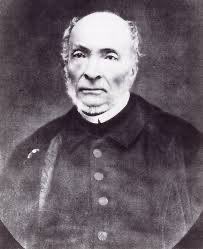
Who abolished slavery? Ask any fourth grader in Togo, and the answer comes without hesitation: Victor Schoelcher. Wake me from a deep sleep with that question, and my subconscious will answer before my eyes are open: Victor Schoelcher. Twenty-five years after leaving primary school, the colonial curriculum still lives in me like a reflex.
That is what was planted, and that is how thoroughly it took root. It is only the adult brain, the one lucky enough to stumble upon other literatures, other histories, other archives, that comes afterward to contest the first answer. But the first answer is always his name.
That is what colonial schools taught. That is what post-colonial schools taught. That is what is still being taught today, by people placed in power precisely to ensure that the curriculum of self-erasure continues undisturbed.
Because in Francophone Africa, the abolition of slavery has one face, and it is this French man. And in twenty years of academic formation on this continent, from primary school through university, including my own years as a history major at the University of Lome, not once, not in a single classroom, not in a single textbook, was the Haitian Revolution mentioned.
Not once were we told that enslaved Black people organized, fought, and defeated the French army, that Haïti became the first Black nation in colonial Americas and the first nation in modern history to defeat a European power that practiced slavery through the resistance of the very people it had enslaved. Twenty years of “schooling”: not one mention of that historical fact. And this is just one example, on just one subject.
Because not once throughout my entire education in Togo was I introduced to a Black mathematician, a Black physicist, a Black inventor, a Black philosopher. Not once. But for those of us who were cursed with France, the French apparently discovered more than 70% of world knowledge and wrote more than 80% of the world’s books, because our curriculum was designed to make us believe that the smartest, most resourceful, most intellectually gifted humans to have ever walked the surface of this earth were French. When the data actually tells you that France contributes approximately 2% of the world’s scientific innovation. Two percent. And we were built, from childhood, to worship that two percent as the totality of human genius. I imagine the same arithmetic applied to British, or Portuguese colonies, just with a different flag. This just one subject. There are decades of damage underneath it, layered and compounding.
Which is why it is genuinely exhausting to wake up every single day and be expected to debate, with patience and good faith, people who were produced by these laboratories of engineered ignorance and who are entirely convinced that what was done to their minds was an education.
Kenyans. Especially the dealers. The current level of political rhetoric - full of vitriol and chest- thumping, while not entirely new, is deeply concerning and shameful. Party dealers MUST rein in their attack dogs. And themselves show decorum. Or just maybe?
I grew up believing that the worst thing a government could do to its people was to terrorise them openly. I have since come to believe that the worst thing a government can do to its people is to make them forget that they are being governed against their interests at all. Terror, at minimum, produces the clarity of the enemy known. The rotating plutocracy produces something more devastating: a population that has been successfully convinced that its captivity is freedom, that its exhaustion is stability, that its dispossession is simply the way things are, and that the next election, like the one before it and the one before that, will be the occasion on which things finally, at long last, begin to change(…)
The citizens of these plutocracies, technically, have the power to speak. They have newspapers, imperfect and compromised but present. They have social media without the systematic surveillance dragnet that monitors every keystogram in my country. They can assemble, protest, petition, organise, without the immediate certainty of arrest that greets the same activities in Lomé or Harare or Asmara. They have an intellectual elite, sometimes a substantial one, educated, articulate, internationally connected, fully capable of the analytical work that produces political transformation. And the overwhelming majority of them do none of it. They speak, occasionally, and then they wait. They wait for the next election. They wait for the next candidate. They wait with a patience that looks, from the outside, indistinguishable from contentment, and that functions, in political terms, as consent.
The conclusion I have reached, after years of observation and conversation and reflection, is that the plutocracies are in fact worse. Not worse in the physical register, where the violent dictatorships retain their hideous distinction of bodies broken and voices silenced by direct force. But worse in the political and civilisational register, because they produce a condition of oppression that is almost impossible to fight precisely because it is almost impossible to recognise.
For one can only fight for liberation after acknowledging one’s condition of oppression.
Read full piece here: https://t.co/JJjCK6sMWw
@Farida_N This is the real tragedy for Africa (and my county Kenya). Political patronage. Creating dependency. Minus accountability. Failed states. When shall we go back to the basics? Legislators need to represent their constituents not their dictator/demigod.
In my address titled "The Political Economy of Obedience," delivered last month at the Josef Korbel School of Global Affairs at the University of Denver, I identified five key mechanisms through which African populations have been trained into political compliance. I am sharing a summary here because they explain precisely what we are watching play out in real time every day on this continent.
The first is colonial education. The curriculum inherited from the French, the Brits or the Portugese administration was not designed to produce critical citizens. It was designed to produce a particular kind of political subject. one who understood authority as something to be respected rather than questioned, and who experienced his own political traditions as a source of shame rather than institutional possibility. As I said in Denver, the most effective political prisons are not made of concrete. They are made of curriculum. The Togolese school I attended taught us the genealogy of French kings with more precision than the history of the governance systems that predated French colonial presence on our territory.
The second is the economy of obedience itself. Authoritarian systems endure not primarily through permanent terror but because they structure the relationship between political compliance and material survival so that obedience becomes, for most people most of the time, the rational choice. Access to employment, scholarships, market licenses, import authorizations, health clinic access: none of it politically neutral, all of it conditioned on loyalty. People in these systems do not collaborate with power because they are morally deficient. They collaborate because the scaffolding of their daily lives has been designed to make non-collaboration economically catastrophic.
The third is the family as a site of control. In conditions of economic precarity, the individual who considers a dissident act must calculate not only her own risk but the risk she imposes on her parents, her siblings, her children, her cousins etc. I have watched people of intelligence and moral clarity retreat from political engagement not because they were afraid for themselves but because they could not justify the devastating exposure their activism would bring to their families. The authoritarian state does not need to threaten everyone. It only needs to ensure that the threat to one is visible and comprehensible to all.
The fourth is religion. In many parts of Africa, religious institutions have been deployed, not by their most honest practitioners but by their most politically convenient ones, to transmit a theology of earthly resignation and otherworldly reward that discourages political engagement. The pastoral instruction to render unto Caesar what is Caesar's sits very comfortably with the interests of Caesars who have no intention of rendering anything to anyone. Liberation theology, which in Latin America produced an extraordinary tradition of religiously grounded political resistance, has had a far more contested reception in much of African Christianity and Islam, partly because of the direct entanglement of many religious institutions with state power, which has made spiritual authority and political compliance structurally allied.
The fifth is media. In authoritarian African contexts, state and privately owned media aligned with power do not typically practice crude propaganda. They practice something more subtle and more durable: the selection of what is visible and what is invisible; the framing of social problems as natural phenomena rather than political choices; and the treatment of opposition voices as marginal or foreign-funded. The film industry participates in this discipline in its own way, through the systematic promotion of narratives that depict poverty and wealth as conditions of fate or personal failure, stories in which the distance between the poor and the rich has everything to do with luck, talent or divine favour and nothing to do with power, policy or the deliberate engineering of inequality.
The cumulative effect, over decades, is a population whose political imagination has been narrowed to the point where alternatives are genuinely difficult to conceive, not because the alternatives do not exist, but because the political ecosystem has ensured they remain invisible.
These are the operating manual of authoritarian systems on this continent. And authoritarianism today is not limited to regimes with a known dictator who has held power for decades. It extends equally to regimes that perform a change of leadership through placebo elections conducted every four to five years, producing a new face every eight to ten years while the same system of impunity, patronage and repression remains structurally intact.
I would argue that these are in fact the more dangerous form of authoritarianism because their citizens are deceived into believing they are living under a democracy when they are in reality governed by plutocrats. The citizen under an obvious dictatorship at least knows what he is fighting. The citizen under a rotating plutocracy has been convinced there is nothing to fight at all. He votes, he watches a new face take the oath, and he mistakes the performance of transition for the substance of change. He ends up with no voice, no justice, no agency, and worse, no drive to fight for his own dignity. For one can only fight for liberation after acknowledging one's condition of oppression.
#BanditEconomy. Kenyans. We can do better. A large majority of the 349 MPs are mute as citizens are subjected to suffering that equals torture. Shame. Do they really know and understand what their mandate is? Your guess is as good as mine. Fagia wote! @WMutunga@otienowill
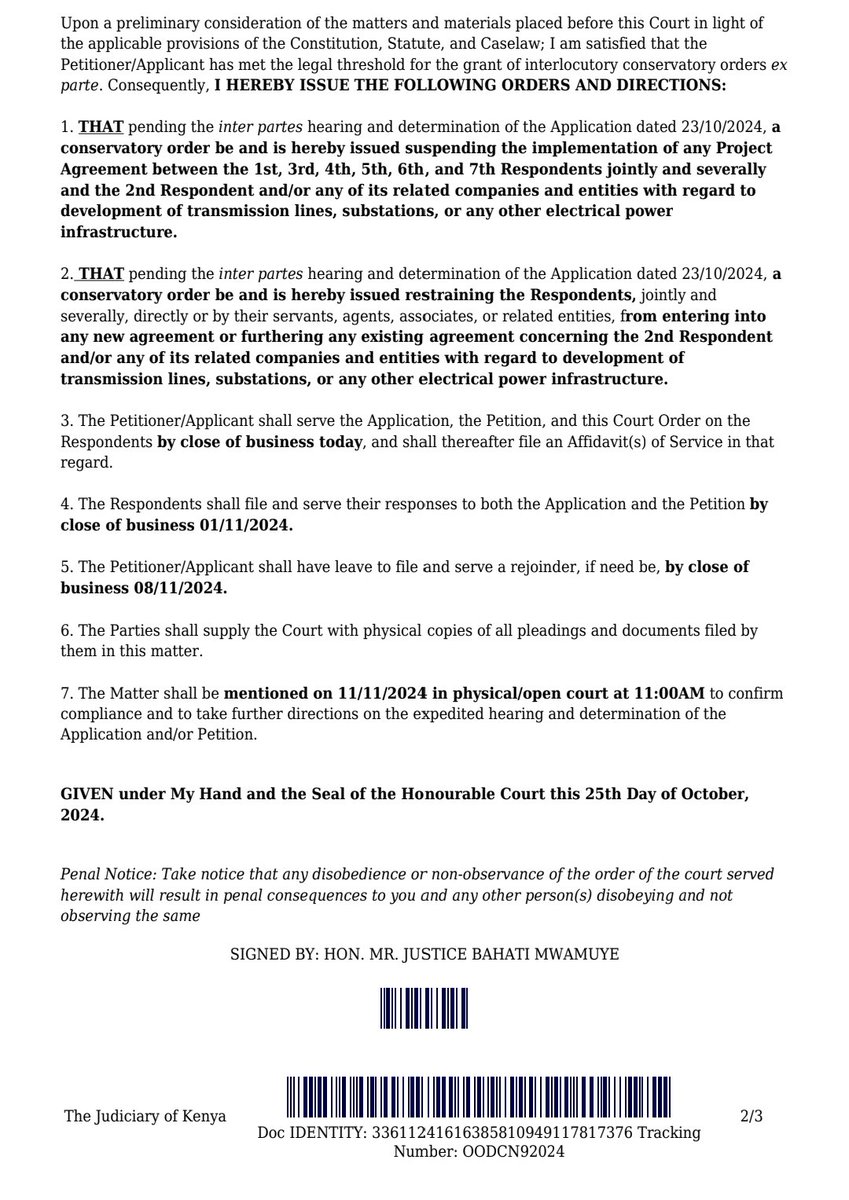
The High Court has granted conservatory orders suspending the implementation of the Project Agreement between @AdaniEnergySol and @KETRACO1 pending hearing of the @LawSocietyofKe's Petition challenging the Constitutionality of the agreement. We emphasise our apprehension over the lack of transparency over the details of the proposed PPP and the hurried nature of how it was procured.
Part of protecting the sovereignty and autonomy of Kenya requires that we preserve our national assets and maintain control of our resources and infrastructure. While PPPs aid additional development, the same must strictly conform to the Constitution, PPP Act and the PPADA to ensure we do not jeopardise the economic viability of our resources. We will prosecute this petition to its conclusion and hope for a favourable determination in the best interests of all Kenyans.