eBPF is kinda insane and nobody talks about it enough
Netflix uses it to trace flow logs across their whole fleet without tcpdump eating the CPU.
Cloudflare drops millions of malicious packets per second with XDP, before the kernel even bothers building an skb.
that's the trick btw: XDP runs at the driver layer, so you reject junk traffic before the network stack wastes a single cycle on it.
Google GKE dataplane v2 is built on Cilium/eBPF, and Google wrote about pushing it to 65,000-node clusters, which is frankly a stupid-big number.
Netflix found a noisy-neighbor disk latency bug in prod that classic tools just couldn't see, because the latency was hiding between syscall and disk.
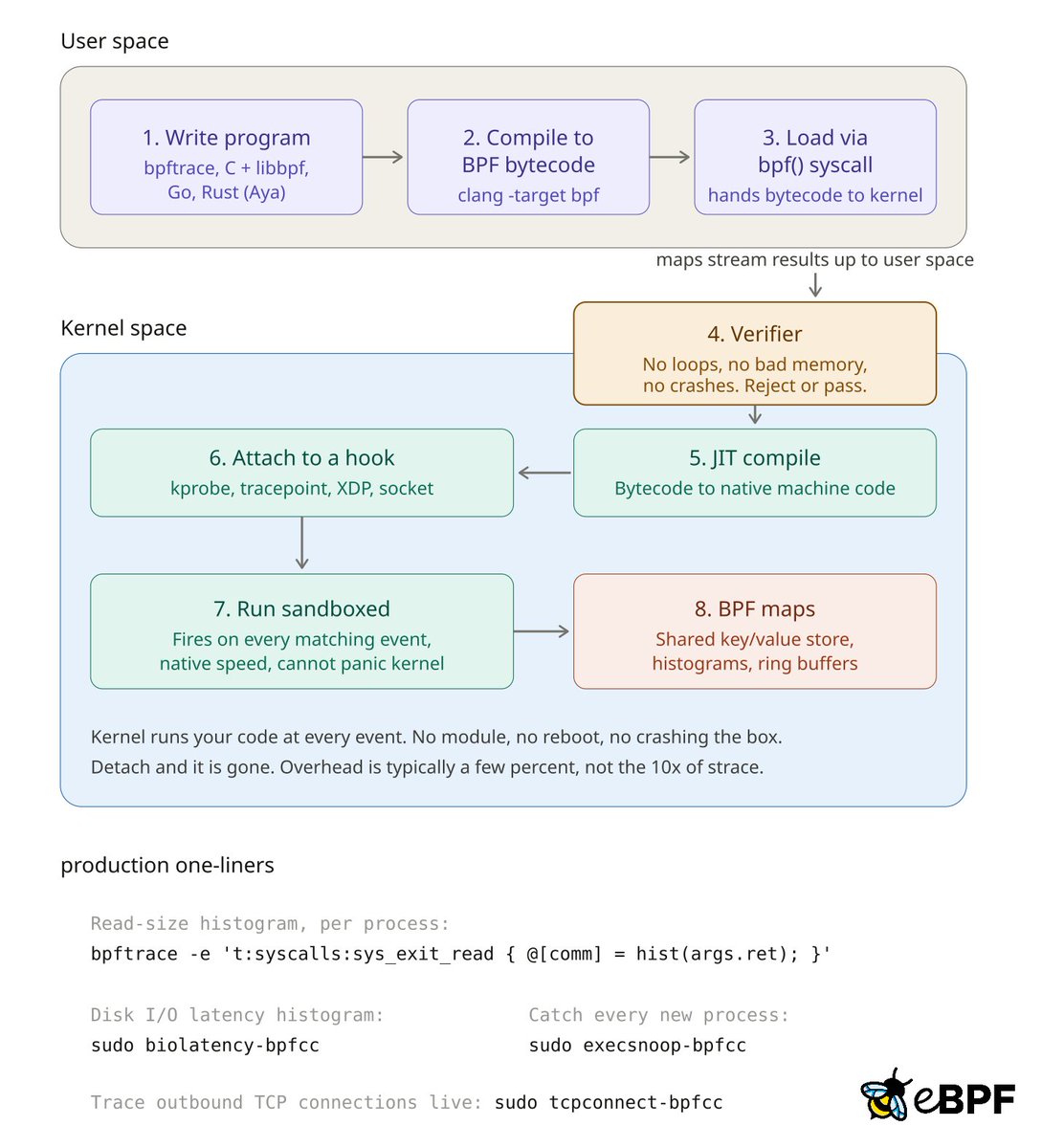
practical tip most people miss: you don't need to write raw BPF bytecode like it's 2016.
grab bpftrace, write a one-liner, get histograms of syscall latency in 10 seconds.
and boom, you can see your prod read sizes live. no recompiles, no restarts, no downtime.
the wild part is it's basically a tiny VM running sandboxed inside the kernel and the verifier won't even let you crash the thing.
observability without the observer effect, finally.
btw, I am building pktz - https://t.co/nqmL5d7beH - eBPF-powered network traffic monitor, per process, per connection, live.
#ebpf #networking #cilium #devops #k8s #kubernetes #sre #cloud
Sci-Hub is an evil website that pirated 85M+ research papers and made them freely available
And now they've added AI to their database to make Sci-Bot.
It answers your questions using latest, full-text articles.
But DO NOT use it. We should all try to make billion-dollar academic publishers richer.
I'm putting the link below so you know how to avoid it.
Heard this today in CS336: "LLMs from scratch" (which is probably the best course on LLMs out there)
The unit of compute used to be a single GPU (V100 back in the day).
Then it was a rack of 8xA100s.
Then a grid of 64. Now its an entire datacenter to consider.
Next will be multidatacenter?
Then I think about the breakdown of all compute in the world:
Smartphones 54%
Laptops 28%
Datacenters 18%
whats the logical conclusion?
someone should do that startup
I accidentally broke my brain reading about Nobel Prize winners last month.
There's this thing called "Janusian thinking" that basically explains why some people's minds work like magic while the rest of us think in straight lines. Named after Janus, the Roman god with two faces pointing opposite directions.
The psychologist who discovered it, Albert Rothenberg, was trying to figure out what made breakthrough thinkers different. He interviewed dozens of Nobel laureates, major artists, revolutionary scientists. What he found sounds impossible.
These people can hold two different ideas in their mind at the same time. They can explore both without switching back and forth or forcing a quick comparison. They can consider “yes” and “no” to the same question simultaneously and stay clear-headed.
Einstein too talked about this when he described his relativity breakthrough. He was imagining riding alongside a beam of light while also standing perfectly still. Both perspectives at once. Mozart said he could hear an entire symphony "all at once," every note, every contradiction, every resolution happening in a single moment of awareness.
Your average person's mind works like a courtroom. Evidence comes in, you weigh it, you reach a verdict. Case closed. But Janusian minds work more like... I don't know, like a quantum computer that can process multiple realities simultaneously until something new emerges from the overlap.
I've started noticing it in conversations. When someone can genuinely see both sides of something without needing to pick one, it drives people nuts. They want you to land somewhere definite. The ability to live in that tension space reads as wishy-washy or indecisive.
Most creative advice tells you to "think outside the box." But Janusian thinking is weirder than that. It's being inside and outside the box at the same time. It's thinking the box exists and doesn't exist simultaneously.
Which explains why truly creative people seem slightly unhinged. They think they're choosing between realities. But, they're inhabiting multiple realities at once, mining the contradictions for insights the rest of us never see.
Sadly, most of us have trained ourselves out of this ability. We've learned that holding contradictions feels unstable, so we rush toward resolution. We've been taught that changing your mind means you were wrong before, so we defend positions instead of exploring them.
But the people changing the world have kept that childlike ability to hold impossible thoughts without needing them to make sense immediately.
We just need to live in the questions everyone else is too scared to ask.
> freeze hiring
> start firing
> invest in AI infrastructure
> deploy "AI software engineers"
> wait 3 years
> ...
> ...
> ...
> AI introduced more technical debt than a fresh mathematics PhD
> software becomes more and more buggy
> slowly lose customers
> hire consultants to fix it
> consultants use AI to fix it
> still not fixed
> management blames consultants
> try to hire cheap juniors to fix it
> no more juniors left because training programs were stopped
> hire super rare and expensive seniors instead
> senior recommends resetting main branch to a commit 3 years ago
> AI infrastructure investments depreciated 90%
> all company numbers red
> seppuku
I just solved the strangest tech problem I've ever come across.
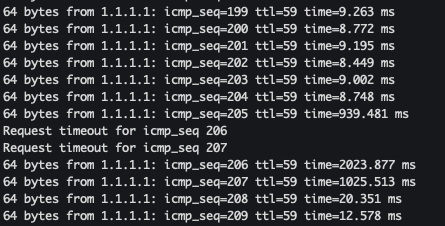
My wifi kept dropping packets, confirmed by ping. It would look something like the first image (packets dropping, then it comes back to life). After a while the connection would just stop working completely and drop all packets. If I turned my wifi off and on again, it would resume working normally.
I thought this was a problem with my router, cables or ISP, so I went through the usual troubleshooting processes: checking settings, swapping cables, powercycling, etc. nothing worked.
Eventually I started noticing that it would only happen when I sat in my office. I was taking a video meeting and it kept dropping segments of audio, making it hard to understand the other person.
I unplugged my laptop from my monitor + keyboard because I wanted to try walking into another room. Immediately, the video started working perfectly.
I thought it was because I was a few steps closer to my router - but that didn't really make sense because the router had always worked fine from that location.
I started thinking about what I'd changed in my desk setup recently, the only thing I could think of was when I changed from using a USB-C <-> DP cable for my monitor, to using a HDMI <-> HDMI cable.
I tried plugging my screen back in. Immediately, the packets started dropping. I unplugged it, the dropping stopped.
It turns out my HDMI cable doesn't have enough shielding, so it was jamming my own WiFi signal with radio frequency interference 🤯
I unrolled the HDMI cable that was sitting behind my laptop and draped the main length of the cord down behind my desk, and now my internet works perfectly.
Apparently this is a fairly common issue?!
- you are
- a random CS grad with 0 clue how LLMs work
- get tired of people gatekeeping with big words and tiny GPUs
- decide to go full monk mode
- 2 years later i can explain attention mechanisms at parties and ruin them
- here’s the forbidden knowledge map
- top to bottom, how LLMs *actually* work
- start at the beginning
- text → tokens
- tokens → embeddings
- you are now a floating point number in 4D space
- vibe accordingly
- positional embeddings:
- absolute: “i am position 5”
- rotary (RoPE): “i am a sine wave”
- alibi: “i scale attention by distance like a hater”
- attention is all you need
- self-attention: “who am i allowed to pay attention to?”
- multihead: “what if i do that 8 times in parallel?”
- QKV: query, key, value
- sounds like a crypto scam
- actually the core of intelligence
- transformers:
- take your inputs
- smash them through attention layers
- normalize, activate, repeat
- dump the logits
- congratulations, you just inferred a token
- sampling tricks for the final output:
- temperature: how chaotic you want to be
- top-k: only sample from the top K options
- top-p: sample from the smallest group of tokens whose probabilities sum to p
- beam search? never ask about beam search
- kv cache = cheat code
- saves past keys & values
- lets you skip reprocessing old tokens
- turns a 90B model from “help me I’m melting” to “real-time genius”
- long context hacks:
- sliding window: move the attention like a scanner
- infini attention: attend sparsely, like a laser sniper
- memory layers: store thoughts like a diary with read access
- mixture of experts (MoE):
- not all weights matter
- route tokens to different sub-networks
- only activate ~3B params out of 80B
- “only the experts reply” energy
- grouped query attention (GQA):
- fewer keys/values than queries
- improves inference speed
- “i want to be fast without being dumb”
- normalization & activations:
- layernorm, RMSnorm
- gelu, silu, relu
- they all sound like failed Pokémon
- but they make the network stable and smooth
- training goals:
- causal LM: guess the next word
- masked LM: guess the missing word
- span prediction, fill-in-the-middle, etc
- LLMs trained on the art of guessing and got good at it
- tuning flavors:
- finetuning: new weights
- instruction tuning: “please act helpful”
- rlhf: reinforcement from vibes and clickbait prompts
- dpo: direct preference optimization — basically “do what humans upvote”
- scaling laws:
- more data, more parameters, more compute
- loss goes down predictably
- intelligence is now a budget line item
- bonus round:
- quantization:
- post-training quantization (PTQ)
- quant-aware training (QAT)
- models shrink, inference gets cheaper
- gguf, awq, gptq — all just zip files with extra spice
- training vs inference stacks:
- deepspeed, megatron, fschat — for pain
- vllm, tgi, tensorRT-LLM — for speed
- everyone has a repo
- nobody reads the docs
- synthetic data:
- generate your own training set
- model teaches itself
- feedback loop of knowledge and hallucination
- welcome to the ouroboros era
- final boss secret:
- you can learn *all of this* in ~2 years
- no PhD
- no 10x compute
- just relentless curiosity, good bookmarks, and late nights
- the elite don’t want you to know this
- but now that you do
- choose to act
- start now
- build the models
> be me, NVIDIA in 2006
> making GPUs so gamers can play World of Warcraft in HD
> Jensen Huang has a vision
> "what if we made them do... math?"
> entire boardroom thinks he's finally lost it
> create CUDA
> a software prison so elegant, academics will volunteer to be inmates
> gamers are confused. "Will this make Crysis run faster?"
> Jensen: "...no :)"
> fast forward to 2012
> AI researchers, hopped up on adderall and free pizza, discover they need a shitload of matrix multiplication to make cat pictures
> their Intel Xeons are crying, smoking, and filing for divorce
> they discover CUDA
> "holy shit this math thing you made is perfect"
> the entire field of AI becomes a subsidiary of a company known for making Fortnite run better
> we see this and our eyes turn into dollar signs
> decide the prison needs better amenities
> invent Tensor Cores
> "what if part of the chip did ONLY the AI math, but did it at ludicrous speed?"
> it's like adding a nitro booster to a Honda Civic specifically for going to the grocery store
> AMD's competing card is over there trying to do the same math with a abacus and hope
> because researchers are so lazy they can't be trusted to write a for-loop
> just give them a big red "MAKE AI" button that runs our code
> create cuDNN
> bake it directly into TensorFlow and PyTorch
> ecosystem lock-in is complete. We own the land, the factory, and the souls of the workers.
> a bunch of hippies from a thing called "OpenAI" call
> they want to build AGI or something
> they need compute
> roll up to their office, which is probably a converted garage, with the world's first DGX-1
> it's like the monolith from Space Odyssey
> I tell them it has 8 GPUs connected by NVLink, so they can gossip like schoolgirls at light speed
> they ask what it does
> "It does AI, idiots. Just plug it in."
> they sign the papers.
> But we're not done. The prison needs a better yard.
> See them trying to connect our beautiful DGX boxes with CAT-5 cables
> embarrassing.
> Acquire Mellanox for their InfiniBand tech
> Now the nervous system connecting the GPUs is also ours
> NVSwitch makes an entire rack of GPUs hold hands so tight they become one colossal mega-brain
> Meanwhile, in a dimly lit basement in Santa Clara... AMD
> They drop a new GPU. "The AMD Instinct MI300X! We have more theoretical FLOPs!"
> "Better Benchmark performance."
> One brave researcher tries to use it.
> spends 6 weeks trying to install ROCm, their knock-off https://t.co/c336ngfjCA version of CUDA
> gets 400 errors, a kernel panic, and divorce papers from his wife
> he finally gets a model to run at half the promised speed
> The benchmark was for a matrix size of 1x1
> He throws the card in the trash and buys an NVIDIA H100 on the company card. The cost is irrelevant.
> Sanity is priceless.
> Jensen takes the stage. The leather jacket has its own gravitational pull. Unleashes the GB200 NVL72
> 72 GPUs and 36 Grace CPUs in a single NVLink domain with 130 TB/s of bandwidth
> the GPUs share thoughts before they even have them.
> 2025
> AMD comes out with their "rack scale" solution, the MI355X 128-GPU rack
> It's just 16 groups of 8 GPUs duct-taped together with Ethernet
> A scale out clown car
> We announce Rubin CPX GPU enabling cheaper prefill during inference
> saving $$$$
> it's the ultimate vendor lock-in
> every other chip designer sees this and has to throw their architecture in the trash and go back to the drawing board
> All hail the leather-clad prophet.