🚨 AiCoin Double 11 Sale is LIVE
Pay for 1 year, get 2 years of access.
🎉Our biggest sale of the year just dropped.
What’s on offer:
Annual Membership — up to 50% off (flash pricing)
Flash sale only on Nov 13, 14:00–16:00 SGT (Singapore Time)
Quarterly Membership — 22% off (limited time)
Unlock pro tools at the discounted rate: Whale Tracking, Large Order Alerts, On-Chain Smart Money, AI Analysis, and more.
Every eligible purchase enters the lucky draw — 100% win rate. Prizes include exchange-exclusive merch + AiCoin limited gifts
📅 Event dates: November 6 – 13, 2026
Whether you need better market structure analysis, whale activity tracking, or on-chain flow data, this is the cheapest way to upgrade your toolkit this year.
👉 Join now: https://t.co/r7FE5fAxHV
Questions about the rules, payment, or features?
Open the AiCoin app or web → Profile → Live Chat
Board is literally meeting today on whether to oust him.
Stock already down hundreds of billions this week from the affair + national security noise.
If they actually pull the trigger, the uncertainty premium gets even worse.
Keeping him is the less bad option right now for the multiple.
@KillaXBT Classic illiquid range setup.
Whales like these spots for size because the book is thin.
76k is the clean first reclaim. Flip it and 80–81.5k comes into play fast.
50-day bleed has everyone watching the same diagonals.
$NVDA has sold off sharply this week amid a growing leadership crisis around CEO Jensen Huang.
Over the weekend Huang admitted an extramarital affair with Alice Huang (no relation), a former Megaspeed executive that U.S. intelligence has viewed as a potential Chinese asset. The relationship reportedly helped move billions in chips to China. Nvidia’s board launched an independent investigation.
On Nov 11, the New York Times reported a second affair — this time with Kimberly Powell, Nvidia’s VP of Healthcare and a direct report. Hours later the WSJ said the board is preparing to oust Huang, with a meeting underway.
Nov 9–10: Down ~4–5.5% each day
Nov 11 regular session: Closed +2.9% at $173.73
After-hours: Plunged ~8.6% to ~$159 on the second-affair + ouster reports
Today marks four years since FTX filed for bankruptcy.
An $8 billion hole, a multi-year restructuring process, and a hard split among creditors—some eventually got paid, many others had already left crypto by the time the dust settled.
Looking back, the industry has changed in some fundamental ways:
Spot Bitcoin ETFs finally opened the door.
Dollar-denominated stablecoins have quietly become one of the most important pieces of global payment infrastructure.
Crypto is increasingly functioning as a distribution rail for traditional assets.
DEXs are no longer a side market.
The old “TradFi vs DeFi” framing has largely faded.
Bybit, Bitget, and Binance have all suffered major security incidents since FTX.
In each case they absorbed the losses instead of socializing them onto users—showing stronger crisis management than FTX ever demonstrated.
Four years ago, crypto’s main appeal was building new financial primitives.
Today, a large part of its growth is simply moving existing financial assets onto the chain.
Bear markets are the sowing season — the hardest period, but the only one that creates future harvests.
#BTC#STOCKS
On @AiCoincom this is when most traders should be preparing positions, not waiting for a perfect bottom.
After entries are made, further drawdowns are common. That’s part of the process. The bigger cost is missing the entire cycle’s move once momentum returns.
When the mindset shifts from “timing the exact low” to “planting while conditions are still unfavorable,” the emotional pressure drops. Charts become clearer. Decisions become calmer.
AiCoincom is built for this phase: clean K-line tools so traders can focus on structure instead of noise, and position with the cycle rather than against it.
Bear market. Time to plant.
This chart answers the question: Where is all the money going?
https://t.co/dweeV83sM1: 97% of users in loss
FOMO: 96.5%
Polymarket & Kalshi: 92.5%
GMGN: 93%
Almost every major trading and prediction platform shows the same pattern — 80-97% of users are losing money.
This isn’t random volatility. It’s a structural reality. These are negative-sum games (fees, spreads, and information asymmetry). Money flows from the majority to a small minority of winners, market makers, and the platforms themselves.
Most people aren’t “investing.” They’re providing liquidity for the few who actually win.
The numbers are brutal.
Digital banks can scale fast but still depend on the same capital, governance, and trust assumptions as traditional institutions. When those break, access vanishes instantly.
For anyone holding significant value in custodial systems: diversification across self-custodied assets (including digital assets with proper key management) is no longer theoretical—it’s practical risk management.
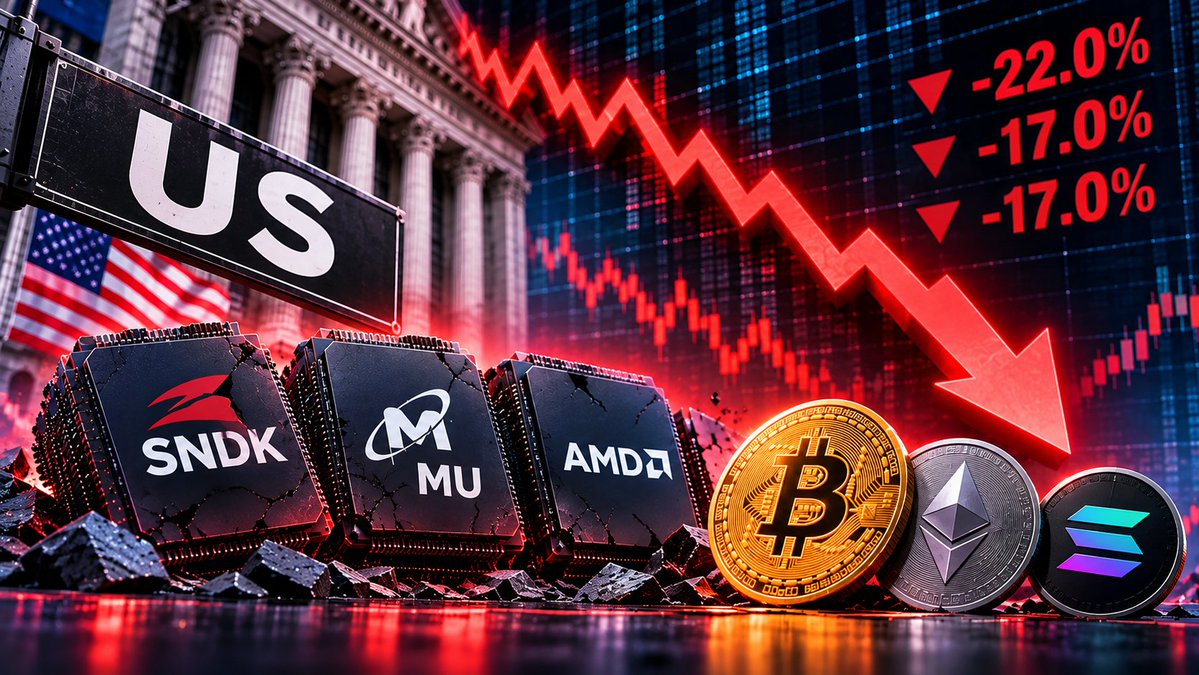
US stock massacre had crypto natives nodding in recognition.
Chip giants got absolutely wrecked in a single session:
$SNDK -22% | $MU -17% | $AMD -17%
Meanwhile BTC -5.8%, ETH -7.9%, and SOL -6.5% suddenly looked almost civilized by comparison.
Traders thought they were buying “blue-chip” tech. Instead the volatility started trading like mid-cap alts.
The trigger was post-midterm fears that a Democrat-controlled Congress will tighten rules around AI data centers, slowing the massive buildout that has been fueling chip demand. The Philadelphia Semiconductor Index (SOX) dropped ~12% — its worst day since March 2020.
While the Nasdaq fell over 5% and the S&P 500 shed roughly $3 trillion in market value. Nvidia alone lost hundreds of billions. Memory and storage names (SanDisk, Micron, Western Digital, Seagate) took the worst of it.
Crypto followed the risk-off move, but the relative calm in majors versus the carnage in “safe” AI-linked stocks was hard to miss.
When traditional tech starts moving like altcoins, the whole risk spectrum gets recalibrated.
Bitcoin is trading around $80,500 after a sharp post-midterm recovery. It dipped to ~$75,600 as results came in, then rebounded more than 6% — consistent with CoinShares’ James Butterfill’s view that the Democratic sweep was largely priced in.
Butterfill: With uncertainty cleared, there is room for a relief rally. The result itself doesn’t necessarily trigger another sell-off.
Bigger risk remains slower crypto reform (CLARITY Act faces a harder path) and political noise from Trump-related probes.
U.S. crypto equities are more sensitive than BTC. Real yields, USD liquidity, and ETP flows still matter more for Bitcoin.
2026 midterms early results: Democrats flipping NC Senate + looking strong in the House.
Crypto impact so far:
• Short-term: mostly priced in (BTC ~$76.5k, still more driven by ETF flows, Fed & risk sentiment)
• House Dem win = slower path for CLARITY Act + more oversight
• Trump still in White House until 2029 → executive remains relatively friendly
Split Congress is the least bad outcome for crypto. Watching final Senate calls.
Longer-term: Dem House = tougher road for market structure bills; Senate remains the key variable.
NK denial doesn’t change the on-chain picture
Kim Yo-jong called the FBI’s attribution of the ~$6.3B Binance theft to North Korea “absurd rhetoric and nothing new,” saying Washington is trying to pin every major cyber incident on the DPRK. That’s the standard response out of Pyongyang.
The data side looks different. TRM Labs and Chainalysis had already tied the exploit to TraderTraitor (the same cluster linked to the $1.5B Bybit hack) with high confidence before the FBI formalized it.
Funds were moved across multiple chains in a tight window, then largely swapped into ETH — the pattern analysts have seen from this group before. The FBI is now asking exchanges and DeFi platforms to block the known addresses.
A denial from KCNA doesn’t move the wallets. The tracking still points the same way, and the conversion/laundering activity is what everyone is watching.
North Korean-linked actors (TraderTraitor) have laundered approximately $242 million through the Tron leg alone within two days exploit.
This is a fraction of the ~$6.3–6.4B total theft (largest crypto heist on record), of which ~$2.8–3B was frozen on-chain by issuers (Tether, Circle, etc.) and protocols. Roughly $3.5B remained controllable by the attackers after freezes; the Tron activity represents early, rapid layering.
Tron flow breakdown:
Stolen on Tron: ~$628M (612.7M USDT + 46.4M TRX).
Tether froze 378.7M USDT on day 1 → ~$249M left movable.
~$194M exited via bridges/swaps: Relay ~$48M, THORChain ~$44M, Chainflip ~$32.1M, Symbiosis ~$16M (plus smaller routes like USDT0, Across). Additional ~$43M via Bitget Wallet and others (destinations partly unresolved).
~$26M stayed on Tron (JustLend, USDD swaps, CEX service accounts); ~$22M lost to fees/slippage.
Bridged funds primarily landed as ETH on Ethereum mainnet (~53k ETH), BTC, and stablecoins, then continued moving. ~$7.5M still on Tron; $3B+ on other chains (BTC, ETH, XRP, SOL) remains largely untouched.
FBI, USSS, and IRS-CI have attributed the full hack to DPRK’s TraderTraitor and explicitly urged THORChain node operators, RPC providers, instant exchanges, and DeFi services to block addresses tied to the proceeds. Laundering shows high automation and volume (thousands of deposits), shifting toward bridges and instant swaps rather than solely mixers.
Bridges remain high-throughput exit vectors even under scrutiny; decentralized designs face clear tension between permissionless operation and law-enforcement pressure. Most capital is still staged, so the next wave of movement will be the key tracking phase.
2026 midterms are days away.
Historical midterm years often saw post-election weakness before higher prices 12 months later
2026 looks different — June ~$58k may already be the low; cycle position > election result
Dem House (likely) could slow CLARITY Act & raise oversight risk;
BTC more resilient than alts
Macro (liquidity, Fed, ETF flows) still dominates politics
Election is noise. Cycle and liquidity are the signal.
A mountain of noise. One signal that matters.
The market is flooded with tokens, trends, and distractions. Don't let the noise dictate your next move.
Cut through the chaos. Track smart money. Spot the signals that matter.
Trade smarter. See clearer. Stay ahead with AiCoin.
@Ondo@Uniswap Cross-chain bridging + DEX pools add potential for tighter pricing, LP fee opportunities, and more composability.
Worth watching actual volume, arb activity, and how liquidity concentrates once the pools mature.
@RobinhoodApp Trick or treat — and compound interest is one of the few treats that actually grows the longer you leave it alone. 🎃
Data over narratives. Happy Halloween. 📊