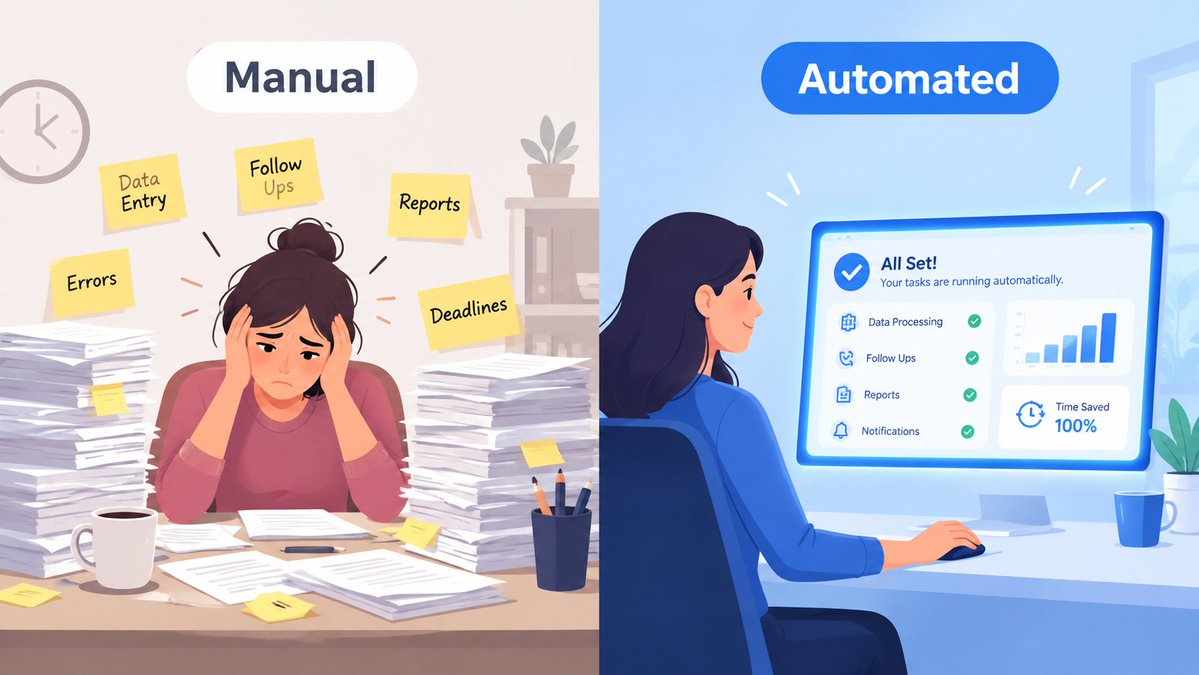
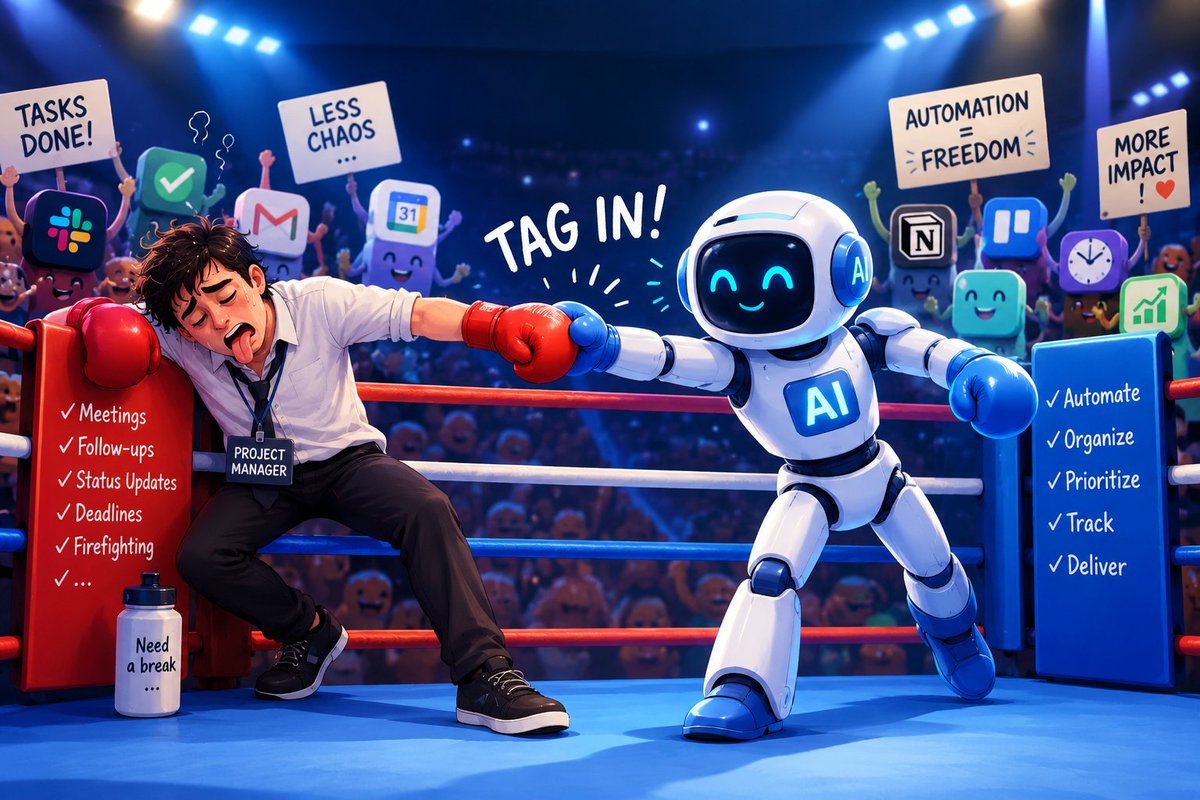
You didn’t start your business to answer the same 12 DMs every single day.
But that’s where most founders are stuck at hour 60 of their work week.
What’s actually eating your time:
6.Manually responding to inbound leads
7.Re-explaining your offer for the 400th time
8.Chasing people who “just need to think about it”
9.Re-typing the same follow-up message
10.Losing an entire evening to admin instead of strategy
None of this requires YOU specifically. It requires consistency.
AI is built for consistency.
How the system works under the hood:
•A trained AI persona handles first-contact conversations in your voice
•It pulls from your actual FAQs, pricing, and objections
•It escalates only when a real human decision is needed
•It runs on autopilot across DMs, forms, and email simultaneously
You’re not removing the human element. You’re removing the exhausted, delayed version of it.
Bigger picture:
The founders who look “effortless” online aren’t lucky.
They built the back-end so the front-end looks calm.
Stop being the engine. Become the architect.
Follow + comment “AUTO” and I’ll send you the exact setup.
Businesses running AI chat agents report a 35-60% increase in after-hours lead capture. Translation: while you're asleep, your competitor's AI is closing deals your business is missing entirely.
Any strong emotion will make them stop and read.
Most business owners still think "chatbot" means the clunky, scripted popup that asks "How can I help you today?" and then fails to answer anything real.
That's not what this is anymore.
Modern AI support agents are trained directly on your product docs, FAQs, pricing, and past support tickets — they can hold a genuinely useful conversation, answer objections, and route qualified leads straight to your calendar without a human touching a single message.
Why this matters for your bottom line:
42% of website visitors leave if they don't get a response in under 5 minutes
AI agents respond in under 3 seconds, 24/7, 365 days a year
Businesses using AI-first support see support costs drop 30-50%
Response consistency goes up — no more "depends which employee answered"
Every conversation gets logged and becomes training data for an even smarter agent
On the technical build: you feed your knowledge base (docs, FAQs, past tickets, product pages) into a vector database, connect it to an LLM via a RAG (retrieval-augmented generation) pipeline, and deploy it through a widget on your site using tools like Voiceflow, Intercom's Fin, or a custom build on top of the OpenAI or Anthropic API.
Escalation logic routes anything the AI can't confidently answer to a human — so you're never leaving a frustrated customer stuck talking to a wall.
Step back further and this is the new baseline for customer experience.
In 3 years, a business without an AI-first response layer will feel as outdated as a business without a website felt in 2010.
Early adopters aren't just saving money — they're setting the expectation their competitors will be forced to catch up to.
I broke this exact setup down step-by-step in a free ebook.
Follow + comment "AUTO" and I'll send it over.
— Automated Segmentation Beats Batch-and-Blast Every Time
Segmented email campaigns generate 760% more revenue than generic batch-and-blast sends. Most businesses know segmentation matters — almost none actually maintain it manually because it's genuinely tedious at any meaningful scale.
*Any strong emotion will make them stop and read.*
The theory of customer segmentation is something every marketer knows: different customers want different messages.
The practice of actually maintaining accurate, useful segments manually — updating them as customer behavior changes, creating new segments as patterns emerge, making sure every campaign actually targets the right group — is where almost everyone falls off, defaulting back to sending the same email to their entire list because it's simply easier.
Here's what automated segmentation actually delivers:
1. Customers get grouped dynamically based on real-time behavior, not a static list
2. Segments update automatically as customer behavior changes, no manual maintenance
3. Messaging and offers tailor automatically to each segment without manual campaign building
4. New meaningful segments get surfaced automatically as patterns emerge in the data
5. Revenue per email sent increases significantly compared to one-size-fits-all campaigns
On the technical side, platforms like Klaviyo or ActiveCampaign build segments dynamically based on behavioral triggers — purchase history, engagement level, browsing behavior — that update automatically as new data comes in, rather than requiring someone to manually rebuild a static list.
Layering an LLM on top allows for automatically identifying non-obvious segments too — customers who behave similarly in ways a human marketer might not think to segment by — and can even generate segment-specific messaging variations automatically instead of requiring a copywriter to manually draft a dozen versions of the same campaign.
Widen the lens: personalization at scale used to require either a huge marketing team or accepting generic messaging as the tradeoff for efficiency.
Automated segmentation removes that tradeoff — you get the relevance of personalized marketing with the efficiency of a single automated system running in the background.
I lay out the complete segmentation automation system in a free ebook.
Follow + comment "AUTO" and I'll send it to you.
Competitor Analysis Doesn't Need to Take a Week
Here's the number that matters: Businesses using AI-powered competitive monitoring catch pricing changes, new product launches, and messaging shifts from competitors within hours instead of discovering them weeks later by accident.
*Any strong emotion will make them stop and read.*
Traditional competitor analysis is a periodic manual exercise — someone checks a handful of competitor websites every month or two, notes what's changed, and reports back.
By the time that report happens, competitors may have already run and finished an entire promotion, launched a product, or repositioned their messaging, and you're finding out well after the window to react has closed.
Here's what automated competitive monitoring actually delivers:
1. Pricing changes across competitor sites detected automatically, often within hours
2. New product launches and messaging shifts flagged as they happen, not weeks later
3. Competitor ad creative and campaigns tracked continuously across platforms
4. Review sentiment for competitors monitored to spot their weaknesses in real time
5. Alerts delivered directly to Slack or email instead of requiring manual checking
Technically, this is built using web scraping and monitoring tools that check competitor websites, pricing pages, and ad libraries on a regular automated schedule, flagging any detected changes.
Layering an LLM on top means the system doesn't just detect that something changed, it summarizes what changed and why it might matter — "Competitor X dropped their starter tier price by 20% and added a new AI feature to their mid-tier plan" — instead of just presenting raw diffs a human still has to interpret manually.
Zoom out: competitive intelligence used to be a resource-intensive function only larger companies could afford to run properly.
Automation makes continuous, real-time competitive monitoring accessible to businesses of any size, meaning the information advantage that used to belong exclusively to well-funded competitors is now available to anyone willing to set the system up.
I break this competitive monitoring system down in a free ebook.
Follow + comment "AUTO" and I'll send it over.
The Virtual Assistant That Never Sleeps
Solopreneurs using AI-powered virtual assistants report reclaiming 15-20 hours a week — roughly equivalent to hiring a part-time employee, at a fraction of the cost and with zero management overhead.
*Any strong emotion will make them stop and read.*
Running a business solo means wearing every hat — sales, support, admin, marketing, finance — and the hours simply don't exist to do all of it well manually.
Most solopreneurs either burn out trying to do everything themselves or start delaying growth-critical tasks because there's genuinely no time left in the day.
AI virtual assistants close that gap without requiring the overhead of managing an actual employee.
Here's what an AI virtual assistant setup actually handles:
1. Email triage and drafted responses, so your inbox doesn't run your day
2. Calendar management and scheduling, handled without back-and-forth messages
3. Social media content drafting and scheduling on autopilot
4. Basic customer inquiries answered instantly without you touching your phone
5. Research and summarization tasks completed in minutes instead of hours
On the technical side, this is built by connecting your core tools — email, calendar, CRM, social accounts — to an AI agent layer, often using a combination of Zapier or Make for the connective automation and an LLM like Claude or GPT-4o as the "brain" handling judgment calls: drafting a reply in your voice, summarizing a long document, deciding which emails need your personal attention versus which can be auto-handled.
Unlike a human assistant, this system works 24/7, never needs training beyond the initial setup, and costs a fraction of even part-time human help.
Widen the lens: solo business owners used to face a hard ceiling — you can only personally do so much before growth requires hiring.
AI virtual assistants push that ceiling significantly higher, letting solopreneurs run operations that would have previously required a small team, which fundamentally changes the economics of starting and running a small business alone.
I document the full AI virtual assistant setup in a free ebook.
Follow + comment "AUTO" and I'll send it your way.
Your Social Media Should Run Itself
Businesses that automate content repurposing publish 4x more consistently and see engagement grow 60% faster than accounts posting manually and sporadically. Consistency, not talent, is what the algorithm actually rewards.
*Any strong emotion will make them stop and read.*
Here's the trap most business owners fall into: they record one great podcast episode or write one great blog post, post it once, and let it die.
Meanwhile that single piece of content could have become 15 pieces — clips, quote graphics, threads, carousels, captions — each hitting a different platform and a different segment of your audience.
Doing that manually is a full-time job.
Automating it takes a few hours to set up once.
Here's the actual value of an automated content pipeline:
1. One long-form piece becomes 10-15 pieces of derivative content automatically
2. Publishing happens on a schedule with zero manual posting required
3. Captions and hashtags are auto-generated and optimized per platform
4. Performance data feeds back into what topics to create next
5. Your presence stays consistent even during weeks you don't have time to create
Technically, this pipeline starts with a source (a podcast, a YouTube video, a blog post), runs through a transcription tool like Descript or Whisper, then an LLM identifies the best quotable moments, generates platform-specific captions, and hands off to a tool like Opus Clip for short-form video cuts or Canva's API for graphics.
A scheduler like Buffer or Metricool then auto-publishes everything on a calendar you set once and never think about again.
Zoom out: content is the new storefront.
People decide whether to trust your business based on what they see you post before they ever talk to you.
A business posting consistently, everywhere, without burning 20 hours a week to do it, is simply going to out-market a business relying on manual effort and inspiration striking at the right moment.
I documented this exact repurposing system in a free ebook.
Follow + comment "AUTO" and I'll send it over.
The Hiring Process Is Broken (Here's the Fix)
The average small business spends 36 days and $4,700 filling a single role — and still gets it wrong 46% of the time. AI-automated hiring cuts both numbers by more than half.
*Any strong emotion will make them stop and read.*
If you've ever hired for a growing business, you know the pain: hundreds of resumes for one posting, most of them irrelevant, a handful worth a real look, and no time to actually give every candidate the attention they deserve.
So you either burn days you don't have manually screening, or you rush the process and end up with a bad hire that costs you 6 months of lost productivity to fix.
Here's what AI-automated hiring actually solves:
1. Resume screening — AI ranks candidates against your job criteria in seconds, not days
2. Automated scheduling — candidates book their own interview slot, zero back-and-forth
3. AI-generated interview questions tailored to gaps in each candidate's resume
4. Automated reference checks via structured AI-conducted calls or forms
5. Onboarding sequences that trigger automatically the moment an offer is accepted
On the technical side, tools like BambooHR or Greenhouse handle the applicant tracking, while an LLM layer parses resumes against your job description to generate a fit score and a summary of strengths and red flags.
Calendly or a similar tool handles self-scheduling once a candidate clears the AI screen, and onboarding paperwork, welcome emails, and account provisioning all trigger automatically from a single "hired" status change in your ATS — no manual checklist required.
Widen the lens: the businesses that win the talent war over the next decade won't be the ones who can pay the most — they'll be the ones whose hiring process is fast enough and precise enough to land great people before competitors even finish their first screening call.
Automation isn't just an efficiency play in hiring.
It's a recruiting advantage.
I broke the full hiring automation system down in a free ebook.
Follow + comment "AUTO" and I'll send it to you.
Payroll Errors Are More Common Than You Think
1 in 3 businesses make a payroll error in any given year, and the average error costs $291 to fix once you factor in the time spent correcting it, communicating with the affected employee, and potential penalty risk.
*Any strong emotion will make them stop and read.*
Payroll feels like it should be simple — pay people the right amount on the right day — but it's actually one of the more error-prone processes in any business because it involves so many variable inputs: hours worked, overtime, PTO, tax withholding changes, benefits deductions, bonus structures.
Manually calculating all of that correctly, every single pay period, for every employee, is a task genuinely built for automation, not humans.
Here's what automated payroll actually fixes:
1. Hours and overtime calculate automatically from time-tracking data, no manual math
2. Tax withholding updates automatically as regulations or employee status changes
3. Payments process automatically on schedule with zero manual approval bottleneck
4. Compliance reporting generates automatically instead of requiring a manual scramble
5. Employees get self-service access to pay stubs and tax documents automatically
Technically, platforms like Gusto or Rippling connect directly to your time-tracking system (When I Work, Homebase) so hours flow in automatically without manual entry.
Tax calculations update automatically based on current regulations and each employee's specific situation, and direct deposits process on a set schedule without requiring manual approval every single cycle.
Compliance filings — quarterly tax reports, year-end documents — generate automatically as well, removing one of the highest-stakes manual tasks in the entire business.
Zoom out: payroll is one of those areas where a mistake doesn't just cost money, it costs trust — employees notice immediately if their paycheck is wrong, and repeated errors damage morale in a way that's hard to repair.
Automation isn't just an efficiency play here, it's directly protecting one of your most important internal relationships.
I break the full payroll automation stack down in a free ebook.
Follow + comment "AUTO" and I'll send it over.
The SEO Workflow That Publishes Itself
Businesses using AI-automated SEO content workflows publish 3-5x more optimized content per month than teams writing manually — and see organic traffic compound significantly faster as a result.
*Any strong emotion will make them stop and read.*
SEO has always been a volume-and-consistency game as much as a quality game, and that's exactly where manual content production falls apart.
Writing one great blog post a month feels productive, but the businesses actually winning organic search are publishing dozens of pieces, each targeting a specific keyword cluster, each optimized precisely for what's actually ranking right now — something that's genuinely hard to sustain by hand.
Here's what an automated SEO content workflow actually delivers:
Keyword research and content gaps identified automatically against competitors
First drafts generated automatically based on what's currently ranking well
On-page optimization (headers, meta descriptions, internal links) applied automatically
Content performance tracked automatically, feeding back into what to write next
Publishing scheduled automatically across your blog and syndication channels
On the technical side, tools like Surfer SEO or Clearscope analyze top-ranking content for a target keyword and generate an optimization brief automatically.
An LLM then drafts the actual content against that brief, a human editor reviews and refines for accuracy and brand voice, and the piece publishes through a CMS integration on a set schedule.
Internal linking can even be automated by having the AI scan your existing content library and insert relevant links automatically as new pieces go live.
Widen the lens: AI hasn't made good content less valuable — if anything it's raised the bar, because low-effort AI content is easy to spot and Google's ranking systems increasingly penalize it.
What automation actually does is remove the repetitive parts of the process — research, formatting, optimization — so the human effort concentrates on the parts that actually require judgment and expertise.
I document the full SEO automation workflow in a free ebook.
Follow + comment "AUTO" and I'll send it to you.
Project Management Shouldn't Need a Full-Time Manager
Teams using AI-automated project management report 25-30% faster project completion, mainly because status updates, task assignment, and bottleneck detection stop depending on someone manually checking in on everything.
*Any strong emotion will make them stop and read.*
Traditional project management runs on a fundamental bottleneck: a human has to manually track what everyone is doing, chase status updates, notice when something's falling behind, and reassign work when priorities shift.
That works fine for small teams and small projects, and breaks down fast as complexity grows — which is exactly when you need it working the most.
Here's what AI-automated project management actually delivers:
Task status updates automatically based on actual work activity, not manual check-ins
Bottlenecks get flagged automatically before they cause a missed deadline
Workload gets rebalanced automatically across the team based on real capacity
Status reports for stakeholders generate themselves instead of requiring a manual write-up
Dependencies get tracked automatically so nothing slips through unnoticed
Technically, platforms like ClickUp, Asana, or https://t.co/yFklS76axr increasingly bake AI directly into the workflow — automatically detecting when a task is at risk based on time elapsed versus estimated duration, suggesting reassignment when someone's overloaded, and generating a plain-English project summary for stakeholders who don't need to see every individual task.
Integrating with your team's actual work tools (GitHub, Figma, your CRM) means status updates automatically reflect real progress instead of requiring someone to remember to update a task card manually.
Zoom out: the goal of project management was never the tracking itself, it was making sure the right work gets done on time.
Automating the tracking layer means your project managers spend their time actually managing — solving problems, making decisions, unblocking people — instead of being a human status-update collection service.
I break the full PM automation system down in a free ebook.
Follow + comment "AUTO" and I'll send it over.)
The average business owner spends 11 hours a week just managing email. At $30/hour that's $1,320/month spent reading, sorting, and replying to messages an AI could triage in seconds.
Any strong emotion will make them stop and read.
Email is the silent productivity killer of small business.
It's not one big task — it's death by a thousand cuts.
Every "just circling back," every "quick question," every invoice request buried three replies deep in a thread.
None of it feels urgent enough to fix, so it never gets fixed, and the hours quietly disappear week after week, month after month, year after year.
Here's what automating your inbox actually looks like in practice:
Auto-categorization — AI sorts by urgency, department, or intent before you even open it
Auto-drafted replies — the AI writes a response in your tone, you just approve or edit
Auto follow-ups — no lead or client ever falls through the cracks again
Auto-summarization — long threads compressed into a 3-line summary
Auto-routing — the right email lands with the right team member automatically
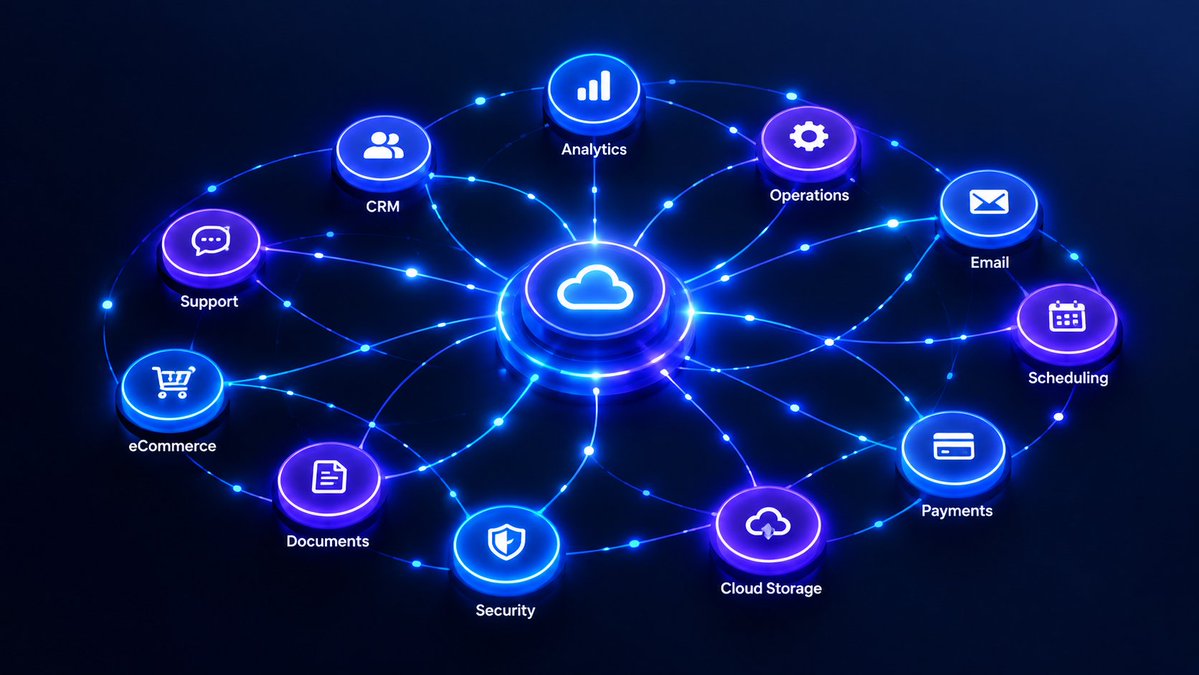
Technically, this is built by connecting your inbox (Gmail or Outlook) via API to an automation layer like Zapier, Make, or n8n, then piping the email content through an LLM prompt that's been trained on your voice and your standard responses.
Labels and folders get applied programmatically, drafts get generated and queued for your approval, and recurring types of emails (invoices, scheduling, support) get fully automated end-to-end with zero human touch.
Widen the lens and email automation is really the entry point to something bigger: an operating system for your entire business where information flows automatically instead of requiring a human to manually shuttle it from place to place.
Once your inbox is automated, the same logic extends to your CRM, your reporting, your onboarding — every repeatable process in your business.
I put the full inbox automation blueprint in a free ebook.
Follow + comment "AUTO" and I'll send it your way.
Businesses running AI chat agents report a 35-60% increase in after-hours lead capture. Translation: while you're asleep, your competitor's AI is closing deals your business is missing entirely.
Any strong emotion will make them stop and read.
Most business owners still think "chatbot" means the clunky, scripted popup that asks "How can I help you today?" and then fails to answer anything real.
That's not what this is anymore.
Modern AI support agents are trained directly on your product docs, FAQs, pricing, and past support tickets — they can hold a genuinely useful conversation, answer objections, and route qualified leads straight to your calendar without a human touching a single message.
Why this matters for your bottom line:
42% of website visitors leave if they don't get a response in under 5 minutes
AI agents respond in under 3 seconds, 24/7, 365 days a year
Businesses using AI-first support see support costs drop 30-50%
Response consistency goes up — no more "depends which employee answered"
Every conversation gets logged and becomes training data for an even smarter agent
On the technical build: you feed your knowledge base (docs, FAQs, past tickets, product pages) into a vector database, connect it to an LLM via a RAG (retrieval-augmented generation) pipeline, and deploy it through a widget on your site using tools like Voiceflow, Intercom's Fin, or a custom build on top of the OpenAI or Anthropic API.
Escalation logic routes anything the AI can't confidently answer to a human — so you're never leaving a frustrated customer stuck talking to a wall.
Step back further and this is the new baseline for customer experience.
In 3 years, a business without an AI-first response layer will feel as outdated as a business without a website felt in 2010.
Early adopters aren't just saving money — they're setting the expectation their competitors will be forced to catch up to.
I broke this exact setup down step-by-step in a free ebook.
Follow + comment "AUTO" and I'll send it over.
Sales teams that automate proposal generation send quotes 68% faster and close 23% more deals, simply because speed itself signals professionalism and keeps momentum from dying between the call and the follow-up.
Any strong emotion will make them stop and read.
Here's a pattern that kills deals silently: a great sales call happens, the prospect is excited, and then... three days pass before the proposal actually lands in their inbox because someone had to manually build it, get it approved, format the pricing, and finally send it.
By the time it arrives, the excitement from the call has faded and a competitor's faster-moving proposal might already be sitting in their inbox too.
Here's what automated proposal generation actually delivers:
Proposals generate within minutes of a call ending, not days later
Pricing pulls automatically from your current rate card, no manual math errors
Content personalizes automatically based on what was discussed on the call
E-signature and payment links are embedded, so closing happens in one step
Follow-up reminders trigger automatically if a proposal sits unopened or unsigned
Technically, this works by connecting your CRM or call transcription tool to a proposal platform like PandaDoc or Proposify via API.
An LLM layer reads the call transcript or CRM notes and drafts proposal language tailored to the specific conversation — referencing the client's actual stated pain points instead of generic boilerplate — while pricing tables populate automatically from your product catalog.
Once sent, tracking data (opens, time spent per page) feeds back to your sales rep automatically so follow-up timing is based on real buyer behavior, not a guess.
Zoom out: in competitive sales environments, speed and personalization used to be a trade-off — fast meant generic, personal meant slow.
Automation removes that trade-off entirely, and the businesses that figure this out first are winning deals purely on responsiveness before the product comparison even starts.
I document the full proposal automation system in a free ebook.
Follow + comment "AUTO" and I'll send it over.
90% of Meetings Could Be an Automated Summary
The average employee spends 23 hours a week in meetings, and studies show up to 90% of the value in most of those meetings could be captured in a 5-minute automated summary sent afterward.
Any strong emotion will make them stop and read.
Meetings feel productive while you're in them and evaporate almost immediately after.
Nobody remembers the action items without someone manually typing notes, chasing people down for follow-through, or re-explaining the same context in the next meeting because nothing got written down clearly the first time.
Multiply that across a team and you're looking at hundreds of hours a month spent in rooms that produce very little that actually sticks.
Here's what automated meeting workflows actually solve:
Every meeting gets transcribed and summarized automatically, no note-taker needed
Action items get extracted and assigned automatically to the right person
Follow-up emails draft themselves based on what was actually discussed
Meeting notes sync directly into your project management tool
Recurring meetings get auto-flagged for cancellation if attendance and value drop off
On the technical side, tools like Fathom, https://t.co/SeMPnKdkMN, or Fireflies connect to your video calls and transcribe them in real time, then an LLM layer pulls out decisions, action items, and owners, formatting them into a clean summary.
That summary can automatically create tasks in ClickUp, Asana, or Notion, and trigger a follow-up email draft sent to all attendees within minutes of the call ending — no one has to remember to do any of it manually.
Widen the lens: this isn't just about saving time in the room, it's about actually capturing the value that meetings are supposed to create in the first place.
A meeting that produces zero tracked follow-through was, functionally, a waste of everyone's time — automation is what turns conversation into action reliably.
I cover this exact meeting automation workflow in a free ebook.
Follow + comment "AUTO" and I'll send it to you.
Stockouts cost global retailers an estimated $1 trillion a year, while overstocking ties up cash that could be growing your business. AI demand forecasting fixes both sides of that problem simultaneously.
Any strong emotion will make them stop and read.
Inventory is one of those problems where being wrong in either direction hurts you.
Run out of stock and you lose the sale plus the customer's trust.
Overstock and you've got cash sitting on a shelf instead of in your bank account, plus storage costs eating your margin the whole time it sits there.
Most businesses manage this with gut feel and a spreadsheet, which works fine right up until demand shifts and the gut feel is wrong.
Here's what AI-driven inventory management actually delivers:
Demand forecasts based on historical sales, seasonality, and external trend data
Automatic reorder triggers before you actually run out
Multi-channel sync so stock counts are accurate everywhere at once
Slow-moving inventory flagged automatically for markdown or bundling
Supplier lead times factored directly into reorder timing
Technically, this connects your sales data (Shopify, Amazon, your POS system) to a forecasting model that analyzes historical patterns and seasonal trends, then automatically generates purchase order recommendations before you're at risk of stocking out.
Tools like Cin7 or inventory modules within your existing e-commerce platform can trigger these reorders automatically, while a Zapier or n8n layer keeps stock counts synced in real time across every channel you sell on, so you're never overselling a product that already sold out somewhere else.
Zoom out: inventory has always been part science, part gut instinct.
AI shifts that ratio dramatically toward science — and the businesses making that shift are running leaner, tying up less cash, and hitting fewer costly stockouts than competitors still eyeballing their reorder points.
I break the entire inventory automation system down in a free ebook.
Follow + comment "UGC" and I'll get it to you.
The average online store abandons 70% of shopping carts — and automated recovery sequences win back 15-30% of that "lost" revenue without a single human lifting a finger.
Any strong emotion will make them stop and read.
Cart abandonment is the most expensive silent leak in e-commerce, and most store owners barely think about it because the customer technically "didn't buy," so it doesn't feel like a loss in the way a canceled order does.
But that customer already showed intent — they picked products, entered their info, got most of the way there.
Letting that interest evaporate without a single follow-up is leaving money on the table that's genuinely easier to recover than acquiring a brand new customer.
Here's what automated recovery actually does:
Sends the first reminder within 1 hour, while intent is still hot
Escalates with a discount or urgency element on email 2-3 if there's still no purchase
Personalizes the message with the exact products left in the cart
Segments customers by cart value so high-value abandons get priority treatment
Tracks recovered revenue automatically so you know exactly what the sequence is worth
Technically, platforms like Klaviyo or Shopify Flow detect the abandonment event via a webhook the moment a cart is left inactive for a set period.
That triggers a pre-built sequence, but the real upgrade is layering an LLM on top to personalize each message dynamically — referencing the specific product, addressing likely objections (price, shipping time, fit), and adjusting tone based on whether it's a first-time visitor or returning customer, instead of sending the same generic templated email to everyone.
The bigger picture: in e-commerce, the difference between a mediocre store and a highly profitable one is rarely traffic — it's what happens to the traffic you already have.
Automated recovery sequences are one of the highest ROI systems you can build because they're monetizing attention you already paid to acquire.
I put the full cart recovery playbook in a free ebook.
Follow + comment "AUTO" and I'll send it to you.
Businesses that automate content repurposing publish 4x more consistently and see engagement grow 60% faster than accounts posting manually and sporadically. Consistency, not talent, is what the algorithm actually rewards.
Any strong emotion will make them stop and read.
Here's the trap most business owners fall into: they record one great podcast episode or write one great blog post, post it once, and let it die.
Meanwhile that single piece of content could have become 15 pieces — clips, quote graphics, threads, carousels, captions — each hitting a different platform and a different segment of your audience.
Doing that manually is a full-time job.
Automating it takes a few hours to set up once.
Here's the actual value of an automated content pipeline:
One long-form piece becomes 10-15 pieces of derivative content automatically
Publishing happens on a schedule with zero manual posting required
Captions and hashtags are auto-generated and optimized per platform
Performance data feeds back into what topics to create next
Your presence stays consistent even during weeks you don't have time to create
Technically, this pipeline starts with a source (a podcast, a YouTube video, a blog post), runs through a transcription tool like Descript or Whisper, then an LLM identifies the best quotable moments, generates platform-specific captions, and hands off to a tool like Opus Clip for short-form video cuts or Canva's API for graphics.
A scheduler like Buffer or Metricool then auto-publishes everything on a calendar you set once and never think about again.
Zoom out: content is the new storefront.
People decide whether to trust your business based on what they see you post before they ever talk to you.
A business posting consistently, everywhere, without burning 20 hours a week to do it, is simply going to out-market a business relying on manual effort and inspiration striking at the right moment.
I documented this exact repurposing system in a free ebook.
Follow + comment "AUTO" and I'll send it over.
The average small business spends 36 days and $4,700 filling a single role — and still gets it wrong 46% of the time. AI-automated hiring cuts both numbers by more than half.
Any strong emotion will make them stop and read.
If you've ever hired for a growing business, you know the pain: hundreds of resumes for one posting, most of them irrelevant, a handful worth a real look, and no time to actually give every candidate the attention they deserve.
So you either burn days you don't have manually screening, or you rush the process and end up with a bad hire that costs you 6 months of lost productivity to fix.
Here's what AI-automated hiring actually solves:
Resume screening — AI ranks candidates against your job criteria in seconds, not days
Automated scheduling — candidates book their own interview slot, zero back-and-forth
AI-generated interview questions tailored to gaps in each candidate's resume
Automated reference checks via structured AI-conducted calls or forms
Onboarding sequences that trigger automatically the moment an offer is accepted
On the technical side, tools like BambooHR or Greenhouse handle the applicant tracking, while an LLM layer parses resumes against your job description to generate a fit score and a summary of strengths and red flags.
Calendly or a similar tool handles self-scheduling once a candidate clears the AI screen, and onboarding paperwork, welcome emails, and account provisioning all trigger automatically from a single "hired" status change in your ATS — no manual checklist required.
Widen the lens: the businesses that win the talent war over the next decade won't be the ones who can pay the most — they'll be the ones whose hiring process is fast enough and precise enough to land great people before competitors even finish their first screening call.
Automation isn't just an efficiency play in hiring.
It's a recruiting advantage.
I broke the full hiring automation system down in a free ebook.
Follow + comment "AUTO" and I'll send it to you.
Businesses that automate invoicing get paid an average of 18 days faster and cut billing errors by 87%. If you're still manually generating and chasing invoices, you're financing your customers' cash flow with your own.
Any strong emotion will make them stop and read.
Invoicing feels like a small task until you actually total up the hours: creating the invoice, formatting it correctly, sending it, tracking whether it was opened, following up when it's late, reconciling it against your bank feed, chasing the client who "forgot" for the third time.
Multiply that by every client, every month, and it's easily 5-10 hours a week for a business with even a modest client base.
What automated invoicing actually fixes:
Invoices auto-generate the moment a project milestone or subscription renews
Automatic payment reminders sent on a schedule, no awkward human follow-up needed
Real-time reconciliation against your bank feed — no manual matching
Automatic late fees applied per your terms, no negotiation required
Cash flow forecasting updates automatically as invoices are paid or overdue
Technically, tools like QuickBooks, Xero, or Wave connect via API to your CRM or project management tool, so an invoice is triggered automatically by a defined event (project marked complete, subscription billing date hit).
Reminder sequences run on autopilot through the same platform, and an AI layer can even draft the "hey, following up on this" message in a tone that matches your brand instead of a generic robotic notice.
Pair this with Stripe or another payment processor and clients can pay in one click straight from the reminder.
The bigger picture here: cash flow, not revenue, is what actually kills small businesses.
A business making $2M a year can still go under if money isn't coming in on time.
Automating your billing cycle isn't a convenience feature — it's a direct defense against the single most common cause of small business failure.
I cover the full billing automation stack in a free ebook.
Follow + comment "AUTO" and I'll get it to you.