Governance works when the community shows up. 🤝
Be part of Let’s Talk Fund 15, our Cardano Governance Forum, focused on increasing community participation in #Cardano Governance. Join us
Register here 👉 https://t.co/tihMdsKcw6
#CardanoCommunity#Fund15#OnChainGovernance
The Collapse of the Clarity Act: A Setback for Stablecoin Innovation in 2026
Clarity Act Failure: The Clarity Act, a proposed legislation to regulate digital assets in the U.S., failed in early 2026 due to a controversial provision banning interest payments on stablecoins.
Impact on Stablecoin Innovation: The failure of the Clarity Act is a setback for stablecoin innovation, hindering the potential for greater institutional adoption and regulatory certainty.
Economic Impact: If stablecoins continue to offer competitive yields, they could potentially siphon off a significant portion of U.S. bank deposits, leading to a contraction in lending and impacting the economy.
U.S. Stablecoin Regulation: The proposed Clarity Act, which aimed to ban interest on stablecoins, faced opposition from the crypto industry and ultimately failed to pass.
International Approaches: China’s decision to offer interest on its digital yuan highlights a contrasting approach to digital asset regulation.
Potential Outcomes: Possible outcomes include U.S. users seeking offshore yield options, the emergence of alternative reward mechanisms, or increased adoption of decentralized protocols.
Impact of Clarity Act Failure: Highlights the power struggle between legacy finance and decentralized finance.
Crypto Sector Resilience: The sector has historically adapted to obstacles and will likely continue to do so.
Policy Implications: Policymakers face the challenge of balancing innovation, consumer protection, and economic stability in the digital asset landscape.
The future of business is decentralized, and Ghana is ready.
Explore real-world Bitcoin application cases for businesses, including payments and cross-border trade, under Ghana's new digital asset framework.
🚀 Build. Adapt. Get Bitcoin-ready.
Register in the link below 👇
Crypto Whale's $282M Nightmare: Gone in Minutes – The Dangers of Revealing Your Seed Phrase
The Incident Details
On January 10, 2026, a crypto whale lost $282 million in Bitcoin and Litecoin during a single phone call. The victim held 2.05 million Litecoin (valued at approximately $153 million) and 1,459 Bitcoin (around $139 million) in cold storage wallets. Scammers, impersonating Trezor support staff, tricked the investor into revealing their seed phrase, allowing immediate restoration of the wallet and drainage of funds. This highlights how social engineering exploits human trust rather than technical flaws, with no actual device compromise occurring.
How the Scam Unfolded
The attackers contacted the victim, creating urgency by claiming a security breach involving the Trezor Vault wallet service. Through psychological manipulation—likely emphasizing immediate action to "protect" the assets—they convinced the sophisticated investor to share the seed phrase verbally. Once obtained, the scammers used it to access and transfer the funds instantly, demonstrating the simplicity and speed of such attacks compared to complex hacks.
Comparison to Previous Scams
This theft mirrors a $243 million loss in August 2024, where scammers posed as Google and Gemini support, reset 2FA via spoofed calls, and used remote access software like AnyDesk to steal from a Bitcoin Core wallet. The perpetrator, Malone Lamb (alias "Pink Drainer"), was later arrested. Both cases show a shift from exchange hacks to targeted social engineering, as improved security pushes criminals toward deception.
Recovery Challenges and Low Success Rates
Only 0.25% of the stolen funds ($700,000) were frozen in this case, far below the 4% recovered in the 2024 incident. The video explains that tracing and freezing crypto is difficult due to its decentralized nature, emphasizing that prevention is key since post-theft recovery is often impossible.
Rise of Social Engineering in Crypto
Social engineering has become the dominant threat, surpassing traditional hacks. Scammers exploit urgency, authority, and trust, as seen in calls pretending to be from reputable companies. The video notes that legitimate firms like Trezor never request seed phrases or initiate unsolicited contact, advising users to verify through official channels.
Physical Risks: Wrench Attacks
Beyond phone scams, "wrench attacks" involve physical coercion to obtain seed phrases. In 2025, over 65 documented cases occurred, including the kidnapping and finger severance of Ledger co-founder David Balland in France, a family waterboarded in British Columbia for $150,000 in crypto, and a Florida couple held at gunpoint. As Bitcoin's value rises, such violent threats increase, making self-custody riskier for large holders.
Self-Custody vs. Institutional Custody Debate
While self-custody follows the "not your keys, not your coins" principle, it exposes users to scams and physical dangers. Institutional options like Coinbase Custody or Anchorage offer armed guards, multi-signature approvals, and insurance, potentially safer for whales despite higher fees (0.1-0.2% annually). The video weighs this against the risk of institutional failures like FTX.
Prevention Advice for Users
Never trust inbound calls—hang up and contact support via official websites. Avoid sharing seed phrases, installing remote software, or acting on urgent demands. Use hardware wallets properly, diversify holdings across multiple wallets/locations, and consider professional custody for significant amounts to mitigate risks.
Broader Implications for the Crypto Community
These incidents signal a maturing market where security focuses on human factors. As scams evolve, education and skepticism are vital. while crypto offers financial freedom, it demands personal responsibility to avoid devastating losses.
Call for Community Vigilance
The crypto space must promote awareness to combat these threats. Resources like @coinbureau@Diyblock_africa@Aidblock_Inst content aim to educate, urging viewers to verify everything and trust no one blindly in high-stakes environments.
Governance works when the community shows up. 🤝
Be part of Let’s Talk Fund 15, our Cardano Governance Forum, focused on increasing community participation in #Cardano Governance. Join us
Register here 👉 https://t.co/tihMdsKcw6
#CardanoCommunity#Fund15#OnChainGovernance
In African traditional history, before #Chainlink, our grandfathers knew the importance of linking Blockchains for unity, smooth smart contracts execution across blockchains for better human relationships and faster transaction. The #Asante Adinkra symbol for this is Nkonsonkonson. To wit, a symbol unity and human relations. #CardanoCommunity equally has a quality human relations united around its innovative engine #ProjectCatalyst. #Fund15Live 🤩
Hello Fam 😊
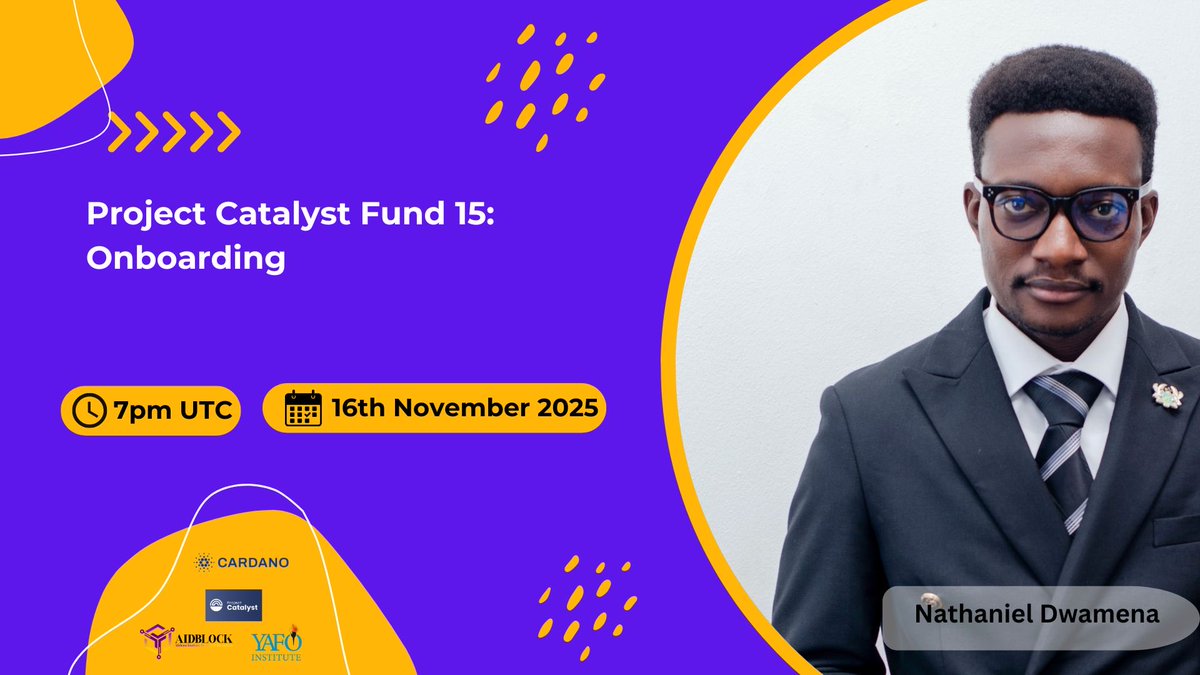
Join the Catalyst Fund 15 Onboarding with Nathaniel Dwamena
📆 16th November 2025
⏰07:00 PM UTC
Participate for free using the link below 👇🏽
https://t.co/tqSZNAfx5p
After registering, you will receive a confirmation email containing information about joining the meeting.
#Cardano #CardanoADA #CardanoCommunity
Hello Fam 😊
Join the Catalyst Fund 15 Onboarding with Nathaniel Dwamena
📆 16th November 2025
⏰07:00 PM UTC
Participate for free using the link below 👇🏽
https://t.co/tqSZNAfx5p
After registering, you will receive a confirmation email containing information about joining the meeting.
#Cardano #CardanoADA #CardanoCommunity
Join our CEO, @Nat_Dwamena at Catalyst Africa TownHall this Friday.
Together, let’s explore from policy to practice and to drive enterprise adoption for #Cardano.
Be there 😊
Register here https://t.co/MLHCoehWch