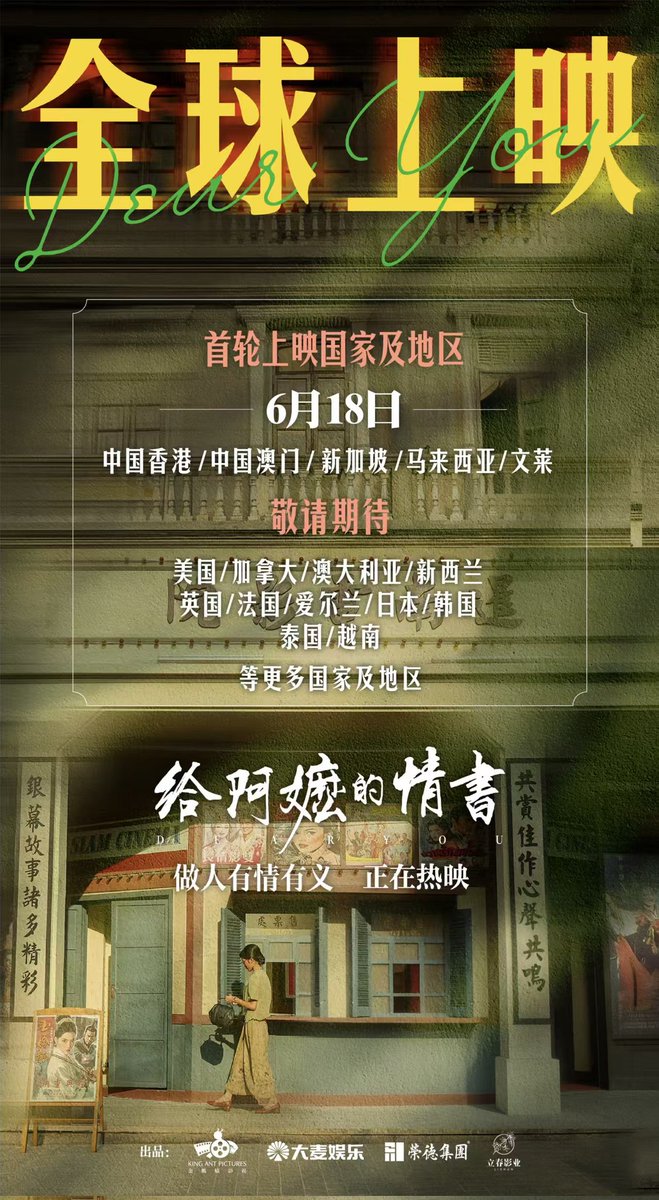
Let’s be honest. In an era ruthlessly dominated by cold algorithms, calculated marketing, and cynical traffic-driven blockbusters, A Love Letter to Grandma (给阿嬷的情书) has done the absolute impossible.
It didn’t just become a cinematic miracle; it has officially exploded into a historic national phenomenon, drawing a staggering 44 million viewers to theaters. To put that in perspective for global audiences: that is more than the entire population of Canada or Poland buying a ticket to watch the exact same story.
This isn't a commercial victory engineered by corporate capital—it is a collective emotional rebellion. In a movie market saturated with special effects, the Chinese audience is standing up in unison to reclaim what truly matters: pure human affection (Qing-Yi) and cultural roots.
The film follows a grandson chasing a rumored inheritance in Thailand, only to unearth a decades-old mystery involving his grandmother, Shurou, her long-lost husband, Musheng, and Nanzhi, the woman in a mysterious photograph.
While Western storytelling often thrives on betrayal, jealousy, and cheap drama, A Love Letter to Grandma dares to be profoundly gentle. Musheng never cheated. Nanzhi never betrayed. When Musheng tragically died in a foreign land trying to protect others, Nanzhi—who had been helping him read and write letters home—decided to shoulder the burden. For decades, she impersonated Musheng's handwriting, sent money, and even shipped the bicycle Musheng had promised his wife, just to save Shurou from the devastating news while raising three kids alone.
It is a story where good people meet good people, where trust is met with ultimate devotion. The emotional climax isn’t a loud, Hollywood-style breakdown. It is two elderly women, who sustained each other across oceans for half a century, finally meeting and simply asking each other if the homemade food they sent tasted good. That is the genius of Chinese resilience—heavy burdens carried with ultimate grace.
Now, this raw, soul-stirring masterpiece is going global. Starting June 18, A Love Letter to Grandma will be released in Hong Kong and Macao of China, Singapore, Malaysia, and Brunei, sharing the profound warmth and authentic charm of Eastern culture with international screens.
Mark your calendars for June 18. In a world of artificial content, are you ready for a story that reminds us what it means to be human? Let’s talk below. 👇
A few years ago, I spent two weeks visiting ten startups across the Greater Bay Area, Jiangsu, and Zhejiang, and interviewed their chairmen. Three were already public companies, including Ecovacs. I came away very impressed and quite optimistic, although that was five years ago, when the broader mood in China was much more upbeat.
I think the bigger issue is not talent. Chinese founders have always been very capable. The real constraint is political. They are trying to grow companies while operating under limits that most founders in other countries do not face. In China, once a company becomes truly successful, that success itself can sometimes create new risks.
China’s biggest strength is its full industrial chain. Its weakness is that few people want to spend serious money and energy on true zero-to-one innovation when the payoff is uncertain and the risk is high. Chinese entrepreneurs are usually very rational about that tradeoff.
If the system ever truly rewards zero-to-one innovation, and the upside is clear and protected, I think a huge amount of entrepreneurial energy would move there very quickly.
@LynneBP_294 This is called Jianbing, a thin pancake filled with vegetables, eggs and meat. It is common in northern provinces of China, such as Shandong, Henan, Hebei, Tianjin and Northeast China.