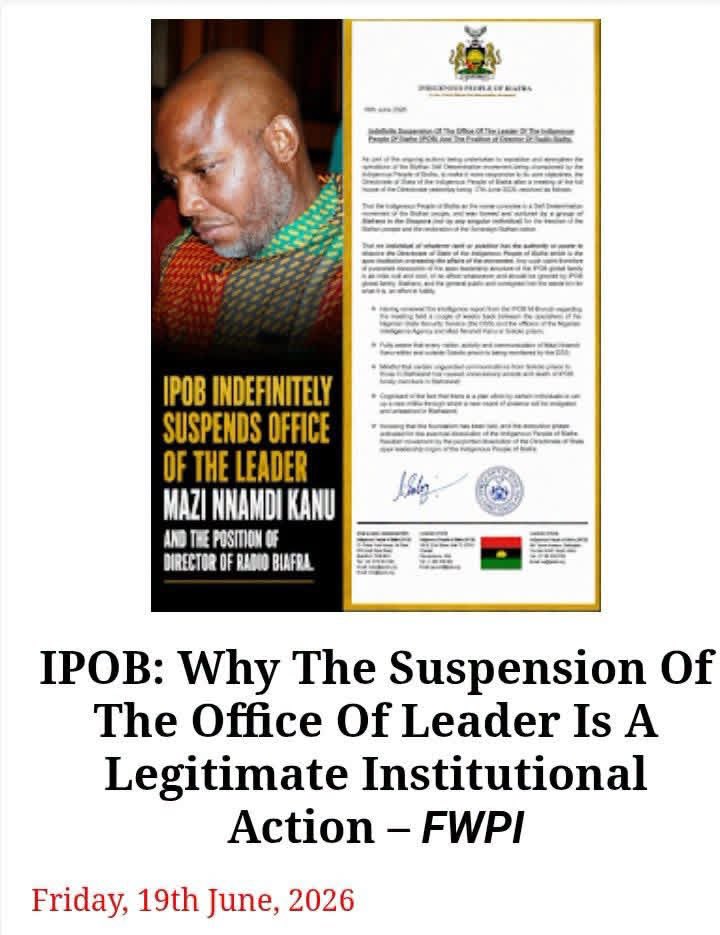
This man does not represent IPOB. He's not even an IPOB member to start with and we challenge him to dispute us. They have packaged him in an empty room to utter rubbish.
Once you see the Zoo media like @DailyPostNGR promoting things of this nature, know it that such entity is working in their favour.
They did it for Simon Ekpa. The Zoo media was first to announce Ekpa as IPOB's leader. Throughout Ekpa's evil reign, @DailyPostNGR was used to promote him.
They are back again, but they are welcome. Let them bring it on. That's why we are here.
Some have suggested that the decision carries grave legal consequences. Such claims appear exaggerated. Internal disciplinary, administrative, or restructuring decisions are common within organizations worldwide. The mere fact that an institution exercises powers assigned to it under its governing framework does not automatically create legal liability. Disagreement with a decision does not, by itself, make the decision unlawful.
https://t.co/YoQjtCWwdq
No single person has the ability to influence IPOB worldwide; rather, IPOB influences individuals organizations and government .
IPOB possesses the power to dispose anyone who opposes Biafra's quest for freedom.
This time will serve as a lesson for those who deceitfully exploit the blood of Biafrans for personal gain and then seek to blackmail the innocent and committed individuals who have sacrificed greatly for Biafra's restoration.
Regardless of their preference, IPOB is prepared to address this matter definitively.
“Agbachie nsị nkiti ona esi”
Biafrans and IPOB Worldwide, be courageous in the face of these challenges .
This is a struggle for freedom ; it's never going to be easy. In due time, millions of Biafrans will understand that DOS 's decision to suspend the office of the leader is to protect lives, preserve the movement, and, above all, to make sure we never derail from the pursuit of Biafra's freedom.
@radiobiafralive
The faithful are assured that all things, whether pleasant or adverse, visible or unseen, ultimately work together for good to those who love God and are called according to His divine purpose. In the economy of God’s providence, nothing is wasted; every trial refines, every season instructs, and every circumstance advances His sovereign will and glory.
Most importantly, Scripture teaches that when righteousness occupies the seat of authority, both the earth and its inhabitants rejoice; for righteous leadership brings justice, peace, equity, and divine favour.
May the abundant blessings of the Lord rest upon you all . Amen 🙏
@EjioforBar
June 19,2026
IPOB Cote d'Ivoire Chapter Rejects Purported Dissolution of DOS, Pledges Full Support for Leadership of Mazi Chikadibia Edoziem https://t.co/mK4o4Gxmb8
One dominant truth about human nature is that no person can successfully conceal, for eternity, the inherent traits of deceit, fraud, misrepresentation, blackmail, and other reprehensible conduct. Time remains the ultimate revealer of character. No matter how carefully such vices are disguised, romanticized, or cloaked in false virtue, they will inevitably be exposed. The tragedy, however, is that when the mask finally falls, often by the very actions of the perpetrator, the revelation sends shockwaves far and wide.
I had long foretold that a day of reckoning would come; a day when deception and falsehood would stand naked before the court of truth, and when the souls sacrificed on the altar of lies would cry out for justice, even from their graves.
May the Good Lord deliver our people, heal our land, and grant us the wisdom to discern truth from illusion. It has now become abundantly evident that all that glitters is not gold.
@EjioforBar
June 18, 2026
A proposal for the death sentence by the Nigerian government has been in effect since March 6th, 2026.
on cross appeal, that is what they suppose to concentrate on by combating Nigeria in his court case but they’re preoccupied since March fighting Chinasa Nworu and DOS.
They conceal this document from the public so that later they will blackmail IPOB leadership for colluding with the Nigerian government. If the aim isn’t to eliminate IPOB and its leaders, why would they ignore this critical court ruling of a death sentence and target those who have been advocating for him for years?
You now understand why there is a desire to destroy IPOB; let it be clear that Nnamdi Kanu lacks the authority to dissolve IPOB leadership. If he could do that, that means it would imply he has the power to dismantle and dissolved the global IPOB movement, a struggle established by the people through their resources and sacrifices.
@real_IpobDOS@radiobiafralive
WORDS ON THE MARBLE
“The oracle occupies no domain by divine entitlement alone; it dwells where men have chosen to place it. The hand that established its sanctuary may relocate it, enlarge its influence, or withdraw its honour altogether. Fidelity to purpose preserves its relevance, but failure invites neglect; and that which ceases to serve the living is often consigned to the silence of forgotten history.”
— @EjioforBar
18 June 2026
WEDNESDAY MUSINGS
WHEN JUSTICE IS HURRIED, LIBERTY IS BURIED: A SOBERING REFLECTION ON PROLONGED DETENTION, COERCED GUILTY PLEAS, AND THE EROSION OF CONSTITUTIONAL SAFEGUARDS IN NIGERIA
The Constitution is not a decorative manuscript to be admired in tranquillity and discarded in moments of political expediency. It is the supreme covenant between the State and the citizen, binding alike on the governed and those who govern.
Recent events emanating from purported proceedings conducted before the Federal High Court, Abuja, have once again brought into sharp focus a profoundly troubling question: Can the pursuit of convictions ever justify the abandonment of constitutional safeguards?
Under our criminal justice system, the right to fair hearing is neither a procedural luxury nor a charitable concession from the State. It is a fundamental constitutional guarantee entrenched under Sections 35 and 36 of the Constitution of the Federal Republic of Nigeria, 1999 (as amended). These provisions are not ornamental phrases inserted into our grundnorm for aesthetic appeal; they are binding commands designed to protect every citizen against the immense coercive powers of the State.
The framers of our Constitution understood a timeless truth: that the greatest threat to liberty often comes clothed in the garments of legality. Consequently, they erected formidable constitutional barriers against arbitrary detention, secret proceedings, involuntary confessions, denial of legal representation, and every other manifestation of executive overreach.
It was therefore with cautious optimism that we received reports that several young Igbo men and women, fathers and youths alike, found themselves unjustly bundled together with “notorious hardened terrorists”, without any meaningful distinction between the innocent and the culpable, having hitherto been subjected to prolonged detention for periods exceeding five years, with some languishing in custody for over six years without trial, were finally being brought before the courts to answer criminal allegations levelled against them.
Like many concerned Nigerians, we hoped that the long-delayed process would provide these detainees an opportunity to confront their accusers, challenge the allegations against them, secure competent legal representation, and enjoy the constitutional presumption of innocence guaranteed under Section 36(5) of the Constitution, a fundamental right that has regrettably eluded them throughout the long and harrowing years of their solitary confinement.
Regrettably, emerging accounts from those proceedings appear to have transformed what should have been a solemn judicial exercise into a matter that raises grave constitutional concerns.
From reports presently available to us, and obtained by our lawyers who were present in the courtrooms, the proceedings were conducted under an atmosphere of unusual secrecy. More disturbing are allegations that some defendants were induced, pressured, or otherwise prevailed upon to enter guilty pleas to offences whose factual foundations they neither understood nor admitted. Equally troubling is the fact that legal practitioners from our office, who sought to represent some of these accused persons/defendants, were prevented from doing so and, in some instances, threatened with arrest should they remain within the courtroom; While the Legal Aid Council, an agency established and funded by the government, is the only institution permitted to represent the defendants in the very criminal proceedings being prosecuted by the same Government, serious concerns inevitably arise regarding the perception of fairness and the defendants’ right to counsel of their choice.
These accounts strike at the very heart of constitutional democracy.
A guilty plea in criminal proceedings is not a magical incantation capable of curing fundamental procedural defects. Before any plea can attract legal validity, the court must satisfy itself that the plea is voluntary, unequivocal, informed, and entered without coercion, intimidation, inducement, or misunderstanding. Anything short of this constitutional threshold reduces the process to a mere ritualistic performance dressed in judicial robes.
The Constitution does not permit the State to manufacture convictions through fear, isolation, prolonged detention, or procedural ambush. Indeed, our courts have repeatedly emphasised that justice must not only be done but must manifestly and undoubtedly be seen to be done.
Particularly alarming is the fact that some of the individuals presented before the court were among persons whose detention had been repeatedly denied by security agencies over the years, even as litigation concerning their detention progressed through the superior courts up to the Supreme Court. This situation would expose a deeply disturbing contradiction. A citizen cannot simultaneously be non-existent in custody and yet appear years later before a court after spending half a decade within detention facilities.
Among those presented to court as terrorists, were several innocent, unarmed, and law-abiding Igbo youths, apprehended in 2021 without any lawful justification, and thereafter subjected to prolonged detention in solitary confinement.
From 2021 until their eventual appearance before the court several years later, these young men remained in custody without being formally charged, arraigned, or afforded the constitutional safeguards guaranteed under the law. They were among the individuals who were subsequently and discreetly brought before the court approximately five years after their arrest to answer to terrorism-related allegations, despite having been deprived of their liberty for an extraordinarily long period without due process of law, during which period they were unlawfully denied access to their lawyers and family members, in further violation of their constitutionally guaranteed rights.
One is inevitably compelled to ask: Where were these citizens during those lost years? Under what legal authority were they held? Why were they denied timely access to judicial processes? Why were constitutional timelines for arraignment and trial seemingly disregarded? And who bears responsibility for those years irretrievably stolen from their lives?
The tragedy of prolonged detention without trial extends far beyond the prison walls. It destroys families, extinguishes careers, fractures communities, and condemns innocent relatives to years of emotional and economic anguish. Time unlawfully taken from a citizen is one commodity the State can never restore.
The Constitution is unequivocal. Section 35 guarantees personal liberty. Section 36 guarantees fair hearing within a reasonable time by an independent and impartial court. Section 36(6)(c) guarantees the right of every accused person to defend himself through legal practitioners of his choice. These guarantees are not suspended because an allegation bears the label “terrorism.” Constitutional rights do not evaporate merely because the accusation is politically convenient or publicly sensational.
Indeed, the true measure of a constitutional democracy is not how it treats the popular, the powerful, or the politically connected. It is how it treats the vulnerable, the unpopular, and those standing accused.
History offers a stern warning. Every era that permitted expediency to triumph over due process eventually discovered that the machinery of injustice, once unleashed, rarely confines itself to its original targets.
The struggle, therefore, is not about shielding the guilty from lawful accountability. Those who commit crimes should be investigated, prosecuted, and punished in accordance with the law. The real struggle is to ensure that constitutional safeguards survive even when the State is pursuing those it suspects of wrongdoing.
For when due process becomes inconvenient, liberty becomes endangered. When constitutional guarantees become negotiable, justice becomes illusory. And when convictions become more important than fairness, the courtroom risks becoming a theatre where outcomes are predetermined and rights are merely ceremonial.
For now, I shall refrain from further comment until all relevant materials and records are obtained and subjected to careful legal scrutiny. However, one principle remains immutable and beyond dispute:
The Constitution has not changed.
Its supremacy remains unchallenged.
Its provisions remain binding.
And no institution, no agency, no official, and no government possesses authority greater than the Constitution itself.
The Constitution remains supreme, and every action inconsistent with its provisions, no matter how expedient or politically attractive, remains null, void, and constitutionally unsustainable.
#NigerianConstitution
#AccessToJustice
#EndArbitraryDetention
#CivilLiberties
#PresumptionOfInnocence
#LegalAccountability
#JusticeMustBeSeenToBeDone
#DefendTheConstitution
#HumanDignity
#FundamentalRights
#NigeriaRuleOfLaw
#NoConvictionAtAllCosts
#ConstitutionalDemocracy
#BarEjioforWrites
Signed
Sir Ifeanyi Ejiofor, Esq., KSC
Dunu-Ezeugosinachi
17 June 2026
Someone wrote -
A CALL TO SERVE: Being Chosen for the IPOB Movement
You have been chosen to be part of the IPOB movement. That selection is not just a label or a title, it is a responsibility that comes with expectations, discipline, and a duty to protect the integrity of the
MONDAY MUSINGS
THE CESSPOOL OF CORRUPTION IN NNPC: HOW N210 TRILLION REMAINS UNACCOUNTED FOR IN NNPC RECORDS — AUDIT REPORT STIRS NATIONAL CONCERN
N210 TRILLION MISSING? THE QUESTIONS NNPC MUST ANSWER AND NIGERIA CANNOT IGNORE.
The timeless adage that “wonders shall never end” appears to have found a permanent residence within Nigeria’s public governance architecture. With each passing day, Nigerians are confronted with revelations so astonishing that they sound less like contemporary realities and more like chapters extracted from an improbable political fable. Yet these revelations emerge against the backdrop of crushing economic hardship, escalating inflation, widespread unemployment, and deepening poverty confronting millions of citizens.
It is, therefore, impossible not to be alarmed by the revelations emerging from proceedings before the Senate concerning the accounts of the Nigerian National Petroleum Company Limited (NNPC).
According to records and deliberations reported on the floor of the Senate, a private auditing firm engaged by the NNPC itself reportedly identified financial discrepancies and sums running into approximately N210 trillion that remained unaccounted for within the corporation’s records. The audit report was subsequently transmitted to the Office of the Auditor-General of the Federation and, following the requisite administrative processes, referred to the Senate Committee on Public Accounts for investigation and further scrutiny.
What followed has raised even more troubling questions.
As publicly narrated during Senate proceedings by Senator Adams Oshiomhole, both former and serving officials of the NNPC, including past and present executives of the corporation, were invited on several occasions to appear before the Committee and provide explanations concerning the issues highlighted in the audit report. According to the account presented, these invitations were repeatedly ignored, notwithstanding the multiple opportunities afforded to the concerned officials to address the matters raised.
However, the reported appearance of an immediate past Chief Financial Officer of the NNPC, rather than providing clarity on the troubling audit observations, generated even greater controversy. As publicly recounted, the official insisted that no funds were missing and challenged the Committee in terms many observers considered combative rather than illuminating.
Rather than providing documentary reconciliations capable of extinguishing public concern, the exchange reportedly descended into arguments about patriotism, political relationships, and employment recommendations, which further culminated in revelations concerning how principal officers of the Senate, including the Senate President, facilitated a highly coveted appointment for his daughter in the NNPC.
One would have expected the overwhelming national concern to be centred on a simple question:
What became of the monies identified in the audit observations?
Instead, public attention appeared to drift toward procedural controversies, points of order, and debates surrounding the validity of enforcement measures adopted by the Committee against officials who allegedly failed to honour legislative invitations.
A reasonable observer may be forgiven for wondering whether the spotlight has been deliberately redirected from the substance of the allegations to the mechanics of the investigation itself. In what increasingly resembles a theatre of institutional inversion, members of the Senate Committee on Public Accounts appear to be subjected to greater scrutiny for issuing bench warrants against NNPC executives who allegedly refused to honour their invitations than the very issues they were constituted to investigate.
Indeed, one is tempted to ask:
How did the issuance of a bench warrant become a greater national emergency than the issues that necessitated the warrant?
How did the conduct of those seeking explanations become more controversial than the apparent refusal of certain officials to provide those explanations?
How did the conversation migrate from the audit findings to the audacity of asking questions about those findings?
These are questions that strike at the very heart of public accountability.
If the accounts rendered on the floor of the Senate are accurate, then the nation is confronted not merely with allegations of financial irregularities, but with something potentially more dangerous: a culture of institutional indifference to scrutiny.
The tragedy of corruption is not merely the disappearance of public resources; it is the gradual normalization of public outrage. It is when citizens hear figures measured in trillions and no longer react with shock because disbelief has become exhausted. It is when astonishing allegations generate less urgency than parliamentary technicalities. It is when procedure becomes a refuge from substance.
The figure of N210 trillion is not merely a statistic. It represents schools that were never built, hospitals that remain under-equipped, roads that exist only in budgetary promises, industries that never emerged, jobs that were never created, and countless dreams deferred by the chronic mismanagement of public resources.
President Bola Ahmed Tinubu, in his June 12 address, encouraged Nigerians to continue believing in the nation while exercising their democratic right to criticise the government. That appeal is both fair and necessary. However, belief in a nation cannot be sustained by rhetoric alone; it must be reinforced by a visible commitment to transparency, accountability, and the equal application of the law.
Most importantly, Nigerians deserve an investigation that is comprehensive, independent, fearless, and immune from political interference or institutional protectionism.
History will judge not merely those who may have committed wrongdoing, but also those who looked away when the nation demanded answers.
The time has come for a thorough, transparent, and uncompromising investigation into every issue raised by the audit report. Anything less would amount to a profound betrayal of the Nigerian people and of the principles upon which public trust is founded.
#NNPCAuditScandal
#WhereIsTheMoney
#FollowTheMoney
#N210TrillionQuestions
#AccountabilityNow
#TransparencyMatters
#NigeriaDeservesAnswers
#PublicFundsPublicTrust
#NoSacredCows
#InvestigateNNPC
#AuditTheAudit
#DemandAccountability
#RecoverTheLoot
#EndImpunity
#FightCorruptionNow
#TruthMustPrevail
Signed
Sir Ifeanyi Ejiofor, Esq., KSC
Dunu-Ezeugosinachi
June 15, 2026