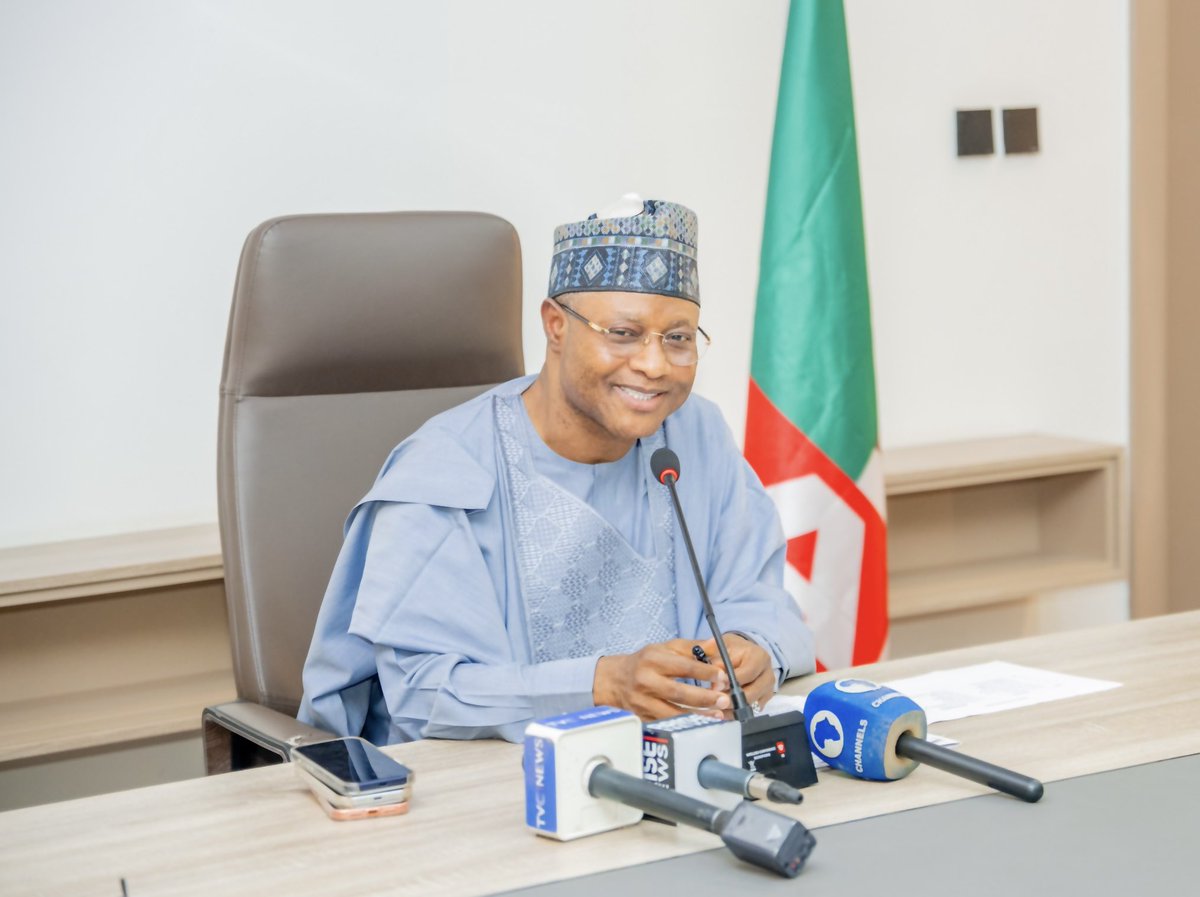
We held productive discussions on strengthening the strategic partnership between the Kaduna State Government and the Gates Foundation to advance healthcare delivery and accelerate sustainable development across our state. I was pleased to welcome the Foundation’s delegation, led by its Nigeria Country Director, Mr. Uche Amaonwu.
Our discussions reviewed the remarkable progress achieved through the Foundation's support, particularly in strengthening our health system, expanding Universal Health Coverage, revitalising Primary Healthcare Centres, and establishing the Data Intelligence Unit to drive evidence-based planning, policy formulation and service delivery. We also held candid and constructive conversations on commitments and agreed on practical measures to deepen our collaboration in pursuit of even greater development outcomes.
I reaffirmed our administration's unwavering commitment to building a resilient, inclusive and people-centred healthcare system; noting that we have upgraded at least 255 Primary Healthcare Centres in the state to Level II status; commissioned the 300-bed Bola Ahmed Tinubu Specialist Hospital; carried out the comprehensive renovation of General Hospitals, and undertaking the expansion of health insurance coverage for vulnerable citizens.
I was particularly encouraged by the Foundation's recognition of Kaduna State as one of its foremost subnational partners. It is a singular honour that Kaduna has been selected as the first destination for the Foundation's global leadership team during its forthcoming visit to Nigeria to understudy the progress recorded through this partnership. We also agreed to institutionalise quarterly strategic review meetings to sustain momentum, strengthen accountability and accelerate the delivery of measurable, life-changing outcomes for our people.
Strong partnerships, anchored on mutual trust, innovation and shared purpose, remain indispensable to building healthier communities and a more prosperous future for every resident of Kaduna State.
Senator Uba Sani, CON
Governor, Kaduna State.
DECADES AFTER, UBA SANI RESTORES THE HISTORICAL DIGNITY OF KWOI AND HAM KINGDOM
By Peter Achi
For generations, Kwoi has occupied a unique place in the historical and cultural geography of Kaduna State. Nestled in Jaba Local Government Area, the town is far more than an administrative headquarters. It is the ancestral heartland of the Ham people, custodians of one of Nigeria’s oldest indigenous cultures, and the traditional seat of the Kpop Ham, whose institution remains a powerful symbol of identity, continuity and communal cohesion.
A short distance from Kwoi lies Nok, the archaeological site that introduced the world to the celebrated Nok terracotta sculptures; among the earliest known examples of figurative art in sub-Saharan Africa. Although scholars distinguish the ancient Nok civilisation from the present-day Ham people, the discovery forever linked the area to one of Africa’s greatest archaeological legacies. For centuries, therefore, Kwoi has stood at the intersection of history, culture and agriculture, its fertile lands producing some of Nigeria’s finest ginger while its people continue to preserve traditions that have enriched the country’s diverse cultural mosaic.
Yet, for all its historical importance and economic promise, many residents believed Kwoi had remained on the margins of public investment for decades. Road infrastructure deteriorated, movement became increasingly difficult, especially during the rainy season, and communities often struggled to connect efficiently with markets, healthcare facilities and educational institutions.
It was against this backdrop that the commissioning of the Kwoi Township Roads and the strategic Kwoi–Gora Road assumed significance beyond the inauguration of physical infrastructure. For many residents, the occasion represented an important milestone in the town’s development and an opportunity to reconnect a historically significant community to wider economic and social networks.
Speaking during the inauguration ceremony, Kaduna State Governor, Senator Uba Sani, described the projects as “far more than completed infrastructure,” characterising them as “enduring symbols of our resolve to ensure that no community is excluded from the dividends of democratic governance.”
The projects include: the Audu Tilo Road, Sabon Gari Road, Doctor Sani Road, Hospital Road, Kpop Ham Palace Road and the Kwoi–Gora Road, all designed to improve mobility within Kwoi and strengthen connectivity across Jaba Local Government Area.
The governor recalled that when he visited Kwoi for the groundbreaking ceremony, he had publicly committed to completing the roads.
“When I stood before you at the groundbreaking ceremony,” he said, “I assured you that our intervention would not be another promise deferred but a solemn commitment that would be honoured. Today, by the grace of God and through the dedication of our team, we have returned to redeem that pledge. Nothing strengthens the bond between a government and its people more than promises fulfilled.”
That statement resonated with many residents who viewed the completion of the roads as the fulfilment of a commitment rather than merely another government project.
Beyond symbolism, the roads address practical challenges that had constrained development for years. The Hospital Road improves access to healthcare facilities and emergency services. The township roads facilitate movement within Kwoi’s commercial districts, while the Kpop Ham Palace Road enhances access to one of Southern Kaduna’s most respected traditional institutions. The Kwoi–Gora Road reconnects communities that had long endured difficult travel conditions, particularly during the rainy season.
The governor noted that the corridor had become synonymous with hardship, explaining that erosion and poor road conditions had isolated communities, increased transportation costs and limited access to essential public services.
https://t.co/paTFfqGE13
It was a privilege to deliver the keynote address and participate in the panel discussion at the National Security Roundtable on Constitutional Reform and the Establishment of State Police Services, organised by the National Assembly Library Trust Fund in Abuja. The Roundtable brought together an eminent gathering of security practitioners, legislators, constitutional scholars, policymakers and other distinguished stakeholders to deliberate on one of the most consequential institutional reforms before our nation. At a time when Nigeria's security challenges are becoming increasingly complex and multidimensional, such thoughtful engagement is essential to shaping a constitutional and institutional framework that is both responsive to present realities and resilient enough to meet future demands.
In my keynote address, I reaffirmed my support for the establishment of State Police as a vital component of a more effective and responsive national security architecture. I stressed, however, that the success of this reform will depend not merely on constitutional amendment, but on building institutions anchored on professionalism, accountability, operational independence and robust constitutional safeguards.
I emphasised that State Police should complement, not replace, the Nigeria Police Force, with both institutions operating within a coordinated framework founded on collaboration, intelligence sharing and clearly defined constitutional responsibilities. I also underscored the imperative of nationally benchmarked recruitment and training standards, technology-driven policing, independent oversight and sustainable funding.
Drawing from our experience in Kaduna State, I observed that lasting security is built through trust, dialogue, inclusion, community partnership and intelligence-led policing. I remain convinced that a carefully designed State Police system will deepen federalism, strengthen democratic governance and significantly enhance the protection of lives and property across our country.
Senator Uba Sani, CON
Governor, Kaduna State
July 15, 2026