613 SQM PLOT OF LAND FOR SALE:
Price: N60m.
Location: Spotter Lifestyle Estate, Centenary City, Enugu.
Title: Deed of Assignment.
Enquiries: ️☎️09060587316.
#enugurealestate#centenarycity#landforsale#enugu
6 units of 1 bedroom flats,
2 units of 2 bedroom flats,
1 unit of self contain flat,
A gate house.
Price: N280m.
📍Majesty Estate, NTA Road, Port Harcourt.
▫️Band A Power Supply,
▫️Secure Estate wt. Uniform Security,
▫️Tarred access roads,
▫️Interlocked premises.
1. Does Anambra State have a rail line? No.
Plans are to connect the Aba line to Owerri, but it is not yet complete.
2. Does Anambra have an independent power project? No.
The 1,500 MW Century Power Generation (CPG) in Okija is not operational.
3. How many steel plants does Anambra have?
There are many small steel operations, but only one major steel plant—the Milton Steel Manufacturing Company Limited in Akwuzu.
There are no other major industrial steel plants.
4. What about an airport? Yes.
Anambra has a state-funded airport.
I have not heard of any nation or state that has industrialised without power, rail, and steel.
Yet, the professor of economics believes that the way to industrialise the state he inherited is to build a second airport, given that it already has the largest open-air market in Africa, the largest automotive SME cluster in Africa, an inland port (the only one in the Southeast), and Onitsha, the gateway to the entire Southeast.
Scale of preference is an economic term for a reason
If the airport is so viable, let the private sector, which looks at profit build it
A Unit Of 4-Bedroom Terrace Duplex For Sale:
Price: N155m.
📍 Peter Odili Road, Port Harcourt.
▫️Ensuite bedrooms with walk-in closets, Fitted Modern kitchen,
Family lounge +a guest powder room, 24-hour electricity support.
Centralized treated water supply, Dedicated parking.
6 Bedroom Duplex wt 2 Sitting Rooms and Uncompleted Block Of Flats For Sale:
Price: N150m.
Location: Elioparanwo, off Ada George, Port Harcourt.
Land size: 2 plots.
Title: Deed Of Conveyance.
☎️ 09060587316.
20 PLOTS OF LAND FOR SALE:
Price: N50m.
📍: Isiokpo, Port Harcourt.
Land size: 9300 SQM.
Title Documents: Deed of Conveyance & Registered Survey plan.
✅️ Suitable for commercial, residential and investment purposes.
☎️ 09060587316.
6 UNITS OF SPACIOUS 2 BEDROOM APARTMENTS FOR SALE:
Price: N140m.
📍Rumuagholu new layout, off SARS Road, Port Harcourt.
Land size: 930 sqm.
Attraction:
Spacious rooms & premises.
Impressive rental income.
Tarred access road.
Peaceful neighborhood.
☎️09060587316.
Africa is still largely exporting what it extracts, not what it manufactures.
Oil, gold, copper, diamonds, cocoa, coffee, tobacco, cotton the continent remains heavily dependent on raw commodities while importing finished products at a premium.
This is why many African economies can be resource-rich but still struggle with industrialization, jobs, and currency stability.
A ton of cocoa earns far less than a global chocolate brand.
A barrel of crude oil earns far less than petrochemicals and refined fuel.
The countries that will dominate Africa’s next economic era are the ones that move from extraction economies to production economies.
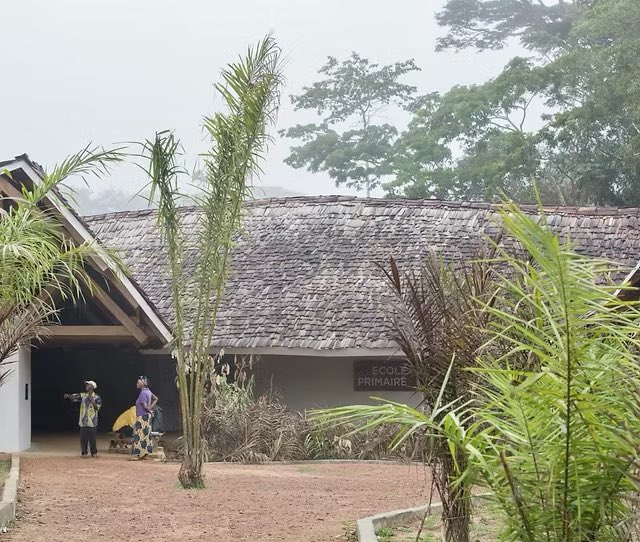
This school is six hours by motorcycle from the nearest airstrip in the middle of the Congo rainforest. Not one building material could come in that couldn’t fit on the back of a bike.
MASS Design Group’s co-founder put it simply: “We had to build it all out of materials we could source or farm from this very site.”
The walls are sun-dried adobe bricks made from termite mound soil, which creates stronger cohesion than regular earth. They’re plastered with a clay-sand mix, white clay rendering, and two coats of boiled palm oil; an innovation that makes the bricks water resistant. The roof shingles were hand-cut from local trees. Doors woven from Lilian vine, dried before use to prevent shrinking. The trusses hand-sawn and planed on site.
In exchange for the school, the community pledged to protect over 600,000 acres of surrounding rainforest from hunting, logging, and agriculture. Architecture as a conservation agreement.
Between 160 and 170 people from Ilima and surrounding villages worked on construction. Families set up shops around the site. Two young Congolese architects were trained in sustainable building methods.
The building didn’t only serve the community. It was built by it.
📍 Ilima Primary School, Tshuapa Province, DRC.
Architects: MASS Design Group.
📷 African Wildlife Foundation
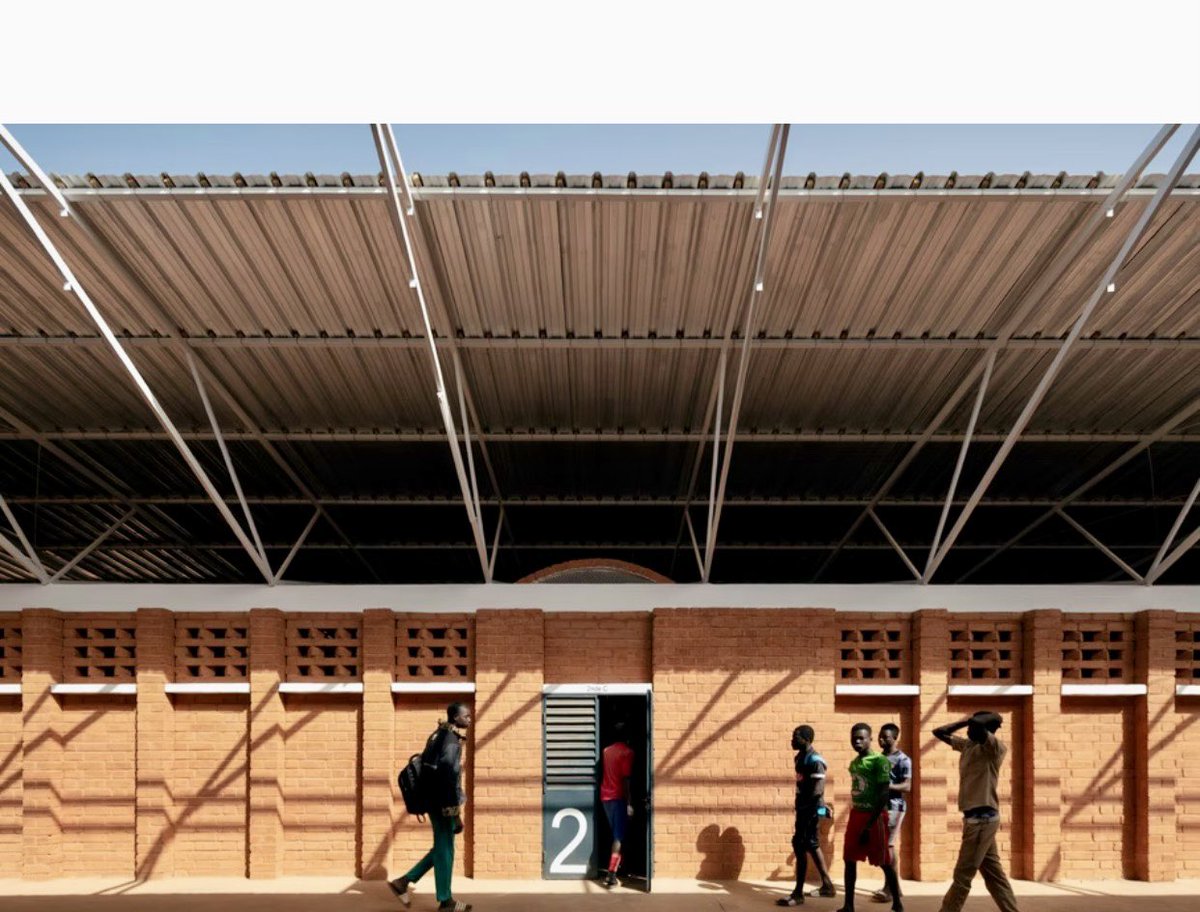
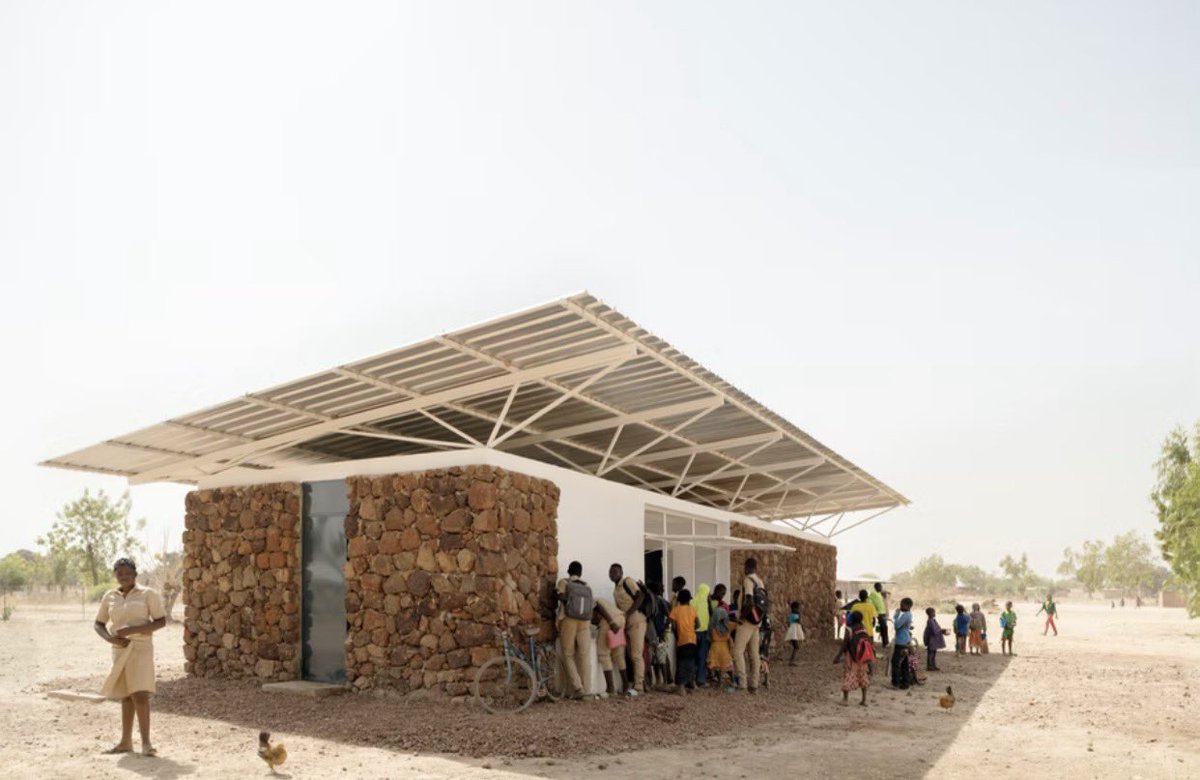
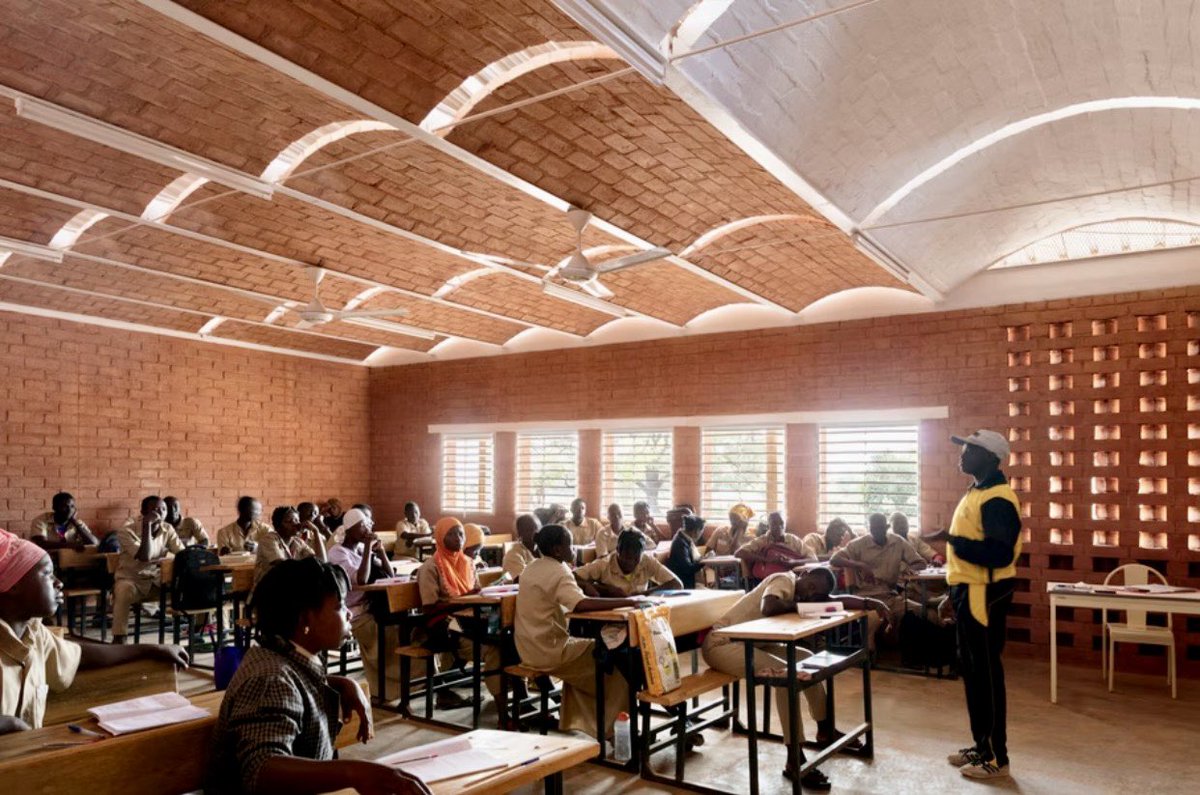
Burkina Faso is one of the hottest countries on earth with temperatures that sit at 40°C during peak season. While most West African cities keep building concrete boxes that trap heat and run up electricity bills nobody can afford, Burkina Faso keeps showing the rest of us what building for your climate actually looks like.
The Bangre Veenem school complex is built from laterite stone bricks native to the area. Compressed earth brick vaults for the classrooms, thick walls that absorb heat during the day and release it at night, keeping interiors cool without a single air conditioning unit. A double roof system creates a buffer of moving air above the vault, whisking away Saharan heat before it reaches the students below.
The classrooms are oriented north-south to catch prevailing winds. Centuries-old Néré trees were preserved on site and integrated as structural shade elements. Bougainvillea vines are trained over pergolas to become living screens, green, cooling and beautiful.
“The students don’t say it’s really hot and want to go home because they’re comfortable and can concentrate” that’s the school’s education adviser speaking.
A school that keeps children in class because the building works. That’s the standard.
📍Bangre Veenem School Complex, Koudougou, Burkina Faso.
Architect: Albert Faus.
📷 Milena Villalba
Nigerians spend over $10 billion every year on diesel, petrol, and generator maintenance.
Total energy spending is estimated at over $22 billion yearly.
Yet almost half the country still does not have reliable electricity.
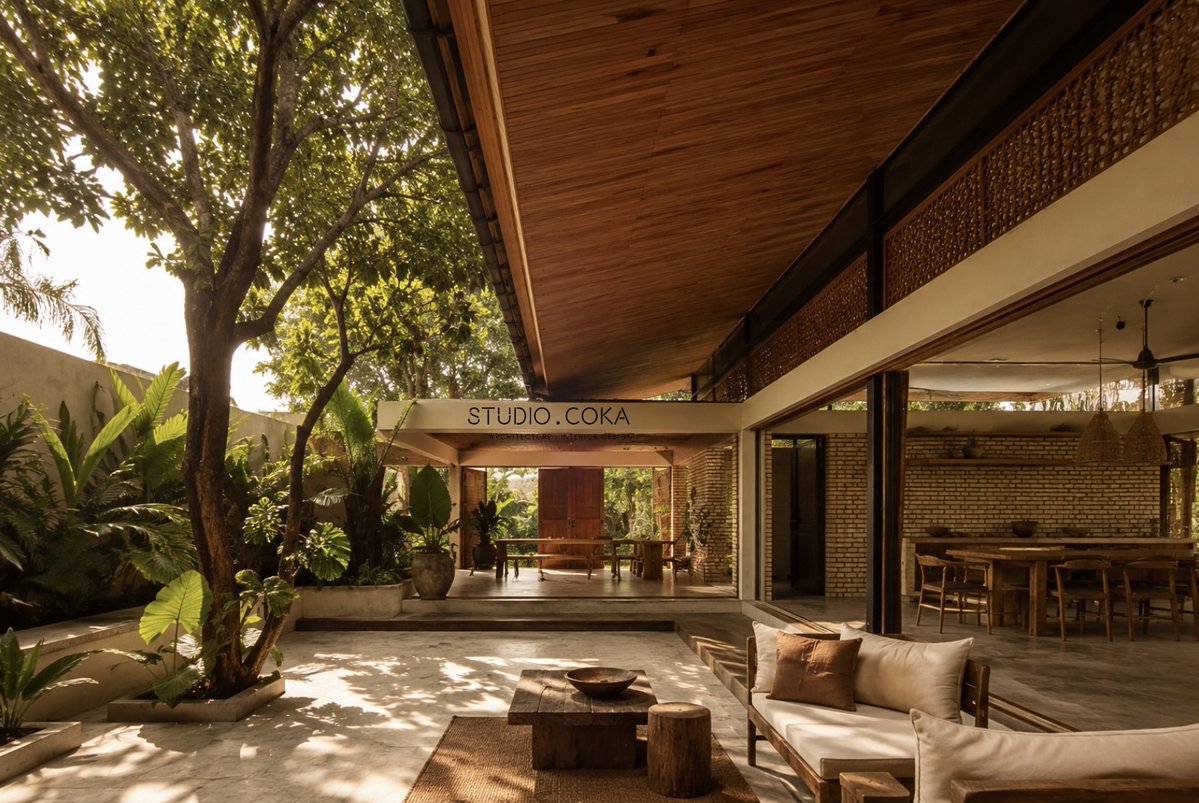
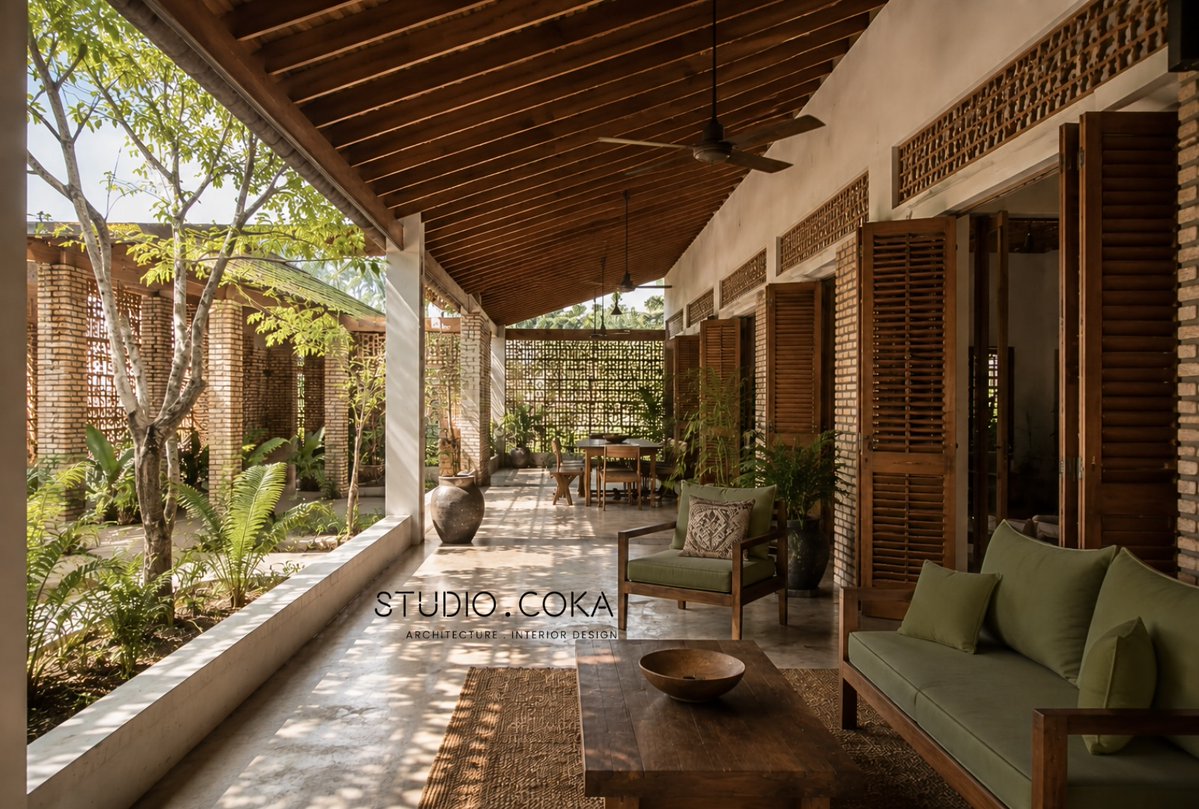
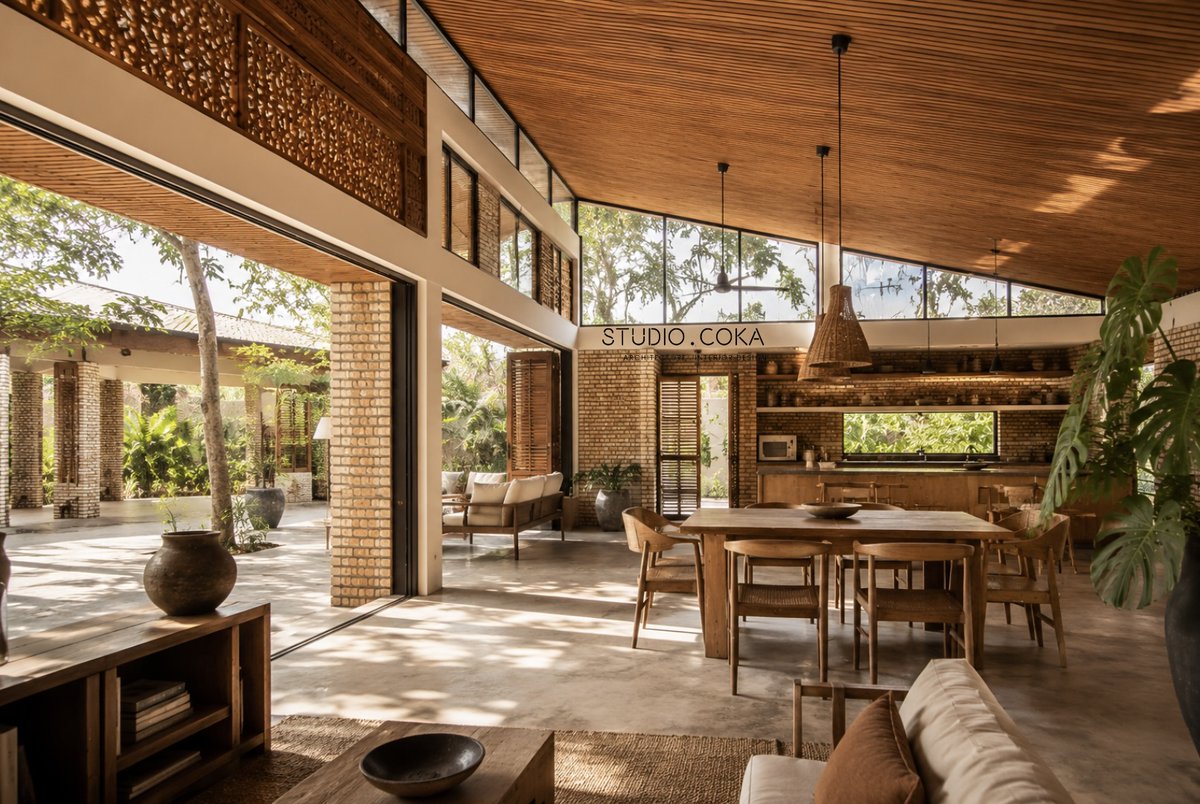
Architecture should respond to this reality.
Imagine homes designed to stay cooler naturally.
Homes that breathe.
Homes that block heat better.
Homes that rely less on fans and AC to stay comfortable.
That money could go somewhere else.
In hot climates, architecture is not just about how a building looks.
It is about:
how it breathes,
how it cools,
how it blocks heat,
and how little energy it needs to stay comfortable.
But many Nigerian homes are designed like Europe, copy pasted into the tropics.
Tiny overhangs.
Dark roofs.
Limited airflow.
Then we wonder why the house gets hot by 2pm.
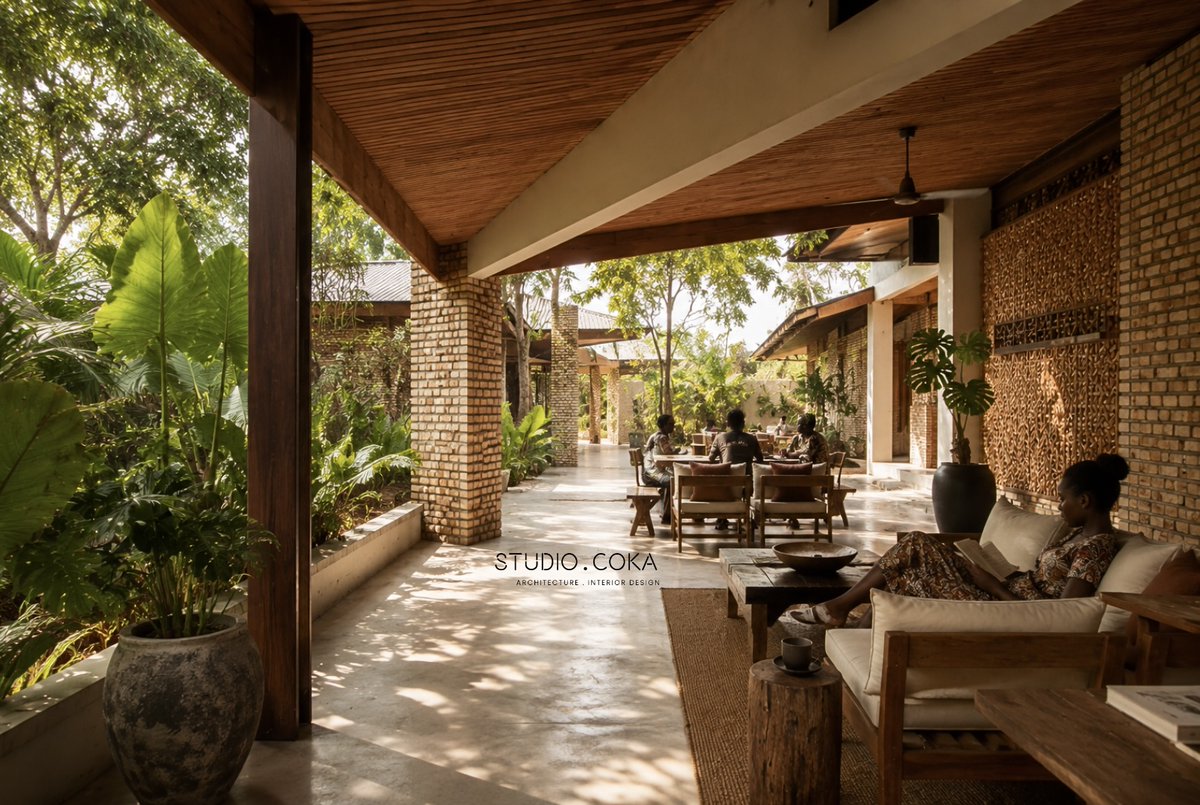
The irony is that many traditional African buildings already understood this.
Courtyards.
Shaded outdoor spaces.
Ventilated roofs.
Thick walls.
Better airflow.
We abandoned climate intelligence and called it progress.
A beautiful building that overheats is poorly designed.
India has a tradition of building homes that know what climate they’re in. This house in Ahmedabad doesn’t fight the heat. It outsmarts it.
Exposed brick walls. A cantilevered slab that blocks summer sun and lets winter light in. A lotus pond where the veranda should be. Kota stone floors that stay cool without AC.
The garden isn’t decoration. It’s doing structural work on the temperature inside.
This is what it looks like when the architect lives in the house they designed.
More images are INR the comments🧵
📍 Floating Frame House, Ahmedabad, India
🏛 Rushi Shah Architects + Tattva Landscapes
📷 Umang Shah
6 Units Of 2 Bedroom Flats For Sale:
Price: N200m net.
📍Majesty Estate, NTA Port Harcourt.
Land size: 1,160 sqm.
Income potential: up to N20m per annum after little renovation.
☎️ 09060587316.