@teekappa24 lol most of mainlanders are just mix of aasi asi and ani that is why cringe some north indians and south indians kang on being aryan or dravidian when are too mixed to classified as anything and indo aryan and dravidian are linguistic families
@AryanBhatta6@5623_vikram lol already indians dominate britsh industry you know jadguar bought by tata house it is like india is dad of british now tell me one thing which nepali businessman bought from abroad
@dp_331 In Vishwagorilla even love marriages are semi arranged marriages by friends and acquaintances. Ludos think they are some giga chads when it was all proximity and the girl was feeling lonely🤣🤣
@AryanBhatta6@5623_vikram lol 😂 western and southern India can buy country in auction where guys basically come to work as our servants and slaves your taking of poorer part of country which is as equally poor as Nepal.
Indian moids if they keep themselves fit can look much younger than they are
My husband and two other moids I came across recently are examples of it. One moid looked younger than me but turns out was 2008 BE grad 💀
@AgentSaffron Helps that I am well versed in North Indian history and knew a bit cultural nucissances something which average South Indian does not know . Granted I am nice to those who are nice to him
@AgentSaffron lol 😂 I ragebait northies by being equally racist towards them if they give that typically Kalu lungi jokes . Call me black I will point how Delhi ncr guy is darker than me .call me lungi I will call them dhoti gutka or how there ancestors are from Bihar .
The Indians sit and observe, while the white liberals take action.
Nothing but pity for the cowardly NRI. You can say what you want about the Muslims, but they wouldn't wait for the white person to stand up for them.
Duncan Idaho did not actually survive. The original was killed, and what returns is a Tleilaxu ghola, a reconstructed being grown from his dead flesh.
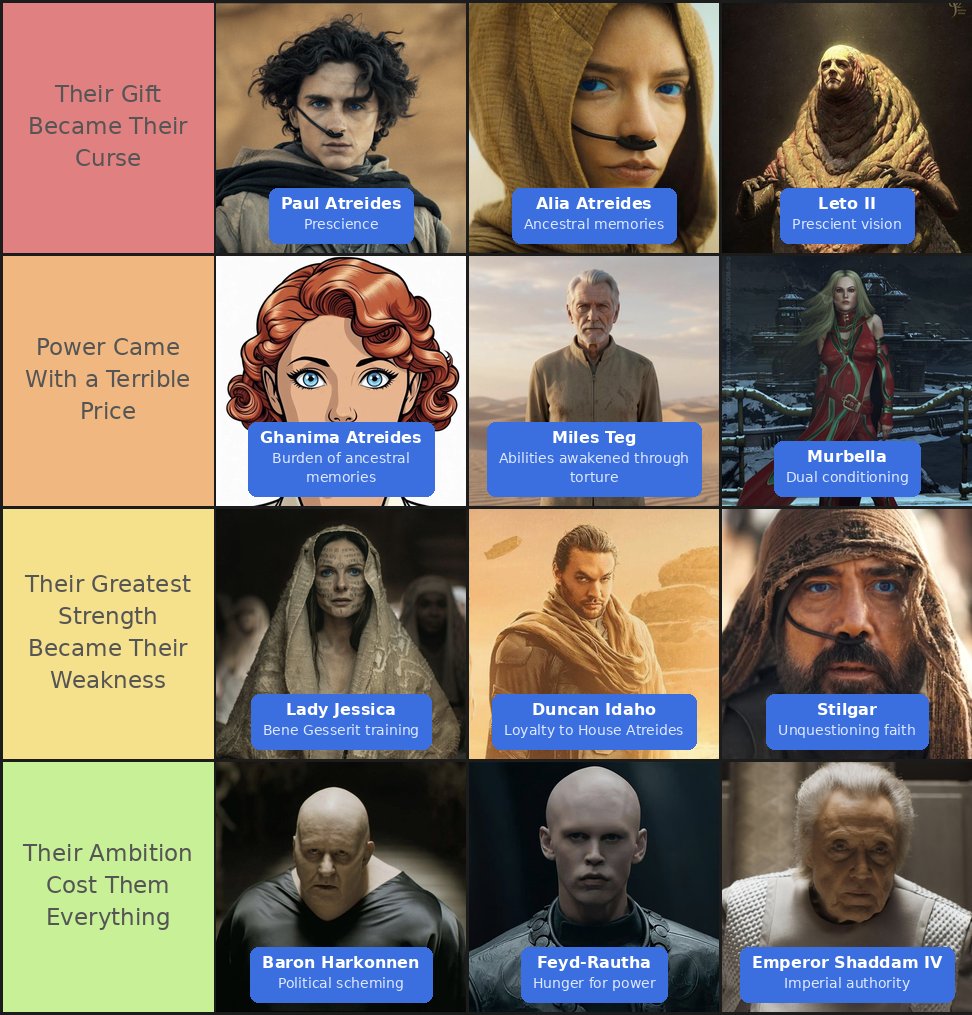
In Frank Herbert’s Dune, Duncan Idaho, Swordmaster of the Ginaz and one of the last of that school, dies during the Harkonnen-Sardaukar assault on Arrakeen. Cornered with Paul and Jessica at a botanical testing station, he holds the door long enough for them to escape in an ornithopter. Before he falls to a grievous head wound, he kills nineteen Sardaukar, an unprecedented number against the Emperor’s elite. His body is later recovered and sold to the Bene Tleilax.
In Dune Messiah, the Tleilaxu return him as a ghola named Hayt, grown in their axolotl tanks from the original’s cells. A ghola is not a conventional clone; it is reconstructed from the dead, typically without the original’s memories or personality. Hayt arrives with metal eyes (a Tleilaxu modification), Mentat training, and Zensunni philosophical conditioning. He is presented to Emperor Paul Muad’Dib as a gift “psychic poison” intended to tempt the Kwisatz Haderach into using forbidden Tleilaxu methods. More critically, he is programmed with a compulsion to assassinate Paul.
The plan fails through the very loyalty encoded in the cells. When the assassination trigger activates, Hayt cannot reconcile the imposed compulsion with the residual Atreides loyalty still present in his flesh. The resulting psychological trauma forces the original Duncan Idaho’s memories to surface, up to and including the moment of his death. He becomes Duncan again, free of the Tleilaxu control, and remains loyal. This event is pivotal: it proves to the Tleilaxu that ghola memory can be restored through extreme stress, a capability they later refine and exploit.
From that point, Duncan becomes a serial ghola. Leto II, the God Emperor, maintains successive Idaho gholas across millennia as a living baseline of uncorrupted humanity, loyalty, and the unpredictable against which he measures his own post-human existence. Later incarnations can carry not only the original’s memories but the accumulated experiences of prior gholas. The Tleilaxu continue supplying them, often with hidden conditioning, while Leto repeatedly destroys those who rebel.
By the time of the later books, Duncan is less a single person than a continuous thread of identity stretched across thousands of years through deliberate technological resurrection.
The image in the post is consistent with the film portrayal of Hayt in the material adapting Dune Messiah: the white robes, the altered presence, the sense of a man who is both familiar and fundamentally other.
The original Duncan is dead. What stands in his place is a demonstration of Herbert’s recurring concerns, identity as something recoverable yet discontinuous, free will asserting itself against genetic and psychological programming, and the Tleilaxu’s cold mastery of life and death as a political instrument. The “survival” is not survival at all; it is the Tleilaxu making the dead useful again, and Duncan’s loyalty making that usefulness incomplete.