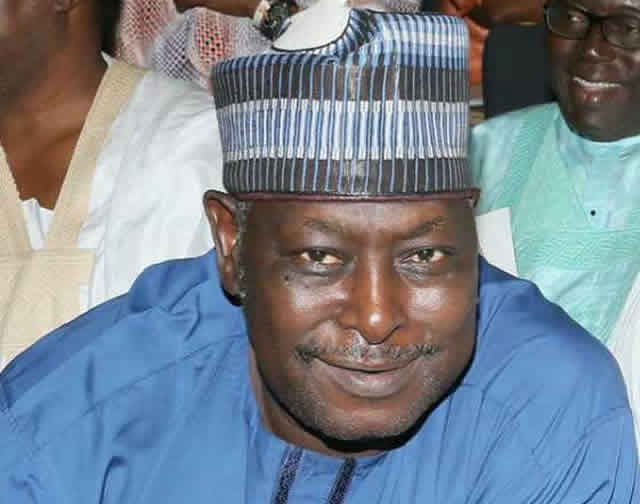
A must-read for anyone interested in El-Rufai; it's long but worthwhile.
Reminiscence: Working with El-Rufai in the FCT
By Auwalu Anwar.
Since his voluntary but spectacular return to the country from Cairo on 12 February 2026 and subsequent incarceration by the agents of Emperor Bola Ahmed Tinubu, the story of Malam Nasir Ahmad El- Rufai (NAE) has been narrated differently by many interest groups, including his acquaintances, friends, human rights activists, journalists, lawyers and politicians. However, what I found conspicuously missing in all the narratives that I came across is, an objective analysis of his character as an administrator by someone who worked closely with or under him in any of the three public places he administered, namely: Bureau of Public Enterprises (BPE), Federal Capital Territory (FCT) and Kaduna State. For instance, the common remarks about his style of leadership that presented him either as a mere sinner or a revered saint, without making any attempt to go beyond the smokescreen of such moral categorization were both irrelevant and unhelpful for the proper understanding of his essential nature as an administrator or a public servant.
How did NAE, for instance, conceive, protect or violate the trust given to him when he served as Director General, BPE; Minister of the FCT or Governor of Kaduna State? How did he recruit and relate with his political appointees, who were answerable to him? What was the extent of his distance or interference in running the day- to- day affairs of the MDAs under his jurisdiction; but especially in the implementation of their capital projects? This write- up aims to frankly answer these crucial questions, with particular reference to my experiences working with and under him in the FCT.
I first came across NAE in 1998 when a mutual friend, Malam Bashir Yusuf Ibrahim, invited me to the inaugural meeting of an All- Nigeria Elite Group known as the Abuja Initiative or simply AI, in Abuja. NAE was then working as an economic adviser and member of the Programme Implementation and Monitoring Committee under General Abdulsalami Abubakar. Because of the activities of AI and my relationship with Bashir, our paths continued to cross at that time.
With the formation of the Peoples' Democratic Party (PDP) and the emergence of General Olusegun Obasanjo as President, NAE was appointed Director General of the BPE. I later became Special Adviser (Political) to the Speaker, House of Representatives, the purposeful and selfless Rt. Hon. Ghali Umar Na'Abba in February 2000. When NAE established a steering committee on Competition and Anti- Trust in the BPE, he appointed me as one of the members. It was an influential committee with many respected persons including Alhaji Aliko Dangote, Comrade Adams Oshiomole, Professor Charles Soludo, Madam Oby Ezekwesili, Hajiya Maryam Uwais and Mr. Asue Ighodalo, constituting the membership.
In 2003, on his appointment as Minister of the FCT, NAE met with all categories of staff and audited all the operational organs of the institution. To his dismay, he discovered that civil servants had all the time to lazy around as much as they wanted for two reasons: firstly, they had thirty- five years to stay in the service; they could also live up to sixty years before retirement. As such, most of them had no motivation for initiative, innovation, or even commitment to the responsibilities for which they were employed.
To change the trajectory, he thought of creating mandate secretariats, which would operate like state ministries and appoint secretaries, who would serve as commissioners. He compiled all his findings, the audited reports of all the sectors and his vision for a way forward into a comprehensive document. He shared copies of the documents with Bashir, Asue and my humble self to study for a week, with the request that we should all think of suitable individuals who would be invited to assist him in running the new structure.
I see people claiming that Peter Obi and RMK saw the ADC primaries crisis coming, and that is why they left. Their supporters are trying to use that narrative to justify their exit.
I don’t share in that opinion, in fact I believe that opinion is not just myopic, it is mostly carried by people who have a very short political sight.
Atiku Abubakar is a political heavyweight who has contested for president in six elections, and this is his seventh attempt. Out of those contests, he has won party primaries three times, with this one now four. That alone tells you the level of experience he brings into any political structure.
Beyond that, he also has more friends within the political class than all of the actors in today’s opposition space combined. That kind of network is not something you ignore in Nigerian politics.
In the ADC structure from inception, Atiku does not control everything as many people want us to believe, but he clearly holds a significant share of the structure. You can reasonably say he holds about 25% influence, while the remaining 75% is spread across other opposition leaders.
Now within that remaining 75%, the person who holds the strongest structure is Peter Obi, but he alone doesn't have enough to defeat Atiku.
The only realistic way to defeat Atiku in that kind of arrangement would have been unity among the other blocs. Because a fragmented opposition cannot defeat a well structured and deeply connected political actor like him. And I know for a fact that a good number of them as at then would not align with Atiku in a direct contest. That is why the unity was very important, but they are all feeling too big.
But what did they do instead of playing the politics the right way, they chose to exit before the real fight even began.
So Peter Obi, who held the most visible structure in that bloc, left his structure behind. And naturally, those structures became politically unanchored. In politics, structures do not die, they move.
Our political scientists in the house that are familiar with “Duverger’s Law” will understand this, in a winner takes all electoral systems, political fragmentation almost always strengthens the most organised or dominant remaining actor, while divided opponents weaken each other. So it is not a fluke, or rigging
So in that kind of vacuum, only Atiku Abubakar had the reach and network to absorb parts of that space, so they gradually aligned where they could survive politically.
If the results eventually come out and you will see that in states where Peter Obi and Kwankwaso would have won, Atiku won it, people will rush to say it is surprising or even say it is rigging. But it is not. It is structure at work.
Because once key actors leave, what remains on ground is not loyalty, it is survival. And those remaining political structures will always realign with whoever has the strongest national machinery left, which is Atiku.
So yes, I believe the exits of Peter Obi and RMK opened the door for Atiku to have a smoother path in that environment. If they were fully in the race, the dynamics would not be the same at all.
They had the clout and capacity to challenge him, but they did not stay to contest it to the end.
And in politics, when you step out of a contest, you don’t just remove yourself, you also reshape the entire balance of power left behind.
Nigeria use to have brilliant, well-spoken, intelligent amd fearless representatives like this on the international scenes until APC happened to her in 2015.
We now appoint jagudas, quoter system illiterates to represent the nation under APC.
Please listen to this man.
FOR IMMEDIATE RELEASE
ADC APPOINTS LIYEL IMOKE, ABDULFATAH AHMED TO HEAD PRESIDENTIAL PRIMARY COMMITTEES
The African Democratic Congress (ADC) has appointed former Governor of Cross River State, Senator Liyel Imoke, and former Governor of Kwara State, Abdulfatah Ahmed, to lead its presidential primary committees ahead of the party’s forthcoming presidential primaries.
While Senator Imoke will serve as Chairman of the Presidential Screening Committee, Abdulfatah Ahmed will head the Presidential Election Committee.
Other members of the Presidential Screening Committee include Hon. C.I.D. Maduabum as Secretary, Alhaji Lawal Batagarawa, Prof. Bode Ayorinde, Hon. Nnena Elendu-Ukeje, Prof. David Salifu, and Col. Abubakar Ali Ciroma.
The Presidential Election Committee has Prof. Yisa Gana as Secretary, alongside Maj.-Gen. Adamu Jalingo, Dr Auwalu Anwar, Chief Emenike Ikechi, Dr. Macaulay Iyare, Tajudeen Bakare, Elder Ubolo Itodo Okpanachi, Zainab Buba Galadima, Uzoamaka Onyeama, and Maj.-Gen Muhammad Inuwa Idris as members.
The party also constituted a Presidential Appeals Committee chaired by Dr. Suleiman Usman, SAN, with Barr. Ken Imasuagbon serving as Secretary, while Barr. Dare Okerade will serve as member.
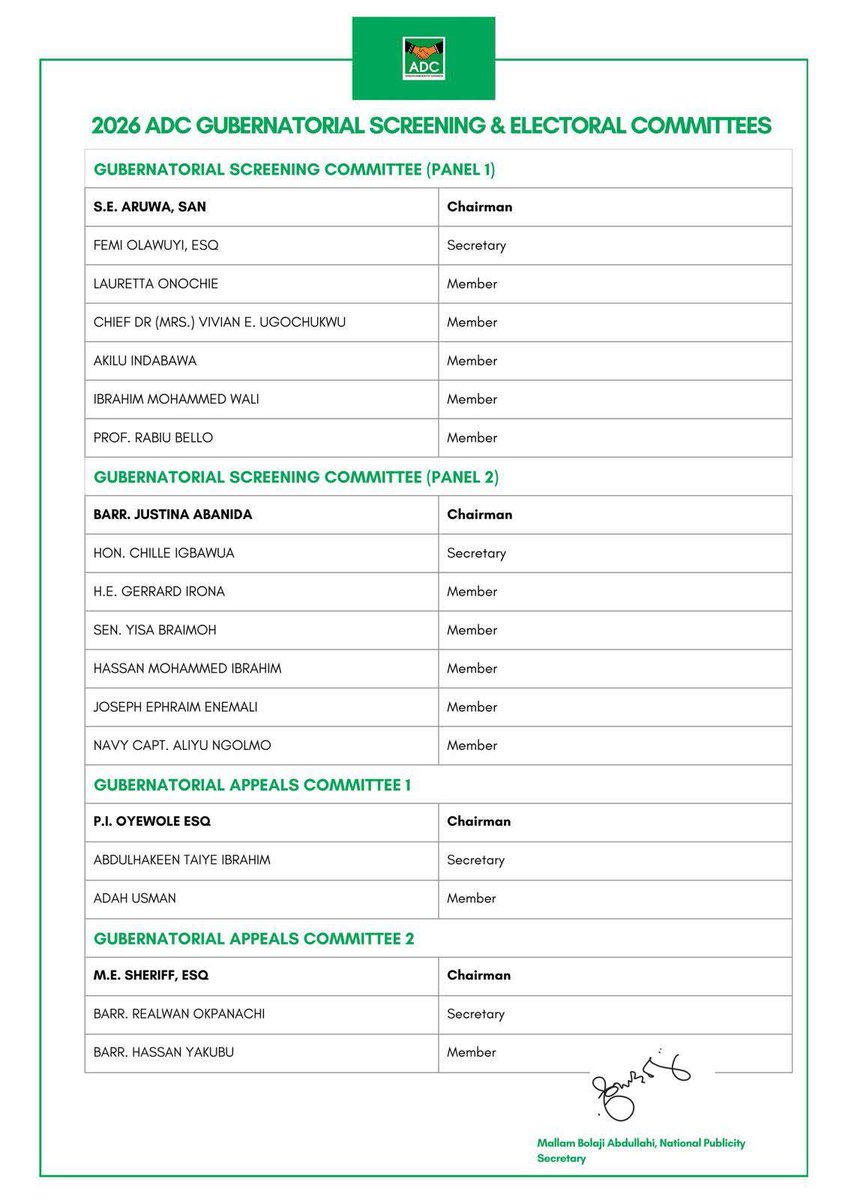
For the governorship primaries, the ADC constituted two screening panels. The first panel is chaired by S.E. Aruwa, SAN, with Femi Olawuyi, Esq as Secretary. Other members include Lauretta Onochie, Chief Dr (Mrs.) Vivian E. Ugochukwu, Akilu Indabawa, Ibrahim Mohammed Wali, and Prof. Rabiu Bello.
The second governorship screening panel is chaired by Barr. Justina Abanida, with Hon. Chille Igbawua as Secretary. Other members are H.E. Gerrard Irona, Sen. Yisa Braimoh, Hassan Mohammed Ibrahim, Joseph Ephraim Enemali, and Navy Capt. Aliyu Ngolmo.
The party also approved two Governorship Appeal Committees. The first committee is chaired by P.I. Oyewole Esq, with Abdulhakeen Taiye Ibrahim as Secretary and Adah Usman as member. The second appeal committee is chaired by M.E. Sheriff, Esq, with Barr. Realwan Okpanachi as Secretary and Barr. Hassan Yakubu as member.
The ADC said the committees were carefully constituted to ensure transparency, credibility, fairness, and internal democracy throughout the conduct of the party’s primaries.
Signed:
Mallam Bolaji Abdullahi
National Publicity Secretary
African Democratic Congress (ADC)
PRESS RELEASE
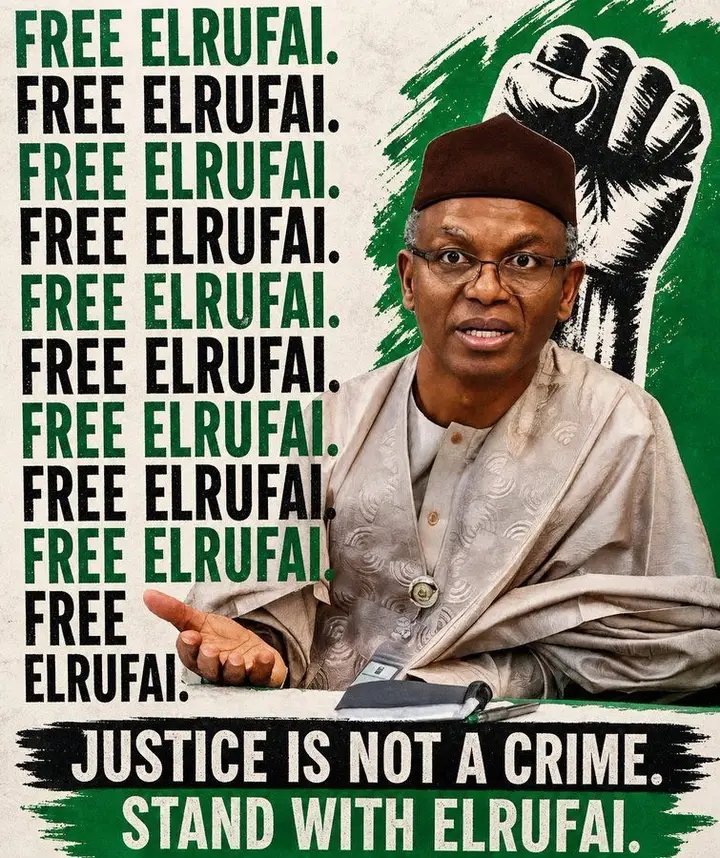
End This Political Vendetta Now: @atiku Calls for El-Rufai’s Immediate Release Before Eid Kabir
Former Vice President, Atiku Abubakar, has called on federal authorities and the Kaduna State Government to immediately release former Kaduna State Governor, Mallam Nasir El-Rufai, condemning his continued detention, especially at a time when Muslims across Nigeria are preparing for the sacred Eid Kabir celebrations, as cruel, unjustifiable, and deeply troubling. He described the development as a disturbing assault on civil liberties, democratic decency, and the rule of law, raising grave concerns about the deployment of state power to intimidate perceived political adversaries.
This was contained in a statement issued by Atiku’s Senior Special Assistant on Public Communication, Phrank Shaibu, who described the continued detention of the former Kaduna State Governor as deeply troubling, politically provocative, and wholly inconsistent with the principles of justice, democracy, and basic human decency.
“At a time when millions of Muslims across Nigeria and around the world are preparing to celebrate Eid Kabir — a sacred season of sacrifice, compassion, forgiveness, and family reunion — it would be unconscionable for any government to weaponise state power in a manner that denies a citizen his liberty without just cause, particularly in circumstances that raise legitimate concerns about political persecution.
“Mallam El-Rufai, regardless of political differences or shifting alliances, remains a Nigerian citizen entitled to the full protection of the Constitution, including his rights to dignity, liberty, and due process.
Democracy does not grant the government the licence to punish dissent, settle political scores, or deploy coercive institutions as instruments of intimidation.
“The Federal Government and the Kaduna State authorities must understand that selective justice is injustice. The credibility of any democracy is measured not by how it treats loyalists, but by how it treats perceived opponents.
“If Mallam El-Rufai is being held on the basis of any legitimate legal process, the authorities owe Nigerians full transparency. If not, then his continued detention can only reinforce growing fears that our democracy is sliding dangerously toward intolerance and authoritarian excess.
“Eid is a time for mercy, reconciliation, and humanity. There is absolutely no justification for keeping a man away from his family during such a solemn and spiritually significant occasion, especially where due process has not been clearly demonstrated.
“Former Vice President Atiku Abubakar therefore calls for the immediate release of Mallam El-Rufai and urges all relevant authorities to rise above political bitterness and act in the interest of justice, peace, and national cohesion.”
Signed:
Phrank Shaibu
Senior Special Assistant on Public Communication to Atiku Abubakar, Vice President of Nigeria 1999-2007
Abuja
15th May, 2026.
PRESS RELEASE
@atiku Sets Agenda for Proposed US Visit
Former Vice President of Nigeria, Atiku Abubakar has declared that his forthcoming engagement with policy and institutional stakeholders in the United States will be driven by one overriding concern: the alarming deterioration of security, governance, and economic stability in Nigeria.
Atiku states plainly that Nigeria is facing a full-blown internal crisis, one that can no longer be downplayed, politicized, or explained away. From the ravaging violence in the North-West and North-East, to the persistent bloodshed in the Middle Belt, and the growing spread of kidnapping and criminality across the country, Atiku warns that the Nigerian state is steadily losing its grip on its most fundamental responsibility: the protection of lives and property.
According to him, the situation has moved beyond isolated incidents to a pattern of systemic failure. Communities are being overrun, livelihoods destroyed, and citizens abandoned to their fate. He argues that any government that cannot guarantee basic security forfeits the moral basis of its mandate.
The former Vice President also points to the deepening economic hardship confronting Nigerians, describing it as both severe and avoidable. He notes that rising inflation, a weakened currency, and collapsing purchasing power have pushed millions into distress, while policy inconsistency and lack of strategic direction continue to erode confidence in the economy. In his words, Nigerians are not just tired, they are being stretched to the limits of endurance.
Atiku further raises concerns about the state of Nigeria’s democratic institutions, warning that declining public confidence in governance, accountability, and the electoral process poses a direct threat to national stability.
As the country moves toward another election cycle, he insists that any attempt to undermine transparency or manipulate outcomes will carry serious consequences for both unity and legitimacy.
Addressing the anticipated criticism of his international engagement, Atiku is unequivocal: telling the truth about Nigeria is not unpatriotic. He rejects the notion that engaging global partners amounts to inviting foreign interference, stressing that Nigeria does not exist in isolation and cannot pretend that its internal failures have no external implications. He maintains that the world already sees what is happening; the real question is whether Nigerian leaders are prepared to confront it honestly.
He reiterates that only Nigerians will decide Nigeria’s leadership, but insists that international partners have a legitimate interest in the stability, governance standards, and democratic health of a country as strategically important as Nigeria.
According to him, responsible leadership does not hide from scrutiny, it welcomes it as a pathway to improvement.
In a direct message to the current administration, Atiku warns against complacency and deflection. He states that power is not an entitlement but a responsibility, and that Nigerians expect results, not explanations. He calls on the government to urgently reset its priorities, restore public confidence, and demonstrate a clear, credible strategy for addressing insecurity and economic decline.
To Nigerians, he delivers a blunt reminder: no nation survives in silence. He urges citizens to remain vigilant, engaged, and unyielding in their demand for accountability, emphasizing that real change will not come from outside the country but from the collective will of its people.
Atiku concludes that Nigeria stands at a critical juncture. The choice, he says, is between confronting hard truths now or allowing the country to drift further into instability. For him, the moment demands courage, honesty, and decisive leadership, anything less would be a disservice to the nation and its future.
Signed:
Paul Ibe
Media Adviser to Atiku Abubakar
Vice President of Nigeria, 1999-2007
Abuja
03 May, 2026.
BREAKING: Mallam Nasir El-Rufai, former Governor of Kaduna State, has raised concerns, accusing The Nation of publishing false imputations aimed at linking him to an armed invasion of a prosecution witness’s home, describing the report as part of a wider smear campaign to secure his indefinite detention.
In a public statement issued by his Media Adviser, Muyiwa Adekeye, El-Rufai said the newspaper’s April 18 report headlined “El-Rufai’s trial: Gunmen invade principal witness home” contained innuendos suggestive of a plot to frame him.
The article quoted witness Mohammed Umar Karage as alleging that armed individuals had invaded his residence, with the witness drawing a parallel between the incident and an alleged effort to silence him.
“Any objective reader would recognise the clear intent behind these statements: to smear Malam Nasir El-Rufai’s reputation, jeopardise his pending bail application at the Kaduna State High Court, and implicate him in serious capital offences,” the statement read.
The former governor, who has maintained his innocence, said he has “no connection whatsoever” to the incident described and has already instructed his legal team to initiate defamation proceedings.
The statement also revisited earlier events, noting that El-Rufai was nearly arrested upon arrival at Abuja Airport from Cairo on February 12, 2026. He subsequently honoured an invitation from EFCC on February 16, was detained, and then transferred to the custody of the ICPC on February 18. He remains in detention and has been arraigned in two separate high courts.
Adekeye said the former governor has been subjected to “an appalling and sustained campaign of innuendos and vilification” since 2023, despite his record of public service, including his role in the 2022 primaries of the ruling party.
“The rule of law must never be perverted into a tool of oppression,” the statement added. “Legal processes should serve the ends of justice, not be employed to deny a citizen his fundamental right to liberty while he stands trial.”
The story making the rounds that Binani wanted the ADC to hand her the ticket is not only untrue, it is a misleading narrative being pushed by the same camp responsible for the crisis that brought the party to where it is today.
Binani is not someone who runs away from a fight. Anyone familiar with the APC 2022 primaries knows that. Considering the calibre of people she defeated back then, it is hard to argue that the current ADC lineup matches that level, so the claim that she is asking to be handed the ticket doesn’t even make sense, they really need to cook up a better narrative.
From the beginning, her position has been very clear and consistent to those who were following, the woman only asked for a fair and level playing ground for everyone involved. Nothing more, nothing less, and many of you are aware of this.
In a truly free and fair contest, Binani does not need anyone’s backing to defeat any member of the ADC. She has the structure, the recognition, and the grassroots support to stand her ground. That includes anyone who may choose to contest, even Babachir David Lawal himself, and that's what they are afraid of because they know she won’t worship them.
The main issue is denying a major stakeholder like Binani, someone with arguably more followers and political weight than most within the party, even a single EXCO slot out of over 100, that is outright disrespect and exclusion, that's what she is fighting against, which is a very very very VALID to be upset.
At the very least, fairness should not be too much to ask.
Breaking: Justice A.K. Tukur has dismissed the suit filed by the former Katsina State ADC Chairman, Usman Wamba.
The presiding judge ruled yesterday that the case has no legal basis and lacks merit.
He further stated that it is an internal party matter and that the party has the authority to handle such issues.
Three Against One: How Atiku, Obi, and Kwankwaso Could Redefine the Battle for Aso Rock Against Tinubu
1. First, understand the 2023 election numbers
In the 2023 Nigerian presidential election:
Tinubu (APC) → 8.79 million votes (36.6%)
Atiku (PDP) → 6.98 million votes (29.1%)
Obi (LP) → 6.10 million votes (25.4%)
Kwankwaso (NNPP) → 1.49 million votes (6.2%)
👉 If you combine Atiku + Obi + Kwankwaso:
Total ≈ 14.5 million votes
That is far higher than Tinubu’s 8.7 million
Simple meaning:
They collectively had more support than Tinubu, but they were divided.
2. What each man brought to the table in 2023
i. Atiku Abubakar
🫱 Strong in Northern Nigeria, especially North-East
🫱 Political structure from PDP (old, established network)
🫱 Finished 2nd overall
ii. Peter Obi
🫱 Massive support from youths + urban voters
🫱 Dominated South-East and parts of South-South
🫱 Won places like FCT Abuja
🫱 Finished 3rd but very influential
iii. Rabiu Musa Kwankwaso
🫱 Strong grassroots base in Kano (North-West)
🫱 “Kwankwasiyya movement” is highly loyal
🫱 Though 4th, he controlled a strategic voting bloc in Kano state
3. Now imagine them working together in ADC
If they truly unite, three major things happen:
(A) Regional dominance becomes national coverage
Atiku → North-East, North-West
Kwankwaso → North-West, Kano
Obi → South-East + urban South
👉 That combination covers almost all political zones in Nigeria
(B) Opposition votes stop splitting
In 2023:
Tinubu didn’t need majority of Nigerians
He just needed the opposition to be divided
Now:
A united front = one candidate, one vote bank
👉 That alone is a huge threat
(C) Momentum + perception shift
Politics is also about perception
If Nigerians see:
“All major opposition figures are now one”
It creates:
Bandwagon effect (“this might actually win”)
Stronger voter turnout
4. But Tinubu still has a major advantage
He has over 30 governors
That matters a lot.
What Tinubu controls:
🫱 State structures (governors influence votes)
🫱 Federal power (incumbency)
🫱 APC political machinery nationwide
👉 In Nigeria, governors = ground game + logistics + influence
5. So what does it really mean for Tinubu?
Scenario 1: If opposition unity is REAL, then
i. Tinubu faces his strongest challenge ever.
ii. Election becomes very competitive
iii. Could even lead to runoff or loss
Scenario 2: If unity is shaky (very likely in Nigeria politics)
i. Internal fights (who becomes candidate?)
ii. Ego clashes
iii. Regional distrust
👉 Then Tinubu still wins comfortably
6. The biggest question: WHO steps down?
This is the real issue, not just alliance.
Will Atiku step down for Obi?
Will Obi agree to be Atiku's Vice?
Will Kwankwaso accept a minor role?
👉 If they fail to agree on one candidate, everything collapses.
7. Final simple summary
In 2023: Opposition divided → Tinubu won
On paper today: Opposition combined → stronger than Tinubu
In reality: Unity is hard, power structure still favors Tinubu
👉 So:
If they truly unite → Tinubu is in serious trouble
If they don’t → history repeats itself
#AlaBruce
Rivers, Nigeria 🇳🇬
@AOEgbedun@Accord_Osun@AOEgbedun please alot is happening at ilesa inec office ilesa East my sister went there to register for her voter card the inec staff was tell her that if she not going to vote for APC they are not going to register for her. Please help us look to this
You can now correct your NIN discrepancies by yourself using ur phone .
Guys please repost don't keep this vital information all to yourself 🙏
Millions of people need it