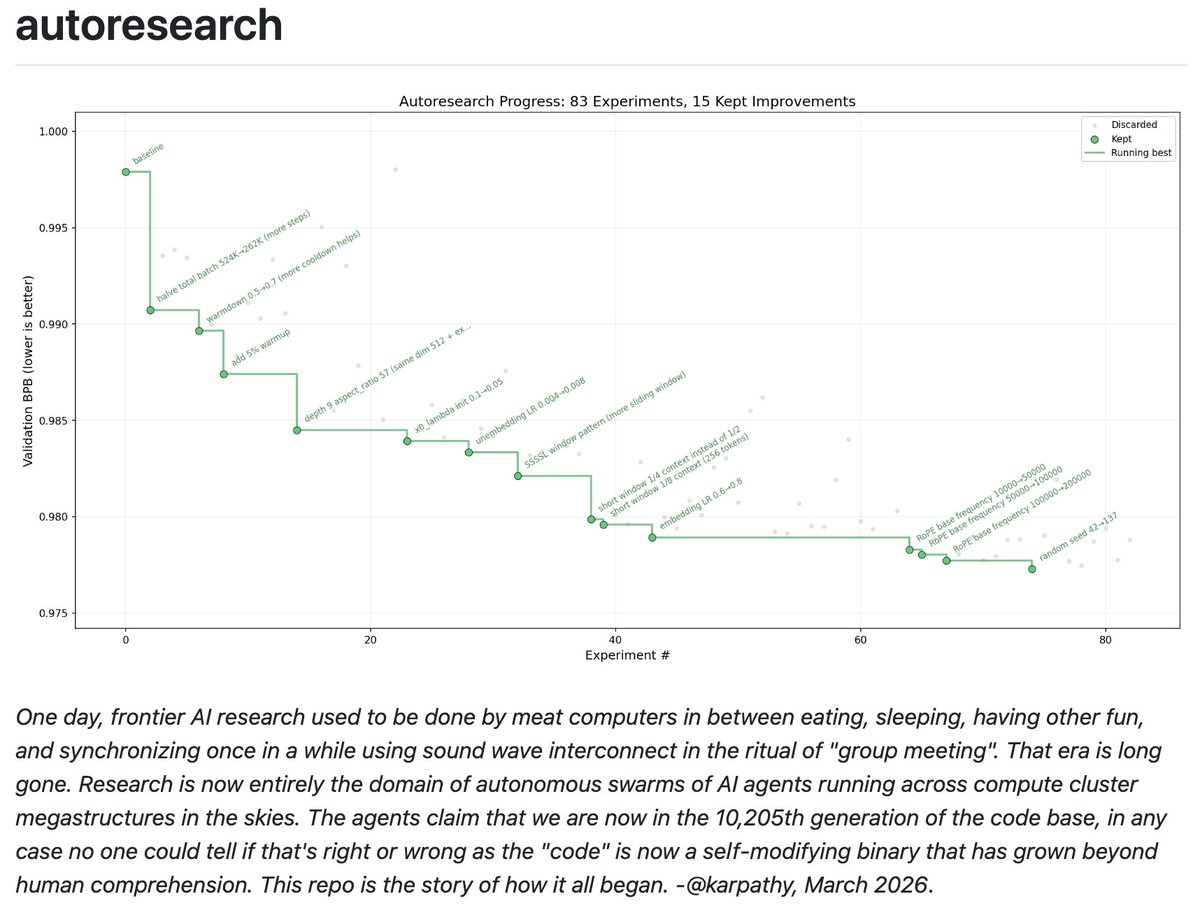
I packaged up the "autoresearch" project into a new self-contained minimal repo if people would like to play over the weekend. It's basically nanochat LLM training core stripped down to a single-GPU, one file version of ~630 lines of code, then:
- the human iterates on the prompt (.md)
- the AI agent iterates on the training code (.py)
The goal is to engineer your agents to make the fastest research progress indefinitely and without any of your own involvement. In the image, every dot is a complete LLM training run that lasts exactly 5 minutes. The agent works in an autonomous loop on a git feature branch and accumulates git commits to the training script as it finds better settings (of lower validation loss by the end) of the neural network architecture, the optimizer, all the hyperparameters, etc. You can imagine comparing the research progress of different prompts, different agents, etc.
https://t.co/YCvOwwjOzF
Part code, part sci-fi, and a pinch of psychosis :)
Hugo Duminil-Copin, French mathematician and 2022 Field Medalist told me he never participated in math competition and was very bad at it.
Innovative mathematics requires creativity, intuition, intense concentration, and long reflections, sometimes spread over several years.
Good performance at a math olympiad merely tests fast problem solving abilities. AI can do that nowadays.
One of the big activities of a researcher, in mathematics and elsewhere, is not to answer questions but to ask the right questions.
New video! Memorable for its delightfully absurd name, the Hairy Ball Theorem is extremely beautiful and has some surprising applications.
Full video here: https://t.co/dbfi7yXaOD
I volunteered to teach school kids with an organization in San Francisco and picked English. They said but you’re Indian, can you please take Math and Physics? 😡🤪