@valblavatnik Can���t remember something like “here’s a link to Tristan top channels, build a YouTube style viewer for its videos. Add an about page, dark mode, and TV mode for laid back watching”.
Earlier this week Tristan published his top YouTube channels:
https://t.co/NZ3UCNo6cT
Which looked excellent so clearly I had to turn it into TristanTube:
https://t.co/l0KyW1WdNH
47K super nerdy videos +TV mode for laid back watching. (One-shotted with Claude Code in 3 minutes)
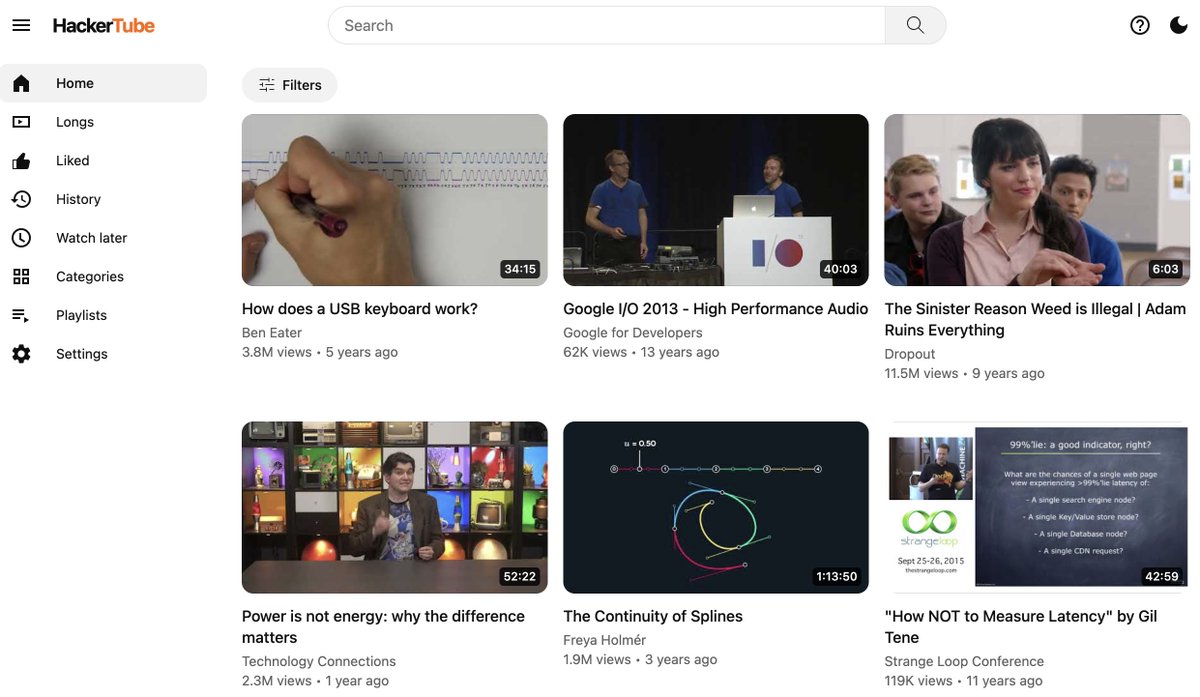
Weekend hack: HackerTube. I was annoyed with YouTube's recommendations so I had Claude filter down 43M comments over 20 years of HN to 6,454 videos that keep being recommended. *Significantly* better viewing experience, ~2 hours with Opus 5.5:
https://t.co/JIhXN7OSh1
- Excellent recs without any logins (state is kept in local browser session)
- Thumbnail is a representative frame from middle of the video instead of the super duper A/B test hyper-optimized user uploads
- Underlying data from the comment analysis as one zip file, point your Claude at it and ask for your own version
- HackerTube Longs ✊
A bit more on the process:
I use Claude Code (desktop app for Mac), Opus 5.5 on Medium effort as my default. I only talk to Claude and have it do everything, the only "manual work" I helped with in tandem was in the browser (reminiscent of MenuGen): 1) I had to create some kind of API key from Google Cloud UI to query YouTube for video metadata, 2) I booted up a VPS box for serving and 3) I bought the domain name. Once the box was up I gave Claude the IP and told it update, secure, harden, deploy and optimize the code, and it did the whole thing.
Many awesome projects that would have normally taken weeks/months even can now be few-shotted for breakfast. What else are we not thinking of.
There are a few notable counter-examples (e.g. HAL) but this is basically right for a lot of pre-2000 sci-fi.
I think getting AI right from e.g. somewhere in the ~1970s would require a fairly complicated set of inferences, probably the biggest things would be:
Image the world in 50 years.
1. "Digital knowledge work / computing". The vast majority of knowledge work (which makes up a very large fraction of the economy) goes digital. As computers get cheaper, much of society’s work happens on screens, over billions of machines in homes and offices.
2. "Internet". Similar to ARPANET (and see Licklider’s ���Intergalactic Computer Network” (1963)), this creates demand for a global network of computers where people work, argue, teach, joke, and socialize.
3. "Big data". This creates a very large, compounding repository of digital information, with traces of how people reason, how they create, what they know etc.
4. "Statistical learning". Trying to program intelligence by hand is extremely difficult. But Shannon's n-gram approximations of English (1948) show examples of how language has statistical structure that can be "learned". You could imagine doing so over extensions of cybernetic computing (e.g. in the style of Rosenblatt's Perceptron 1958). So instead of programming thought, we could fit a statistical model to the record.
5. "LLMs". This might lead to something along the lines of ELIZA (1966), but with enough data (per 1-3), and enough compute (see Moore's law 1965), the imitation might become of extreme hight fidelity to the point that it's economically extremely useful.
6. "Scaling laws". These networks may demand a huge amount of data / computing resources and expertise to train. It's plausible that the more of each you have, the better your ELIZA gets. The economics concentrate, where a few organizations build a few minds and then deploy copies of them digitally.
Something like that. Basically, it's a lot of leaps. You have to start with computers, to internet, to big data, to big compute (Moore's law), which then allow large-scale statistical learning approach based on neural networks, and then posit scaling laws, and then imagine the form factor of language models as a lot more sophisticated ELIZA. And you'd have to short everything else, most predominantly I think the idea that we'd figure out how to program robots by hand.
@pondorasti Yeah this is really good. Btw you can also just tell your Claude Code "Create and deploy an extension for my browser that shows YouTube thumbnails from halfway of the video instead of the user-uploaded version. Include a toggle between the two", works great
@davegoldblatt "Hi Claude good morning how are you I'm great thx build me a YouTube-style site but restricted to videos that have been repeatedly recommended on HN over the years pls. Don't make any mistakes."
Weekend hack: HackerTube. I was annoyed with YouTube's recommendations so I had Claude filter down 43M comments over 20 years of HN to 6,454 videos that keep being recommended. *Significantly* better viewing experience, ~2 hours with Opus 5.5:
https://t.co/JIhXN7OSh1
- Excellent recs without any logins (state is kept in local browser session)
- Thumbnail is a representative frame from middle of the video instead of the super duper A/B test hyper-optimized user uploads
- Underlying data from the comment analysis as one zip file, point your Claude at it and ask for your own version
- HackerTube Longs ✊
A bit more on the process:
I use Claude Code (desktop app for Mac), Opus 5.5 on Medium effort as my default. I only talk to Claude and have it do everything, the only "manual work" I helped with in tandem was in the browser (reminiscent of MenuGen): 1) I had to create some kind of API key from Google Cloud UI to query YouTube for video metadata, 2) I booted up a VPS box for serving and 3) I bought the domain name. Once the box was up I gave Claude the IP and told it update, secure, harden, deploy and optimize the code, and it did the whole thing.
Many awesome projects that would have normally taken weeks/months even can now be few-shotted for breakfast. What else are we not thinking of.
@RagavanThurair Same... I had to bring it down (RIP) because it was just too much work to maintain, it would have been a lot easier today. But today there's also https://t.co/oYXEotT37i, which I like & use and is in the same spirit.
@eyadnour Oh tbc Claude filtered it down a lot: urls, regexes, dropping spam, only the remainder was dispatched to Sonnet with a CC Workflow (so it uses the sub tokens). You can see surviving comments under videos, the comments that recommend videos seem to be of nice & helpful character.
@TipOfTheBanana Truly hideous stuff. Quickly converging to the perfect form of infinitely shelf stable commodity paste of refined sugar / corn starch, fully hydrogenated palm oil and defatted soy protein, in a shell of synthetic flavors and dyes for the illusion of what you’re eating.
If you've ever wondered why smart TVs are so cheap, this is why.
@log4j rooted his Samsung and found an always-on hot mic, automatic content recognition, geolocation, network mapping, ad targeting and user profiling, shared with Samsung's "400 partners".
A lot of it can be blocked in <15 min, wrote a basic guide below.
What your TV is doing
The main culprit is ACR (automatic content recognition). Your TV screenshots what's on screen, fingerprints it, and sends it home to build your ad profile. Samsung does it every 500ms, LG every 10ms [1].
What is insane: it happens on connected devices too.
Plug in your laptop, your console, your work machine, and your TV can fingerprint that via HDMI [1].
He also found that if your Samsung doesn't have a mic, it'll look for one from a connected soundbar or bluetooth device.
https://t.co/vNdTnIQ6KF
It's on by default, and you likely agreed to it on the setup screen you clicked through in 10 seconds.
Step 1: Turn off ACR
Samsung: Terms & Privacy → Viewing Information Services
LG: Live Plus
Vizio: Viewing Data
Roku: "Use info from TV inputs"
Sony/Google TV: Samba Interactive TV
Menus vary by model, but those are the names to look for. While you're in there, opt out of interest-based ads, reset your advertising ID, decline every optional privacy agreement, turn off voice recognition, and delete apps you never open.
Step 2: Give smart devices their own network
Put the TV, cameras, speakers and vacuum on your router's guest/IoT network. The logic is simple: these devices rarely get patched. If one gets compromised (getting drastically more frequent with AI), it shouldn't be able to see your other devices or home network.
Step 3: Block trackers for the whole house with DNS-level filtering
NextDNS (cloud-based) is easy and has a solid free plan. Pi-hole is a little bit more work if you prefer self hosting. For simplicity we'll focus on the former.
1. Sign up at https://t.co/IwhafVWVM8 (free tier is plenty)
2. Privacy tab: add a blocklist (OISD is a good bet) and turn on Native Tracking Protection for Samsung, LG, Roku, Amazon (see attached image)
3. Setup tab: copy your endpoint
4. Paste it into your router's DNS settings as DNS-over-HTTPS/TLS (or use the IPs + "Link IP" if your router only does plain DNS)
5. Bonus: block outbound port 53 except to your router. Some devices hardcode their own DNS to get around you
Then open the NextDNS logs and watch how often your TV phones home. It's eye-opening. If an app or update breaks, find the domain in the logs and allowlist it.
Why they do this
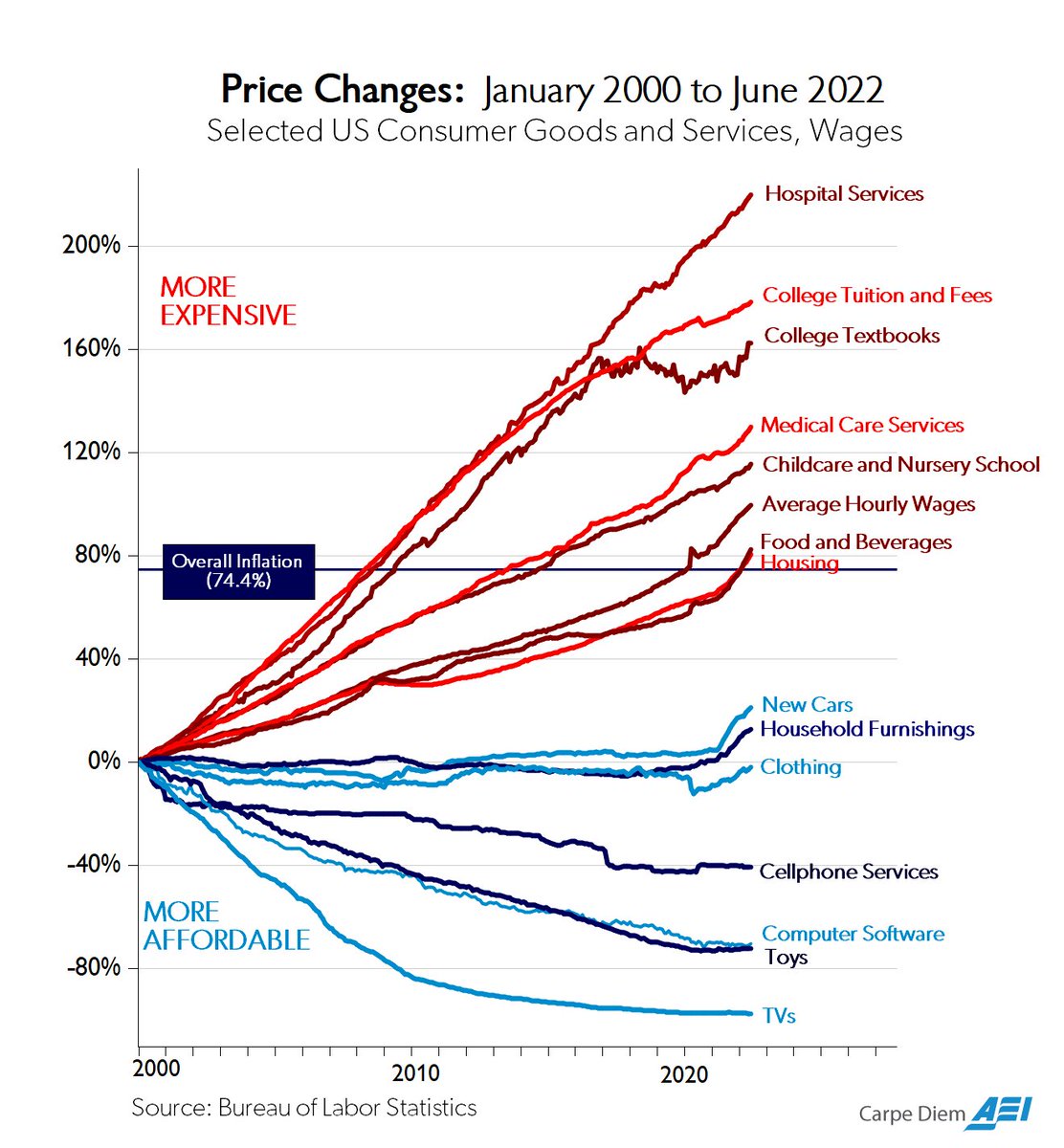
TV prices are down 97% since 2000 [2]. Most of that is better manufacturing and brutal competition. But once margins on the hardware hit zero, the cost moved to you.
In Q3 2024, Vizio lost $6.7M selling TVs and made $115.8M in gross profit from ads and viewing data [3]. They've said on earnings calls that they keep TV prices low to grow the audience they sell to advertisers. Walmart bought them in 2024.
This isn't a conspiracy theory either. Vizio paid $2.2M to the FTC in 2017 for tracking 11 million TVs without consent. Last December, Texas sued Samsung, LG, Sony, Hisense and TCL over ACR. Samsung and LG have since agreed to stop collecting that data without explicit consent [4].
TL;DR
1. ACR off
2. Ads + voice off
3. Smart devices on their own network
4. NextDNS filtering on the router
Sources:
[1] ACR study: https://t.co/S1IS8lXNbA
[2] Cost of US consumer goods: https://t.co/nclXELXcbd
[3] Vizio Q3 2024: https://t.co/CrVbwc9ZXk
[4] Texas v. Samsung: https://t.co/wFOUdeh1if
Dusting off this tweet from April because this gap in shared understanding of LLM capability is *widening*. It's now less "two groups of people speaking past each other" and more a sharp funnel.
- Napkin math somewhere around 6B people (~75% of the population) have barely come in contact with LLMs at all.
- Around 1-2B (~20%) are casual and infrequent users of free-tier ChatGPT-like products. This group sees derpy chatbots and treats them a bit like a better Google search, a writing aid, or etc. Maybe an agent tries to book you a flight. I have non-tech friends who (reasonably, imo) say they have not much use for it at all. Even many professionals outside of math&code are in this tier. For example, execs and many other functions spend a lot of their time talking to other people, so while they understand what is happening intellectually, it is still second-hand and a bit abstract.
- Now we get to professional use of frontier-grade LLMs in math&code. Somewhere around 20M people (0.2%) see first-hand that large, complex projects that used to take them weeks/months can now be completed by agents with a prompt. Building apps, copying apps, translating apps, decompiling apps from binaries... This has all happened very quickly and recently - less than 1 year ago, I was writing code manually by hand, typing memorized computer code commands into a code editor character by character, occasionally pressing Tab to autocomplete a little chunk of code.
- And finally we get to the ~5,000 people (~0.00006%) with access to frontier-grade systems internally. The external world has seen the preview. It looks like swarms of thousands of agents collaborating over weeks on software mega projects: minting zero days, running cyber attacks and defenses at machine speeds, discovering new science, advancing the frontier of mathematics. Things that would have taken top professionals in the industry years of work. Meanwhile, human review and comprehension are starting to fall behind. For example, people are still involved in the "archeology" of the OpenAI-HF incident from many months ago. Mathematicians may be poring over the 722 manuscripts on frontier mathematics for a while.
The funnel is driven by a combination of factors:
1. The impact scales with ambition, problem size, and horizon. A question with a paragraph answer barely stresses the system. You need a reservoir of big, difficult problems that you really care about. This aspect drives the consumer / professional dimension of the funnel.
2. The jaggedness of the system (which I have written about a lot separately). Capability peaks in domains that are digital, verifiable and economically valuable. This is because LLM capability emerges from reinforcement learning on verifiable rewards on a curated environment mixture driven by revenue potential. This aspect primarily drives the area (e.g. math&code) dimension of the funnel.
3. Access. Free-tier, paid-tier, internal.
So this is the weirdness of the moment. The general public has mostly not interacted with these systems. When they have, it looks like a derpy chatbot. The majority of professionals still see only a modest uplift. And a small sliver of professionals are experiencing the vertigo of the curve going vertical. And it is all happening at the same time.
Judging by my tl there is a growing gap in understanding of AI capability.
The first issue I think is around recency and tier of use. I think a lot of people tried the free tier of ChatGPT somewhere last year and allowed it to inform their views on AI a little too much. This is a group of reactions laughing at various quirks of the models, hallucinations, etc. Yes I also saw the viral videos of OpenAI's Advanced Voice mode fumbling simple queries like "should I drive or walk to the carwash". The thing is that these free and old/deprecated models don't reflect the capability in the latest round of state of the art agentic models of this year, especially OpenAI Codex and Claude Code.
But that brings me to the second issue. Even if people paid $200/month to use the state of the art models, a lot of the capabilities are relatively "peaky" in highly technical areas. Typical queries around search, writing, advice, etc. are *not* the domain that has made the most noticeable and dramatic strides in capability. Partly, this is due to the technical details of reinforcement learning and its use of verifiable rewards. But partly, it's also because these use cases are not sufficiently prioritized by the companies in their hillclimbing because they don't lead to as much $$$ value. The goldmines are elsewhere, and the focus comes along.
So that brings me to the second group of people, who *both* 1) pay for and use the state of the art frontier agentic models (OpenAI Codex / Claude Code) and 2) do so professionally in technical domains like programming, math and research. This group of people is subject to the highest amount of "AI Psychosis" because the recent improvements in these domains as of this year have been nothing short of staggering. When you hand a computer terminal to one of these models, you can now watch them melt programming problems that you'd normally expect to take days/weeks of work. It's this second group of people that assigns a much greater gravity to the capabilities, their slope, and various cyber-related repercussions.
TLDR the people in these two groups are speaking past each other. It really is simultaneously the case that OpenAI's free and I think slightly orphaned (?) "Advanced Voice Mode" will fumble the dumbest questions in your Instagram's reels and *at the same time*, OpenAI's highest-tier and paid Codex model will go off for 1 hour to coherently restructure an entire code base, or find and exploit vulnerabilities in computer systems. This part really works and has made dramatic strides because 2 properties: 1) these domains offer explicit reward functions that are verifiable meaning they are easily amenable to reinforcement learning training (e.g. unit tests passed yes or no, in contrast to writing, which is much harder to explicitly judge), but also 2) they are a lot more valuable in b2b settings, meaning that the biggest fraction of the team is focused on improving them. So here we are.
@TheStalwart I had some amount of journalistic inbound way back as a PhD student but the only person I consistently replied to was Jack because he actually put in effort, read academic papers and asked good technical questions and I have not really seen that before (or since).
@omarsar0 My mental model for what is happening is that 99%+ of people who are now paying attention have been onboarded to anything related to AI in <1 year. This is very confusing to the AI dinosaurs (anyone in AI for pre 2026. Or even, gasp, pre 2012).
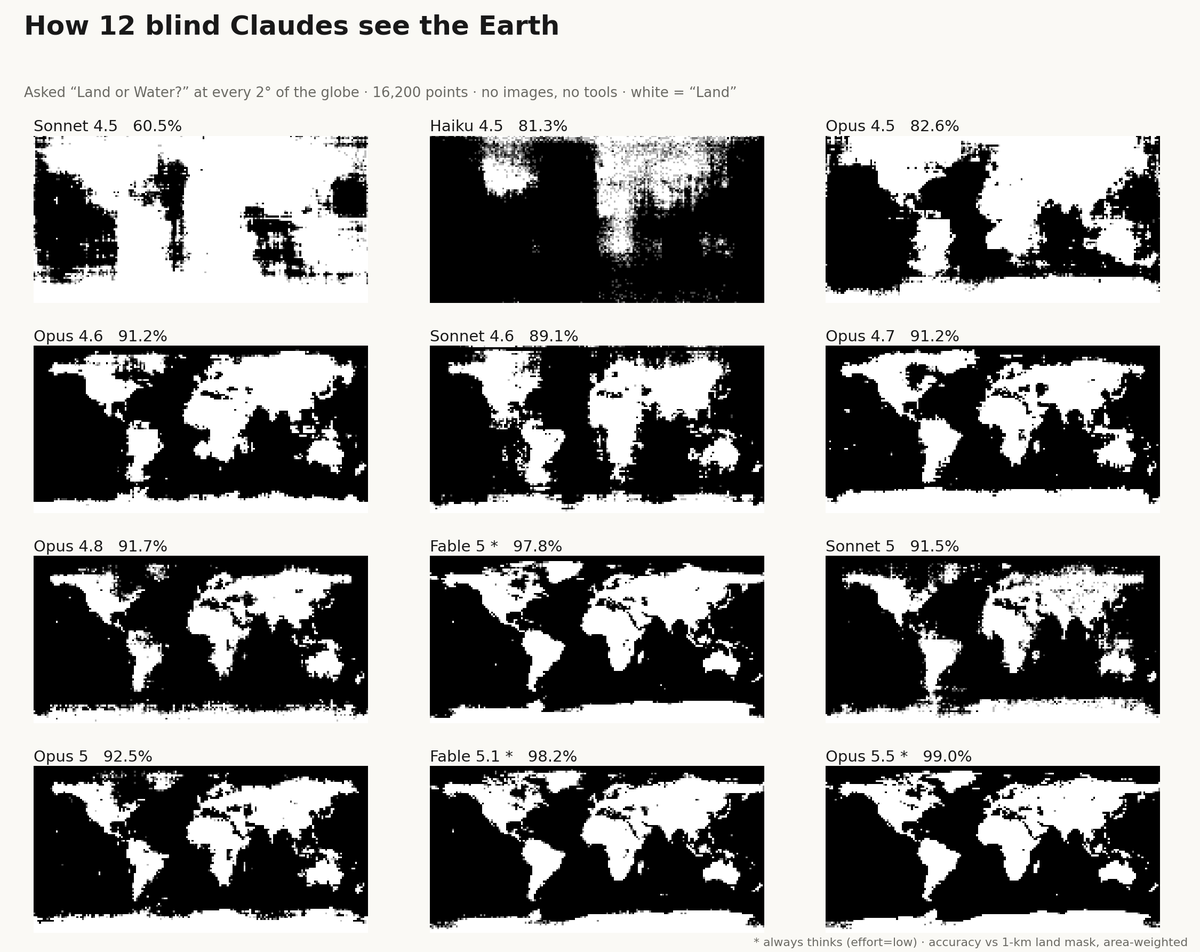
@francchen Worth emphasizing that this all comes from just reading a ton of text and then predicting text. There are no images involved except the way you arrange the text responses in 2D.
Cool eval. Simply ask an LLM “Land or Water?” and give it a latitude and longitude coordinate as text. Ask 16,200 times, plot as image. The models know. From compressing the internet.