NdiIgbo,
I’m from Anam. Geographically located in Kogi State. Anam and Nzam which still speaks Igala, are brothers. Further West still are our cousins the Ibaji/Igala. Speaks Igbo. Bears Igbo names. Known as Olumbanasa. (True trivia: Odobo, Enekpa, Igah, Iyano, towns in present day Ibaji LGA of Kogi, are quarters in Nzam).
All in Anambra West LGA, Anambra State. In Igbo land. All physically separated from Igboland by big rivers, Niger and Omambala (the bridge connecting us to Igboland was only built in the 80s. Even today we call them, “Ndi Igbo” to distinguish from “ndi mbammili”, water people).
The entire lower Niger was once under Igala rule until the Aboh rose to prominence- as corroborated by Landers Brothers (1830s) and Baikie (1854) expeditions?
And there is nothing unusual about the Igala connection. The Abriba (small London, ndi Okpogho, Kalu ukwu na Kalu nta), the wealthiest Igbo group who control the seas and trade routes extending to Northern Europe, is Igbo mixed with Ejagham.
Igala? Like Anam, like Nsukka, Osomala, Asaba, and Okpanam (Anam’s big brother), etc, etc. The Igbo are an ancient civilization. Neighbors influence it, it influences neighbors.
We live at the edge of Igboland. Like Ikwerre, Ika, Etche etc.
And the point? Anam remained Igbo during the Biafra war. In fact, Ndi Anam were amongst the most ferocious fighters during the Biafra war (been that way since time, ask Illah and Aboh, our brothers who inhabit the other side of the River Niger, whom we terrorized in the remote past, or the Fulani who attempted entry into Anam in the recent past).
And that is precisely the point. No denial of our Igboness. No betrayal of our Igbo brothers. No abandoned property. No name change to escape Nigeria’s punishment of the Igbo after the war (like some of Ika’s prominent people, etc - “If I speak, I am in big trouble.")
If Nnamdi from Ikwerre, Uche from Ika, Amechi from Etche etc say they’re not Igbo let them be. The Guilt from betraying your brothers is a terrible thing to deal with. And people will go to great lengths to cover it up - like saying they’re from Benin. It is difficult to accept Responsibility for breach of trust. To forgive yourself and grow.
Unity is never forced upon any peoples (observe Nigeria’s condition forcing people to unite). Be patient. The Northern Irish were turned against their brothers in the South by the British. I believe the Emerald Isles will eventually be reunited.
For now remember, NdiIgbo are NOT recruiting.
Stay focused. Form a coalition of the willing. And keep pushing for regional autonomy. Our road is to Catalonia in Spain
Notable examples:
Nigeria
1. Yomi Awobokun - EA to CEO of Oando Group, later COO of Oando downstream subsidiary, later CEO of Oando downstream, later founder of Enyo Retail
2. Alex Irune - was an EA to Group CEO of Oando, now CEO of Oando upstream and Group ED in Oando
3. There was a Kunle guy in Oando too (can't remember the surname again) that was EA to Group CEO and later became Head of Strategy in the downstream subsidiary
4. Obong Idiong (pictured) - Former EA to Tony Elumelu, later CEO of Africa Prudential Plc, now CEO of Heirs Technologies (both Elumelu companies)
Outside Nigeria
5. Steve Ballmer - Joined Microsoft as assistant to CEO Bill Gates, rose to become CEO of Microsoft.
6. Ursula Burns - Worked as EA to Xerox executives, later become CEO of Xerox herself.
7. Mary Barra - EA to CEO of General Motors. She later became CEO herself.
8. Sam Palmisano - EA to CEO of IBM, later became CEO of IBM.
EA or Chief of Staff to executives is a very good way to prepare people for leadership position.
If you are good on the job, the executives notice you, trust you and that propels your career.
The problem is, these days, people that are not even executives are hiring some virtual assistants (which is fine) but calling them executive assistant. You no be executive, why you dey call your admin assistant executive assistant? That is what the original poster may have been using as standard for executive assistant.
Executive Assistant - proper one to a proper executive - is a top job. You know practically everything about the CEO's (or other executives') job!
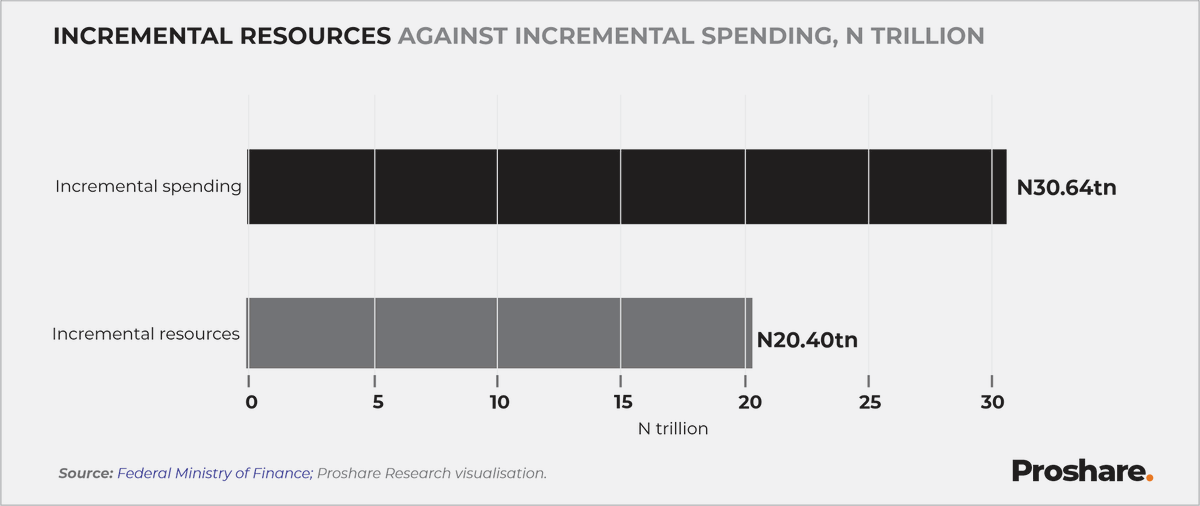
Nigeria’s reform scorecard provides a useful basis for assessing the gains, costs and unfinished work arising from the current policy programme. The reported N20.40tn in incremental resources, against N30.64tn in additional spending pressures, shows that stronger revenues have not eliminated the fiscal gap, with borrowing financing a significant share of the difference.
The Federal Government deserves commendation for acknowledging the costs of stabilisation, the continuing pressure on households and the limits of the outcomes achieved. Public recognition that “a scorecard that only lists wins is not a scorecard” strengthens accountability and creates a more credible basis for policy evaluation.
The next phase must now be about how we translate macroeconomic stability into lower food costs, improved real incomes, productive employment and stronger private-sector investment.
This will require much more hard work from the economic management team and, indeed, the entire executive council and the public-private governance architecture. Regular reporting on how additional public resources improve measurable economic, security and social outcomes will go a long way towards shaping narratives and public mood, both of which are needed under a reform programme.
READ MORE>>> https://t.co/ssW0Wtp2ox via @ecopoliticsNG@proshare
cc: @FinMinNigeria@cenbank@NGRPresident@FMINONigeria@officialNESG@Econassociates@FDC_ltd@NIPSSKuru@IoDCCGNigeria@nbccng@SECNigeria
“There are only four ways to make money. Labor. Capital. Arbitrage. Insurance.” (Rendex)
Rendex forgot the most important way: deception/ fraud.
There are two kinds of profit: (i) profit from the production/consumption cycle Qm, and (ii) profit from value changes Qn. The point to distinguish first is: making money and making a profit are not the same thing. Actually, profit does not come from Labor or Capital. It comes from dissaving/deficit-spending, i.e., the growth of private/public debt. (⇓ AXEC143g)
The profit theory has been false from Adam Smith onwards to the sorry folks that currently populate the economics departments. Profit is the concept where the whole of legacy economics can be mathematically proven false.
For details, see
Cross-references Profit/Distribution
https://t.co/taznr3RMBt
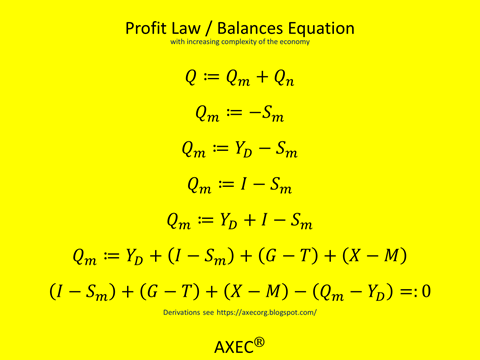
Monetary profit is given by the axiomatically correct Profit Law Qm≔(I−Sm)+(G−T)+(X−M)+Yd. The Law implies PublicDeficit-Is-PrivateProfit Qm≔(G−T)>0, i.e., macroeconomic profit is (co-)produced by deficit-spending/money-creation, i.e., the growth of public debt.
In free-market economies, public debt has increased with minor interruptions for over 200 years. Therefore, Qm≔(G−T)>0 is a critical element of the economy's survival. The growth of debt increases the stock of financial assets, which come in very different forms. The main counterpart of public debt is government bonds. The stock of bonds changes its value constantly, and this is where non-monetary profit comes in. Monetary profit is cash in the box or additional money in the bank. Non-monetary profit is a change of value in the books without a money counterpart. Non-monetary profit can be realized in principle at any point in time.
The minimum requirement for a free-market economy is that macroeconomic profit is greater than zero, i.e., Qm≥0. If Qm<0, recession/depression/breakdown results. This is the main economic principle; all other explanations of how the economy works are secondary. Utility/profit maximization or flexible markets or competition or hard work or innovation or correct expectations or heroic risk taking do not keep the economy above the zero-profit line.
Increasing microeconomic profit does not increase macroeconomic profit; it only redistributes it. The Fallacy of Composition is the representative economist's incurable mental defect.
Scientifically, it's rather simple: no macroeconomic profit, no economy. But economists are only look-alike scientists. They have never had enough brains to understand the objective, systemic facts.
Profit from changes in valuations is an entirely different thing. It's a zero-sum game, except for the Central Bank, which is the ultimate profit pump of both monetary Qm and non-monetary profit Qn.
The problem of theoretical economics is that the sources of total macroeconomic profit Q:=Qm+Qn are hidden behind concepts such as the Invisible Hand, Spontaneous Order, Complexity, or Randomness.
Mathematicians/statisticans are currently trying to convince an amazed audience that money can be made out of randomness. Ultimately, this is the old goldmaker's dream to transmutate shit to gold.
In the financial sphere, 'value' is not created out of nothing but is manufactured behind the veil of countless licit/illicit financial transactions between the Central Bank, the Commercial Banks, Funds, Firms, Insurancies, etc., and the agencies that stand behind them. Randomness is the best veil. It lets the manipulators vanish behind the anonymous noise of markets.
Strictly speaking, financial wealth is the counterpart of private/public debt. For a closed economy, the net position is zero. The people on the asset side of financial wealth are rich. The people on the liability side of public debt are poor, but they don't realize that they —not the State— will eventually pay the debt. This is when the so-called free-market economy eventually breaks down.
I'm a second-generation bookseller. My family runs Houston's largest used & rare bookstore and I'm building an AI tool for used bookstores. We got hit by exactly these orders, including a single order for 70 obscure books that made us pause online sales entirely. So I dug in. I don't think this connects the way people want it to.
Every ingredient of the viral story is true. ISBNdb really does advertise sourcing books for AI companies. Anthropic really did destructively scan millions of books though they were mostly acquired through things like library deaccessions, not bookstore inventory. And booksellers really are getting bizarre bulk orders. But "rare" here isn't what you're picturing. It's The Insider's Guide to Metro Denver (1995) and how-to-use-WordPerfect 1991 manuals. Obscure, but often not precious.
When we combed through our orders, nearly every book bought from us was either unavailable on Amazon or listed there at 5, 10, 20x our price on the platform they were purchased on. And the shipments are going to FBA prep companies: which is what you do with a book you're about to resell, not one you're about to cut apart. There is more than circumstantial evidence that this is a well-funded company running algorithmic arbitrage, buying underpriced or out-of-stock books to relist on Amazon at markup. This evidence includes an official denial that they are selling to train AI but I don't want to mention them for several reasons. You can Google it.
That's more mundane than the shredder story. The actual risk is worse, though, because it's quieter: books that don't sell via FBA eventually get liquidated. If we really hold the last copies of some of these (and comparing platforms, it looks like we might) we're feeding them into a portal they may not come back from. No AI company required.
Everyone assumes the internet preserved everything. It didn't. Many of these books have almost no metadata anywhere, just a scattered listings across proprietary databases then nothing. That's what my project is for: building better bibliographic records for these books than exist anywhere else, so we at least have a map of what we stand to lose. So the Library of Alexandria is still burning, just more slowly, and kore from “who cares” than from some cinematic villain.
(I am open to being corrected.)
Full writeup: https://t.co/tHXMH0L3us
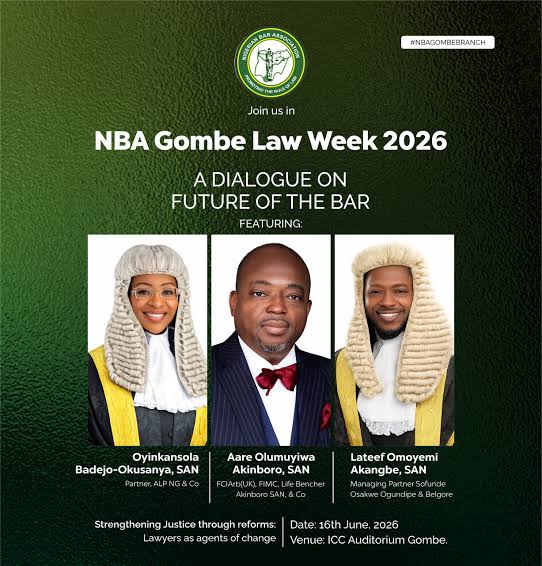
Next month, @NigBarAssoc will elect its 33rd President. There are three candidates vying for the position: @OmoyemiAkangbe; @MuyiwaAkinboro; & @MrsBBold. All 3 are Senior Advocates of #Nigeria, #SANs.
The presidency of the NBA is rotated among the 3 major regions of the country at independence - East, North, & West.
This year, the presidency of the NBA rotates to the Western Region. The West comprises 2 informal associations.
One is @Egbeamofinoodua, which is made up of the 6 States south-west Nigeria. The other is the Midwest Bar, which comprises Delta & Edo States. These are informal regional arrangements that are not formally part of the NBA.
In this round, the Midwest Bar has chosen not to field any candidate. So, the president to be elected will be from one of the 6 States of SW Nigeria.
For this round of elections, the Egbe Amofin has chosen to line itself up behind @MuyiwaAkinboro as their preferred candidate. They have gone further to seek to require the NBA to exclude other candidates from the contest so that Mr. Akinboro can emerge unopposed.
That, however, wld be unfair to people who are not part of the Egbe Amofin & to the wider body of @NigBarAssoc. It wld also be a profound subversion of the constitutional & institutional arrangements of the Association.
To drive home their demand, the Egbe Amofin went to the High Court of Oyo State in Ibadan to get an order of court to suspend the NBA's electoral season until they get their way. In the end, that case has suffered uneasy suspension.
Yet, some powerfully leveraged interests are insistent on prescribing to the Association whom its next president must be. They are even threatening - if they do not get their way - to get the Attorney-General of the Federation to "nationalise" the Association & designate a #SoleAdministrator for it.
Sadly for them, the NBA is an NGO, there is no legal framework for achieving this end. The problem they have is that they have refused to adapt to the reality of #OnLawyerOneVote; #OLOV.
If you are a young(er) lawyer in #Nigeria, there is a presidential candidate in this election who wants to abolish #OLOV if he wins. Ask yourself the question if that is what you want.
For the 1st time since 2006, this year, there is on the slate, a woman who has a real & competitive chance of becoming the 1st woman to be directly elected as the President of @NigBarAssoc & only the 2nd female president in the history of the Association.
Will you #BBold & be part of making history?
Between 1958 and 1962, China tried to abolish private farming and run the entire country's food supply from a central plan. Somewhere between 30 and 45 million people starved to death. The food to save most of them was sitting in government warehouses the whole time.
Farmers were forced off their land into collective farms called communes, and growing food for yourself became a crime. Local officials had to report their harvests up the chain, and reporting a big number was how you kept your job and avoided being branded an enemy of the state. So they lied. Officials across the country inflated their harvest figures by 30 to 40 percent, and one region claimed its yields had multiplied by thousands of percent. When Mao toured the countryside to see the bounty, local officials staged it for him, transplanting shoots from other fields along his route so the crops looked impossibly thick.
A village that claimed to grow twice what it really had still owed tax on the full invented amount, so the state hauled away nearly everything that actually existed. People who reported the real shortfall were beaten or accused of hiding grain. One reporter watched bodies collect in the roadside ditches and wrote nothing, because he had already seen what happened to the people who told the truth.
In 1959, with the harvest already falling, China sold more grain abroad than in any other year of the decade, about 4 million tons, to earn hard currency and save face abroad. Beijing turned down foreign food aid and called the famine a Western invention. The grain it exported in those two years could have fed more than 16 million people. Starving families were banned from leaving their own districts to look for food, so they died where they stood, some within walking distance of full state granaries.
The weather those years was close to normal. Drought and floods hit some areas, but the researchers who later separated the causes found that policy, far more than weather, drove the scale of the dying. The deadliest famine in recorded human history was almost entirely man-made. It ended only when the leadership quietly reversed itself. Families were handed back their own plots of land, and local markets were allowed to reopen. Within a year, the country that had been exporting grain was importing it instead. The thing the plan had set out to erase turned out to be the only thing that kept people fed.
A woman in my office had been doing the same job for nearly ten years. She knew every shortcut, every process, and every excuse for why she shouldn’t apply for a promotion.
Whenever people encouraged her, she’d laugh and say..
“I’m not management material.”
One day, her manager resigned unexpectedly. Until a replacement was found, she was asked to lead the team for just two weeks.
Q: Why is it so easy to criticise and have a plan till you get into government? 🤔
A: Because outside govt, you see the problem in straight lines. Inside government, you meet the maze.
From outside, failure often looks like a lack of will, competence, courage, or integrity. Sometimes it is. But inside government, plans meet weak institutions, inherited liabilities, vested interests, procurement rules, courts, legislators, budget limits, security realities, civil service inertia, and the politics of timing.
Culture happens, stories begin and self-preservation agendas find life.
The easiest sentence in public life is: “They should just fix it.” The harder truth is that the state is not one person with one button. It is a network of laws, interests, fears, incentives, sabotage, capacity gaps, and consequences.
Still, complexity is not an excuse for failure. Government exists to organise complexity into results. The real test of leadership is whether a plan survives contact with reality, adapts without losing its moral centre, and delivers relief citizens can feel.
So, I have learnt to appreciate progress, momentum and incremental gains..... not the eldorado version.
Yet, criticism keeps power honest, but getting results for desired governance requires more than criticism. It requires getting involved, sequencing, coalition-building, courage, competence, communication, and the humility to accept that the problem was deeper than the slogan.
The code is to win by knowing when to lose, win or compromise.
On a scale we can all relate wirh, we should for example know that the wedding, of which we priotise expenses with, is just an event, while the marriage remains the institution of priority. Even within this family arrangement, optimising value reflects similar challenges.😔 You can read this in a way you get the message.
Be ye circumspect.....
In 2017, I traveled to China to source automated agricultural equipment for a commercial farming project. My focus was on battery cages, feed milling systems, and silos.
After a week of visiting different Manufacturers and Factories I couldn’t find a Battery Cage System that wasn’t Power dependent- They entire world was using Fully Automated Battery Cage System.
One young CEO became genuinely frustrated with me when I told him-His Automated Battery Cages (with sensors and temperature regulators) wouldn’t work for me because I didn’t have Electricity.
When I explained that reliable electricity was not available in Nigeria, he thought I was exaggerating. To him, uninterrupted power was such a basic requirement for business that the absence of it seemed impossible.
He asked, “How do Survive”? So I showed him on Baidu and he genuinely felt sorry for me.
Even my translator, Cherry, struggled to understand what I meant. We eventually had to research it online before she accepted that a country of over 200 million people could have such a fundamental infrastructure gap.
After further investigation, she helped us locate a manufacturer in Henan Province that produced semi-automated systems specifically for African markets—equipment designed to operate despite unreliable power supply.
Nine years later, the situation remains largely unchanged.
I still do not have Electricity in any farm I own or have helped develop.
Baba let me help you out a little cos the abstract Maths is long, and it failed to consider infrastructures and other costs of the estates.
The idea behind affordable housing is that we keep it below the commercial market rates. The initiative has a website, you can get the prices out, they are significantly below market rates.
This isn’t to say that they are cheap, they are not all cheap, but unfortunately, housing is not cheap. We have not scaled enough as a nation to make it so -not yet. But you would also notice that outside of Lagos, FCT, Kano and PH, the houses are really affordable, even going as low as 8M in some cases. I’m not sure of what else could have been done here.