If we do not reject Ramanujan's theorems because Devi came and gave them in his dreams, why shud we reject a research question on Gomutra? A detailed post responding to the comments on my original post.
My six questions to @priyankagandhi, @INCIndia and @RahulGandhi remain unanswered. Instead, much of the response has been an invitation to drink a glass of gomutra. That completely misses the issue under discussion.
Let me state clearly the principle I am defending, because it is not the one being attributed to me.
The issue is not whether every claim originating in Hindu tradition is true. The issue is whether such a claim may be dismissed as superstition solely because of its origin. That is the genetic fallacy: a mistake the philosophy of science discarded nearly a century ago.
Hans Reichenbach, one of the founders of modern philosophy of science, drew the distinction that governs this debate in Experience and Prediction (University of Chicago Press, 1938): the context of discovery versus the context of justification. How an idea arises belongs to psychology, biography or history. Whether it is true is an entirely different question, answered only through evidence and testing. Karl Popper made the same point in The Logic of Scientific Discovery (1934): the origin of a hypothesis may interest the psychologist, but it is irrelevant to the logical evaluation of scientific knowledge.
Origin carries no epistemic weight, neither negative nor positive.
Kekulé said the ring structure of benzene came to him in a dream of a snake biting its own tail. The structure remains in every chemistry textbook; no one proposes discarding it because of its provenance.
Closer to home, Srinivasa Ramanujan said many of his formulae were revealed by the Goddess Namagiri of Namakkal. Hardy did not ask where the ideas came from. He checked the mathematics. That was the only thing that mattered. Science has operated on that principle ever since.
That is the whole of my case. Check the work. If you would not reject Ramanujan's theorems because a Hindu deity appears in his account of them, do not reject a research question for the same reason. Equally, do not accept one for that reason either.
The history of pharmacology makes this principle unmistakable. In 1970, screening a fourth-century Chinese medical text for antimalarial compounds would have seemed absurd to many Western pharmacologists. Tu Youyou did it anyway. The result was artemisinin, saving millions of lives and earning the 2015 Nobel Prize. Foxglove gave us digoxin. Willow bark gave us aspirin. French lilac gave us metformin. Roughly half of approved small-molecule drugs are natural products or their derivatives. Traditional knowledge is a source of hypotheses, not a substitute for evidence. The scientific method exists precisely to determine which hypotheses survive and which do not.
Nor is research on cow urine devoid of scientific investigation. There are already peer-reviewed studies reporting antimicrobial and antifungal activity, bio-enhancing effects, antidiabetic effects in animal models, stem-cell and oxidative stress effects, and agricultural applications. Whether one ultimately agrees with the findings is a matter for scientific debate. But once a hypothesis is being investigated through peer-reviewed experimental research, calling it "unscientific" is simply incorrect. The relevant scientific question is whether the evidence is robust, reproducible, and sufficient, not whether the hypothesis originated in a Hindu tradition.
On the objection that a computer scientist has no business discussing microbiology: a computer scientist is not a microbiologist, just as a Nobel laureate in economics is not a physicist. There is, however, an important distinction between adjudicating pharmacology (which requires domain expertise) and judging whether a research question is scientifically admissible (which is a question of scientific methodology). Every trained researcher understands how to formulate hypotheses, evaluate evidence, distinguish correlation from causation, assess experimental design, and interpret results. On pharmacology we defer to specialists. On methodology, every serious researcher is competent to speak. What nobody is entitled to do is settle either question by ridicule.
On the objection that there is no approved drug, therefore the research is invalid: every approved medicine was once merely a hypothesis under investigation, and most hypotheses fail. That is not a flaw in science; it is how science progresses. The absence of an approved product tells you where a line of inquiry currently stands—not whether it was worth investigating. The proper question is whether the published evidence justifies further investigation. That is answered by reading the evidence, not by pointing to an empty shelf.
On the surveys and newspaper reports being circulated as refutation: a survey measures what people believe. It is vulnerable to sampling bias, selection bias, framing effects, response bias, and social desirability bias. It establishes nothing about biology. Likewise, a newspaper article reporting a controversy is journalism, not scientific evidence. Opinion and reportage answer different questions from experimental science. Confusing them with evidence of biological efficacy, or inefficacy, is a basic methodological error.
Finally, on the question I've been asked most often in ad hominem attacks if I would drink gomutra. My calm response: that is the wrong question.
Faecal microbiota transplantation is an established treatment for recurrent Clostridioides difficile infection, with FDA-approved products available since 2022. Captopril, which transformed the treatment of hypertension, was developed from the venom of a Brazilian pit viper. Botulinum toxin, which is one of the most potent toxins known, is used therapeutically worldwide. Maggot debridement therapy has long been part of modern wound care. In every case, the criterion was controlled evidence of safety and efficacy, not aesthetic comfort or cultural familiarity.
Science progresses by testing hypotheses, not by mocking them. Equally, science does not accept hypotheses because they are ancient, traditional, or culturally meaningful. It accepts or rejects them on the basis of evidence alone.
That is the scientific temper I am defending.
One of the "joys" of social media is that no matter what your qualifications and accomplishments are, there will be someone who would equate you to trash. I am sure Professor Kamakoti's cup of joy is overflowing at this characterization by a senior politician. 😀
A few questions for Ms. @priyankagandhi, @INCIndia & @RahulGandhi:
1. As an IITian, I ask - what scientific or academic expertise qualifies you, Ms. @priyankagandhi, to mock the research of the Director of @iitmadras, one of India's foremost scientific institutions?
2. As a research scholar, I find Prof. V. Kamakoti's credentials speak for themselves. What are yours to pass judgment on his scholarship (other than being born into a political dynasty)?
3. Have you actually read Prof. Kamakoti's work before caricaturing him? If so, which part of his research do you disagree with, and on what evidence?
4. Since when did the cultural or religious origin of a scientific hypothesis become grounds for ridicule? Aspirin traces its origins to willow bark, artemisinin emerged from traditional Chinese medicine, and many modern drugs began as traditional remedies. Science tests hypotheses... it doesn't mock them because of where they originate.
5. Is ridiculing distinguished scholars @INCIndia's idea of promoting Viksit Bharat as envisioned by PM @narendramodi?
6. Why does @INCIndia so often reserve its derision for ideas associated with Hindu traditions? Would the same standard of mockery be applied to beliefs rooted in any other faith?
India's scientists and scholars deserve better than ridicule. They deserve evidence-based debate.
Modi-ji appoints Nandan Nilekani, who contested the 2014 elections as a Congress Party candidate, because the government respects his experience leading Infosys and Aadhaar and so many other projects.
Priyanka-ji attacks IIT Madras Director Prof Kamakoti, under whose leadership IIT Madras has emerged as the top tech institution in India and has spawned a vibrant startup ecosystem.
One of them is a classy leader.
Unrest in Bangladesh, turmoil in the Middle East, and the ongoing Russia-Ukraine war make it a difficult time to live in. #SheikhHasina#Bangladesh#Iran#MiddleEast
@ShekharGupta I firmly believe it has more to do with the belief in not changing the winning combination, a matter of faith or superstition. Besides that, I fail to see any valid reason for Shivam Dube to play
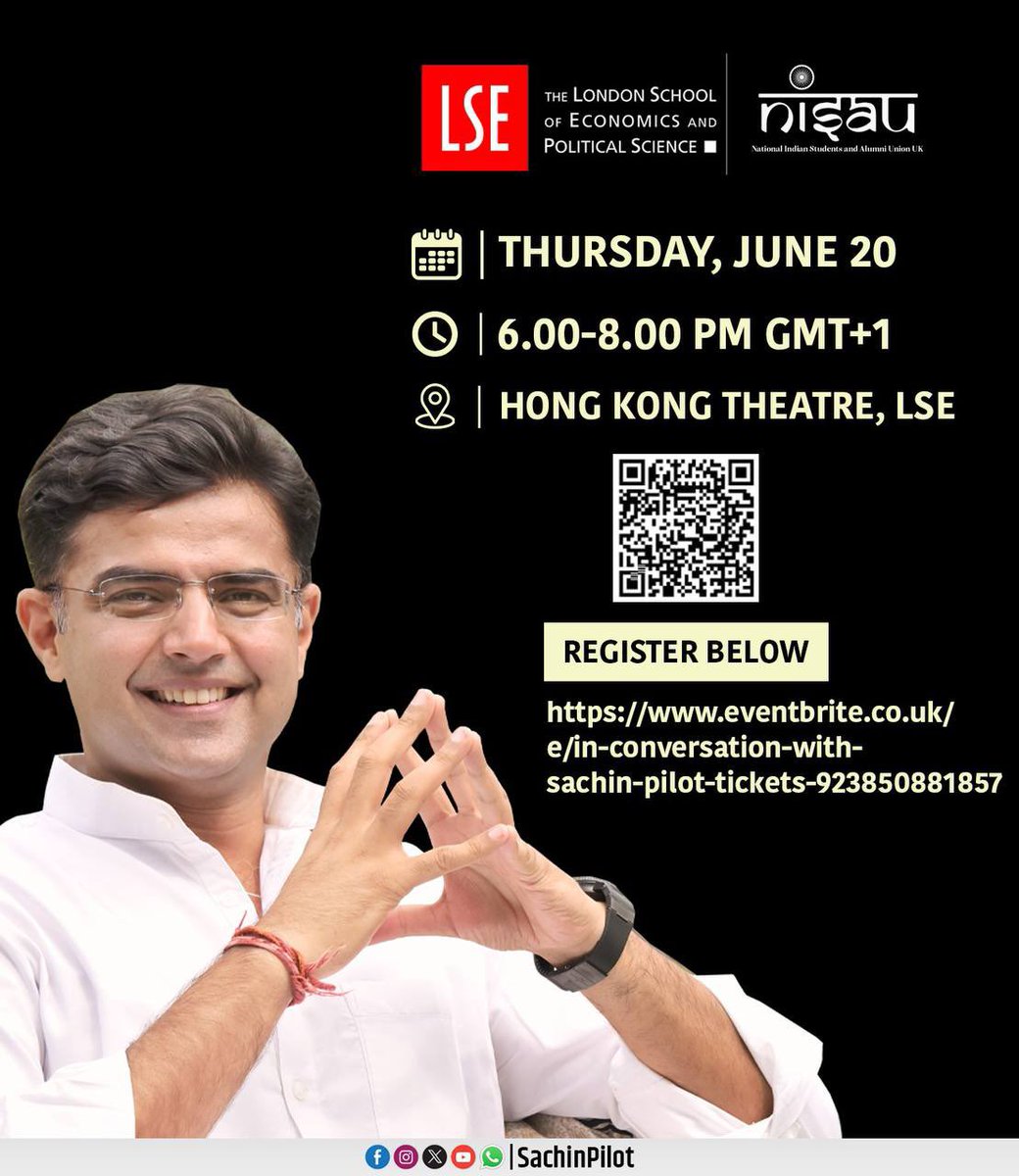
I will be speaking at the discussion hosted by the London School of Economics (LSE).
Looking forward to an engaging conversation.
🗓️ Thursday, 20th June
🕕 6.00 PM (GMT+1)
📍Hong Kong Theatre, LSE
The event is open to the public.
For further details, click on the link below:
https://t.co/XXhFMIJwVW
@LSEnews@NISAU_UK
Exit polls are like unofficial answer keys; they might not be 100% accurate, but they can give you a good idea of whether you've passed the cutoff or not! #ExitPoll
Ordered a carpet from @Flipkart , got a completely different product with a different color and design. Been trying to return it for a month, but delivery guys give lame excuses that it's not matching! I'm returning it because it doesn't match!
Trivago, which is majority-owned by Expedia Group, has debuted a first-of-its-kind AI-driven television advertising campaign featuring its new logo and visual identity. https://t.co/OgZrZBIseD
#GenerativeAI#ArtificialInteligence#Advertising