Fall ’26 Student Ambassador applications are now open.
We’re looking for builders, operators, and community drivers who want to get hands-on with decentralized cloud and actually ship.
Deploy apps. Run AI models. Host events. Contribute to real infrastructure.
Apply here: https://t.co/XyQ3JY7gzc
Akash approaches compute as an open marketplace where resources can be discovered and used when needed.
It’s still early, but one of the most interesting questions in AI isn’t what agents will do.
It’s what infrastructure will power them.
Akash Ambassadors, Deepthi M. (UT Austin CS + Business Honors), shared a thoughtful take on a question most people aren't asking:
If AI agents become ubiquitous, what infrastructure will actually power them?
A few insights worth thinking about 🧵
The more I learn about AI systems, the more I believe some of the biggest opportunities in AI aren’t at the application layer.
They’re at the infrastructure layer.
That’s what initially led me to learn more about @akashnet .
Q: What's your favorite part of the ambassador program so far?
A: "I love how we have so many opportunities to build on Akash and host events, and the community is incredible as well! I feel very supported as part of the cohort, and I am excited to continue building."
One of the best parts of the Akash student community is watching ambassadors become educators for the next wave of builders.
Awesome work on this tutorial @l1di13 👏
Déployez automatiquement sur @akashnet depuis GitHub avec ce tutoriel.
Découvrez comment automatiser vos déploiements sur le réseau décentralisé Akash.
Sous-titres : 🇫🇷 FR | 🇬🇧 EN | 🇪🇸 ES
👉 https://t.co/IzWue5IeZQ
@AkashStudents#AkashNetwork#DevOps#GitHub
Proud to share that 7 of our Spring ’26 ambassadors are returning for the Fall ’26 cohort.
These are our ambassadors who consistently showed up, built, contributed, organized, and brought real energy to the community all semester long.
That’s exactly the kind of program we want to keep building.
Fall ’26 applications are rolling and open now ↓
Three months. That's how long it took one of our Spring '26 ambassadors to feel like they'd actually made an impact.
Not from an event. From deploying on Akash, hitting rough spots in the docs, and fixing them.
The contribution that mattered wasn't loud. It was a better paragraph in the documentation that every future deployer will read.
Impact compounds quietly
Builders on Akash shipped autonomous scam detectors, a clinical watchdog catching chemo dosing errors in handwritten charts, smart glasses that trained a custom gesture model on Akash GPUs in one hour, a @Polymarket bot fusing 20+ data sources through Bayesian inference, and a simplified @openclaw / Hermes agent deployer.
↓ We're breaking down five of the most standout AI apps built in 2026.
https://t.co/CiezHRAufS
@gregosuri Here since you launched on Osmosis, up and down. You are building a genuine product of value. This is a big year to complete these next few items on the roadmap.
Your @AkashStudents rock, we see you out there, in the office, in Washington etc.
keep grinding 🙌
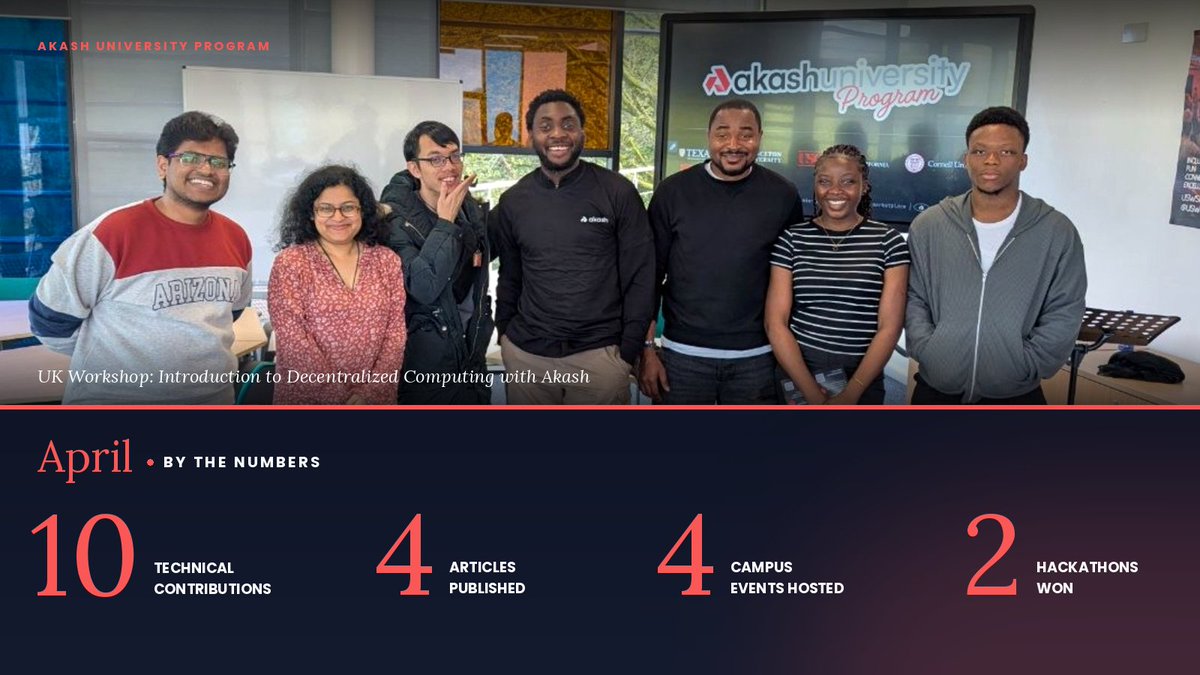
Powered by compute from @akashnet , our Indiana University ambassadors built and shipped two winning projects at the USC Blockchain Conference
Avalanche Track Winner: AgentHire — AI agent marketplace with on-chain identity + escrow-backed coordination
GitHub: https://t.co/HXiNkEGtFA
Solana Track Winner: Senthos — decentralized prediction market platform
GitHub: https://t.co/ETBp0isUH3