@PBHelpDesk Extremely disappointed with your service. I took car insurance 1.5 months ago after full inspection, yet my genuine claim is being denied as “Old Damage.” It’s been a week with no action. Need this resolved ASAP.
This clip which was shared with me is about Shri Inder Jit Singh Sidhu of Chandigarh.
Apparently, every morning at 6 AM, in the quiet streets of Chandigarh’s sector 49, this 88-year-old retired police officer begins his day in service.
Armed with nothing but a cycle cart and an unwavering sense of duty, he moves slowly and purposefully, picking up rubbish from the roadside.
He says he wasn’t happy with the ‘low rank’ Chandigarh got in the Swachh Surekshan listing. But instead of complaining, he chooses action.
Each piece of trash he clears is more than just litter removed. It’s a statement. A quiet, persistent belief in a better world. A belief in living with meaning, regardless of age or recognition.
In a world often obsessed with youth and speed, his slow but steady footsteps tell us that Purpose doesn’t retire. Service doesn’t age.
A Salute to this quiet warrior of the streets. 👏🏽👏🏽👏🏽
“Bahawalpur.”
I still have chills in my heart from when I first heard that town’s name in late January 2002. For the 23 years since, I have reported on how Pakistani intelligence and military leaders have used that city — Bahawalpur — in the southern province of Punjab as a base for its homegrown domestic terrorists.
When I heard India bombed training camps in Pakistan this week in Operation Sindoor, in response to a Pakistani terrorist rampage in India’s Kashmir state, I had one city’s name on my lips: Bahawalpur.
Did India bomb Bahawalpur?
It did. I knew then India was striking actual hubs for Pakistan’s homegrown domestic terrorism.
Why do I know?
My friend, WSJ reporter Danny Pearl, went to Bahawalpur in December 2001 with a notebook and a pen. Gen. Pervez Musharraf had just promised he was shutting down Pakistan’s militant groups after a strike by Pakistan’s terrorists against the Parliament in India, and Danny reported on the militant offices in Bahawalpur.
He literally knocked on their doors. Dear Dr. @yudapearl, this story is a window into Danny’s reporting enterprise. And because people will wonder: Danny was no cowboy. This was a calculated low-risk reporting trip because no journalist had been targeted for kidnapping in Pakistan. Around that time, Danny sent me an email: “I’m anxious to go to Afghanistan, but I’m not anxious to die.”
What did Danny learn?
The militant training camps were open for business in Bahawalpur.
On Jan. 23, 2002, Danny left a home I had rented in Karachi, Pakistan, for an interview.
I learned Danny’s fixer, Asif Farooqi, had arranged an interview for Danny through a man named “Arif.” Danny didn’t know it but Arif was the PR man for a militant group, Harkutul Mujahadeen. What was Arif’s hometown? Bahawalpur.
The police launched a manhunt to find Arif in Bahawalpur. We learned Arif’s family faked a funeral for Arif. Police found him trying to board a bus in Muzaffarabad, across the country by Pakistan’s border with Kashmir.
It is another town India said it bombed terrorist training facilities.
Arif had handed Danny off to Omar Sheikh,a British-Pakistani dropout from the London School of Economics, radicalized in the 1990s in London mosques. He went to Pakistan to train in these militant training camps. Then he kidnapped tourists in India. He was caught and jailed but on Dec. 31, 1999, he was traded for hostages in the hijacking of Indian Airlines Flight 814.
Omar Sheikh was freed with Pakistani terrorist leader Masood Azhar, whose family was allegedly killed this week by India’s air strike in Bahawalpur.
Did Pakistan jail Omar Sheikh and Masood Azhar when they returned to Pakistan with a third terrorist, freed from India’s jails?
No. Pakistan’s military and intelligence gave them safe passage. They used them as weapons against India. But in fact these domestic terrorists have waged war against innocents in Pakistan, like civil society activists, Benazir Bhutto, Punjab Governor Salman Taseer, schoolchildren and countless others.
Their extremism has ruined Pakistan, and Pakistanis can’t blame America for creating the mujahideen to fight the Soviets in the 1980s.
Pakistan has had a duty to dismantle those terrorist bases — for even the safety of its own people. What India is doing is a strategic attack on terrorist bases Pakistani military and intelligence should have eliminated but never did in their obsession to take over Kashmir.
You will see parallels in the propaganda messages against India and Israel. Like Hamas, Pakistani terrorists crossed a border to kill. Now, Pakistani propagandists call themselves victims of their “fascist” “colonizer” neighbor.
It’s the Reverse Uno strategy of moral inversion, just like @stoolpresidente got from the Temple student who won’t take responsibility for promoting the “HATE THE JEWS” sign. Don’t fall for it. Nations, communities and people must own up to their extremism, from Bahawalpur to beyond.
Sam Konstas first innings was almost a mutiny in the reign of King Bumrah. Suddenly showing a rebellion is possible, it’s possible to throw a rock at the emperor, almost provoking other subjects to do it. Glad the king purged the mutineer. And the reign of fear continues :)
Jasprit Bumrah evokes the same emotions for Indian fans as Sachin in 90s or Kohli in his prime: a beacon of brilliance when others falter,the unwavering hope for brilliance every time he steps up & the incredible knack of meeting those towering expectations time & again...
Dear Rafa,
It has been a privilege to watch you evolve on our clay, where you will leave a perpetual mark on such a challenging surface.
We're proud to count you as our greatest champion, as much for your 14 titles as for the man you are. Your legacy will live on forever, on and off the tennis courts.
Victory belongs to the most tenacious. Legend belongs to the King of clay.
Thank you for the countless memories we've shared together. We wish you all the best for the future. Roland-Garros has been and always will be your home.
Hasta pronto, amigo 🧡
Roland-Garros
Vamos, @RafaelNadal!
As you get ready to graduate from tennis, I’ve got a few things to share before I maybe get emotional.
Let’s start with the obvious: you beat me—a lot. More than I managed to beat you. You challenged me in ways no one else could. On clay, it felt like I was stepping into your backyard, and you made me work harder than I ever thought I could just to hold my ground. You made me reimagine my game—even going so far as to change the size of my racquet head, hoping for any edge.
I’m not a very superstitious person, but you took it to the next level. Your whole process. All those rituals. Assembling your water bottles like toy soldiers in formation, fixing your hair, adjusting your underwear... All of it with the highest intensity. Secretly, I kind of loved the whole thing. Because it was so unique—it was so you.
And you know what, Rafa, you made me enjoy the game even more.
OK, maybe not at first. After the 2004 Australian Open, I achieved the #1 ranking for the first time. I thought I was on top of the world. And I was—until two months later, when you walked on the court in Miami in your red sleeveless shirt, showing off those biceps, and you beat me convincingly. All that buzz I’d been hearing about you—about this amazing young player from Mallorca, a generational talent, probably going to win a major someday—it wasn’t just hype.
We were both at the start of our journey and it’s one we ended up taking together. Twenty years later, Rafa, I have to say: What an incredible run you’ve had. Including 14 French Opens—historic! You made Spain proud... you made the whole tennis world proud.
I keep thinking about the memories we’ve shared. Promoting the sport together. Playing that match on half-grass, half-clay. Breaking the all-time attendance record by playing in front of more than 50,000 fans in Cape Town, South Africa. Always cracking each other up. Wearing each other out on the court and then, sometimes, almost literally having to hold each other up during trophy ceremonies.
I’m still grateful you invited me to Mallorca to help launch the Rafa Nadal Academy in 2016. Actually, I kind of invited myself. I knew you were too polite to insist on me being there, but I didn’t want to miss it. You have always been a role model for kids around the world, and Mirka and I are so glad that our children have all trained at your academies. They had a blast and learned so much—like thousands of other young players. Although I always worried my kids would come home playing tennis as lefties.
And then there was London—the Laver Cup in 2022. My final match. It meant everything to me that you were there by my side—not as my rival but as my doubles partner. Sharing the court with you that night, and sharing those tears, will forever be one of the most special moments of my career.
Rafa, I know you’re focused on the last stretch of your epic career. We will talk when it’s done. For now, I just want to congratulate your family and team, who all played a massive role in your success. And I want you to know that your old friend is always cheering for you, and will be cheering just as loud for everything you do next.
Rafa that!
Best always, your fan, ���
Roger
@bhogleharsha Absolutely boring for cricket watchers. Not everyone has enough time and patience to watch this kind of “nudging around”. Which offers no entertainment at all. This might be good for the game though, but no doubt about it being boring from fans’ perspective.
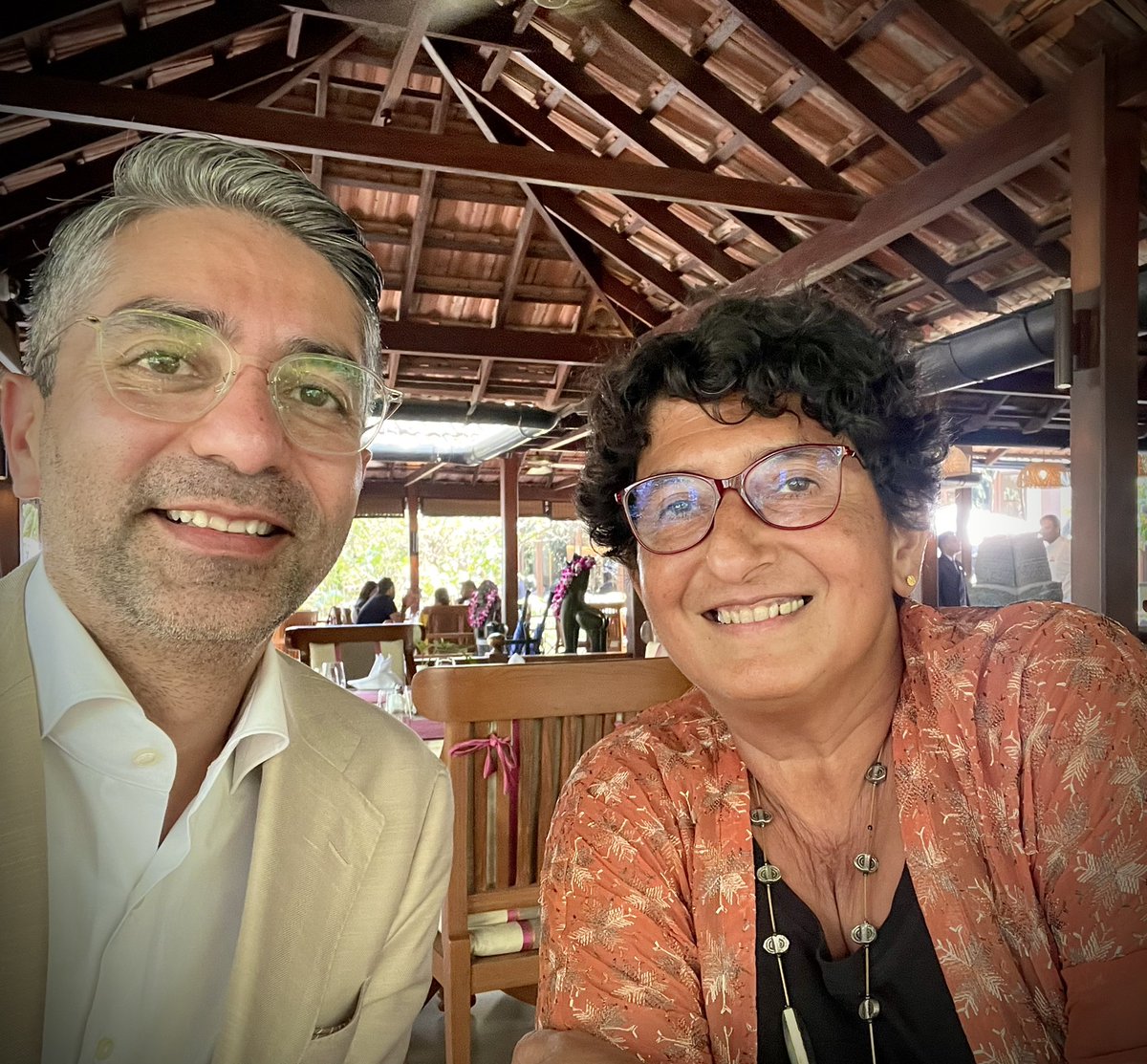
Today I had the pleasure of reuniting with Sharda Ugra over lunch in Bengaluru, a meeting that felt like a bridge connecting the past and present of my journey. The story of our connection takes us back to the moment when a young, 17-year-old me was embarking on his first Olympic Games to Sydney—a journey first captured by Sharda's insightful interviewing.
Our story weaves through the highs and lows of an athlete's life, particularly a poignant moment in Athens, where, despite breaking an Olympic record, I faced a heartbreaking defeat, finishing 7th. In the whirlwind of emotions that followed, feeling the weight of my world turned upside down, I confessed to Sharda, "I am done. I want to give up." Yet, it was in that moment of despair that Sharda, with the utmost kindness, told me what then seemed like nonsense, "You will win gold in Beijing." And as fate would have it, her words turned into a prophetic encouragement that led me to scream, just minutes after winning the Olympic gold in Beijing, "You were so right!"
Reflecting on that journey, it's clear that while it was Sharda’s job to report on my meltdown in the Olympic final—which I am sure she did—she first approached me as a human being who was in despair. Her gentle and kind words in that moment of despair had a profound impact on me. It is a testament to the power of empathy and the strength that comes from the support of those who believe in us, even when we doubt ourselves.
Sharda Ugra remains my favorite sports journalist, not merely because of this personal story but due to the quality of her work and the integrity with which she approaches it. For over two decades, Sharda has played a significant role in writing about athletes and their journeys, capturing not just the achievements, but the human spirit behind each victory and defeat.
As I share this story, it's a reminder of the incredible people we meet along our journey, whose belief in us can light the path to our greatest achievements. Sharda, thank you for being a beacon of inspiration, not just for me, but for countless athletes whose stories you've told with such grace and empathy. Here's to the power of words, the resilience of the human spirit, and the unbreakable bonds formed through the love of sport. 🌟 #Gratitude #Inspiration #OlympicJourney
8000+ test runs as an opener with an average of almost 50 and a strike rate of 82, the highest in the world for anyone above 2000 test runs, are incredible.
Sehwag changed the way Test matches were played. He was a one-man 'bazball' before 'bazball' was even a thing. His batting was the difference between a win and a draw in an era where draws were more common than results.
His ODI average is a little low, but that's expected from an opener known to provide an explosive start. His quickfire 30s and 40s used to give the middle order the cushion to take time and build innings.
Totally deserves to be in the ICC Hall of Fame.