After working on improving the quality of automated radiology report labelers for over a year, we are pleased to show (in our new short paper) that our recent improvements allow the training of better vision models for chest X-ray interpretation.
Radiology report labelers have significantly improved over last couple of years.
BUT, do these improvements translate to better chest X-ray diagnosis models?
Our new short paper shows that they DO: https://t.co/36EzKSPrCw
@saahil9jain@AkshaySmit@stanfordnlp
1/5
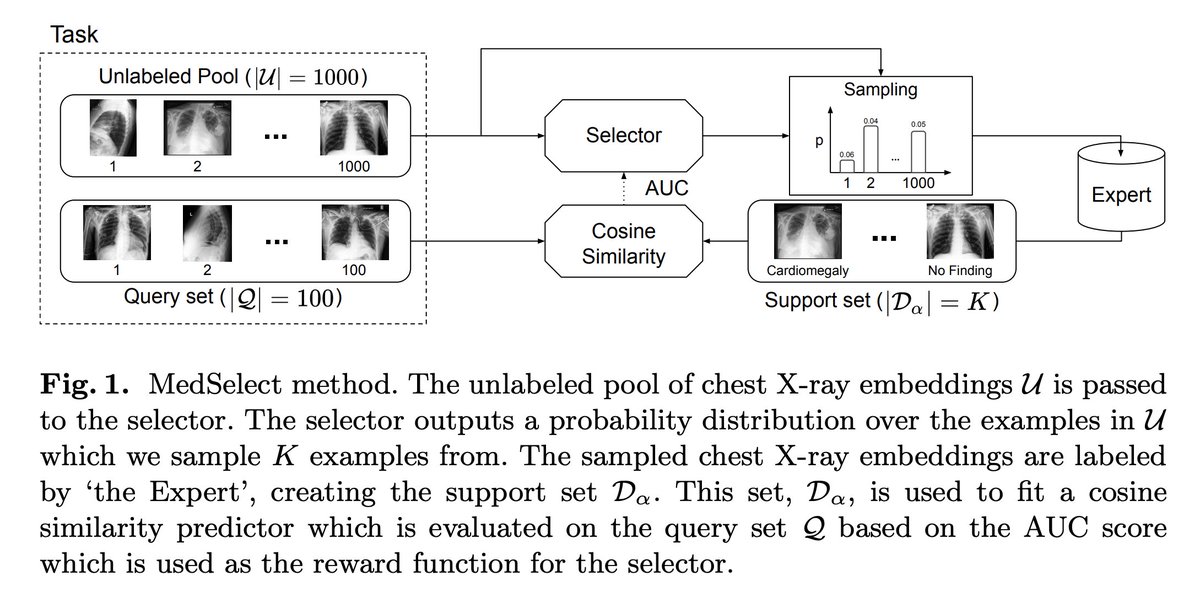
Excited to share our new work, MedSelect, on using deep reinforcement learning and meta learning to learn an effective selective labeling strategy for unlabeled medical images.
It is $$$ to label a large number of medical images for deep learning.
Can we select the “best” few images to label in a single step? #MedSelect
Yes, we can! Using meta learning w/ deep RL https://t.co/8CcSDsqQHk
@AkshaySmit@dvrabac@yujiehe9 & @AndrewYNg@AndrewLBeam
1/n
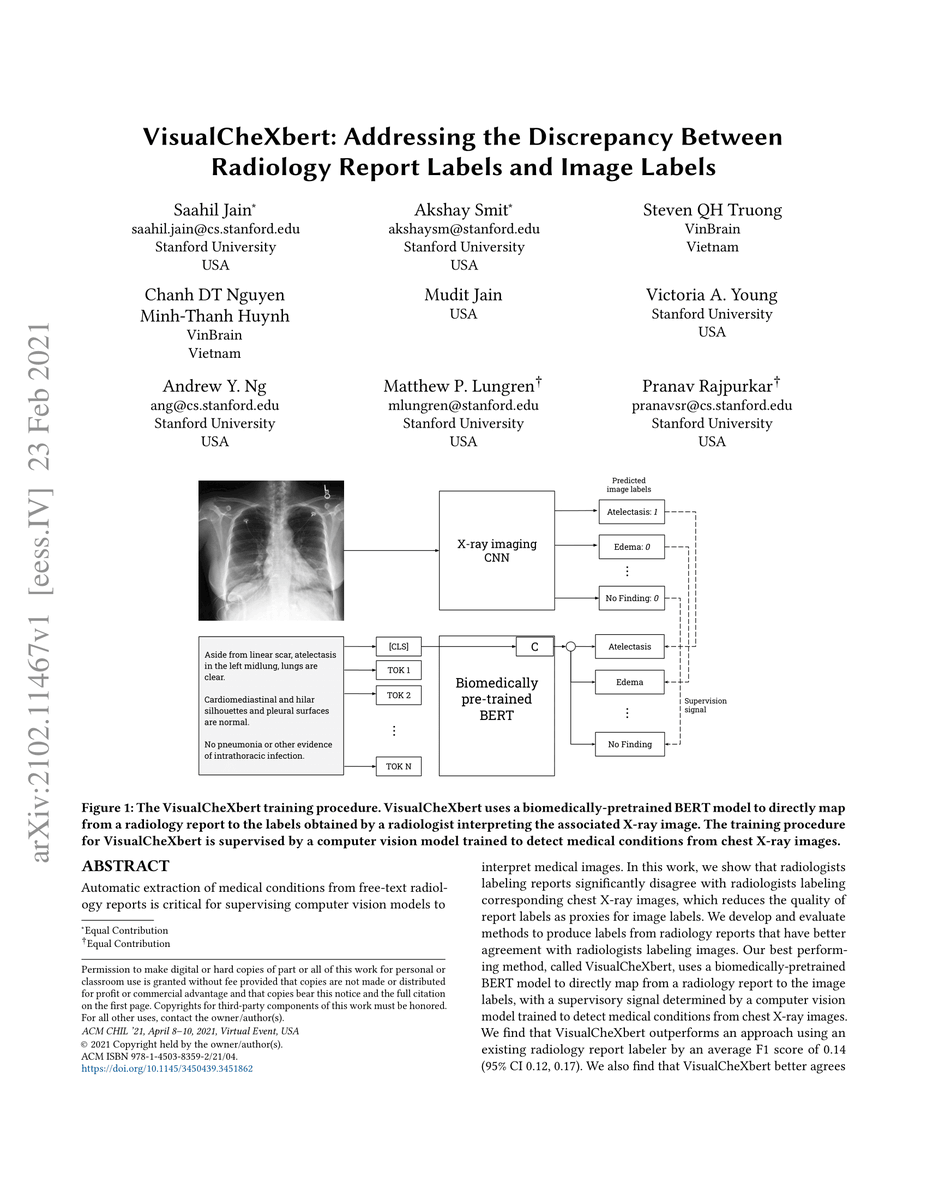
A common technique to train computer vision models to do automated image diagnosis is to train them with labels extracted from medical reports. Turns out these report labels are poor proxies for image labels! We investigate this in our work, VisualCheXbert!
Common practice for training medical imaging AI models is to use labels extracted from radiology reports.
This assumes that report labels are good proxies for image labels. BUT are they?
No! 😲
New paper🔎 https://t.co/Ug17cCCt8C
@saahil9jain@AkshaySmit@mattlungrenMD
1/9
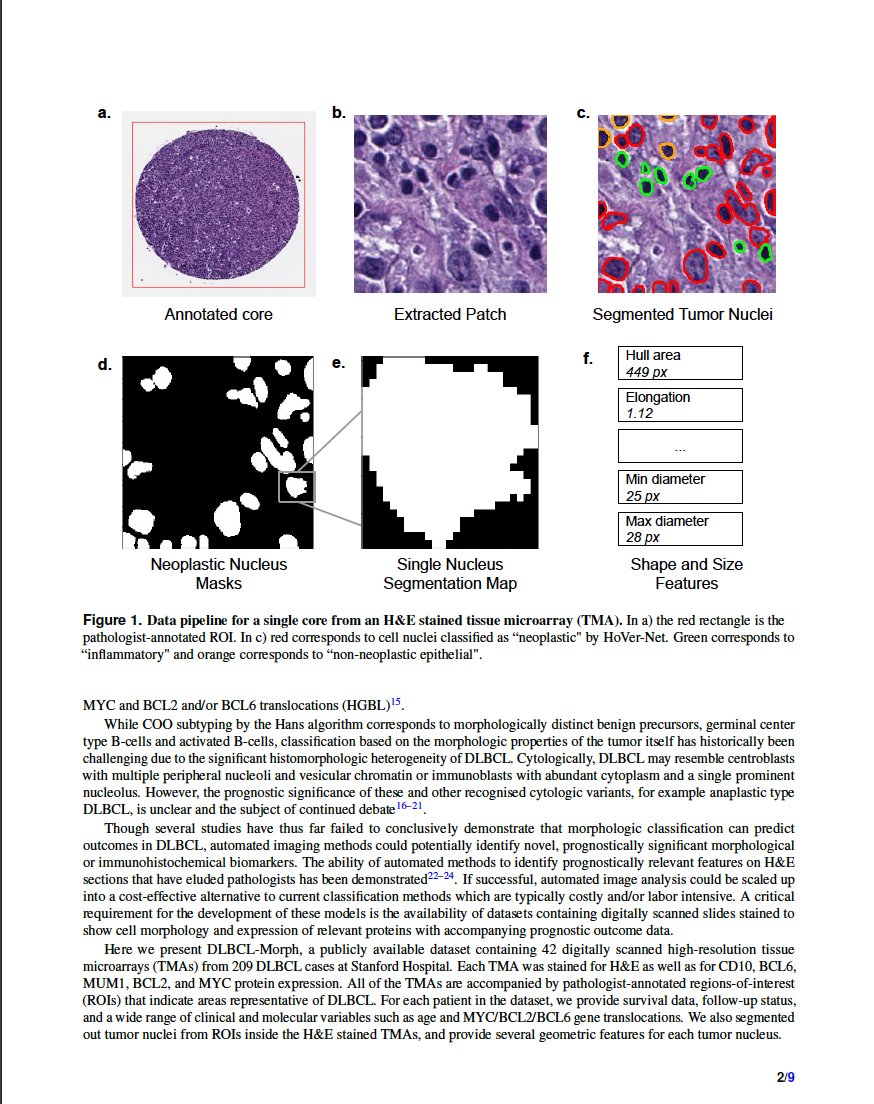
We present our new work on using the shape and size of cancerous cells to predict the survival of patients with Diffuse Large B-Cell Lymphoma (DLBCL)! Historically, no morphologic features have been consistently shown to correlate with prognosis. We release our annotated dataset.
Excited to share our new work (paper+dataset) on predicting survival with cancer (DLBCL) using histology sections 🔬💭
DLBCL-Morph https://t.co/gBqJLFlwmV
With @dvrabac@AkshaySmit, Sebastian Fernandez-Pol
Rebecca Rojansky, @yaso_natkunam, Ranjana Advani, @AndrewYNg
1/n
12 months ago, neither I nor @saahil9jain knew what NLP was. Then in Jan 2020 we got started with NLP through Stanford's CS224N, taught by the very effective Chris Manning. @stanfordnlp
CheXbert was originally just our class project!
2/n
Very excited that our paper CheXbert (https://t.co/BQ9HWxGMDr) was recently accepted to EMNLP 2020! Great effort by my co-first authors @saahil9jain@pranavrajpurkar
But there's a funny story behind this...
1/n
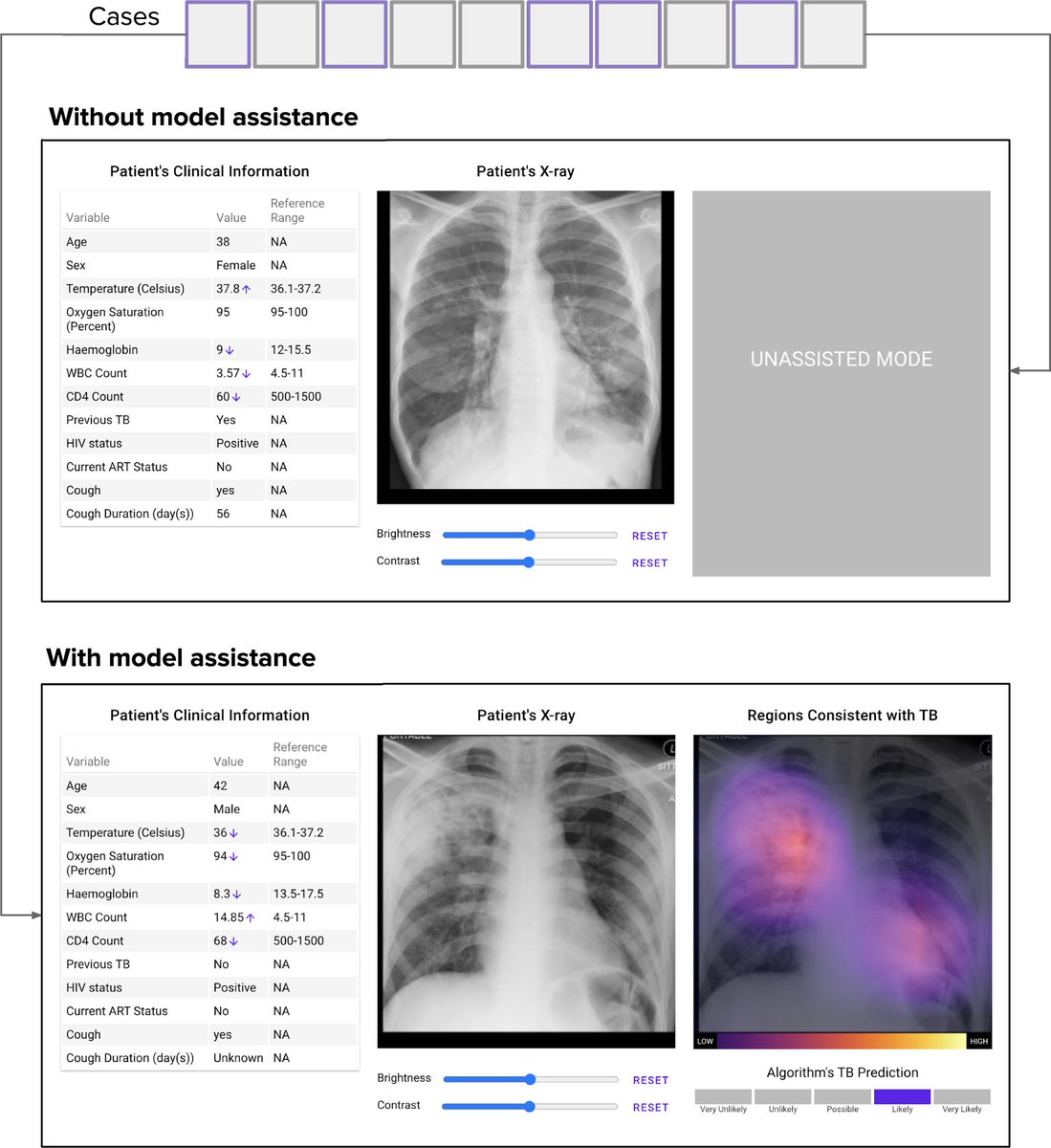
Excited to announce the publication of CheXaid, pushing the frontier of combining AI with clinician decision making 🥳🥳‼️‼️
https://t.co/Buq04XJpNh
w/ @chloepoconnell1@amitschechter, & @AndrewYNg @DocTomBoyles @mattlungrenMD
A short tweet summary
1/n
1/n Stanford's #CampusCompact is a coercive document that is intended to push the liability of Covid-19 to individual students. They are threatening to block enrollment, stipends, and housing until signed, but you can't read the contents of the document until you sign.
Excited to share our upcoming #MLHC 2020 paper, CheXpert++, providing a fast, differentiable, and probabilistic alternative to CheXpert: https://t.co/1ggTM4yZwH
Tzu-Ming Harry Hsu, @ckbjimmy, @MarzyehGhassemi, Pete Szolovits
1/n
New publication!
We apply machine learning to predict response to antidepressant treatments in patients with major depressive disorder @JAMANetworkOpen
https://t.co/3oAvC8Isyk
w/ @JingboEYang, Nathan Dass, Vinjai Vale, @AndrewYNg, Leanne Williams and more.
Tweet thread...1/n
In an update to our earlier work on automated radiology report labeling, we are able to at least match the previous SOTA (CheXpert labeler) by training only on radiologist-labeled reports (with backtranslation). The key was to use biomedical pretraining.
Updated work on deep learning for radiology report labeling with #CheXbert. https://t.co/9Drj55CPHI
Fun Fact! We improved upon last SOTA with biomedical pretraining using BlueBERT, thanks to @pengyifan's suggestion after our v1 preprint.
@AkshaySmit@saahil9jain
1/3
Excited to share our work on using BERT to label chest radiology reports for 14 medical conditions! Our model, CheXbert, combines training on automatically-generated labels with training on expert-labeled reports augmented via backtranslation, to achieve a new SOTA.
Tweet summary of our new work, CheXbert, on deep learning for radiology report labeling.
Key idea: Train BERT on labels of existing labeler, then finetune on augmented expert labels.
https://t.co/9Drj55CPHI
@akshaysmit@saahil9jain@anujpareek@AndrewYNg@mattlungrenMD
1/n
Excited for the release of the AI For Medicine course tomorrow! In this video, I'm referring to the seminal work on detecting lymph node metastases in tissue sections of women with breast cancer, published in @JAMA_current in late 2017: https://t.co/lz8C1lNC2Z