Rheu_n_me | Peeking through the window of science, chasing fresh perspectives in rheumatology. Passionate learner—growing a little wiser every day! 🌟🌻😄💘
🧵 Pyoderma Gangrenosum : Is there something sinister ?
PG is a rare, non-infectious neutrophilic dermatosis 🧬
👉 rapidly progressing, painful skin ulcers hallmarked by undermined borders and peripheral erythema.
👉 Not caused by infection or true gangrene, but due to immune dysregulation
Check out this thread to learn the "Must Know" essentials
#MedTwitter #RheumTwitter #Rheumatology #MedEd #Rheumatology #Immunology
#MedX #Medtwitter #Mnemonics #Medicine #History
@IhabFathiSulima@Janetbirdope@Lupusreference@RheumNow@IlliasulK@Rheumat_Aravind
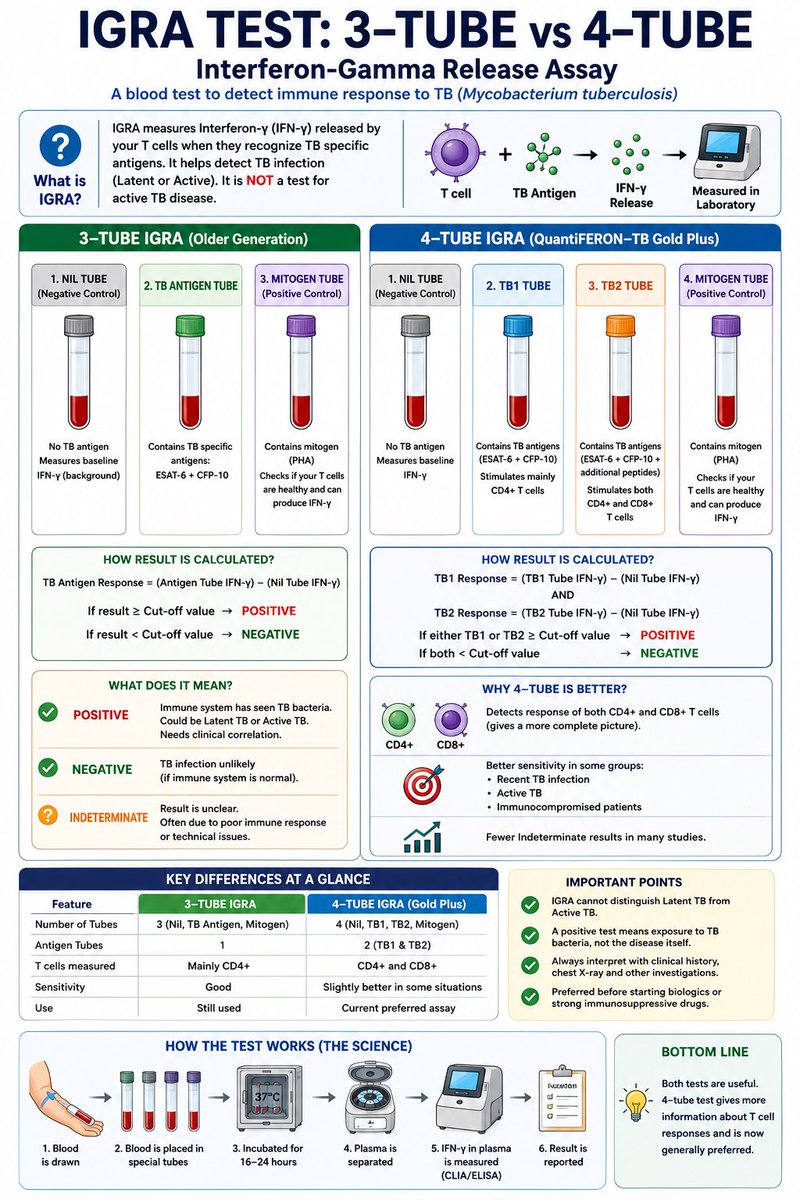
🧪 IGRA Made Easy: From Sample Collection to Interpretation
1️⃣ What is IGRA?
Blood test to detect immune response against TB bacteria
Measures Interferon-gamma (IFN-γ) released by memory T cells
Detects TB infection (latent or active) but cannot distinguish between them
⸻
2️⃣ How is the test performed?
✅ Collect blood in special tubes
⚪ Nil tube → Background IFN-γ (Negative control)
🟢 TB Antigen tube (or TB1 & TB2) → Stimulates TB-specific T cells
🟣 Mitogen tube → Positive control; confirms healthy T-cell function
⬇️
Incubate at 37°C for 16–24 hours
⬇️
Separate plasma
⬇️
Measure IFN-γ using CLIA/ELISA
⬇️
Interpret results
⸻
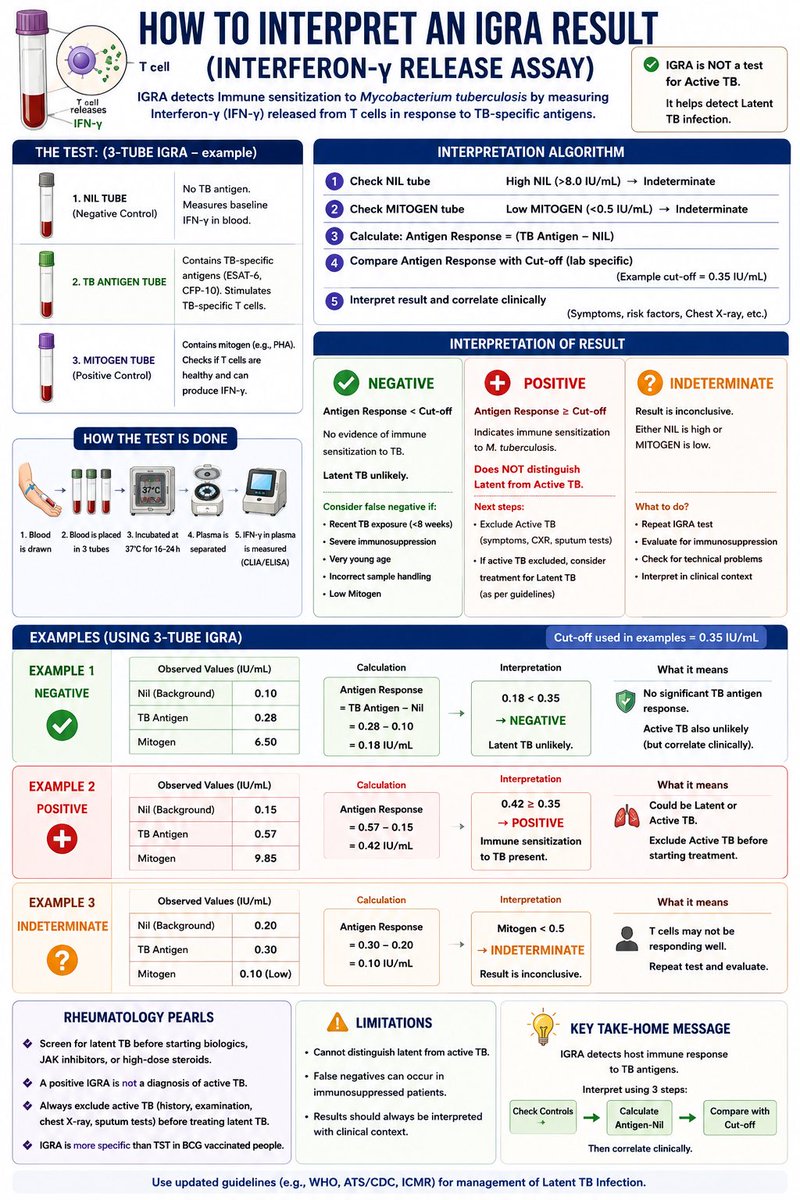
3️⃣ How do you calculate the result?
TB Response = Antigen − Nil
Compare with laboratory cutoff.
⸻
4️⃣ Interpretation
🟢 Negative
Antigen − Nil below cutoff
No evidence of TB sensitization
Consider false negatives in immunosuppressed patients
🔴 Positive
Antigen − Nil above cutoff
Immune system has recognized Mycobacterium tuberculosis
Does NOT mean active TB
Evaluate clinically
🟡 Indeterminate
Low Mitogen or High Nil
Repeat test
Consider immunosuppression or technical issues
⸻
5️⃣ Role of each tube
⚪ Nil Tube
Measures baseline IFN-γ
Detects background inflammation
🟢 TB Antigen Tube
Contains ESAT-6 & CFP-10
Activates TB-specific memory T cells
🟣 Mitogen Tube
Strong non-specific T-cell stimulant
Confirms immune system is capable of producing IFN-γ
⸻
6️⃣ 3-Tube vs 4-Tube IGRA
3-Tube
Nil
TB Antigen
Mitogen
Mainly measures CD4⁺ T-cell response
4-Tube (QuantiFERON-TB Gold Plus)
Nil
TB1
TB2
Mitogen
Measures CD4⁺ + CD8⁺ T-cell responses
Preferred in many centres
⸻
7️⃣ Important limitations
❌ Cannot differentiate latent TB from active TB
❌ Cannot assess bacterial load
❌ Positive result may persist after previous TB infection or treatment
⸻
8️⃣ Practical example
Nil: 0.15 IU/mL
TB Antigen: 0.57 IU/mL
Mitogen: 9.85 IU/mL
TB Response = 0.57 − 0.15 = 0.42 IU/mL
➡️ Compare with laboratory cutoff
➡️ Report as Positive if above the validated cutoff.
⸻
9️⃣ Rheumatology Pearls
✔ Screen before:
TNF inhibitors
JAK inhibitors
IL-6 inhibitors
Rituximab
Abatacept
✔ Positive IGRA ≠ Active TB
✔ Always exclude active TB before treating latent TB or starting biologics.
🔑 Take-home Message
Remember the 3 Cs:
Controls → Nil & Mitogen
Calculation → Antigen − Nil
Clinical Correlation → Symptoms + Chest X-ray + Risk factors
IGRA detects immune memory, not live TB bacteria.
Our last Batch of superspeciality doctors completed tenures more than 7 months ago. NEET SS held in Dec 25, the batch of doctors hasn't joined yet due to counselling delay. Doctors at 2/3rd workforce working 1.5 times on average to take care of patients. Why are we paying taxes?
@amarDgreat@SudhanidhiB why unnecessarily medications are being given ? The doctor might have been pressurised to atleast give an IV fluid inspite of having no vitals or serious bodily injury. It is a shame
@svembu When ears are folded and eyes are shut , science stops progressing. The foundation of medicine is questioning everything. Critical thinking and reliable data is requiredin vaccine tech
But for a layman, when antagonism comes from a reputable person like yourself, it's final word
@svembu The best talents stay in India, overcoming local competition. Only "above average" ones emigrate due to intense rivalry. Family duties and workload curb their ambitions. Endless pressure from 10th through NEET/JEE, college, PG, exhausts them for ambition as family comes first
The Real Reason Behind Bed Shortage & Overcrowding at Safdarjung Hospital
The real problem of bed shortage and crowd problem at Safdarjung Hospital is not negligence or laziness of doctors — it’s the system failure created by poor policies and infrastructure.
Safdarjung follows a “No Refusal Policy”, which means no patient can be turned away — no matter how full the hospital is.
But what makes the situation unbearable is the poor referral system from primary, secondary, and even tertiary care centers like RML, GB Pant, and AIIMS.
Every day, patients with simple acidity problems are referred from other hospitals to Safdarjung with the note that the “patient is having a heart attack.”
Dengue patients with no serious symptoms are sent saying “your patient needs admission in a big hospital” or “needs platelet transfusion” — when in reality, all they need is oral fluids and reassurance.
Patients with simple diarrhea, cough, cold, or minor ailments — who should be treated at primary or secondary centers — are being referred to Safdarjung as “emergency cases.”
During my PG residency, I personally saw referral letters saying: “Patient being referred due to non-availability of Glucometer / BP Machine.”
What are we supposed to say to that? If even basic equipment is missing, why are such hospitals running?
Even tertiary care centers like RML, GB Pant, and AIIMS — which have superspeciality and ICU departments — still refer patients to Safdarjung for those same services.
Sometimes there’s not even proper documentation; attendants are just told,
“Go to Safdarjung Hospital.”
Even ambulance drivers know that Safdarjung has a “No Refusal Policy.”
So even when the referral paper clearly mentions another hospital, they still bring the patient here — because they know Safdarjung will admit them.
This referral policy flaw has been reported many times to higher authorities and even to the Health Ministry, but nothing has changed
In the Medicine Department, we have 48 beds per ward, managed by 2 units.
Each week, there are 2 emergency duties, sometimes 3 (due to Sunday emergencies).
Each emergency, we are forced to admit around 80–120 patients, meaning 200–300 new admissions every week — all in those same 48 beds.
Around 40% of these patients require ICU-level care, but there are only 10 ICU beds available in the ward — and even those don’t have full facilities like monitors, ventilators, or infusion pumps for every bed.
The government provides staff — doctors, nurses, technicians — based only on the 48 sanctioned beds, not the actual 200–300 patient load we handle.
In every emergency, we clearly explain to attendants about the bed situation, ICU availability, and limitations.
At that time, attendants usually say:
“Sir, just admit our patient anywhere, we’ll manage.”
But once they see the real situation in the ward, they start blaming doctors, making videos, creating chaos, or pressuring doctors using their connections — MS, MLAs, MPs.
Tell me — what can a doctor do in that situation?
Our job is to treat patients, not to provide beds, buy equipment, or build infrastructure — that’s the government’s job.
Safdarjung Hospital handles 2,000–3,000 patients every day.
Many of them require radiological imaging like CT or MRI.
But the hospital has only one CT machine, which also doesn’t work from 4–6 AM because of daily maintenance.
Result?
Patients get CT/MRI dates after 5–6 months.
In my first year of residency, many patients got MRI dates that were one full year later.
So again — how can anyone blame the doctor for this?
Should we buy more machines from our salary?
#MedTwitter #Delhi #SafdarjungHospital #Doctors #Healthcare #SystemFailure
@DrAkhilX @IMAIndiaOrg@DrDhruvchauhan@Indian__doctor
Incredible breaking news for all myositis patients and physicians: Brepocitinib, a TYK2/JAK1 inhibitor, showed positive and meaningful primary and all secondary outcome with 30 mg daily oral dose in a phase 3 RCT on Dermatomyositis (VALOR trial). @Roivant https://t.co/yf6cNKul0L
A 26-year-old female presented with left knee pain and swelling for 24 months, with an X-ray showing the Phemister triad (periarticular osteoporosis, peripheral bone erosions, and joint space narrowing), suggestive of TB arthritis,confirmed by culture