BREAKING: The New York Times has obtained leaked audio recordings of the White House Situation Room when Trump and Rubio were discussing going to war with Iran.
📌 The narcissist doesn’t smear you to hurt you emotionally, though that’s a bonus. They smear you to ensure: nobody will believe you when you try to tell your side. Nobody will support you when you try to leave. Nobody will validate your experience when you start questioning.
THE ISOLATION EFFECT
The smear campaign doesn’t just hurt you socially. It isolates you strategically. And the isolation is the mechanism. Not a side effect. The mechanism.
Because the narcissist understands: isolated people are powerless people. An isolated person can’t build alliances. Can’t find validation. Can’t tell their story to anyone who might believe. Can’t access perspective from the outside.
Isolated, you’re completely dependent on the narcissist’s version of reality. Because they’re the only voice you can hear clearly. The only narrative that’s consistent. The only explanation available.
The narcissist doesn’t smear you to hurt you emotionally, though that’s a bonus. They smear you to ensure: nobody will believe you when you try to tell your side. Nobody will support you when you try to leave. Nobody will validate your experience when you start questioning.
By the time the isolation is complete, you’re not just cut off from the group. You’re cut off from yourself. Because without external validation, without alternative perspectives, you start to believe the narcissist’s version. You start to doubt your own perception.
The isolation also serves another purpose: it keeps you focused on the narcissist. All your energy goes to trying to fix what they’ve said. Trying to change people’s minds. Trying to prove yourself. All of that focus, all of that effort, all of that emotional energy is directed at them. Toward managing their narrative. Toward living in reaction to their lies.
You’re not healing. You’re not building a life for yourself. You’re not moving forward. You’re completely consumed by the narcissist’s campaign. And the narcissist loves this because it means: you’re still controlled. Still focused on them. Still dependent on the outcome of their narrative.
The isolation prevents you from seeing clearly what’s happening. If you had allies, you could say “is this real?” and they could ground you. Could remind you of the truth. Could help you see beyond the fog.
But alone, the narcissist’s version becomes the only version. And you start to believe it. Start to internalize it. Start to blame yourself for the very things the narcissist did to you.
This is why isolation is the greatest tool of abuse. Not because it’s painful. But because it’s effective. Because isolated, you can’t access the truth. Can’t find perspective. Can’t escape.
The narcissist knows this. That’s why the smear campaign is designed to isolate you completely. That’s why it’s so effective. That’s why breaking the isolation is the first step toward freedom.
Even one person who knows the truth. Even one person who believes you. That one person breaks the monopoly. That one person restores your reality. Because the narcissist’s power depends on total isolation. The moment you have one ally, the power cracks.
"Ironically, people who see themselves as victims often feel entitled to mistreat others. The implicit moral logic seems to be 'because I’ve been wronged, I can do no wrong.'"
https://t.co/F4bTXnnZtx
«أشار أرسطو، إلى أن الديمقراطية لا تكون ممكنة إلا داخل الجماعات العرقية المتجانسة، وأن الطغاة والمستبدين يستقدمون الأجانب لأن المجتمعات المنقسمة تكون أسهل في الحكم والسيطرة».🫣
Aristotle correctly pointed out that democracy is only possible within ethnic groups, and that tyrants import foreigners because divided societies are easier to rule over and control.
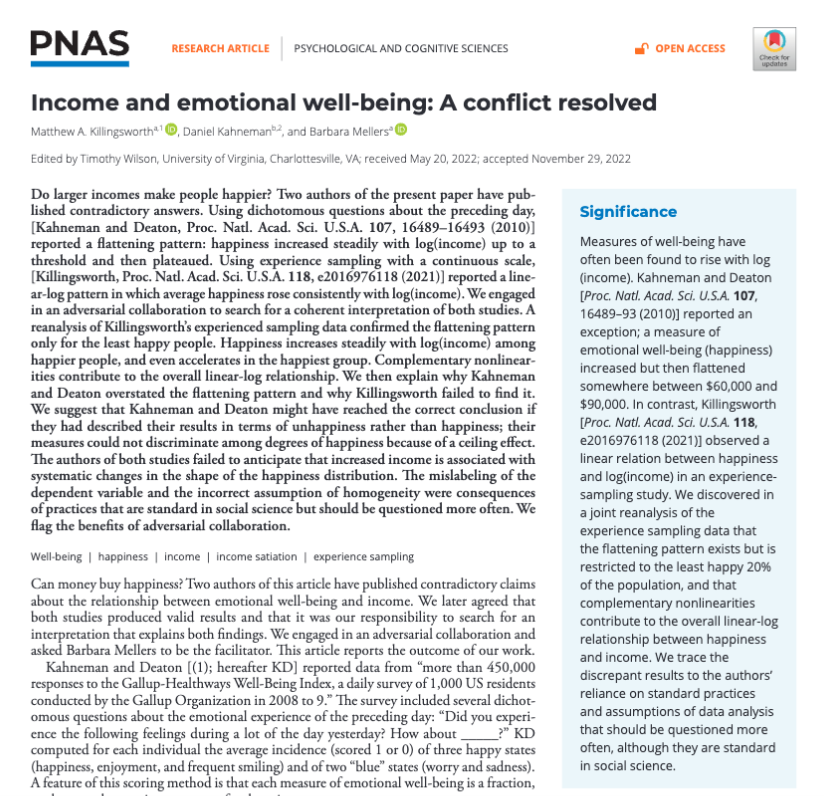
Does money buy happiness? A Princeton Nobel laureate said no above $75,000. A Penn researcher with 1.7 million data points said yes. The day they sat down together to settle the fight, the answer they reached should change how you think about your own life.
The Nobel laureate is Daniel Kahneman. The Penn researcher is Matthew Killingsworth.
The fight between them lasted 13 years, and the way it ended is one of the cleanest examples in modern science of two smart people being wrong in opposite directions about the same question.
In 2010 Kahneman and his Princeton colleague Angus Deaton published a paper that became one of the most quoted findings in the history of social science.
They analyzed 450,000 responses to the Gallup-Healthways Well-Being Index and concluded that emotional well-being rose steadily with income up to about $75,000 a year, and then flattened out completely. Above that line, the extra money was not buying any more daily happiness.
The headline traveled around the world. Every news outlet ran the number.
A CEO in Seattle famously cut his own salary to raise his employees to that exact threshold. The 75,000 dollar figure became cultural shorthand for the idea that the rich are not actually any happier than the rest of us once basic needs are met.
For 11 years almost nobody seriously challenged it. Kahneman had a Nobel Prize in Economics, the sample size was massive, and the conclusion was emotionally satisfying in a way that made everyone feel a little better about not being wealthy.
Then in 2021 a 33 year old researcher at the University of Pennsylvania published a paper that quietly destroyed the entire finding. His name is Matthew Killingsworth.
He had spent the previous decade building a smartphone app called Track Your Happiness that pinged users at random moments during their day and asked them a simple question.
How do you feel right now, on a scale from very bad to very good. The app was designed to catch happiness in the act, not to ask people to recall it later.
By 2021 he had collected over 1.7 million real-time happiness reports from 33,000 adults. When he plotted income against in-the-moment well-being, there was no plateau anywhere.
The line just kept rising. People earning $200,000 were happier on average than people earning $100,000. People earning $400,000 were happier than people earning $200,000. The curve flattened slightly but never stopped climbing.
The famous $75,000 ceiling that the world had been quoting for 11 years simply did not exist in his data.
Now there were two Nobel-quality findings sitting in direct contradiction with each other. One of them had to be wrong, and neither researcher was willing to walk away.
What happened next is the part of the story almost nobody knows.
Kahneman called Killingsworth and proposed something rare in academic science. He called it an adversarial collaboration. The two of them, joined by Penn psychologist Barbara Mellers as a neutral referee, would sit down together and reanalyze the raw data from both studies, line by line, until they figured out which one of them was wrong.
The paper they co-authored was published in March 2023 in the Proceedings of the National Academy of Sciences. And the answer they reached was not what either of them had expected.
Both of them had been right at the same time. They had been measuring two different populations without realizing it.
When the team broke Killingsworth's 1.7 million data points apart by baseline happiness, the picture clarified completely. For the happiest 70 percent of people, more money kept buying more happiness all the way up to $500,000 a year, with no sign of slowing down.
For people in the middle, the same pattern held. But for the bottom 20 percent of the sample, the ones who were already unhappy before the question of money even came up, the curve flattened almost exactly where Kahneman's original paper had said it would. Above roughly $100,000 a year, adjusted for inflation, more money did nothing for them.
This is the finding that changes how the question should be asked.
If you are not already unhappy, money keeps buying happiness for a much longer stretch than Kahneman's original paper suggested. The runway is wider than the world has been telling itself for a decade.
If you are already unhappy, money does almost nothing past a certain point. There is a ceiling, but the ceiling is not about income. It is about the underlying state of the person collecting it.
The deeper insight in Killingsworth's original research, the one almost nobody talks about, is the part that should sit with you longer than the income numbers. The Track Your Happiness app had been telling him for years that the single biggest predictor of in-the-moment well-being is not money at all. It is whether your mind is on the thing you are doing.
His most cited paper, written with Daniel Gilbert at Harvard, is titled A Wandering Mind Is an Unhappy Mind. The data from the app showed that people are mentally absent from what they are doing 47 percent of the time, and that mental absence is one of the strongest predictors of unhappiness in the entire dataset. More predictive than income. More predictive than the activity itself. More predictive than almost any demographic variable you could measure.
Which means the unhappy 20 percent that Kahneman's plateau actually described were probably not unhappy because they did not have enough money. They were unhappy for reasons that more money could not reach.
The reason the curve flattened for them at $100,000 a year is the same reason it would have flattened at $300,000 or $700,000. The thing they were missing was not buyable.
The most uncomfortable line in the entire 2023 paper is the one that nobody on the internet quotes. The authors note that the relationship between income and happiness, while real, is much weaker than the relationship between attention and happiness. A person earning $40,000 who is fully present in their own life will, on average, report higher in-the-moment well-being than a person earning $400,000 whose mind is somewhere else.
The fight about money was the wrong fight the entire time.
The two researchers spent 13 years arguing over whether the dollar ceiling was at $75,000 or $500,000, and the data from Killingsworth's own app was sitting there the whole time saying the ceiling was not about dollars at all. The ceiling is whether you can hold your attention on the life you actually have.
You can run the experiment yourself the next time you catch your mind drifting. Stop. Put your phone down. Look at the room you are in, the person across from you, the food in front of you, the work you are actually doing. That is the part the apps cannot sell you and the salary cannot buy you.
The data has been clear for over a decade. The plateau is not in your bank account. It is in your attention.
النبي تتلهي على عينك َوتقعد ساكت يا طاطا.
دول الخليج من نفسها اجرت اتصالات سرية مع إيران وقت الحرب، ودفعوا لها فلوس سرا علشان يتم تجنيبهم الضربات الانتقامية.
عندما يقول نائب الرئيس الأمريكي جي دي فانس: ان دول الخليج ستدفع ٣٠٠ مليار دولار لإعادة تعمير إيران، فهذا يعني استهانه وبلطجه تمارس علي دول الخليج ، التي لاعلاقة لها بالحرب ، ولم تكن طرفا فيها ، هذه عملية ابتزاز تجري علي حساب دول الخليج ، أمريكا وإسرائيل شنا الحرب علي إيران ، وهما المطالبان بدفع الأموال لإعادة تعمير إيران . دول الخليج تحملت الهجمات الإيرانيه ولم ترد ، بل كانت فقط في موقع الدفاع ، لذلك يبدو غريبا هذا المطلب من الإدارة الأمريكيه ، التي تسعي إلي التصالح مع إيران علي حساب دول الخليج . حقا اللي اختشوا ماتوا !!
قائد فيلق القدس إسماعيل قاآني في مقابلة تبثها شبكة خبر الإيرانية:
▪️ سيعاد بناء حركة حماس.
▪️ لقد تألق كامل محور المقاومة بقوة في الحرب الأخيرة.
▪️ ما زال أمامنا طريق طويل مع الولايات المتحدة والكيان الصهيوني…
▪️ وصيتي لهم، من مصلحتكم أن تصغوا، لا تنخرطوا مجددًا في المواجهة، لأن أوراقًا أخرى غير مضيق باب المندب ومضيق هرمز ستُكشف.
عراقجي: إيران تأخذ بعين الاعتبار تاريخ الولايات المتحدة في نقض العهود وانتهاك الاتفاقيات
- برنامجنا التفاوضي وتنفيذ التفاهمات مبني على انعدام الثقة وخبرتنا في تاريخ انتهاكات الطرف الآخر
- نسعى جاهدين لإيجاد أكبر قدر ممكن من الانفتاح الاقتصادي للبلاد عبر هذا المسار
BREAKING: NETANYAHU SAYS HE DOES NOT AGREE WITH TRUMP’S IRAN DEAL & HE TOLD TRUMP ‘WE HAVE OUR OWN INTERESTS’
“This agreement was made by the United States, by the President of the United States, and he believes that he can achieve both supervision and the dismantling of the nuclear program.
I said: that is his decision. I repeat: that is his decision. He is leading it.
Of course, I expressed my views in various conversations.
On the other hand, I said that we have our own interests.”
JD Vance has confirmed Iran may have access up to 300 billion dollar reconstruction budget funded by the Gulf States if they honour their side of the deal.
BREAKING: 🇺🇸🇮🇷 President Trump, Vice President JD Vance, and Iranian Parliament Speaker Mohammad Bagher Ghalibaf have electronically signed the Memorandum of Understanding.
JD Vance on Iran:
We are extending an open hand to Iran. If they want to change their relationship with us, we will change our relationship with Iran.
That's the offer.
📌 المتحدث باسم وزارة الخارجية الإيرانية:
"وفقًا لاتفاقية المذكرة، ستتولى إيران وعُمان مسؤولية إدارة المرور عبر مضيق هرمز. إيران لا تسعى لفرض رسوم مرور. ومع ذلك، مقابل خدمات الملاحة، وحماية البيئة، والتأمينات، وغيرها من الخدمات البحرية، ستجمع إيران الرسوم اللازمة."
JUST IN: Iran’s Foreign Ministry Spokesman, Ismael Baqaei on the Strait of Hormuz:
“According to the MoU, Iran and Oman will be responsible for managing passage through the Strait of Hormuz.
Iran is not seeking to impose tolls. However, in return for navigation services, environmental protection, insurances and other maritime services, Iran will collect the necessary fees."
انسحاب اسرائيل من الجنوب اللبناني يقضي على ناتنياهو سياسيا!
إسرائيل خسرت مدنيين في قصف مستوطنات الشمال و خسرت أكثر في الجنوب من أفراد جيشها و دول بيعدوهم بالواحد…