Crown shyness is a phenomenon where the top branches of neighboring trees avoid touching to stay safe, leaving visible jigsaw like gaps between their crowns.
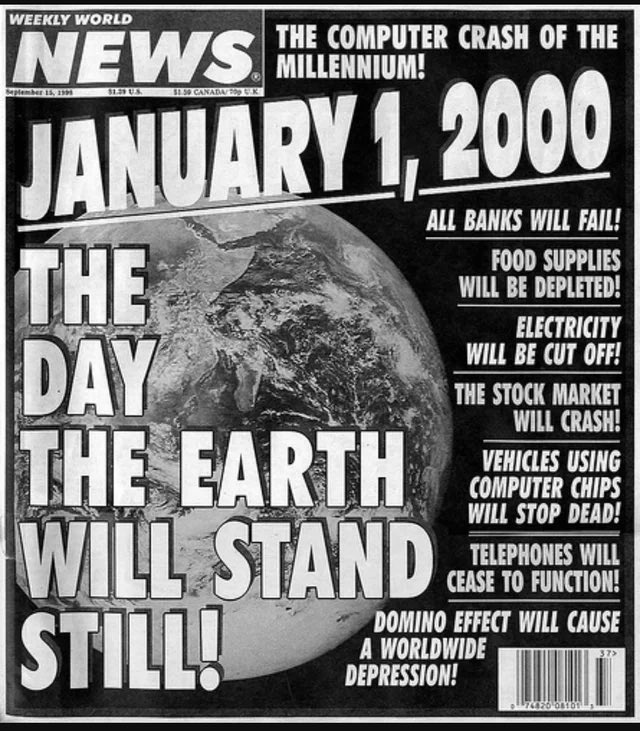
The Y2K scare peaked as the year 2000 approached. The concern stemmed from the way dates were programmed in computers, as many systems represented years with just two digits, leading to worries that computers would not differentiate the year 2000 from 1900. This issue had potential implications across various sectors, including banking, utilities, and government operations, raising fears of widespread system failures.
In response, extensive efforts were undertaken globally to address these potential glitches. Software and hardware companies raced to fix the bug and provided "Y2K compliant" programs to help. The simplest solution was the best: The date was simply expanded to a four-digit number. Governments, companies, and organizations invested heavily in updating and testing their computer systems. These preventive measures ranged from simple software patches to complete system overhauls.
Despite the widespread panic, the arrival of January 1, 2000, was largely uneventful with minimal disruptions. While the United States and other countries had spent millions to combat the potential issue, other countries including Italy, Russia, and South Korea had done little to prepare for Y2K. They had no more technological problems than those countries, like the U.S., that spent millions of dollars to combat the problem.
Japan’s iSpace HAKUTO-R lander captured this stunning photo in orbit around our Moon while a solar eclipse was occurring on Earth last week. You can see the Moon’s dark shadow passing above Australia as a dark smudge.