PhD candidate @uniofeastanglia using social licence to operate to understand how we can achieve biodiversity net gain in a way that works for people and nature!
Interested in #BiodiversityNetGain, or want to find out more?
Check out this animation then, if you're 16+ and living in England, fill in my questionnaire to contribute to research on how organisations should fulfill their BNG requirements: https://t.co/lU6KEQeFz1
@jstgerlach@Bill_Sutherland Having used these plots extensively in my masters, I’d say they’re a replacement in almost all cases, but fall down when you have a *very* skewed distribution as a single bar of the histogram gets too wide. Other plots don’t deal with this well either, though!
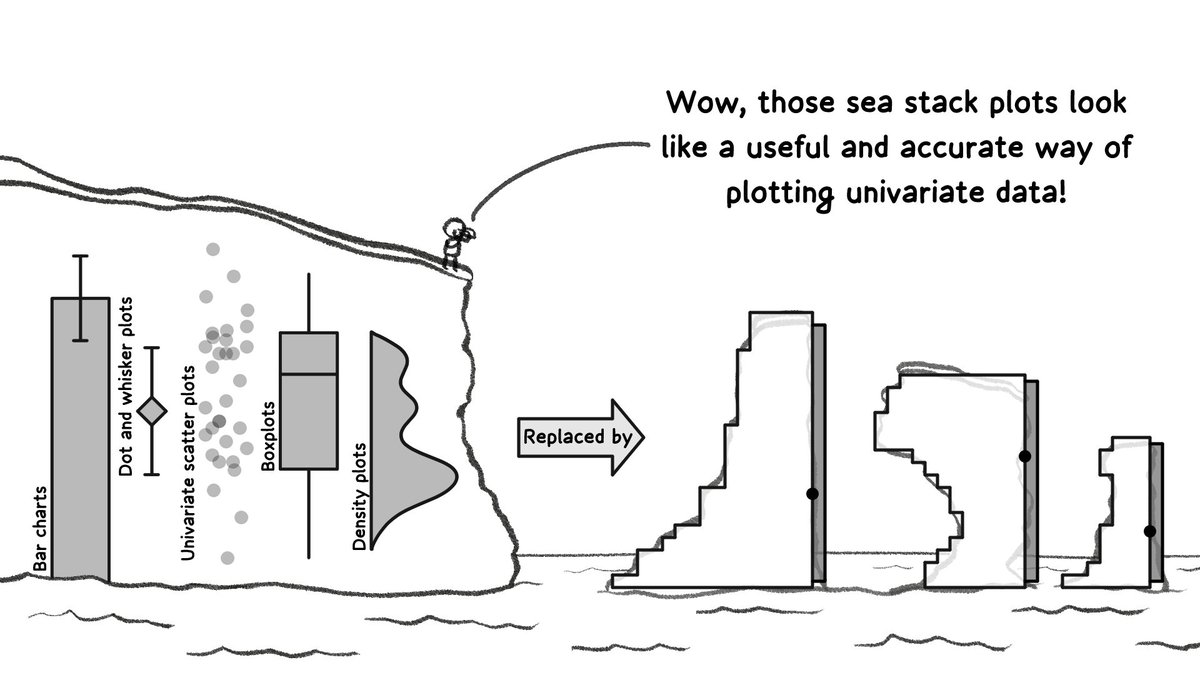
Happy to introduce Sea stack plots as an alternative to bar charts! What started as an interesting exchange here on X/Twitter, has now been published in Ecology and Evolution:
https://t.co/6Am0eNKajt
Amazing effort by @Bill_Sutherland, @BennoSimmons and especially @alice_stu_ !
Ever looked at a bar chart and thought “there must be a better way of plotting this data…”? Look no further than sea stack plots!
https://t.co/vs7UmBE5OP with @MajaIlicZg@BennoSimmons and @Bill_Sutherland
We teach a really cool module at @CamZoology for our ecology students on natural history #museums' vital role in evidencing environmental change. What's even better is that it includes a class on colonial legacies too. It's important they hear the history behind the collections.
Was lucky enough to be treated to not one, not two, but three cranes on my train to London this morning. Sadly no pictures (moving train…) but a great privilege!
@rebeccakeeling1 Hi Rebecca, I do not know exactly as will depend on number of responses, but will not be before the end of March so would be great if you could share it!
Interested in #BiodiversityNetGain, or want to find out more?
Check out this animation then, if you're 16+ and living in England, fill in my questionnaire to contribute to research on how organisations should fulfill their BNG requirements: https://t.co/lU6KEQeFz1
@Bill_Sutherland I'm not in a named lab (too small), but prefer groups named after what they do (e.g. Conservation Science Group) than the person running it. This also feels much more accessible to non-academics and those in other fields/ starting out as does assume knowledge of senior academics.
For a while now, @LauraEllenDee and I have been working on a guide to introduce Ecologists to causal inference tools for observational data that has problematic unobserved confounding variables lurking in the background. And now it's up as a preprint!
https://t.co/54ZyVoD4OU
@SueSteel2 @WWoodlanders@ueaenv Hi Sue, I also leafleted the local postcodes sharing the questionnaire and posted in a number of local and parish council Facebook groups. Doing my best to ensure everyone who wants to can contribute.
@Pete_Day @SueSteel2 @WWoodlanders@ueaenv Hi Peter, the reason for this is because the questionnaire is part of a wider research project - the options given are common arguments as to how we should prioritise biodiversity net gain compensation, so are relevant to other projects too. Happy to discuss this further!
@Pete_Day@WWoodlanders@ueaenv Hi Peter, I am the researcher in question, drop me a dm or email me (address in questionnaire), I'd love to chat about this!
Interested in #BiodiversityNetGain, or want to find out more?
Check out this animation then, if you're 16+ and living in England, fill in my questionnaire to contribute to research on how organisations should fulfill their BNG requirements: https://t.co/lU6KEQeFz1
@Ed_pheasant I found the (free) data downloads easier than scraping, but the bibliographies are a mess so there’s a lot of data cleaning to do once you have them!
An excellent checklist to assess whether your organisation is following evidence-based practice. Is also interesting to try and apply these principles to our daily lives!
If convinced by the likely gain in effectiveness from being evidence based then here is a checklist to see how your organisation is doing. Interested to know how your organisation scores (out of the number applicable - maximum 19).