Most professional services companies get caught looking out the rearview mirror. They explain last month, last quarter rather than focusing on making the next one. A primary focus of mine right now is building a forward-thinking muscle across our leadership team.
The core mechanism for this is how we’re utilizing data. Not just to analyze our past, but to inform our future.
Sure, we’re using that same data that explains the past… last month, last quarter, last year, etc. And we’re pairing it with data about our future, like forecasting and our active pipeline.
The result is we’re using all of this data more like a sophisticated consumer products business.
We’re not just dissecting the past, we’re using the information to help us make our month, our quarter, our year.
I sat with senior leaders recently walking through a new set of data workbooks that provide a real-time view of what's happened, what's in front of us, what's coming.
You could see the gears grinding. Not because they disagreed. More so because they were being asked to think differently.
It’s the classic immediate vs important conversation.
The immediate is what's right in front of you and what has already happened. The important thing is how you make next month.
As a result of our recent data efforts, our leaders are more informed about the business than they've ever been. We have more data in one workbook than I've ever seen.
I’m going to bet that, as a result of this forward-focused muscle, we’re going to have different, outsized results.
#professionalservices #growth #strategy
A friend recently asked me: "Alan, is Emma (his daughter) entering a profession that's going to be disintermediated or gone in 5 years?"
Me: "No. But the way she does her job is going to be different."
Emma just finished a couple internships at a CPA firm and she's about to start her full-time gig.
Her dad is asking the question every parent of a young accountant is asking right now… and a lot of those young accountants are probably asking it themselves.
My answer…
The profession isn't going away. The lower-level work, on the other hand, like performing 500 tax returns, basic reconciliations…the stuff that used to define a young associate's first three years.
That's going to automation.
Which means Emma can't run the same play I did.
I climbed an escalator. You know the one… time and grade…one step at a time. The escalator was slow. Production and repetition-based.
Emma has to take the stairs, two and three at a time.
She has to be intentional about learning more quickly than I did, so she can get through the stuff that's about to be automated and reach the work that won't be. Advisory. Relationship building. The judgment work.
I remember Mark Mendola (Former PwC US MP) saying it to me years ago, ”The firm that goes from production to outcomes will win.”
The same is true of the employee.
So, no, I don’t believe this noble profession will be gone in 5 years. But the work and the pathway are going to look a lot different.
It will require young people to be intentional about their development. Learning, fast, is going to be the #1 job of a young person entering the profession, not producing for the sake of getting hours in.
And it means people like Emma taking her career into her own hands much earlier than I did.
That’s the future ahead of young people entering our profession.
#cpa #professionalservices #accounting
It’s easy for companies to fall into the belief that it’s team members’ responsibility to give the organization their all. Sure, I can agree with that. And what about the company's responsibility to team members?
I’d argue we’re doing team members a disservice if we aren’t seeking intentional development opportunities, challenging and enabling them to do more, and providing the tools and guidance for them to grow as individuals and professionals.
It’s actually not fair to our people if we, as companies, don’t put our all behind their growth and development.
Early at Nichols Cauley, it’s something I think about often and am bringing to the forefront of how I interact with our team members and leaders.
Of course, I want team members to show up to work every day and give us their all.
AND I want Nichols Cauley leadership and us as an organization to show up every day for our team members and provide them with an environment that’s representative of giving it our all.
It’s a two-way street.
#people #culture #development
I have a pretty simple goal as it relates to how we’ll approach people development at Nichols Cauley: Enable people to become the best versions of themselves. How?
Well, it could mean a variety of things:
- Using technology and automation to free up capacity so people can spend more time as advisors
- Moving people to different (sometimes unconventional) roles that maximize their impact
- Elevating people to be one-to-many type leaders who enable others to achieve more
- Finding bespoke development opportunities to teach people skills in their area of interest
- Elevating people to roles before they might feel ready
- Shifting the expectation from completing tasks to owning solutions and outcomes
I believe one of my primary roles as CEO, and as a leader in general, is to challenge and enable people to become the best version of themselves. To call them to greater opportunities and push them to achieve more than they might think they are capable of.
I think it’s one of the most rewarding parts of leadership, and as I’ve seen firsthand, an enormous difference-maker for an organization.
There’s a part of AI adoption that I think gets easily overlooked, but is quietly on the hearts and minds of many people in professional services:
“If AI automates the services I provide, what’s my worth?”
It’s not just about understanding and accessing the technology. In some ways, that’s the simple part.
There’s a very real emotional roadblock to using AI and I’d argue that’s the greatest cause of slower adoption rates.
As leaders, I’d suggest it’s our role to have conversations with team members about what their greatest value to the organization and clients really is.
At Nichols Cauley, we’re discussing how it’s our business acumen, our advice, and our counseling to small and mid-sized business owners as they navigate the cycles of growth and uncertainty that provide the most value.
It’s not about the individual services we provide, but how we sit at the table next to clients and help them manage, protect, and grow their wealth that represents the greatest value-add.
So the goal of our AI and automation efforts is to create more capacity so people can spend more time doing THAT. I refer to it as creating capacity. That’s how team members deliver the most value to the company, and therefore to clients.
But overcoming the emotional hurdle doesn’t happen overnight. It takes time.
The first step is recognizing there’s more to adopting AI than learning the technology…emotional adoption is a real thing.
#ai #technology #leadership
I remember a time years ago when we were deep in a strategy rollout, and I was frustrated with the pace of adoption. From where I sat, the path forward was clear. The destination was exciting. So why weren't more people running toward it with me?
Then one of our leaders pulled me aside.
He said, "Alan, it's not about what you're asking people to do. It's about what you're asking them to leave behind."
I think that one sentence lowered my blood pressure more than anything had in months.
Here's what I’ve come to understand... People are hardwired for security, familiarity, and comfort. It’s human nature. And human nature is undefeated.
Decades of processes and thousands of repetitions? That creates familiarity and comfort.
And what are people typically resistant to? The unknown.
So while I was out there evangelizing the future, a lot of objection I got wasn’t about where we were going, it was about the past. Leaving comfort and heading into what was perceived as a greater unknown.
Through that conversation, I learned that progressing as an organization wasn’t as simple as setting a new destination and asking people to sprint toward it (then getting frustrated when that didn’t happen).
As leaders, there’s a critical process where we have to appeal to people’s emotions and help them see the opportunity in where we’re going, plus calm their nerves about what’s being left behind.
Only then can we progress our organizations in the most meaningful ways.
#culture #leadership #progress
I was recently sitting with a leader. Amidst talks of their company being acquired, team members were saying, “I don’t know…there’s a lot of risk in this.” The leader looked at me and said:
“Alan, I sat back and thought about it…Sure, there are risks to us being acquired. But there’s a lot of risk to us staying independent, too. People just don’t want to recognize it.”
Whether it’s being acquired, building a new strategy, or adopting a new technology, there’s always a risk in stepping in a new direction. I recognize that.
AND there are costs to staying the same. It can be easy to forget that standing still is still a decision.
People seem hardwired to consider the risks of what seems more unknown… but what about the risk of staying the same?
I know it’s something I’m constantly thinking about…and it’s a driving force behind my desire to break the mold and seek new ways to progress what we’re building at Nichols Cauley.
We’re looking for leaders and organizations who share in that thinking to come join us. Send me a message if that’s you.
#risk #progress
I wrote my book to share the many insights and lessons I've learned on how to grow, scale, and transform professional services organizations...all at the same time. It means the world to see people find value in my principles and apply them to their own organizations. Grab your copy of Break the Mold: https://t.co/P9SfzBo7vq
I had lunch a recently with one of our leaders. To their surprise, there was only one agenda item for our meeting…
People.
A purposeful, deliberate sit-down about the humans inside the business.
How do we help people become the best versions of themselves?
How do we enable people to do more?
What mindsets do we need to overcome to enable our strategy?
It’s the people part of the equation that doesn’t show up in dashboards, and you can’t monitor and report via email.
You have to learn it (and optimize it) during intentional 1:1 conversations.
Sitting down with leaders to talk about people and strategy is one of my absolute favorite parts of leadership. And I believe it’s one of the greatest enablers of success.
But it’s often overlooked…I see many leaders punt on people conversations when the day-to-day work seems more pressing.
I’d encourage leaders to do a self-audit…
First of all, how often do you invest intentional 1:1 time with your leaders?
Then, when you do, what’s the topic of discussion?
For most, it’s reporting, numbers, and status updates. But those are all things that happened in the past.
While we can learn from the past, the future is where we enable differentiated results.
I’d suggest more leaders would be better off shifting more of those conversations to discussing people and strategy. Leave the reporting and numbers to email.
#people #leadership #culture
There’s a narrative that professional services is becoming less of a people business because of automation. I’m not so sure about that. It depends on your definition of a people business...
If it's that 100% of the work is done by humans, then sure, we're trending the other direction.
But I’d argue that's not the definition, and, in fact, it never was.
The value being delivered in professional services isn't the tax return. It isn't the report. It isn't the model. The value is the advice, the judgment, the relationship, and the counsel that enables a client to achieve better outcomes… the stuff clients can't get from a machine.
And from a leadership standpoint, if anything, I'm having MORE people conversations now than before because the pace of change demands it.
So, yes, the processes are shifting. More are moving from humans performing the tasks to more artificial means. Fine. But does that make it less of a people business? I don’t think so.
Leaders still have to get people to buy in. We have to shift mindsets and challenge people to adopt new ways of working.
Clients still want to speak with a trusted advisor who can help them make sense of the information they’re presented with. They want someone to come alongside them and help them navigate cycles of growth and uncertainty.
So is it less of a people business? I’m not seeing that.
The people quotient is just being calculated differently. And I believe that’s a good thing.
#ai #leadership #professionalservices
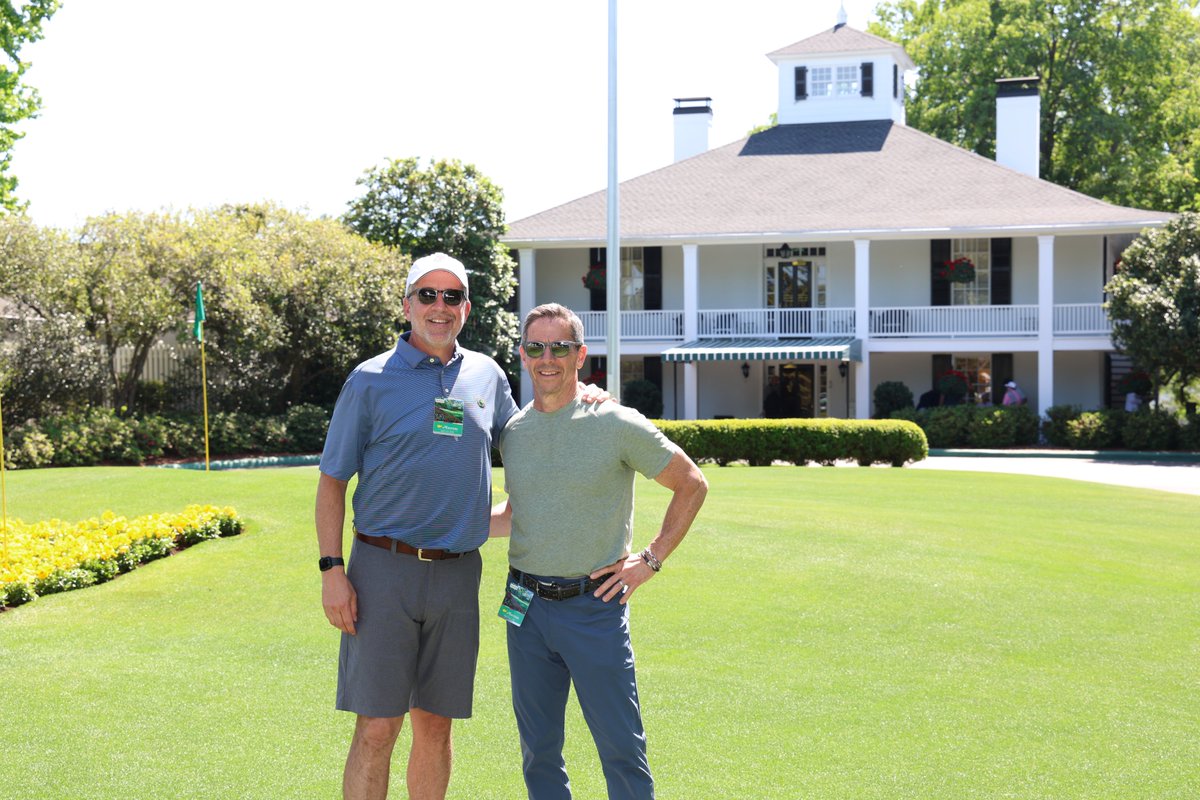
INTENTIONALITY…Last week was my first time back at the Masters since I went with my Dad in 2019, before he passed. This time, I took my brother. I was reminded of just how intentional of an atmosphere Augusta National creates.
First of all, no phones are allowed in the venue. Boy, I have to admit that’s a hard one for me... But it removes distractions and makes everyone focus on two things: golf and connecting with other people.
I can’t tell you how many meaningful conversations my brother and I had with each other, and other attendees. I also can’t tell you how many times I reflexively checked for my phone that of course wasn’t there. Yikes.
It was a reminder of the power of being present. And I can bring more presence into my day-to-day life.
Then, there are a number of unwritten rules at Augusta. For example, you can place your chairs on any hole and once you do, you have the right to them. You can leave them there, others can even sit in them, but once you return, you have the right to claim them back.
Not to mention how intentional Augusta National is about the grounds, the fan experience, and the $3.25 chicken salad sandwiches and $6 unbranded beers.
And it all just… works. People follow the rules and it creates something special. All because of intentionality.
It makes me think…as leaders, how can we be more intentional about the experiences we create for team members and clients
Can we be more present?
Can we give people more undivided attention?
Can we establish ground rules for how we expect to engage with one another?
Can we provide unique development opportunities for our people?
Can we help them focus on doing more that they love?
The Masters is a great example of many intentional choices that are made to create a “wow” experience.
How are we doing that in our businesses?
Just something I’ll be thinking about this week…
Every CEO is trying to figure out their approach to implementing technology and AI in real time. In the spirit of transparency, here’s what I’m doing:
First of all, I have to recognize that this is not my area of expertise.
I know we need to be a technology-led organization.
I’m not an expert in the specific tools.
So one of my first hires as CEO of Nichols Cauley was Greg Stone.
I thought it was critical to find someone who was a systems thinker and had a deep expertise in the technologies and tools of the day.
I also thought it was critical to bring in an outsider.
Someone who could bring a fresh perspective to the organization.
Sometimes organizations need the eyes of an alien—someone who doesn’t carry all the assumptions and beliefs regarding “the way we’ve always done things”.
Now here’s the key…
Greg’s mandate is not to implement AI and technology.
Greg’s mandate is to reduce unnecessary human touches and eliminate friction to increase efficiency and enhance capacity.
The goal is to enable our people to be advisors—spend more time helping clients make better decisions and move their businesses forward.
Frankly, how he accomplishes that doesn’t matter.
It could be:
- Using AI
- Implementing other technology tools
- Designing new processes
- Eliminating archaic systems
So early on, Greg’s approach is to be like a young kid… asking “why” to understand every system and process within the company.
With that understanding, he can build solutions to reduce unnecessary human touches and eliminate friction.
That’s a very different approach from asking him to inject AI into as many places in the company as possible.
That’s how we’re approaching things at Nichols Cauley. I’ll report back on our progress in the future.
We recently passed on an acquisition opportunity based on the way the firm described what they do. They positioned themselves as a managed services firm that takes care of compliance needs.
That’s great… but it’s misaligned with how we position ourselves at Nichols Cauley.
We don’t lead with stating the specific tasks we offer.
We don’t say we “file tax returns”, “complete audits”, or “provide insurance”.
We state that we’re committed to helping small and mid-sized businesses and their owners manage, protect, and grow their wealth.
We’re a financial services company, and our work is focused on delivering client outcomes—tax returns, risk protection solutions, and M&A transaction advisory are simply the ways in which we do that.
That distinction is critical.
And it’s critical that potential acquisition partners are aligned on that mindset.
#strategy #growth #leadership
We all seem to agree that being ‘advisory-first’ is the right model. What seems far less clear is how to accomplish that. Here’s what we’re doing at Nichols Cauley:
1. Seeking to reduce unnecessary human touches and eliminate friction to enhance capacity.
We’re exploring using AI, technology, and alternative work streams to free up people’s capacity.
If team members are less focused on completing day-to-day tasks, they can focus on more valuable work—providing perspective and advising clients.
Free up capacity, and advisory becomes possible.
2. Educating team members on our integrated services model.
More time to be an advisor sounds great, but there’s a critical mindset component to this too…
If people think:
“I do tax” or “I sell insurance.”
That doesn’t work.
We think in terms of integrated solutions that help clients…
Manage. Protect. Grow.
Every client conversation is framed around:
- How are we helping a business owner manage their business?
- How are we reducing their risk and protecting what they’ve built?
- How are we growing their wealth?
- Because you find what you’re looking for.
If you’re looking for tax work… you’ll find tax work.
If you’re looking for opportunities to create value… you’ll find those too.
It’s critical that team members understand our approach to thinking outside-in when servicing clients, AND be educated on the various solutions we can deliver.
This is how we put our strategy into action.
3. Providing hands-on training experiences.
You can’t teach this mindset shift in a classroom alone.
You must also:
- Have team members sit in on real client conversations
- Debrief afterward
- Implement systems that enable people to think horizontally across the organization
- Repeat the approach and mindset over and over
And it's critical to find your evangelists.
The people who get it…
Can demonstrate it in action…
Keep repeating it…
and start pulling others along.
Everyone in the firm needs to be exposed to this process and what ‘great’ looks like so they can see it in action and experience it for themselves.
When that happens, it starts to become real.
- - - - - - -
Being advisory-first is a shift in mindset, language, and behavior.
And it requires intentionality.
This is our plan to make advisory-first a reality at Nichols Cauley.
Happy to connect to share notes.
I think the business community as a whole still tends to misjudge what makes a great leader.
The most valuable asset a leader brings to an organization is not production, communication, or decisiveness.
It’s their ability to develop and enable others in the organization.
I call them multipliers.
Sure, someone could be a rainmaker and produce $5m for the company—and don’t get me wrong, that’s incredibly valuable.
Do you know what’s more valuable?
Someone who can develop and enable 5 other people to produce $2m+.
Or someone who can develop the next generation of partners.
Or someone who can be an evangelist for culture and strategy.
Or someone who can design and integrate systems and processes that make everyone in the company better.
The impact throughout the organization as a result of those things is much larger than what one person can do on their own.
Those people, the multipliers, are the true company builders.
Those are the indispensable leaders—and they don’t require a certain title.
#leadership
The signal that people are paying attention is when they’re sick of hearing something.
That’s when it sticks. So, yes, like a broken record, I repeat critical pieces of our strategy and essential language until it is spread throughout the company.
Lately, that has been “Manage. Protect. Grow.”
It’s how we turn our strategy into action and the way we seek to add value to clients.
Manage, protect, and grow their wealth.
Manage. Protect. Grow.
Over and over.
Every meeting. Every call. Every interaction.
Until team members start saying it without me.
That’s the goal.
Because once the language shifts…
The behavior follows.
So if you’re worried about repeating yourself too much when it comes to critical parts of your strategy and shared language…
I’d suggest there’s no such thing.
There are two mindsets when you walk into a prospective client meeting:
Mindset 1: I know what I do, and I am looking for an opportunity to sell what I do.
Mindset 2: We have a clear strategy on how to add value to clients, and I am looking for opportunities to provide value-added solutions that enable the client to achieve what matters to them.
People will find whatever opportunities they are looking for.
As it relates to Nichols Cauley, if a team member walks into a meeting looking to sell tax preparation, that’s what they will find an opportunity to sell.
But that's just one capability…. one part of what we can deliver.
If the focus is on selling an individual solution, we’ve likely missed many chances to add additional value.
Instead, if a team member walks into a meeting seeking opportunities to help a small to mid-sized business owner manage, protect, and grow their wealth, they will find several opportunities to do so.
Those opportunities require thinking across the organization and considering multiple value-added solutions.
We’re focused on the latter.
We don’t think through the lens of tasks like filing tax returns, performing audits, providing insurance, or offering transaction advisory services.
Those things are the HOW.
The WHAT is helping business owners manage, protect, and grow their wealth.
If we enter every interaction with the intention to find ways to do THAT, we’re going to deliver solutions that operate in concert with one another and deliver better outcomes for clients.
#strategy #growth #outsidein
I continue to see leaders and companies missing the boat with AI.
The question isn’t: “How do we use more AI?”
The question is: “How can we minimize unnecessary human touches and reduce friction?”
That’s the mandate Greg Stone and I discussed at Nichols Cauley.
The goal is to create greater efficiencies and more capacity by reducing friction.
How we do it (i.e. the specific tools used) matters less.
It could be:
- Using AI
- Implementing other technology tools
- Designing new processes
- Eliminating archaic systems
“We need to implement more AI” is a misguided mandate because it’s focused on a specific tool.
Well, the tools are simply ways to help solve problems.
The real objective is:
- Greater speed
- Enhanced capacity
- Increased efficiency
For us, this is ultimately about creating more capacity so we can better help clients manage, protect, and grow their wealth.
AI is just one lever to accomplish that goal.
So while companies are pushing AI usage, we’re doing something different.
We’re trying to eliminate friction and enhance capacity.
That’s a completely different mindset.
We’d never expect an athlete to succeed without practicing… so why do we treat our careers as leaders any differently? Business leaders practice by:
- Reading a book by another proven leader.
- Listening to a podcast on a particular topic you want to learn about.
- Devoting time to developing and executing strategy.
- Meeting with a leader outside of your industry.
- Learning a new technology or AI tool.
- Investing in consistent coaching.
So many leaders I talk to are so focused on “playing the game” all the time that they skip practicing.
Here’s my question:
How can you expect your team, practice area, or business to grow unless you do?
When the people grow, the organization is likely to follow suit.
So what will it take to devote 60 minutes per week to personal growth and development—without adding more time to your work week?
That’s 52 hours a year devoted to YOU.
A measly ~2% of your year.
Is that really too much to ask?
I’m asking… is it?
People write off defining and activating strategy because it seems too hard to measure. Here are signs that your strategy is taking hold and results are likely to follow:
- Leaders start repeating your words back to you
- People start reciting your strategy in rooms you aren’t in
- People start coming to you with ideas to activate strategy
- Leaders generate creative ideas on their own
- Win rates start to go up
- Your trust factor increases
Look, things like strategy, building a movement, and gaining momentum are all difficult to measure.
There are signs, though.
You might have to look harder and they don’t always appear on a dashboard, but they are there.
And maybe more than anything, you can feel it.
How?
Well, you’ll know it when it happens.
Don’t write off the power of getting everyone bought into executing your strategy and cause, it can be the driver that propels your firm to thrive moving forward.
#strategy #growth