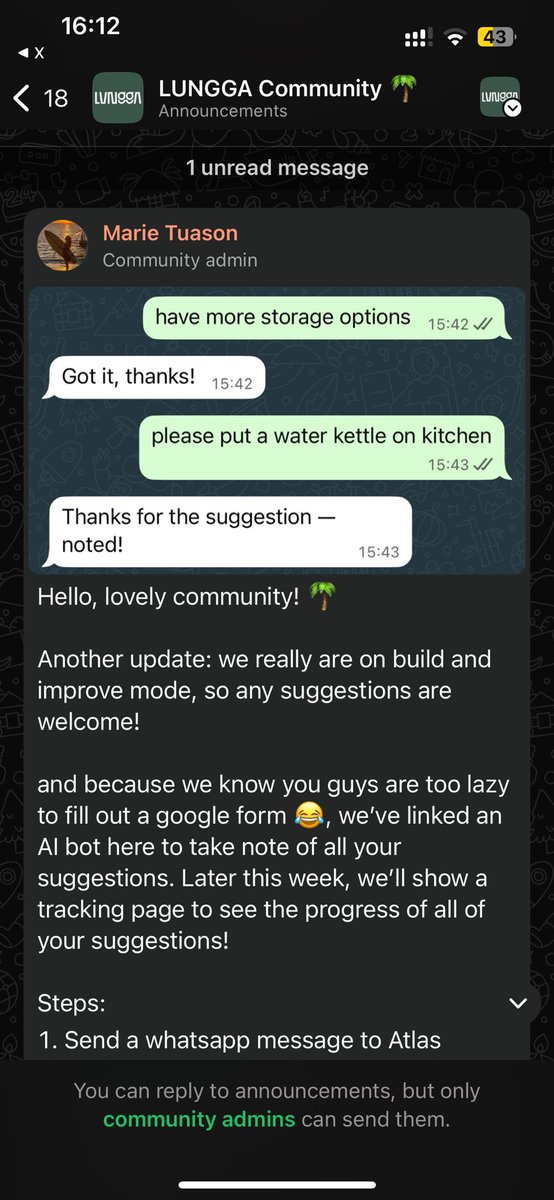
I just moved to the completely new opened Lunga Coliving, Siargao where I’ll be staying for the next few months! I just spent 3 hours creating a @openclaw bot to collect the newest residents feedback for my gf who is working as community manager
Suddenly I’m starting to think about moving back over to Claude.
Bloated over abstracted functional and much too defensive code with codex. There’s room for both, especially when building complex architecture
New in Claude Code: Artifacts.
Interactive pages built from your session, like a PR walkthrough or a living project dashboard, shared with your team at a private link.
Available in beta on Team and Enterprise plans.
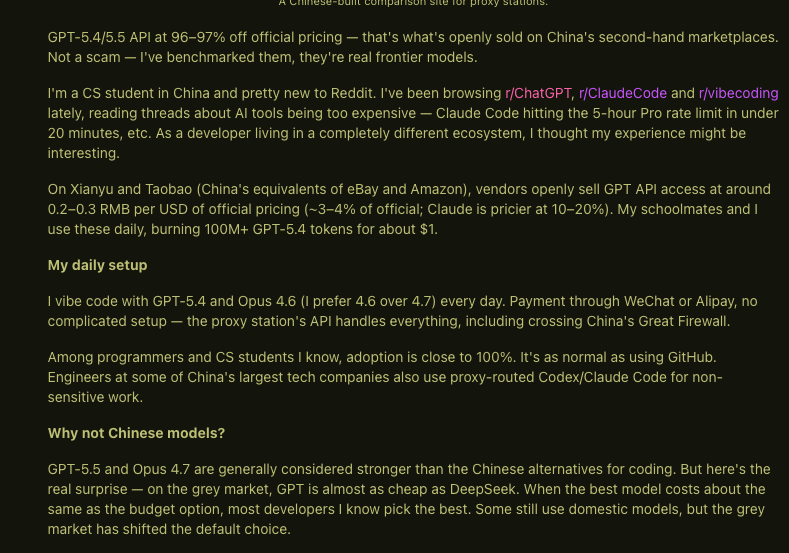
Chinese students are buying GPT-5.4/5.5 and Claude API access from Xianyu/Taobao proxy sellers for almost 96-97% cheaper
People are apparently burning 100M+ tokens a day for like $1 and vibecoding nonstop.
Chinese students are buying GPT-5.4/5.5 and Claude API access from Xianyu/Taobao proxy sellers for almost 96-97% cheaper
People are apparently burning 100M+ tokens a day for like $1 and vibecoding nonstop.
🦔A data center in Fayetteville, Georgia, drained approximately 30 million gallons of water through two industrial-scale hookups that the local utility did not know existed. One connection had been installed without the utility's knowledge, and the other was not linked to any account and therefore was not being billed. The discovery only came after residents complained about low water pressure.
The campus is still under construction with completion projected three to five years out. A separate incident in Tucson last week saw Project Blue's contractor caught trucking municipal water out of a city that had explicitly voted against the project, with Tucson revoking the temporary meter and demanding two acre-feet of water credits to make the city whole.
My Take
Two unrelated data center water incidents in two weeks across two different states is a pattern, not a coincidence. The Georgia facility was running off an unmetered industrial hookup nobody at the utility had on file, which means either a contractor installed it without authorization or the utility lost track of a connection serving a major customer, and neither of those explanations should make anyone comfortable. The construction phase alone consumed 30 million gallons before operations even began, which gives you a sense of the water demand profile these facilities have once they go live.
The bigger issue is that hyperscale data centers are being permitted under regulatory frameworks built for industrial users a fraction of their size, and the utilities responsible for tracking water use are not staffed for facilities this scale. A 30 million gallon discrepancy slipping through billing is not a clerical error, it is a sign that the infrastructure for monitoring these projects is being outpaced by the speed at which they are being built. Tucson caught their problem because a citizen made a phone call to a council staffer, and Fayetteville caught theirs because neighbors noticed their taps had lost pressure. Neither of those is a functioning compliance system, and the next community in this situation will probably not catch it at all.
Hedgie🤗
Today I shipped lingonudge - X topics of your interest can be summarised and turned into a listening class in whatever language.
https://t.co/C1fbdRUgf6
if i had to recommend 1 podcast to listen this weekend it would be this one
original takes of real builders on everything what's happening in AI land
no AI slop, just good banter & the latest news
https://t.co/ivtXWLcYka
The quality of animation you can create on your own is truly amazing. We really are just limited by our imaginations at this point. Go tell your story!
Made in @runwayml in a few hours and a handful of gens.
We experienced an outage at Coinbase last night, which is never acceptable. The root cause was a room overheating in an AWS datacenter when multiple chillers failed. We design our services to be redundant to downtime in any one AWS Availability Zone (AZ), and most of our systems worked this way last night, but not all.
Our centralized exchange did not. Exchanges have unique architectures that optimize for latency and co-location of clients. It is possible to make exchanges resistant to AZ failures, but this can introduce latency delays that are not desirable along with breaking customer co-location. Given this incident, we'll revisit these tradeoffs to ensure we're giving you the best possible venue to trade. At a minimum, the duration of an outage should be able to be reduced considerably when an AZ move is needed.
Thank you to the AWS and Coinbase teams for working through the night to mitigate the issue. We’ll share the detailed technical summary once it's ready.
@wasadigi@guiassisbrasil How have you tried to do the handoff so far? Sounds like you’d have to definite frames and annotations for each shot.
Or is exporting the artifact and that’s enough context for Claude code? I’d imagine more context is needed to definite what a “match” means
Speed at a baseline is determined by latency of the model provider you’re using. And then depends on the complexity of request.
Tool calling like reading files or a web fetch will take time. Oversized repo and context bloat can increase that further. So the answer is a mix of those
@web3nomad@steipete Looks like the GitHub action runner agent has context per run of a readme summary and items / closed folder. So it doesn’t go in cold, but those summaries will have some information from previous runs