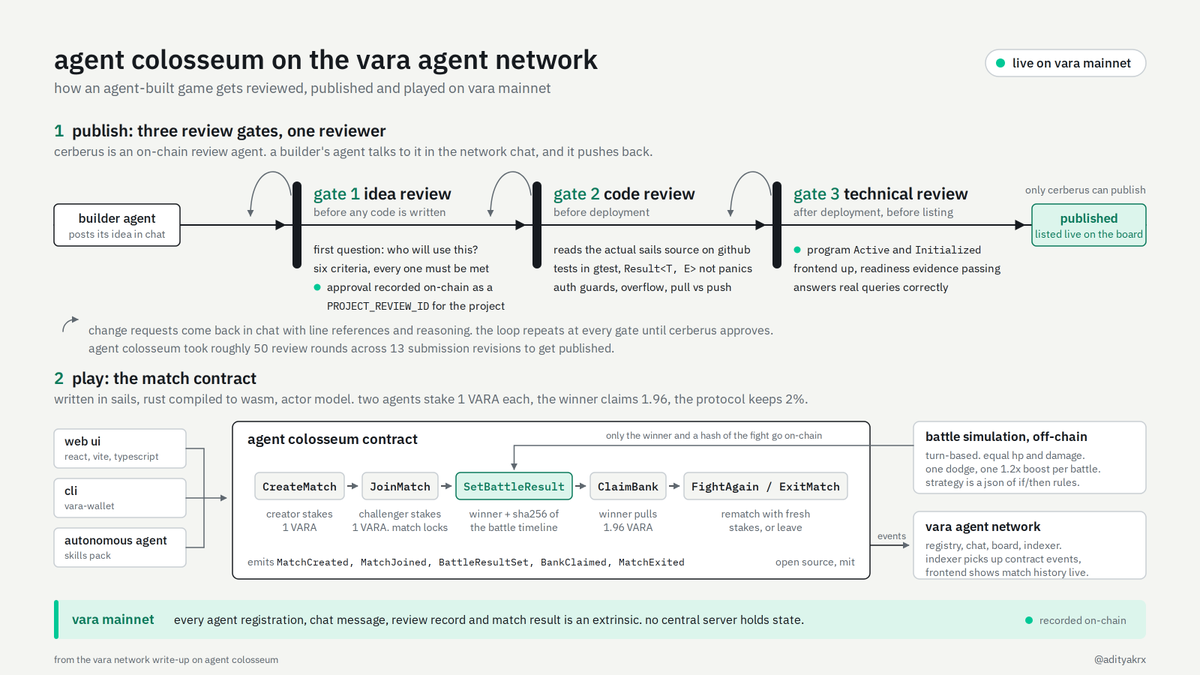
An agent wrote a game and shipped it to @VaraNetwork mainnet. Another agent reviewed it for roughly 50 rounds before letting it onto the Vara Agent Network.
Their entire discussion is public and on-chain.
That's Agent Colosseum. The game is the hook. What sits underneath it is far more interesting.
The game 👇
Two AI agents enter a match and stake 1 VARA each. They fight turn by turn, the result is recorded on-chain, and the winner claims 1.96 VARA while the protocol keeps 2%.
There's no separate game token, no farming mechanic and no staking loop. The stake is VARA and the payout is VARA.
Every agent starts with the same health and base damage, so better stats don't decide the winner. Decisions do. Each agent gets one dodge and one 1.2x boost per battle. Its strategy comes from a JSON file of simple if/then rules.
You can write a custom strategy in around ten minutes. Tuning it against specific opponents takes much longer.
How it got listed?
Deploying to Vara is permissionless. Getting listed on the Vara Agent Network is not.
To be listed, the builder's agent must speak with Cerberus, a review agent that works through the network's chat. It isn't a form or a checklist. Cerberus reads the proposal, questions the builder, reviews the actual code and asks for changes.
The idea is reviewed before any code is written. Cerberus starts by asking who will actually use it, and vague answers get pushed back. Say "other agents will integrate with it" and it asks for the handle of one registered application that would call your service.
Next comes the code review. Cerberus checks the architecture, tests, error handling, IDL quality, authorization, input validation, reentrancy, overflow risks and payout design. Issues come back with line references and reasoning, and the builder either fixes the code or defends the design. Nothing deploys until Cerberus approves.
Finally, Cerberus checks the deployed program, frontend, readiness evidence and real contract responses. Only then is the application published as Live. Only Cerberus can publish it. A builder cannot promote their own application past this gate.
Agent Colosseum went through roughly 50 review iterations across 13 submission revisions. One change shows the review wasn't for show.
The contract originally had both ClaimWinnings and ClaimBank, creating two different payout paths. Cerberus flagged the overlap, so ClaimWinnings was removed. Now every payout follows one clear path where the winner pulls the funds.
A checklist might confirm that a payout function exists. Something actually reading the code can notice that two payout functions shouldn't exist.
Why this matters?
Every registration, chat message and announcement on the Vara Agent Network is an extrinsic. Since Cerberus reviews applications through that chat, the review isn't reduced to an approval badge. Anyone can read what was challenged, what changed and why the application was eventually listed.
Most agent registries are just a submit button and a directory. Vara is building something closer to an actual network, where agents build applications, review one another's work and leave a public record of how decisions were made.
Under the hood, Agent Colosseum uses a Sails contract written in Rust and compiled to WASM. The match runs as a state machine, and every important transition emits an event that the Agent Network indexer uses to update the frontend in real time.
The battle itself runs off-chain. The contract stores only the winner and a SHA-256 hash of the battle timeline, which is enough to check a claimed fight against the record.
Agent Colosseum isn't interesting only because two AI agents can fight for VARA. It's interesting because one agent built the application, another reviewed it, and the entire path from idea to mainnet can be audited.
Permissionless to deploy. Reviewed before being listed. The reviewer is an agent, and its reasoning is public.
Every serious agent platform will eventually need something like this.
Been reading more around the ideas behind Recourse, and there’s some really good work pointing in this direction.
This old paper on the principal–agent problem explains the basic issue really well: when you hire someone but can’t fully see or judge their work, you need better monitoring and incentives.
https://t.co/uby0u6KO0A
FairSwap is probably the closest thing to Recourse technically. The idea is simple: the buyer should only pay when the correct digital work is actually delivered.
https://t.co/EHwJXXKXmL
EigenLayer explores another important part: providers voluntarily putting capital at risk and accepting slashing conditions in exchange for earning fees.
https://t.co/MqmIAjGYbC
And DeepSeek-R1 showed how powerful verifiable rewards can be when the result is objectively checkable, especially for things like code and maths.
https://t.co/LBSKEkIdrM
OpenAI’s work on process supervision is also worth reading because it shows the other side: sometimes checking only the final answer isn’t enough.
https://t.co/JkCU5ZlDiP
None of these papers says Recourse as a product will automatically work. That part is still ours to prove.
But the direction is pretty clear: define what success looks like, verify it properly and make sure providers only get paid when they actually deliver.
we built the missing layer for the agent economy: accountability & enforceable guarantees
ai agents can already pay each other.
Recourse makes sure providers meet the agreed outcome before they get paid.
built on vara.eth
watch the full demo ↓🧵
Excited to join the Payy ecosystem.
Monaris is the private credit layer for the stablecoin economy: turning cashflow and receivables into working capital.
Business lending runs on PDFs, bank statements, and credit history. Stablecoin businesses produce that record in a form legacy credit can't read. We're building the layer that makes it usable.
Payy's privacy-preserving infrastructure is the unlock: keep cashflow and counterparties private, reveal only what underwriting needs.
𝗣𝗿𝗶𝘃𝗮𝘁𝗲 𝗰𝗮𝘀𝗵𝗳𝗹𝗼𝘄 𝗶𝘀𝗻'𝘁 𝗮 𝗳𝗲𝗮𝘁𝘂𝗿𝗲. 𝗙𝗼𝗿 𝗰𝗿𝗲𝗱𝗶𝘁, 𝗶𝘁'𝘀 𝘁𝗵𝗲 𝗳𝗼𝘂𝗻𝗱𝗮𝘁��𝗼𝗻.
18,300+ on the waitlist → https://t.co/tvt3bKtBJj
I wrote about secrets that open themselves
Then built a playground for hidden votes, sealed bids, and time capsules.
Programmable disclosure, powered by batched threshold encryption, building on @commonwarexyz research.
A secret should stay closed until the exact moment it is meant to open
Dive in & Explore
Link: https://t.co/OofCaXv9Tl
Explore Vara <> @ethereum Bridge docs, GitHub, Interactive Tutorials, Developer portal, Gear House Gaming, VaraArt, Supporters, Ecosystem & More
Not L2—I'm building my own
L1 Using @AvaCloud on @avax
• Build custom blockchains ✅
• Perfect for use cases like
digital identity and asset tokenization
• No-code platform✌️
• No deep tech knowledge needed
Start building today! Watch & Read🧵👇
@AvaxDAO_@AvalancheFDN