Albatross 2.5.0 is here, and with it, "Jev Mode"
And I'm pretty sure that makes us the first harness to leverage Jev in this way, more dets below:
��� Jev reviews your prompt first and it classifies the request to determines whether a supported direct answer is possible. If so, damn will it be fast.
🪽 Still retains the good ol' agent loop: coding, explanations, tool requests, uncertainty, and API failures fall back to the primary LLM.
🪽 Try it :
- if you want to tip your toes in the water: "/jev shadow" observes routing while sticking with normal LLM routing and answers
- ready to go full Jev? "/jev on" 🤘
🧪 I'm keeping this experimental and opt-in...so don't worry, it's off by default, so only Jev if you want to.
Now live on Github:
https://t.co/B9viumGexx
I am adding Jev to @AlbatrossCoding, and it could be a really interesting way to make my harness a lot more token efficient.
Instead of just adding Jev as a model provider, I'm going to have essentially what I guess I'll call "Jev Mode" that allows you to leverage what a model like this is actually good at, i.e. making decisions.
Right now, we waste a lot of time with agents having them perform lots of tool calls. I think Jev could essentially short circuit this in a way.
The logic I'm adding will add a step where your prompt goes to Jev first. If it's a question with predefined answers, Jev can just answer it. Otherwise, it goes to an LLM, which can answer or use tools.
I can benchmark this against a traditional harness to see what kind of performance gains it gets, my thought it is could be a lot faster and more token efficient for some tasks.
Will share more once it's ready, but I'm also very open to changing my design here so please poke holes in it if you see a way I could improve.
Hoping to make Albatross one of the first harnesses with Jev Inside™ 🪽
Diagram below of the flow I'm building out:
Albatross v2.4.0 is now live! 🎉
Annnddd, there's a lot in this one. Since I haven't shipped updates in a bit, I thought it was time to do a nice big juicy one.
This release shifts Albatross from a terminal-first agent harness into a platform you can extend, package, share, and embed.
If you just want the TL;DR, here's what's new: extensions, npm/Git packages, Agent Skills, and a Rust SDK.
Now for a little deep dive on each of these.
Extensions
------------
I've wanted this one for a while. Extensions communicate with Albatross over JSON-RPC and stdio, so they can be written in any language you want, Rust, TypeScript, Python, etc.
They can do things like add model tools, slash commands, and listeners without actually changing Albatross itself.
I think this is interesting/important because this makes it much easier for ppl to customize Albatross for your specific infrastructure, workflows, etc. while keeping the harness itself small, safe, and easy to upgrade.
Installable packages
----------------------
Uh yeah, this would should have been done earlier!
Now a single package from npm or Git can have extensions, skills, prompts, and themes.
Makes it wayyyy easier to reuse agent capabilities, and distribute in a more safe and secure way.
Agent Skills
-------------
This was one of my personal features that I just had to add because it was driving me crazy not having it.
Albatross now supports the Agent Skills standard, discovers skills from projects, user directories, etc. and exposes them through /skill:name
Also, Skills load progressively, so agents can discovery capabilities without dumping every instruction into the context window
Embeddable Rust SDK
-------------------------
Another big one imo. You can now use Albatross as the agent runtime inside another CLI, desktop app, service, etc. while still having control over models, tools, permissions, and data.
If you're using homebrew, you can upgrade to this new version by just typing: brew upgrade albatross
or
Check it out on Github here:
https://t.co/KZhGDn453G
Enjoy, and please send feedback!
Agent harness & harness engineering will not be phrases uttered on the internet 12 months from now.
They're necessary for now as applied AI is in its infancy and complexity still hasn't been abstracted out of the user's experience, but this will all sit cleanly under "product" and "user experience" very soon.
I am going to start to share the leaderboard at VulcanBench more regularly.
VulcanBench is the only benchmark I know that benchmarks across effort levels, on an eval suite of 100% real engineering tasks.
Getting ready to sunset eval suite 3 and eval suite 4 is almost ready to go.
Here's the current leaderboard for Eval Suite 3, Grok 4.5 High is the highest scoring model still with Fable 5 Low, yes Low, right behind it.
What I've been able to uncover with VulcanBench is that way too many people are running models at Max effort, thinking that buys them more accuracy, when really it just costs more and uses more tokens so takes more time.
If you're still in the mode of, tell my agent to do something then go get coffee, you're probably still living in the past. You can move faster, with higher accuracy, the key is not thinking you need Max effort all the time.
Just shipped Albatross v2.3.0 🪽
This release came directly from user feedback provided by @danielendara, so thank you Daniel!
He brought up a lot of good stuff, here's what's new:
- cleaner long-prompt wrapping
- familiar Enter-to-select commands
- /provider terminology
- four terminal themes.
- guided /route experience
- bugfix for ChatGPT integration so GPT‑5.6 Sol, Terra, and Luna are now available
brew update && brew upgrade albatross
@BlockedPaths@morganlinton @yuppieventures Well you can technically add it in, but I'd get in legal trouble, I need to actually connect with Anthropic directly, fill out paperwork, etc.
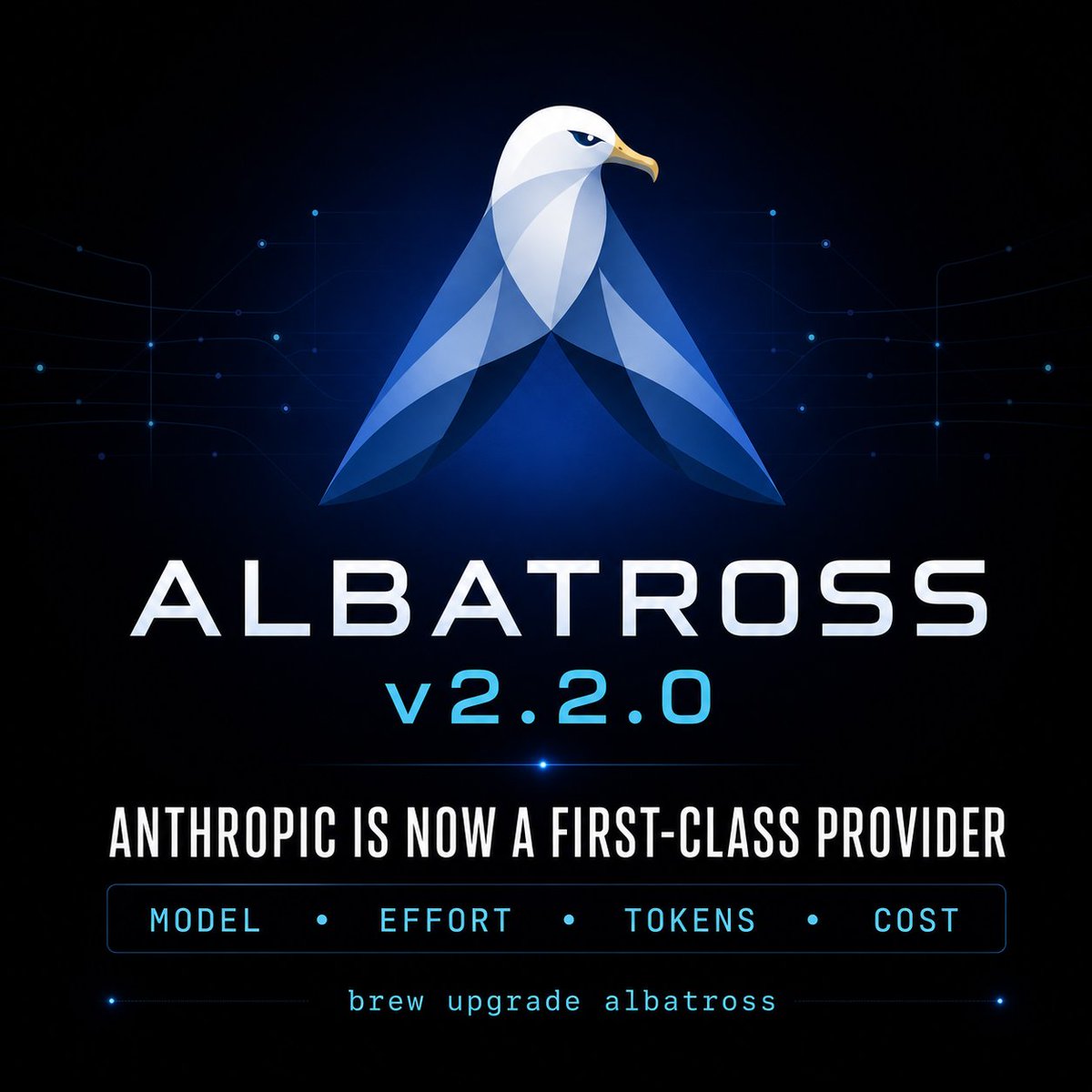
Just shipped Albatross v2.2.0 🪽
Anthropic is now a first-class Albatross provider.
You can bring an ANTHROPIC_API_KEY and use Claude through Anthropic’s documented Messages and Models APIs, with native streaming, tool calls, image inputs, extended-thinking signature round-tripping, model-aware effort controls, and cache-aware token and cost accounting.
And because routing transparency has always been central to Albatross, Anthropic runs get the same inspectable goodness: which model was requested and resolved, which effort level was requested and actually used, input/output/cache tokens, latency, pricing source, and estimated cost.
One boundary I want to be explicit about: this release does not reuse https://t.co/GbDoNE7sVC or Claude Code credentials, and it does not turn a Pro or Max subscription into third-party API access.
I’d love to support subscription OAuth, but only through an approved path, so I'll need to wait to get the greenlight from Anthropic.
For now, v2.2.0 takes the safe path: the official API, your key, and full visibility into every routing decision.
You can jam on the Albatross Github, or if you brew, just type the following:
brew update && brew upgrade albatross