A = UΣVᵀ
Every real matrix (square or rectangular, full-rank or singular) factors into a pair of orthogonal matrices flanking a rectangular diagonal of nonnegative singular values. The left and right singular vectors rotate the domain and codomain so that the linear map becomes a pure stretch along aligned axes; the singular values themselves are those stretches.
When the values decay rapidly the map is essentially low-dimensional, and the partial sum formed by the first k terms is the nearest rank-k matrix in every unitarily invariant norm. Beltrami obtained the square case in 1873, Jordan independently a year later.
One factorization therefore exposes geometry, numerical rank, and the most economical compressions of the data the matrix represents.
Los jóvenes faltan al trabajo el doble que los sénior y copan ya un tercio de las bajas por salud mental
✍️ José A. González, Lucía Palacios https://t.co/RYLVZxY59q
Halvorsen Attractor ✍️
Three simple equations, one parameter and the result is a three-lobed structure that never repeats, never settles and traces an infinitely complex path through three-dimensional space for all eternity. The Halvorsen attractor is chaos made visible.. It is far more orderly than chaos has any right to be.
Full explanation given below 👇
Aizawa attractor visualized in the xy-plane at d = 3.5.
Conversion to polar coordinates shows that θ̇ equals the constant d. Trajectories therefore spin at uniform rate.
The visible complexity arises only from chaotic variations of radius r and the orthogonal coordinate z. Two orbits appear in orange and blue.
Fast Fourier Analysis in action.
Any complex waveform, sound, or shape can be perfectly reconstructed as the sum of simple rotating circles (epicycles).
[🎞️ lingualin]
El plazo de solicitud para el Programa de Jóvenes Profesionales del Grupo Banco Mundial cierra el 30 de septiembre.
No pierdas la oportunidad de unirte a una comunidad de profesionales que impulsan soluciones de desarrollo en todo el mundo.
Envía tu solicitud: https://t.co/dPUhZNb3Gf
🤔 ¿Te interesan los temas sobre las economías solidarias?
¡Participa en el Seminario sobre Economías Solidarias 2027!
👉 Envía tu avance de investigación, artículo o ponencia a [email protected]
🗓️ Fecha límite: 30 de octubre de 2026
@ded_cide@elcolmex@udem
🚨Aviso Presentación #SobreMéxico🚨
Santiago Levy estará a cargo de la conferencia magistral "Salario mínimo, poder monopsónico y mercados laborales" en el 12° congreso de economía y políticas públicas #SobreMéxico
📅 23 octubre
🕚 11:00
¡Imperdible charla!
#EconTwitter
#HoyEnLaUNAM Soprano, oboe barroco, clavecín y viola da gamba: Novum Antiqua Musica traslada a @SanIldefonsoMx hasta fines del siglo XVII 🎻. No te pierdas un #Concierto con piezas de Henry Purcell, Marin Marais y Joseph Bodin de Boismortier, entre otros compositores del Barroco inglés y el francés 🎼 > https://t.co/9yOzXO3Y1c
#AgendaUNAM
Fermat’s last theorem has been turned into computer-verified code for the first time, using an advanced prototype of AI chatbot Claude
https://t.co/CFo7wIDkf5
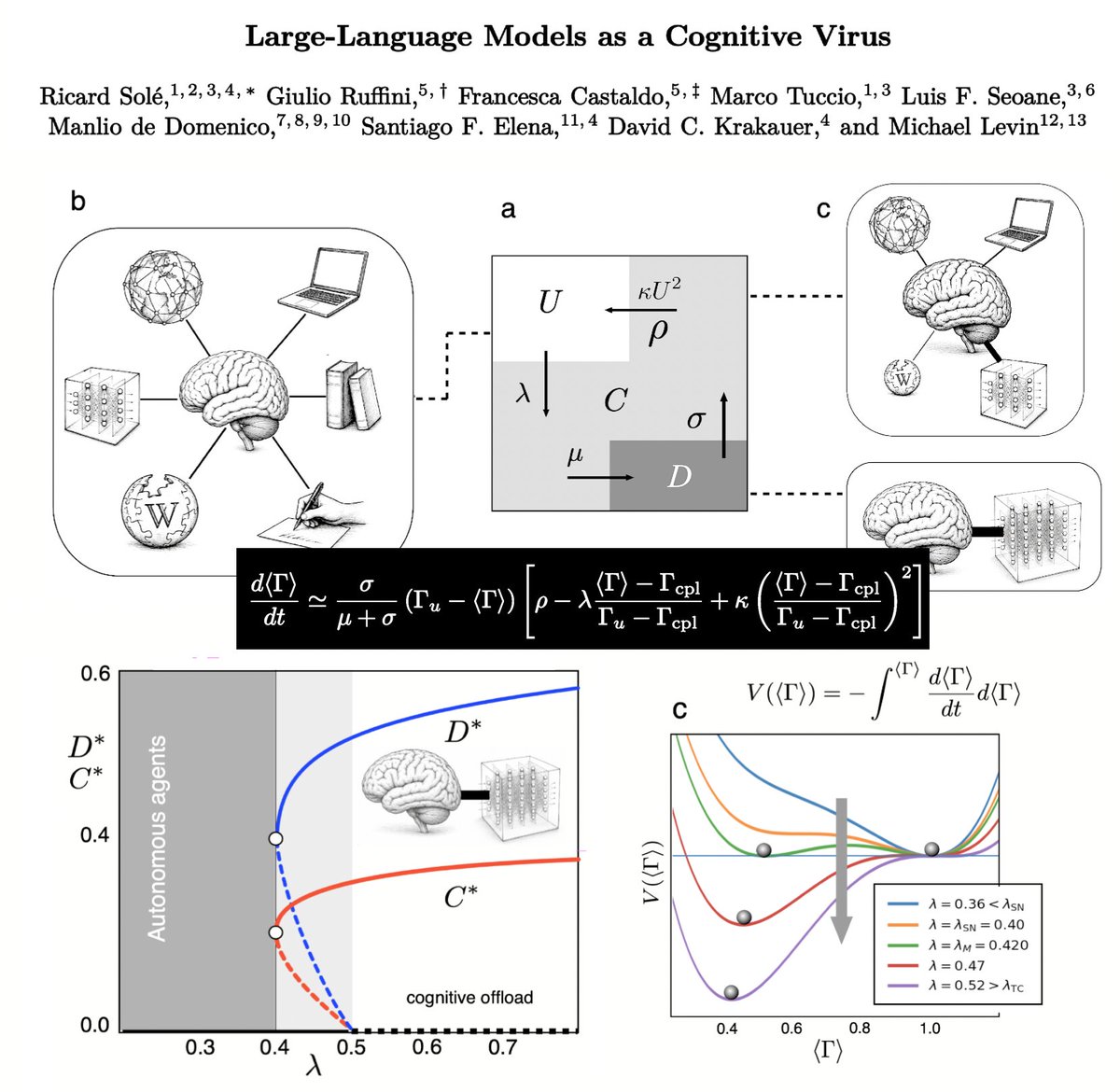
Can AI spread like a virus and erode cognitive autonomy? Our new paper models how LLM adoption can cross tipping points, triggering runaway dependence and tech lock-in, suggesting routes to "cognitive immunization". https://t.co/4e8ya6JNsW
¿Cómo se ha territorializado la política energética en Tula a lo largo de tres sexenios?
La revista Estudios Energéticos del Sur Global, editada por el Centro de Estudios Internacionales (@CEIColmex) de El Colegio de México (@elcolmex) a través del Programa de Energía (@EnergiaColmex) y la #FLACSOMéxico, te invita a leer el artículo “Territorialización de la política energética en Tula: Calderón, Peña Nieto y López Obrador”, de Luis Raúl Pérez Herrera.
El texto analiza los cambios en la política energética nacional y su impacto en proyectos estratégicos de Tula de Allende.
Conoce más. ⬇️
https://t.co/liyRYvzoTS
An absolute banger of a paper.
"A Gentle Introduction to Matrix Calculus" by econometrics legend Jan Magnus — one of the clearest explanations of matrix derivatives ever written. Published in the Journal of Econometrics in 2024.
If you work in econometrics, machine learning, statistics or optimisation, this paper is pure gold.
Free, in my Awesome Math Books list (econometrics section)
https://t.co/soOYrEQ2he
The Law of Large Numbers
Source for infographic: https://t.co/ngyYakLw82
NOTE: Reversion To The Mean and the Law of Large Numbers are closely related and often confused, but they describe different statistical concepts. The law of large numbers states that a sample mean converges to the true population mean as sample size increases, while reversion to the mean states that sequential measurements of some quantity can provide a better estimate of the typical value of that measured quantity as compared to a single measurement.
#Statistics #Mathematics