In a longitudinal study, the authors link cannabis use to blunted reward anticipation signaling, a neural pattern associated with addiction and anhedonia 🧠 / @m_wall@Will_Lawn
https://t.co/6jFQHeusyu
Synergy February 2026: BRIC by BRIC - inside Plymouth’s Brain Research and Imaging Centre. Synergy joined SoR president Katie Thompson on a recent visit to the institute to learn more about the groundbreaking research taking place there 👉 https://t.co/ToTlwTmagy
🧵 New JAMA Study: Cannabis & Schizophrenia
A population study of 13.5 million people in Ontario examined how cannabis policy changes relate to schizophrenia diagnoses. Here’s what they found ⬇️
1️⃣ After cannabis became more accessible, the share of new schizophrenia cases linked to cannabis use disorder (CUD) nearly tripled — from ~3.7% to ~10.3%.
2️⃣ People diagnosed with cannabis use disorder were far more likely to later receive a schizophrenia diagnosis compared to those without CUD.
3️⃣ Young men (ages 19–24) had the highest proportion of schizophrenia cases associated with cannabis use disorder.
4���⃣ Overall schizophrenia rates stayed relatively stable, but diagnoses of other psychotic disorders increased after legalization.
5️⃣ Important note:
This study does not say cannabis causes schizophrenia in everyone — but it shows a growing population-level impact of heavy or disordered cannabis use on serious mental illness.
6️⃣ Why this matters 👇
As cannabis becomes more widely used, public health, prevention, and education—especially for young people—are critical.
🔗 Study: JAMA Network Open (2024) https://t.co/StSQdZMcsp
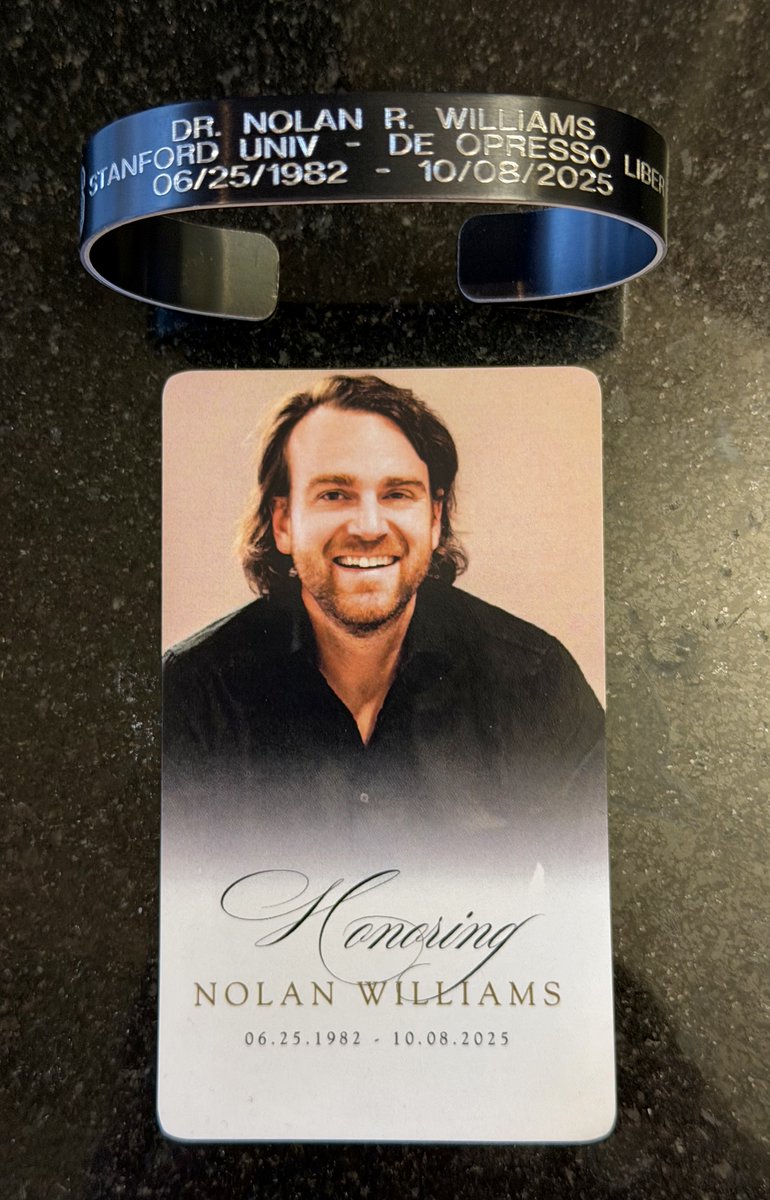
We attended a touching and poignant funeral for Nolan Williams last night at Stanford's Memorial Church. About 500 people showed up, from far and wide.
Tragically, just hours after his death, he was to be nominated to run a major government office. It is a tribute to his legacy, and I wanted to share, lest it be lost forever...
A U.S. Senator gave out wrist bands, a KIA tradition among special forces.
The Stanford chaplain did a wonderful job as did 10 speakers, intermixed with some of Nolan's favorite music, including Stairway to Heaven.
The rear of the card reads:
WHEN THE FORM OF SOMEONE YOU LOVE DISSOLVES,
THE LOVE ITSELF REMAINS.
IT BECOMES YOUR TEACHER,
YOUR COMPANION,
YOUR FAITH.
— ATTRIBUTED TO RAM DAS
I've been mulling this over, and we do need some more information about the settings provided. A key question: was this "low intensity" focused ultrasound, or as I suspect, something greater?
Last week I lost a friend.
But the rest of the world lost a warrior.
A visionary who dedicated his life to healing the sick and relentlessly bulldozing any barriers that got in his way.
1/n
@NolanRyWilliams
I am grateful for the time we had with @NolanRyWilliams. One of my favorite memories was skiing/riding together, and chatting about the future on the lift rides up.
I hoped our next time would be riding unfrozen water together, with him on a kite and me on my wing.
Nolan, I hope you have peace.
A v interesting & rigorous experiment conducted by @ed_chesney found that high dose oral CBD pretreatment *worsened* the acute effect of THC on people with schizophrenia.
Was a pleasure to be involved. Lots to consider!
GLP1-RA treatment for obesity and diabetes does not increase psychiatric adverse events compared to placebo and is linked to improvements in quality of life, emotional eating, and mental well-being. https://t.co/cnxp2phlcK @rdegiorgi, @kcldpsych
Our OA paper “Effects of 28-day simvastatin administration on emotional processing, reward learning, working memory, and salivary cortisol in healthy participants at-risk for depression: OxSTEP, an online experimental medicine trial” https://t.co/nWLQPsLcNP is on #PsyMed
The London Drugs Commission report on cannabis makes several recommendations which I support. We must (1) deliver research-informed cannabis education to *early* adolescents, (2) offer evidence-based, specialist treatment for CUD to youth and adults. https://t.co/Zp3r824P6i
Dr Edward Chesney of King’s College London warns decriminalisation could increase teenage cannabis use — which is likely a causal factor in developing schizophrenia.
'A third of psychosis patients used cannabis at onset.'
🚨JOB ALERT🚨 Director of Postgraduate Medical Education at @MaudsleyNHS. Come help us revise & run our new postgraduate offer & strategy, & lead Europe's largest psychiatry training scheme: https://t.co/4c02eH4cz4 I'm happy to speak with eligible candidates.
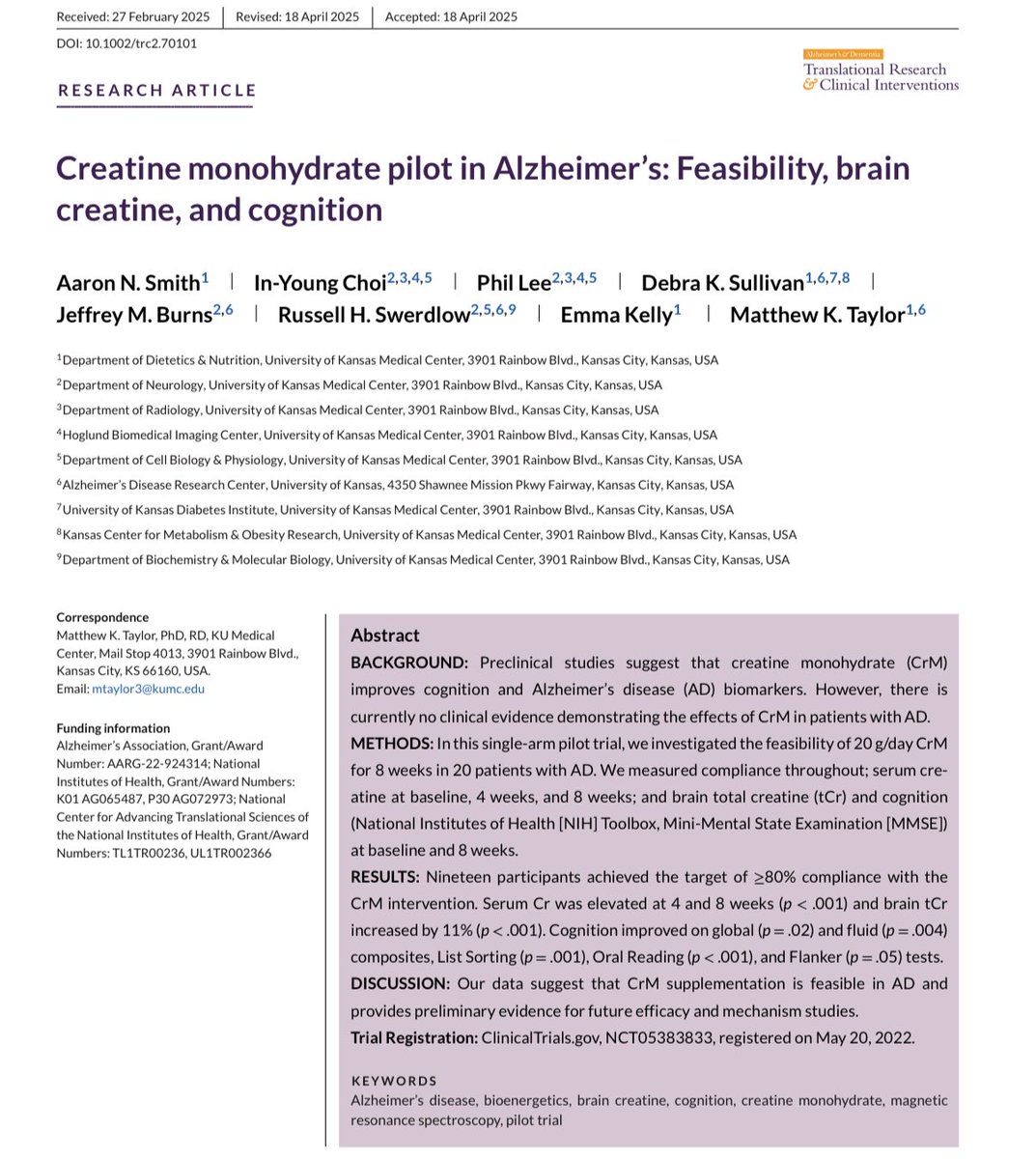
Creatine monohydrate supplementation shows promising potential to boost brain creatine levels and improve cognition in Alzheimer’s disease patients.🧠💡
This discovery comes from an 8-week, single-arm pilot trial by the University of Kansas Medical Center, involving 20 Alzheimer’s patients aged 60–90 who were supplemented with 20g/day of CrM.
Compliance was tracked via self-reports and serum creatine levels. Brain creatine and cognition were measured using magnetic resonance spectroscopy and tools like the NIH Toolbox.🔬
•19 of 20 participants achieved ≥80% compliance ✅
• Serum creatine levels ⬆️ over 23-fold by 8 weeks
• Brain total creatine (tCr) ⬆️ 11%
• Global cognition ⬆️ 4.4%
• Fluid cognition ⬆️ 7.4%
• List sorting working memory ⬆️ 12.1%
• Oral reading recognition ⬆️ 5.1%
• Inhibitory control & attention showed a trending improvement of 7.2%
These results suggest CrM is feasible and may enhance brain energy and cognition in Alzheimer’s, warranting larger trials.
🧵 (1/3) Excited to finally share our creatine pilot trial in AD results! We found that 20 g/day creatine monohydrate for 8 weeks was safe and feasible in people with AD. Compliance was excellent, and serum creatine significantly increased.
We're excited to announce that WIN is now the Oxford University Centre for Integrative Neuroimaging: OxCIN! Our mission: developing and deploying neuroimaging and related technology to solve big challenges in basic neuroscience and brain health. https://t.co/E2zl971TC6
Enjoyed presenting @SOBP#SOBP2025 on a #cannabis symposium organised by Drs E Kroon and J Cousijn. I presented 4-year longitudinal CannTeen data - teenagers who quit cannabis have reduced psychotic-like symptoms, and teens are more sensitive to the impact of frequent use on CUD.
Further to this, we've also published a response letter in @ecnptweets Journal. Supporting the call for clinical trials assessing physical exercise and creatine in depression.
#Neuropharmacology#Psychopharmacology
https://t.co/T3SbCmiKpB
Pleased to share our latest work published in @ecnptweets Journal. We explored the efficacy and safety of Creatine monohydrate as an adjunct to CBT for Depression. Great effort by all involved and thanks to @rdegiorgi for the leadership and guidance.
https://t.co/qLHLsip6C6