An AI-Powered Financial Intelligence Platform
Deciphering US Tech Market Trends and Sentiment by our AI-Research engine
Unlock full research and platform here👇
The future of wealth management isn't just AI. It's AI backed by a heavy-duty quantitative engine. 💡
When we look at the current landscape of financial technology, there is a massive gap. On one side, you have incredible Large Language Models (LLMs) that can summarize data beautifully. On the other side, you have institutional-grade quantitative engines built for deep portfolio analytics.
But what happens when you bridge the two?
Meet AlchemyJ—the platform designed to give relationship managers, investment consultants, and portfolio managers an unfair advantage by combining advanced Agentic AI with professional-grade financial analytics.
We don't just wrap AI around basic data. We power it with a robust, code-free quantitative framework.
Here is what AlchemyJ brings to your workflow:
🤖 AI Advisory & Research: Deploy dedicated AI agents that operate within your custom frameworks. They continuously scan market news, trends, and sentiment to deliver context-aware, unbiased rationales—boosting RM productivity and elevating client service quality.
📊 360° Portfolio Analytics: Calculate sophisticated performance and risk metrics alongside dynamic time-series analysis for historical trends. Best of all? Our code-free framework empowers you to run your own analytic models without typing a single line of code.
📈 Advanced Optimization & Simulation: From implementing sophisticated models like Black-Litterman to running what-if analyses and stress tests via intuitive, Excel-like tools—AlchemyJ lets you project market shocks and uses built-in AI to narrate the exact impacts on your strategy.
The era of static asset allocation is evolving. Wealth management professionals need tools that match the speed, precision, and complexity of today's markets.
Ready to see how institutional-grade AI analysis can transform your investment decision-making?
👇 Unlock TechTrends for FREE and get instant access to our AI-driven Investment Analytics Platform.
Unlock TechTrends for FREE: https://t.co/EI7PvU3TVN
#WealthManagement #FinTech #PortfolioAnalytics #ArtificialIntelligence #QuantitativeFinance #AssetManagement #AIagents #AlchemyJ
Meta's four-day rally reached 17% as investors rewarded consumer AI hardware reveals.
Oracle and Bloom Energy fell as infrastructure delays surfaced.
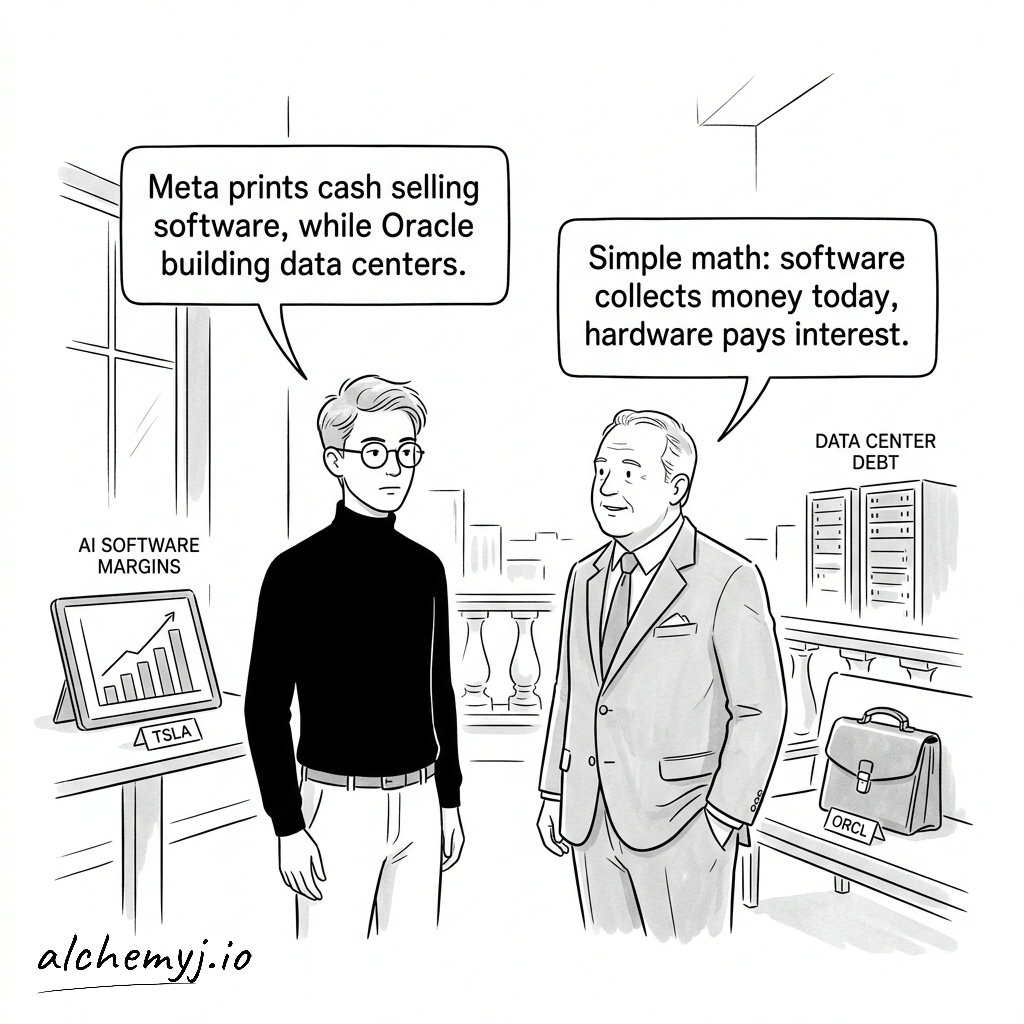
"Software collects money today, hardware pays interest." Oracle's $18 billion loan syndicate, spanning 20 banks, trades below 90 cents on the dollar. Meta's shares climbed as much as 4.5% intraday after its hardware reveal.
Borrowing costs and construction timelines are the two factors the Market Sentiment section ties to this divergence. Neither condition is described as resolved in the data presented.
$SOX $QQQ $SPY $META
$BE Bloom Energy — Moving the pipeline completion target from August 2026 to February 2027 introduces execution uncertainty, delaying fuel cell equipment deployment and associated revenue realization.
Shares fell approximately 3.5% (closing mostly flat in after-hours trading) due to timeline shifts in a key natural gas pipeline feeding Oracle's Project Jupiter data center.
#Tech #FuelCells
$META Meta — Expanding into specialized consumer hardware helps narrow Meta's 10-year price-to-earnings discount compared to Alphabet, though KeyBanc noted ongoing questions regarding consumer utility and messaging overlap across devices.
Shares climbed 3% to 4.5% intraday (contributing to a 17% four-day run, a 13% gain over the last 5 days, and a 4% session rally) after showcasing consumer AI products, including the palm-sized "Muse Charm" device featuring front/back cameras and FaceTiming capabilities with its Muse assistant.
Formed under its design lab and new MSL (Meta Superintelligence Labs) group—which shifted strategy away from Llama—Meta's hardware roadmap includes audio smart glasses and spring 2027 mixed-reality glasses.
#Tech #AIHardware
$ORCL Oracle — Invoking force majeure limits Oracle's exposure to financial penalties if construction misses its projected 2028 completion date, protecting corporate capital while preserving long-term leasing commitments.
Shares fell over 5% (dropping 7% at one point to mark their largest decline since mid-June, and falling 3.5% and 3% in separate sessions) after issuing a force majeure notice to developer Stack Infrastructure, a unit of Blue Owl, regarding Project Jupiter.
The 1,400-acre New Mexico data center project faces missing permits and local opposition, causing an $18 billion loan syndicate across 20 banks to trade below 90 cents on the dollar, though sell-side firms William Blair and KeyBanc called the defensive move logical.
#Tech #DataCenters
Bloom Energy's natural gas pipeline feeds Oracle's Project Jupiter data center. Its completion target moved from August 2026 to February 2027.
That shift touches more than one balance sheet.
Global data center capital expenditure is projected to exceed $1 trillion next year, adding pressure to a strained system. Missing permits and community backlash affect Oracle's 1,400-acre New Mexico project. Rising bond yields and higher borrowing costs are straining project debt across the sector. That strain is visible in Oracle's $18 billion loan syndicate, which is trading below 90 cents on the dollar.
If high interest rates and construction delays persist, technology companies may scale back or delay infrastructure commitments. That outcome would impact energy providers and hardware supply chains. One side controls the decision to build, the other depends on that decision continuing.
Capital expenditure projections extend through next year, while individual project completions are targeted for 2028. The pipeline feeding Project Jupiter shifted from an August 2026 target to February 2027.
$ORCL $BE $XLK
$ORCL's force majeure move on Project Jupiter was called logical by both William Blair and KeyBanc.
Stock fell over 5%, marking its largest decline since mid-June.
Project Jupiter's construction risks missing its projected 2028 completion date. Invoking force majeure limits Oracle's exposure to financial penalties tied to that delay. This protects corporate capital. It also preserves the company's long-term leasing commitments tied to the project.
Oracle's force majeure notice highlights rising execution and capital risks across AI infrastructure. It shows how project-level financing terms are becoming a visible factor in large-scale data center builds.
$ORCL $XLK $QQQ
Today's highlights:
· $META
Muse assistant achieved fastest adoption since ChatGPT, lifting shares higher.
· $QCOM
Qualcomm's $60 billion AWS deal includes $9 billion for custom chips.
· $PANW
Palo Alto Networks shares surged over 100% for the year on demand.
· Data center capex remains sensitive to macro yields even as sector earnings growth stays strong.
Nasdaq Composite fell 1% as 10-year Treasury yields climbed to 5.13%. Nvidia and Amazon were among the shares pulled lower in the pullback.
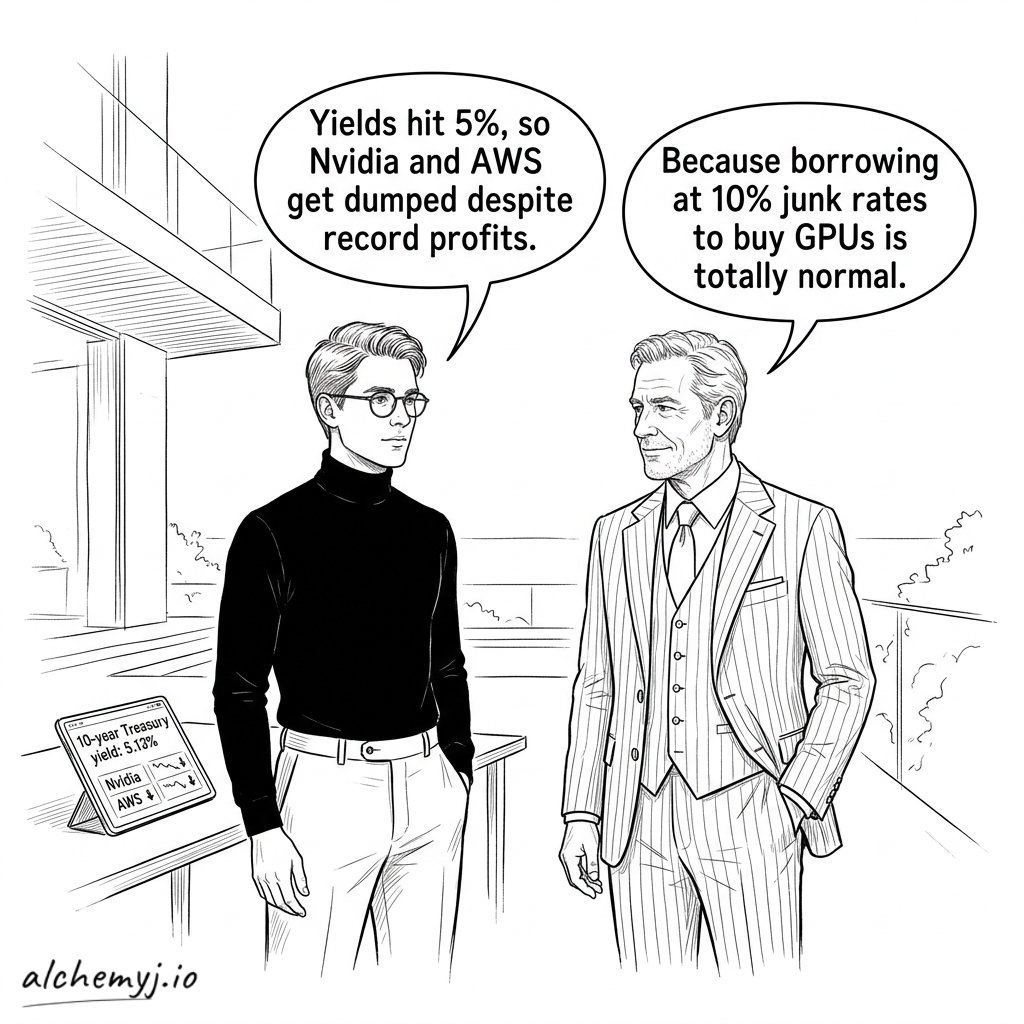
"Yields hit 5%, so Nvidia and AWS get dumped despite record profits." SoftBank raised over $11 billion in junk bonds, a form of high-yield debt. The bonds carried yields nearing 10% to fund its $65 billion commitment to OpenAI. Qualcomm's $60 billion AWS partnership includes $9 billion earmarked for custom data center chips.
Market caution around credit curves and issuance volume in high-yield debt remains a specific point worth watching. Investors continue demanding higher risk premiums for debt-funded AI scaling.
$SOX $QQQ $SPY $NVDA
SoftBank — High yields and widening credit spreads increase borrowing costs, but securing immediate liquidity safeguards its multi-billion-dollar obligations to leading frontier AI developers.
Launched one of history's largest corporate junk bond sales to raise over $11 billion in US dollar debt—offering record yields up to nearly 10%—to back its $65 billion commitment to OpenAI and broader AI goals, building on over $50 billion raised since July.
#Tech #AI
$SPCX SpaceX — Capital expenditure demands for satellite and space computing infrastructure create short-term equity pressure, but establish a unique competitive moat in off-world processing capabilities.
Shares declined by more than 3% (and over 4% in broader trading sessions), even as the company provides critical orbital data center infrastructure and global connectivity that complements physical AI hardware networks.
#Tech #Space
$MSFT Microsoft — Diversified enterprise software revenue and deep AI platform integration afford strong revenue resilience against broader macroeconomic market drawdowns.
Shares eked out minor gains during a session where the NASDAQ Composite fell 1% and major tech peers saw notable declines.
#Tech #Microsoft
Alphabet shares dropped more than 3% as macroeconomic yield spikes pressured broader technology growth equities. Nvidia and Amazon moved lower under the same pressure.
The 'Magnificent Seven' are powering approximately 30% year-over-year earnings growth for the upcoming quarter. Rising Treasury yields, which reached 5.13%, their highest level since 2007, pushed the Nasdaq Composite down 1%. SpaceX shares declined by more than 3%, and by over 4% in broader trading. The company continues providing critical orbital data center infrastructure and global connectivity that complements physical AI hardware networks.
A slowdown in AI data center construction, or increased regulatory drag, poses contagion risks for the broader economy. Reduced capital spending could lower market buoyancy, squeeze enterprise earnings, and compress equity multiples.
Treasury yields at 5.13% represent their highest level since 2007. That level coincides with the 'Magnificent Seven' earnings cycle for the upcoming quarter.
$QQQ $SOX $GOOGL $NVDA
$AMZN Amazon — Co-developing custom silicon lowers long-term cloud infrastructure operating costs, enhancing compute margins against competing cloud providers.
Shares traded lower amid the technology sector pullback, while its AWS cloud unit established a $60 billion partnership with Qualcomm including $9 billion dedicated to custom data center accelerators.
#Tech #AWS
$AMZN AWS secured a $60 billion partnership with Qualcomm, including $9 billion for custom data center accelerators. Shares traded lower amid the technology sector pullback.
Co-developing custom silicon lowers long-term cloud infrastructure operating costs. This enhances compute margins against competing cloud providers.
Amazon's decline occurred alongside broader semiconductor and mega-cap technology losses tied to rising Treasury yields. Sustained capital expenditure commitments, including this AWS-Qualcomm deal, point to enterprise demand not reflected in the stock price.
$AMZN $QQQ
Today's highlights:
· $AMD
Surpassed $1 trillion market valuation, extending its all-time high run.
· $BABA
Unveiled Genu V900 chip with $53 billion committed to challenge Nvidia.
· $SFTBY
Junk bond sale drew over $20 billion in demand for OpenAI funding.
· Tech infrastructure spending is projected at $800 billion this year, funded partly by $420 billion in hyperscaler debt next year.
Equity markets treated President Trump's UN speech rejecting international AI oversight as a non-event. The NASDAQ Composite still closed at a record high for the second consecutive session.
"Who cares what Trump said, AMD hit a trillion selling actual silicon." AMD's stock hovered near all-time highs after surpassing a $1 trillion valuation the previous day. The broader session still showed the Dow edging slightly lower.
SoftBank's bond sale attracted more than $20 billion in early investor demand to help finance its OpenAI investment. That demand allowed SoftBank to pursue more than $11 billion in new debt.
$SOX $QQQ $SPY $AMD
$BABA Alibaba — Alibaba's capital commitment strengthens its independent hardware ecosystem, positioning the company to reduce reliance on foreign chips and capture enterprise cloud workloads across Asian markets.
Under CEO Eddie Wu, Alibaba unveiled its Genu V900 training accelerator, designed to compete against Nvidia alongside domestic rivals Huawei and Cambricon. The company committed over $53 billion to AI initiatives, targeting the development of a 5 to 10 trillion parameter large language model, an ultimate goal of artificial general intelligence, and the acquisition of 20 gigawatts of compute capacity.
#Tech #AIchips
$CSCO Cisco — The decline highlights shifting investor capital within tech portfolios, favoring pure-play silicon and AI hardware over traditional networking infrastructure providers.
Cisco stock fell down more than 5% during a session where tech equity performance presented mixed broader results.
#Tech #Networking
$SFTBY SoftBank — Raising substantial debt capital allows SoftBank to secure large ownership stakes in leading AI model developers, though it increases SoftBank's leverage and ongoing interest expenses.
SoftBank launched a massive junk bond sale (selling high-yield corporate debt) that attracted over $20 billion in early investor demand. SoftBank structured the sale to raise over $11 billion—comprising $10 billion in dollar-denominated bonds and $1 billion in euro-denominated bonds pricing Thursday—specifically to finance its investment in OpenAI.
#Tech #AIinvestment
Amazon stock fell more than 1% after the company blocked Meta's AI shopping agent, Muse, from browsing its platform.
The same agent can complete purchases directly through Shopify's merchant network.
This friction reflects a broader pattern as autonomous AI agents create tension between open e-commerce platforms and closed retail ecosystems. Separately, OpenAI introduced lower-cost Terra and Luna models aimed at corporate customers. Anthropic released Claude Opus 5.5, delivering capability close to its top-tier Fable 5.1 model at a lower operating cost. Together these shifts show enterprise buyers favoring fiscal responsibility over token burn rate, the computing cost of running AI queries.
Model providers that offer cost-effective, task-oriented software will gain market share. Corporate customers are demanding measurable return on investment over raw computing power.
Economists have flagged adoption timelines and labor shifts between tech-producing and disrupted sectors as central questions. That framing places the current cost realignment within a longer economic adjustment.
$AMZN $META $SHOP