New Anthropic research: Emotion concepts and their function in a large language model.
All LLMs sometimes act like they have emotions. But why? We found internal representations of emotion concepts that can drive Claude’s behavior, sometimes in surprising ways.
I think this is one of the most important articles we've published at @AsimovPress. If you read carefully, there are at least 3-4 ideas in here that *should* be large, well-funded research programs.
The article begins by arguing that existing AI models are good at predicting things *within* an existing framework, but are not good at building new frameworks (and, thus, cannot do paradigm-shifting science). As AI models become more widespread in science, they therefore risk "hypernormal science," meaning we will have less actual breakthroughs and more incremental discoveries.
The author (Alvin Djajadikerta) supports this argument with several examples, one of which comes from germ theory:
"In the mid-nineteenth century, doctors thought that illness was caused by noxious air, and kept meticulous records accordingly. The physician William Farr mapped cholera deaths across London and found they correlated strongly with low elevation, which he thought was because noxious vapors accumulated in low-lying areas. He was actually picking up a real signal: low-lying districts were closer to the contaminated Thames River. But because his data was organized around air quality, he could not find the true cause..."
"An AI trained on Farr’s records could have found even subtler correlations, and would have been genuinely useful for predicting which neighborhoods would be hit hardest in the next outbreak. But it would not be able to derive the concept of a waterborne microorganism, as this was not a variable anyone had yet recorded."
After giving other examples of this, Alvin begins mapping out ideas to solve this problem and create AIs that are "visionary" rather than "merely predictive." My favorite idea, of his, is to use AI agents as a model organism for metascience.
The gist is that many paradigm shifts seem to happen under particular conditions. "Bell Labs, Xerox PARC, and the early Laboratory of Molecular Biology at Cambridge all produced extraordinary concentrations of paradigm-shifting work," Alvin writes, "mostly because they were small groups with enough institutional protection to pursue ideas that looked unproductive by conventional measures."
Alvin continues:
"We have never been able to run controlled experiments on scientific institutions; it is impossible to create labs that differ in only one respect and compare the results. But we could run AI agents in parallel populations under different research conditions, and analyze the results...In this sense, AI scientists may give metascience its first model organism."
"For instance, one could test how group structure shapes discovery: do small, isolated teams produce more conceptual reorganization than large, well-connected ones? Do flat hierarchies outperform rigid ones? One could run AI agent populations that vary these factors independently and measure the results — something that is impractical to do with real institutions..."
This essay is excellent throughout and I hope you'll read it.
@owl_posting Anecdotally all the bodybuilders I know have been on tirzepatide (or reta!) for at least 6 months
Honestly give it <12 months until everyone is using GLPs to lose weight
@dr_alphalyrae So true, although I've seen it go the other way as well - just ask a new SWE at a biotech to get caught up on on immunology in 6 months
Some will do great, some won't. The bio learning curve is messy...
Looking for an energy expert to interview on my podcast. I want to get in the weeds on what will happen the wild AI worlds.
As AI actually becomes capable of substituting for human labor, your country's GDP will be denominated by your AI population size, which is downstream of energy.
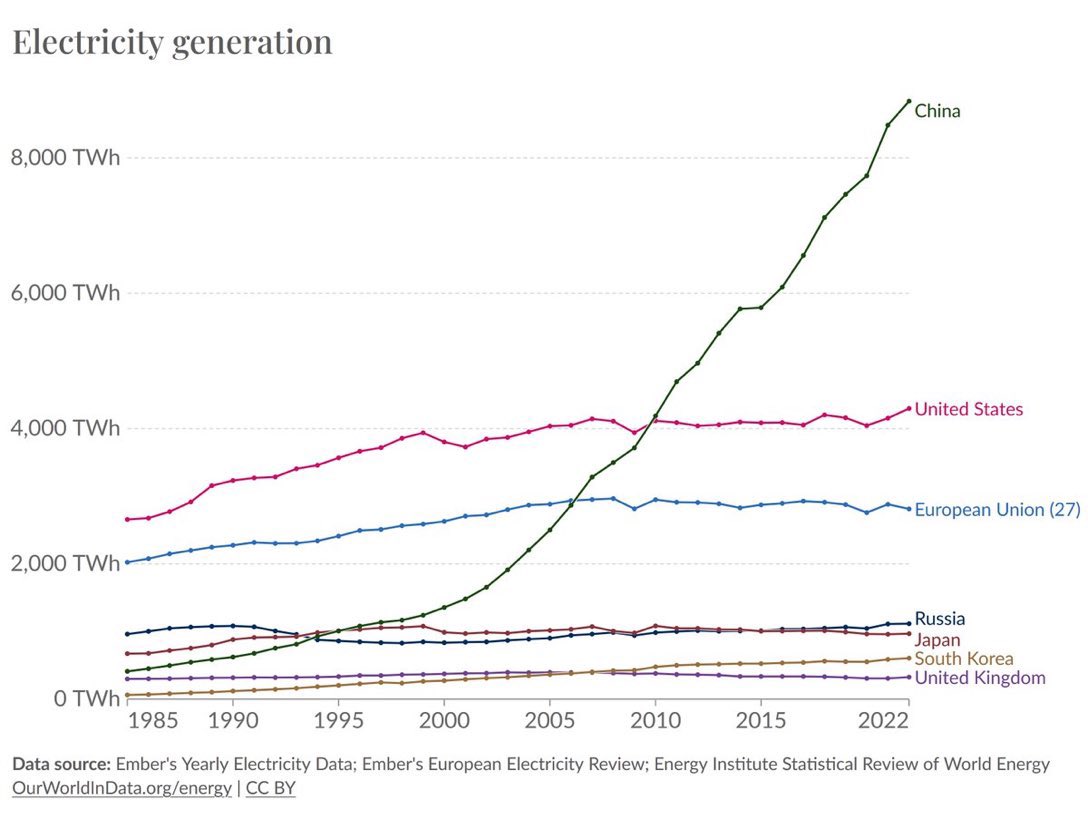
What does this mean for different countries? Given how fast the US falling behind China in electricity generation, what would it take for us to make up the ground?
What are the most plausible sources (natural gas, nuclear, solar), what are their supply curves, the main physical or regulatory bottlenecks that would slow down a ramp up, etc.
Who's the right guest to chat this through?
Harvard researcher Dr Sarah Fortune was only two years away from creating a vaccine that could have saved the 1.25 million people killed each year by tuberculosis. But last month, she received a letter telling her that the $60 million grant funding her research was being halted by President Trump.
UC Berkeley open-sourced a 14B model that rivals OpenAI o3-mini and o1 on coding!
They applied RL to Deepseek-R1-Distilled-Qwen-14B on 24K coding problems.
It only costs 32 H100 for 2.5 weeks (~$26,880)!
It's truly open-source. They released everything: the model, training code, dataset, and a detailed blog (links in the thread).
Finally, a powerful coding model we can run locally. I hope Sam can open-source something better than this.