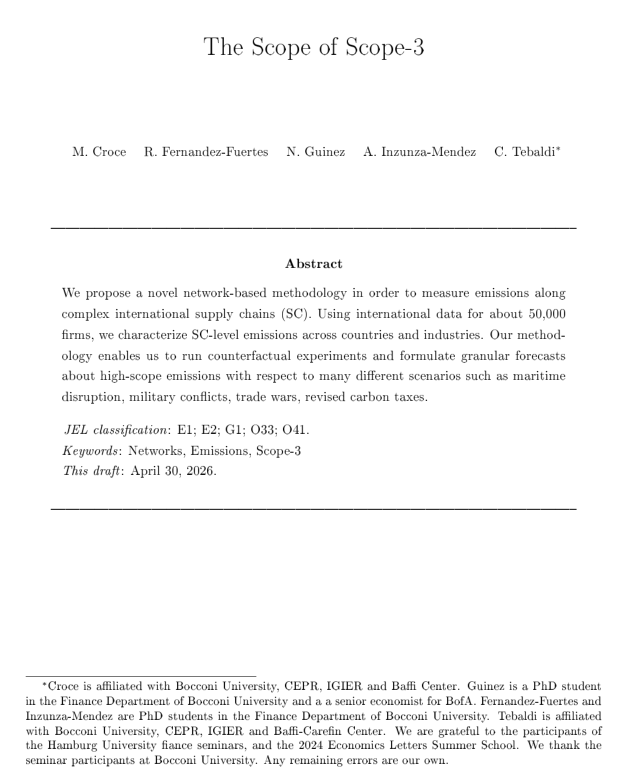
Green Tech #Episode_III: #TheScopeOfScope-3
We provide an international network general equilibrium model augmented with an I/O matrix of emissions. Using only data on direct emissions, we provide high-scope emissions across ~50K firms.👇
@Unibocconi@sdabocconi
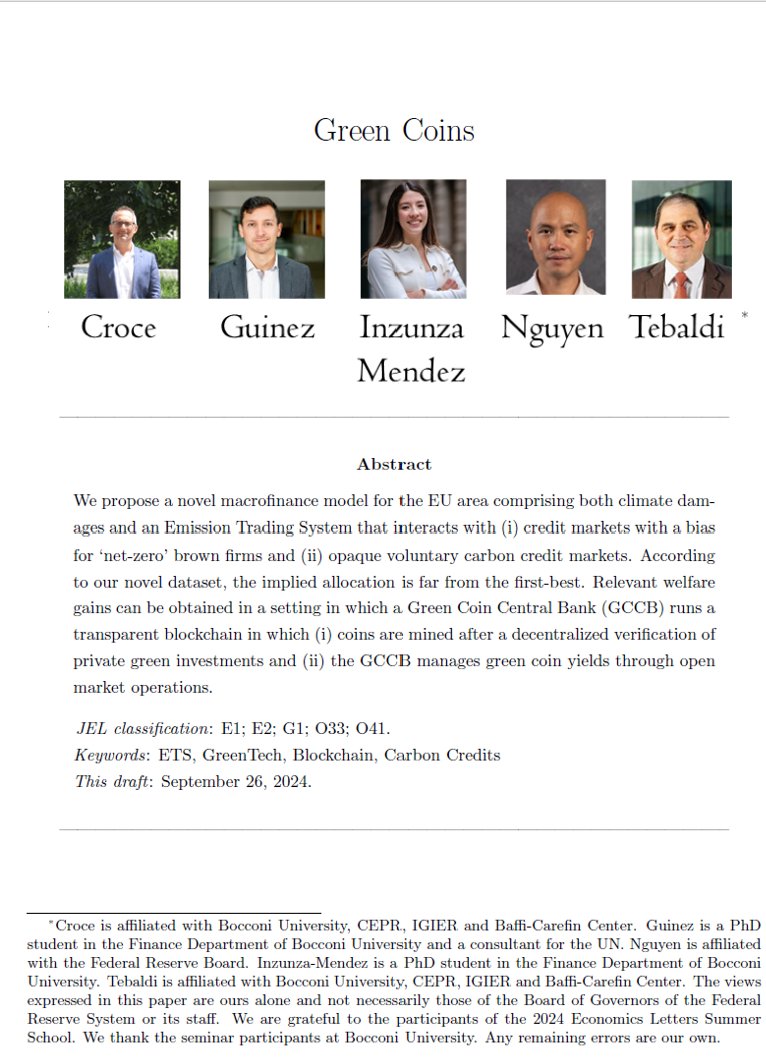
Delighted to have presented #GreenCoins at the New Frontiers in Banking and Capital Markets Conference
It was a great event and the Green-Tech initiative even won a best paper award! Congrats @bezzi_giacomo ;)
Read it: https://t.co/FkGo1DqZeA
One of the most original empirical monetary papers I have seen in recent times.
Said this before, will repeat: have a serious look at @rubenffuentes who is on the market.
Very interesting job market paper by @rubenffuertes. He develops a new framework with multiple AI agents to construct much more precise conditional expectations for monetary policy from Fed communication.
This allows him to quantify narrative monetary policy *surprises* that explain 3 times as much policy rate variation more traditional market-based measures.
Excellent work. The future is bright!
https://t.co/jRslOZguZI
The Fed just cut rates by 25bp on October 29, but was this decision already baked into the Fed's own communications? Markets seemed to have priced it, yet a key question remains: What would you have expected if you only read the Fed's pre-meeting documents?
In my Job Market Paper, I tackle this question by developing a Multi-Agent System of Large Language Models that extracts conditional expectations directly from Beige Books and FOMC Minutes, creating a novel series of monetary policy surprises.
Let's zoom in on last week's example:
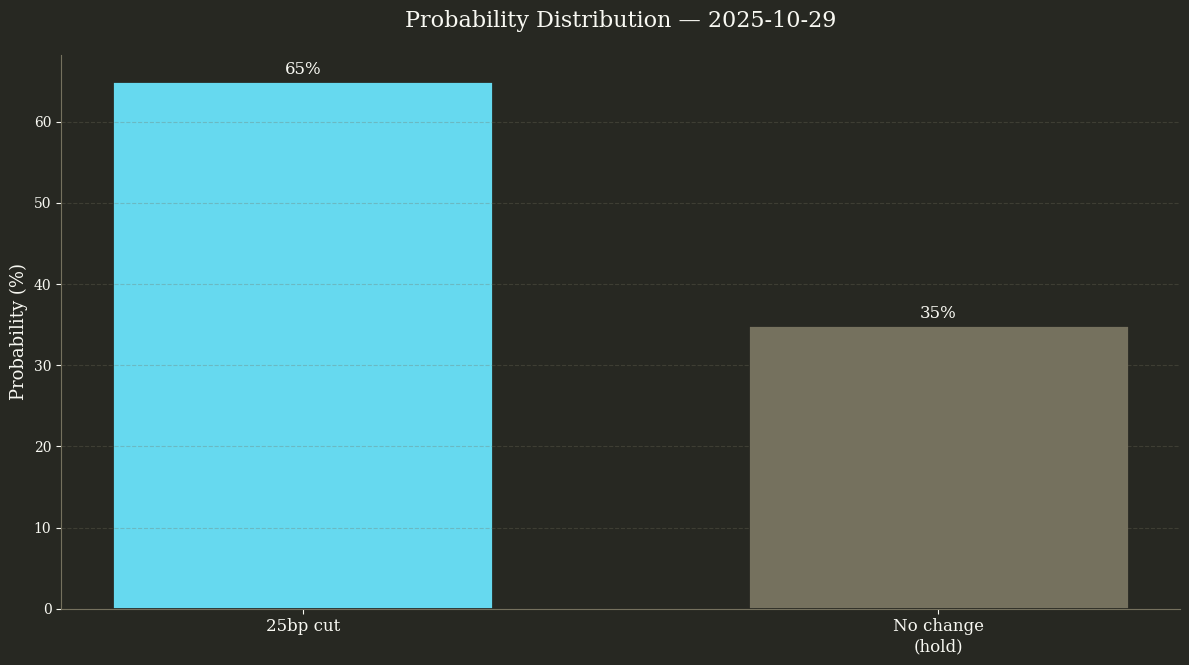
Reading only pre-meeting Fed documents, my system assigned:
• 65% probability to a 25bp cut
• 35% probability to no change
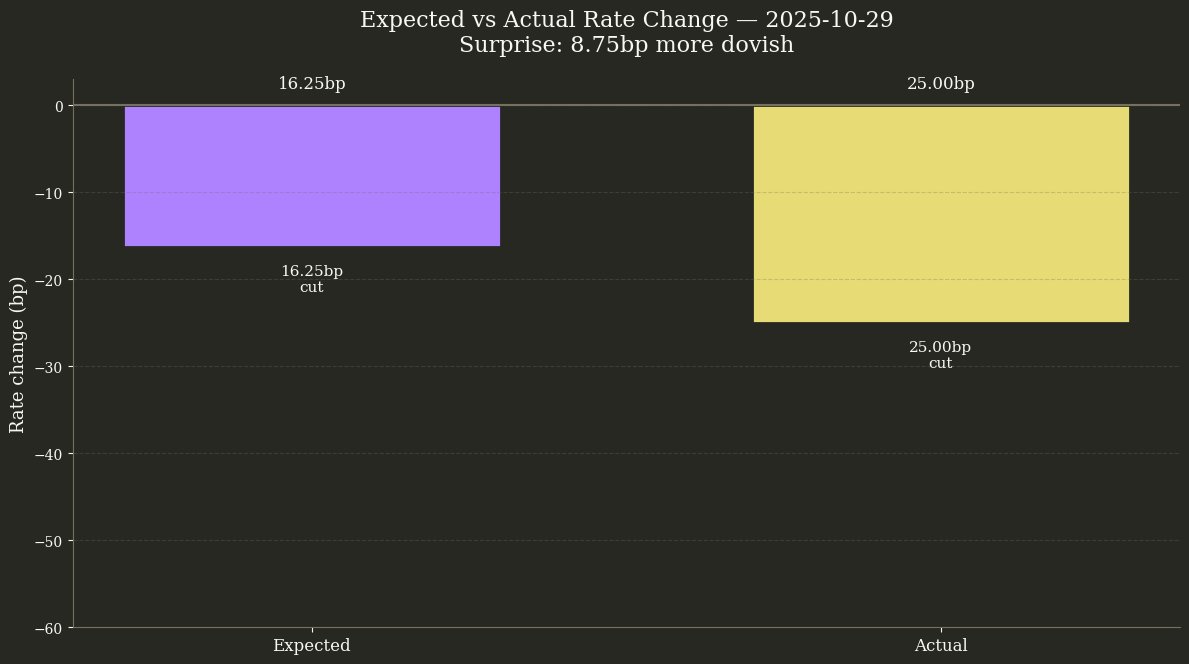
• Expected cut: 16.25bp
The Fed delivered the full 25bp cut, resulting in a small 8.75bp dovish surprise.
❗ Therefore, the decision was mostly expected by reading the official documents that were available before the meeting.
How it works (and why it matters)
Four agents work together on a common task: computing a monetary policy surprise for an upcoming FOMC meeting.
• Agents IA and IM read the Beige Book (for this meeting) and the Minutes (for the previous meeting), respectively.
• Agent II builds the expectations.
• Agent III computes the surprise.
In this way, I extract expectations from Beige Books and FOMC Minutes and compare them with the actual decision to compute the surprise. This approach:
• Bridges narrative and high-frequency identification: Combines narrative approach with high-frequency measures' shock identification
• Builds the first multi-agent LLM system for monetary policy analysis: Synthesizes heterogeneous Fed communications (Beige Books, Minutes, Statements) to extract ex ante probability distributions.
• Enables direct extraction without ex post cleaning: No econometric orthogonalization, regression residuals, or filtering, just strict pre-meeting information cutoffs.
• Uses LLMs for survey-based belief elicitation: LLMs extract probabilistic expectations from text, like surveying a Fed expert who has read all pre-meeting documents.
This gives "New Hope" to monetary policy shock identification. The multi-agent architecture could be augmented with additional agents that read non-Fed information (macroeconomic releases, financial conditions, etc.) to further refine expectations.
You can read more on:
SSRN: https://t.co/I9dsShNM0T
My webpage: https://t.co/LXC8Ryu8AD
#EconTwitter #MonetaryPolicy #LLM #JobMarket #MacroFinance
The 2025-2026 economics job market is tracking 32% below the previous cycle. @rubenffuertes and I built a dashboard analysing 8,400+ JOE postings (2019-2025) to reveal the trends across fields, position types, and more. 🧵 https://t.co/ogMcZsp64K
Very glad that #GreenCoins was selected here: https://t.co/sJEN6JWXWD
#Alejandra, first-year of PhD!, delivered a wonderful presentation [https://t.co/XyK5bfzfe1].
WP: https://t.co/nN03Kw6GRC
Coauthored with Alejandra Inzunza, our paper studies the implications for the fiscal budget and retirees' income of the #pension#laws implemented in #Chile between 2020 and 2025. Published open access in the Journal of Pension Economics and Finance: https://t.co/5CicGdj9j4
#Academia is awesome #2: very grateful to @WarwickBSchool for selecting 'Green Coins' for this event: https://t.co/JE3MFLcEA1
Wonderful day to present my first contribution to #MacroFinTech, a.k.a., FinTech for Macroeconomic challenges #GreatCoauthors 👇







![MCroce_MacroFin's tweet photo. Very glad that #GreenCoins was selected here: https://t.co/sJEN6JWXWD
#Alejandra, first-year of PhD!, delivered a wonderful presentation [https://t.co/XyK5bfzfe1].
WP: https://t.co/nN03Kw6GRC https://t.co/oaXK8M1gGc](https://pbs.twimg.com/media/GubhdNJWEAAA37r.jpg)