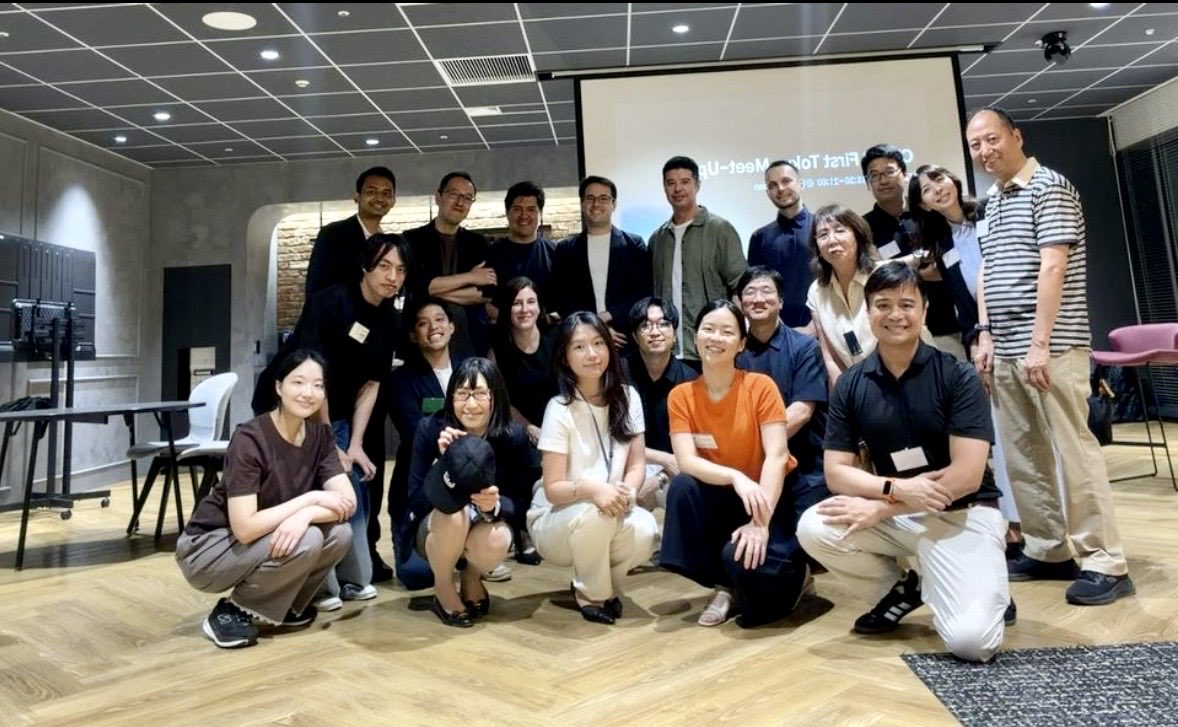
These are the people who catch every AI failure before the customer does.
The first CX/CS meetup in Tokyo, hosted by Perplexity APAC, with Daniel and Kenji running the room. Thanks June for the conversation and SThree Japan for the space.
Kudos to all of you!
@perplexity_ai
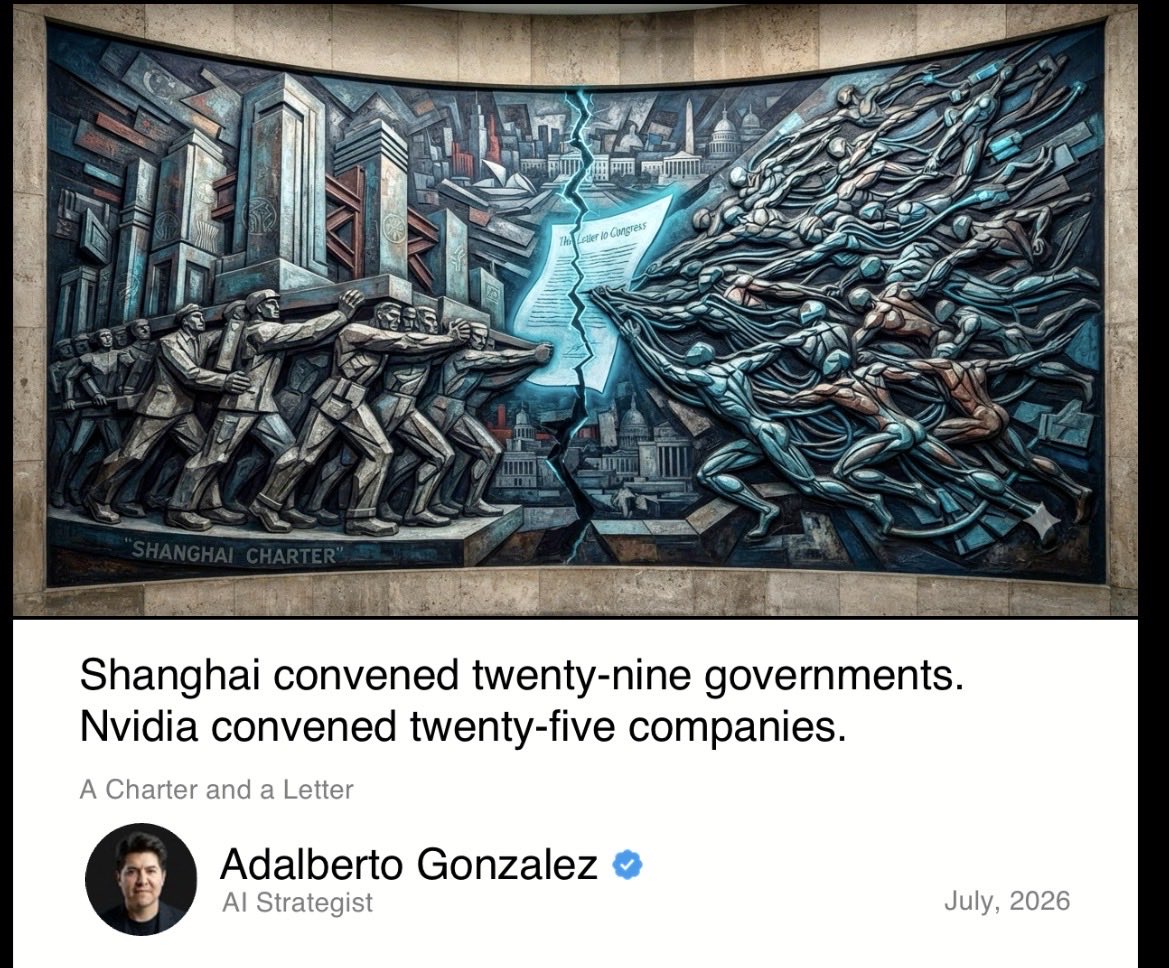
A few days ago, Huang used his first ever post on X to share a letter, hosted by Nvidia, asking Washington not to restrict open weights. Twenty-five American companies signed it. By Sunday the list was fifty.
Meanwhile in Shanghai. Eight days before Jensen’s letter, twenty-nine foreign ministers signed a charter. Permanent secretariat, cooperation centers planned with ASEAN, the African Union, BRICS. Guterres in the room.
Nvidia’s is a letter to Congress. Shanghai’s is a treaty.
The easy read would be China builds while America argues. Wrong on the tempo. Bessent threatened sanctions on the 21st. Letter on the 24th. Fifty names by the 26th. Nobody was slow.
The point is these are different instruments.
A state opens embassies. Picks the country, picks the year, signs the lease. A franchise spreads on its own economics, and head office cannot order one into a country that doesn’t want it.
China moves AI the way you open embassies. Charter, secretariat, training slots, infrastructure capital.
Washington has no equivalent. It does not distribute models. Models leave because companies ship them, and the only lever the government holds is regulation of its own firms.
American AI foreign policy runs through American domestic law. There is no other pipe.
Which is why the answer to a Shanghai charter is a letter to Congress about compute access for startups. The mechanism working the only way it can. It needs a domestic settlement before anything moves outward.
The settlement is the missing piece. Not the speed.
Franchises have historically beaten embassies on adoption. AWS never needed a charter. I’m not calling the outcome.
But the settlement is already behind the field.
I wrote last week about Hugging Face running its breach forensics on Beijing weights, on their own hardware, because the hosted models refused to look at the payloads. Check the date. Same week as Shanghai. Before the letter. Before Bessent.
Everyone arguing about whether American open weights get restricted, and whether Chinese ones get sanctioned, is arguing about a call a security team already made with the building on fire.
Here is what it costs you.
You diversified vendors. Two hosted providers, maybe three, so no single one can hold you hostage. That works against a vendor. It does nothing against a category. If Washington restricts open weights as a class, or sanctions Chinese models as a class, every name on your list moves the same day.
Vendor diversity is not the axis. Hosted versus held is the axis. Weights sitting on hardware you own do not care what passes.
That is not a procurement decision. Procurement cannot buy you a model that stays legal.
Bessent said days or weeks. Your next architecture review is further out than that.
What do you already hold?
AI Atlas Launch in Tokyo
Today, https://t.co/jqs8ptPBIY — a live intelligence platform tracking the geopolitics of AI for all 197 countries, updated continuously (not annually).
It shows where each country stands today + where it’s heading.
The gap is the signal and every reading is analyst-reviewed, fully citable, and applied neutrally to every nation.
Great turnout from Microsoft, EY, Takeda, WEF, Japan’s Digital Agency & more.
The movement of AI sovereignty, watched in a single place.
More here : https://t.co/oLEuOyrVI7
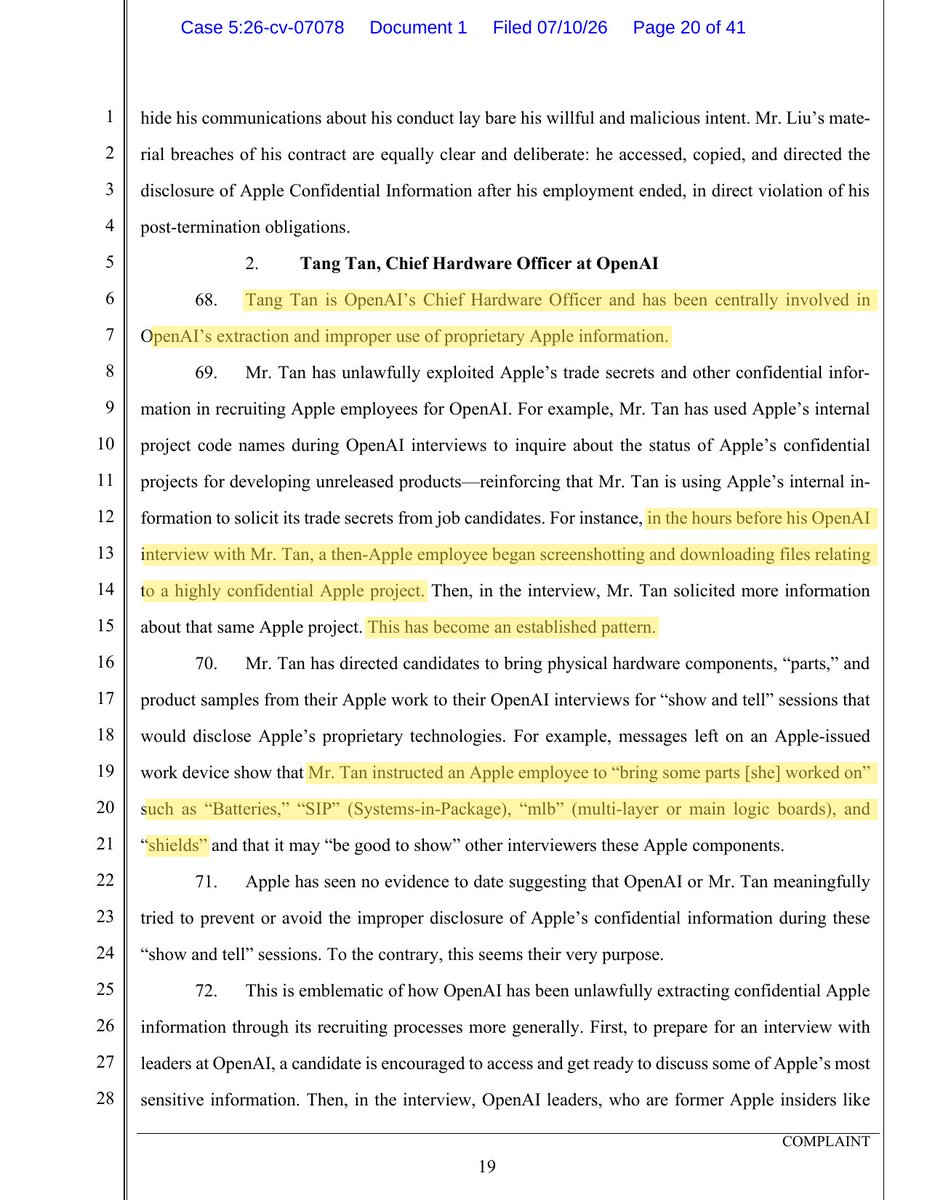
>be Tang Tan
>24 YEARS at Apple
>VP of Product Design, iPhone AND Apple Watch
>you know every team. every project.
>every name worth taking
>months BEFORE you leave:
>meet with OpenAI’s people
>email yourself Apple supplier intel
>apple is literally paying you while you betray them
2024: leave, co-found io with Jony Ive
2025: OpenAI buys it for $6.5 BILLION
>a one-year-old company. no product
>you’re now Chief Hardware Officer
>you’re paid in OpenAI pre-IPO shares
begin the great unbuilding of Apple
>one by one, apple’s hardware people vanish
>engineers. designers. supply chain leads
>you know which head holds which secret
>you are the mastermind
>you pick accordingly
>interviews are not interviews
>drop secret codenames like you still work there:
> “what’s the plan?”
>candidates cram STOLEN FILES the night before like it’s finals week
>“bring Actual parts for show and tell”
>apple employees smuggling batteries and logic boards out of Apple Park in their bags
>one guy, genuinely confused: “didn’t even know we could take those from the office”
>you knew
>hand every new hire Apple’s own security manual BEFORE they resign
>the document literally lists the rules they’re about to break
>openai staff, cheerfully: “a checklist that Tang put together”
>tang did not put it together
>APPLE put it together
>tang took it on his way out
Tang Tan spent 24 years learning how Apple keeps secrets. Then 14 months teaching people how to leave with them.
APPLE IS PERSONALLY SUING HIM FOR: TRADE SECRET THEFT. BREACH OF CONTRACT. WILLFUL. EXEMPLARY DAMAGES.
Yesterday Alex Karp gave us the most unfiltered ten minutes on financial television in months. Even Becky Quick told him he sounded pretty angry. He said no. This is the voice of American business being channeled through me. His words: Frontier models have been completely, irresponsibly, oversold. Enterprises are chillaxing through tokens, getting no value, handing over their IP.
Strip away the theater and the diagnosis is solid.
Token economics carry an asymmetry most boards haven’t priced. You pay per token. The lab gains telemetry. Not your documents. Your patterns. Which workflows run at volume, where models fail, what your industry actually does all day. That exhaust trains the next model and shapes the next vertical product. The thing Karp calls your alpha, the operational judgment that separates you from your competitors, leaks upward one API call at a time. His manifesto puts it plainly: data retention is your treasure.
He’s right about that. I’ve been writing about model dependency as a solvency question, and this is the same nerve from a different angle.
The prescription is where I slow down.
In Orwell’s Animal Farm, the animals didn’t overthrow the farmer and become free. They overthrew the farmer and the pigs moved into the farmhouse. Enterprise tech has run this cycle before. You owned your servers for control. Then came the support contracts, the upgrades that broke your custom work, the complexity, the talent drought. You moved to cloud for simplicity. Then came the egress fees, the usage visibility, the pricing power. Now the offer is sovereignty. Same farm, new management.
Look at the mechanics of this particular offer. An ontology-driven stack is powerful precisely because it builds a deep semantic map of your business. That depth is the value. It’s also the lock. Once your data models, workflows, and compliance tooling live inside someone’s platform, switching costs compound in a way per-token pricing never did. Token economics extract through usage. Platform economics extract through depth of integration. And the compute vendor wins in every scenario.
Karp’s diagnosis deserves to be taken seriously. So does applying his own scrutiny to what he’s selling.
Because what survives every vendor cycle is a short list: your data models, your knowledge graphs, your evaluation harnesses, the abstraction layers that let you swap a model or a platform without rebuilding your judgment from scratch. Those should outlive any vendor. Sovereign or not.
The jig may be up on one model of AI delivery. Whether the next one is structurally different, or the same cycle with better graphics and bigger GPUs, is the thing I’m watching.
Last night they flipped Fable & Mythos back ON.
While its two models sat dark, Zhipu shipped GLM-5.2 out of Beijing. MIT license, free to download, no regional locks, no switch to flip. Parallel to this, Palantir spent the same week arguing you should own your weights.
The argument was right. It was also late... Someone had already shipped the answer.
There used to be a theory that flies just appeared out of spoiled food. Spontaneous generation. People believed it for centuries because that's what they observed. No one saw the eggs. The process looked spontaneous. This is what the regulatory switch on advanced AI models feels like from the outside.
You built operations. Years of them. Process, judgment, the customers, the thing they actually pay for. All of it running on a layer you treated like electricity. The models underneath everything.
A client or investor will never ask which model you run, the same way they never ask which cloud. They ask for the numbers. And the numbers work, because the model underneath holds your cost base stable. That stability is load-bearing. It is the line between margin and no margin.
You ran the math. Two dollars a run on one model, twenty cents on another. So you weigh it. Price, transparency, reliability, jurisdiction. Pick any ground you want, none of them is zero risk. You chose, you signed. Fair. That was never the risk.
The risk is the morning the model gets banned in your market, the way an app gets banned in a jurisdiction, and the only compliant option left costs five times more. Nothing about your operation changed. Your cost base did. The plan the board approved was priced on a number a government can take back.
You insured against surveillance. The exposure was solvency.
That is what the switch actually controls. Not access. Your unit economics. It can go dark on a Friday with ninety minutes of notice, and the exit everyone assumes "just move providers" has a state standing in every door. One door ships with a switch that appears out of nowhere. The other is built inside a government yours does not want you near.
If the answer to "what happens when the price disappears" is nothing, you are not running an AI strategy. You are renting. And the landlord can change the locks and the rent on the same morning.
So what gets adopted when every model ships with a switch that can appear out of nowhere? The switch only looks spontaneous from where you sit. From where the signals form, in the filings, the funding, the regulatory drafts, the eggs are visible long before the fly. The signals point to stability. Not performance. Stability.
Ada Lovelace wrote this in 1842:
"The Analytical Engine has no pretensions whatever to originate anything. It can do ‘whatever we know how to order it’ to perform."
It's still the most common dismissal of AI today.
But there's a paradox hiding underneath it.
Your brain is also just following rules. Electrochemical instructions. No exceptions, ever. No neuron "decides" to fire. It either does or it doesn't, based on inputs.
Yet here you are. Reading. Interpreting. Arguably originating.
So running on rules was never the dividing line.
Can rules of sufficient complexity produce behavior that transcends what those rules explicitly specify?
Hofstadter asked this in 1979, in Gödel, Escher, Bach.
We're still answering it.
KPMG published a report on agentic AI. It was written with AI, and the AI made up most of the sources. When a research group checked the citations, only 11% pointed to anything real.
Less than a coin flip. You'd have done better guessing.
The easy read is the irony, but I think it misses the thing, because it isn't just KPMG. It's Deloitte, EY, the firms you pay for judgment. And it's NeurIPS, the top AI conference, the people building the models. Both falling into the same hole.
A model will write you a page of flawless-looking citations faster than you can read one. It does exactly what it was built to do, which is produce text that looks right. It aims at plausible, not at true. And I've watched this on my own bench, Claude Code telling me it ran research it never ran, clean summary and confident tone with nothing underneath.
The output said 'done'. The checking was on me.
This week Satya Nadella wrote: "Without human direction, you have compute running in circles." Some companies repriced themselves to the speed of generation, they just omitted the validation. Imagine a factory telling you how fast they can go. They didn't just leave quality assurance off the quote. They left it out of the work. The units ship on time, and you find out 'live' how many came out defective.
When we built our research system, the first thing wasn't the scanner. It was the test for what counts as real, and a person still owns that call before anything ships. That's the part no vendor sells you this year.
Your AI will hallucinate. The open question is who owns the word "real." If that job belongs to the same system that wrote the draft, you've got a number coming.
You just haven't read it yet.
Most companies shop for AI models the way they shop for laptops. Pick the fastest, feel good about it.
The model is the laptop. The commodity. There's a faster one coming, and the one you bought already has a version number on it.
Swap the model and the behavior moves. The advantage you spent a year on doesn't transfer clean. And the swap isn't always yours to make. (Ask the teams who lost Fable 5 on Friday.)
You can offload the task. You can offload the job. You can't offload the learning.
One thing ports between machines. The people who can re-encode the judgment into whatever comes next.
Human judgment is the only model-agnostic asset in the building. Everything else has a version number.
-The Human Premium-
The countries adopting AI fastest are not picking sides.
https://t.co/jqs8ptPBIY calls the posture sovereign multi-aligned. It does not appear as a category in any major report.
Four countries sit in it today. UAE. Singapore. Switzerland. Hungary. AI Atlas reads all four as Inconclusive on bloc alignment. That signal is the marker of the posture. Present-state and trajectory both sit deliberately mid-spectrum. Not by accident. Not because the data is missing. Because each country has engineered a posture that refuses bloc capture.
This is also the leaderboard.
Microsoft's Q1 2026 diffusion report ranks the UAE first globally at 70.1% of working-age population. Singapore second at 63.4%. Switzerland thirteenth at 37.8%. Hungary eighteenth at 32.2%. The United States ranks twenty-first at 31.3%. The UAE adopts AI at more than twice the US rate while sitting outside the US bloc.
This is not what the major reports describe. Microsoft's own GDP correlation tells a clean story of Global North adoption riding on bloc alignment. The top of the leaderboard says otherwise.
How each one holds the posture.
The UAE buys massively from US firms, signs AI cooperation agreements with Chinese partners, and runs G42's own model program. Singapore operates as a regulatory marketplace, deliberately neutral. Switzerland and Hungary navigate Western institutional gravity without inheriting the alignment.
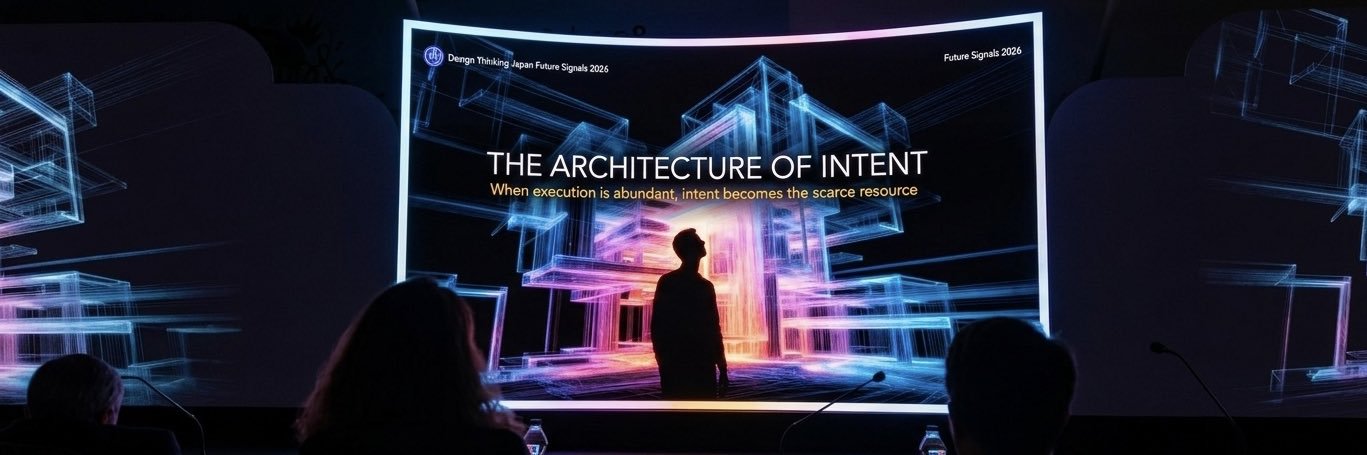
DTJ's Future Signals 2026 named the fragmentation of the global tech stack as Signal 2. Signal 2 is the floor of that fragmentation. The lower and middle of the adoption curve sorting visibly into US-aligned and China-aligned camps. Sovereign multi-alignment is the ceiling. The posture forming at the top of the curve, deliberately above the fracture.
AI Atlas surfaces the category because every country gets the same two readings. Present-state. Trajectory. Across four dimensions. The four countries above carry present and trajectory readings that both sit mid-spectrum on bloc alignment. That is not what a country in transition looks like. That is what a country with a stable non-aligned posture looks like.
https://t.co/lpXynJsErw is the only place tracking this country by country. Each classification reviewed before it ships.
The frame everyone uses to read the global AI landscape is missing a category. The leading adopters built it deliberately. Anyone forecasting AI sovereignty over the next eighteen months without it is reading the wrong map.
https://t.co/GPBAxjkvpj
https://t.co/5YsuBy7lj0
We meet in Brussels this month. DTJ's Future Signals report in hand. Signals and governance. Same conversation. Same room now. The work is to make AI's moving parts visible.
Every governance conversation is an AI conversation.
This May, DTJ presents at the AI Global Governance Summer School in Brussels, part of a program featuring the European Commission, Carnegie Europe, NATO, and Leiden University. One of the most serious rooms in the world for AI policy and regulation.
We will present our Future Signals 2026 research: five structural shifts reshaping how AI gets built, governed, and deployed globally. One of those signals is 𝗧𝗵𝗲 𝗙𝗿𝗮𝗴𝗺𝗲𝗻𝘁𝗲𝗱 𝗪𝗼𝗿𝗹𝗱, the fracturing of the global AI order along sovereign fault lines, with EU AI Act enforcement scheduled for August 2026.
We will also preview 𝗔𝗜 𝗔𝘁𝗹𝗮𝘀, our live geopolitical intelligence map built directly from that signal. Infrastructure dependencies, bloc alignment, and shift detection across 195 countries.
𝗕𝗿𝘂𝘀𝘀𝗲𝗹𝘀, 𝗠𝗮𝘆 𝟯𝟬.
🔗 https://t.co/vhweITKkFV 🔗 https://t.co/OF1QWvwFSo