🚨 SCIENTISTS JUST USED MAGNETIC MICROROBOTS TO HELP REGENERATE SPINAL CORD INJURIES.
In a new study, researchers created tiny magnetoelectric microrobots (called NPCbots) loaded with neural progenitor cells. These were injected directly into spinal cord injury sites in animal models.
Once in place, researchers used external magnetic fields to wirelessly stimulate the microrobots, triggering them to release growth factors and guide nerve regeneration.
Why this matters:
• Spinal cord injuries are currently very difficult to repair because damaged nerves rarely regrow properly
• These microrobots combine precise delivery of regenerative cells with on-demand magnetic stimulation
• Early results in zebrafish and mouse models showed improved tissue repair and nerve regeneration
• The system allows non-invasive, targeted control after the robots are already inside the body
The deeper implication is significant:
We are moving closer to technologies that don’t just treat symptoms of spinal cord injuries but actively help the nervous system rebuild itself using precisely controlled microrobots.
If this approach continues to improve, it could eventually offer new hope for people with paralysis and other severe nerve injuries.
What do you think how close are we to seeing microrobot-based treatments for spinal cord injuries in humans?
Follow for more frontier neuroscience and future medicine.
Microscopic hybrids carried stem-cell progenitors to spinal cord injuries and then delivered electrical cues without implanted wires. @ETH_en@NatureMaterials https://t.co/fWpRAxPxhw
The Quantum tunneling effect is a phenomenon in Quantum Mechanics where a particle can pass through an energy barrier even if it does not have enough energy to overcome it according to classical physics.
The transition from “physical bodies” to field-mediated biological systems is where the next century of Biomedical Data Science lives. If organisms are self-interacting electromagnetic processes supported by physical substrates, then our biological “data” is inherently harmonic and dynamical. Modeling this requires moving beyond static genomics toward signal- and field-aware computational architectures. #DBDS #QuantumBiology #AI
The idea that we are "physical bodies" is wholly misleading. The vast majority of our volume is empty, and all the interactions are electromagnetic in nature.
A truer statement is that we are electromagnetic entities, and these field interactions are supported by molecules acting as small antenna, tissues and ionic flows and so on.
All chemical reactions are in fact electromagnetic field interactions at a distance. Molecules do not "touch" - they push on each other via distant fields.
Of course our electromagnetic bodies do not end at the skin but extend into our surrounding space as well. If you want to know what "awareness" or "experience" are constituted by, it is necessarily these field interactions, both inside our body and without. I do not really "get" the binding problem of how physical processes produce experience. Experience *is* self interacting electromagnetic fields supported by some kind of physical substrate.
So the question of whether "can plasma be alive" or "do machines have experience" is rather obvious. Electromagnetic field interactions are the stuff of experience, full stop. Whether they have memories, ideas, self recognition is a question of memory, internal feedback loops, etc.
Takeaway: you are a coherent self interacting formation of electromagnetic fields, and these are radiated and supported by small clumps of matter that are extremely rarified in space and do not physically touch each other.
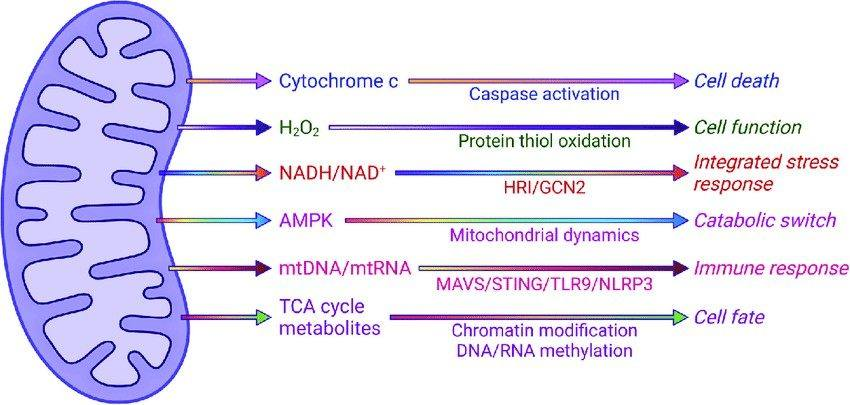
A simple guide to how mitochondria work. 4️⃣ primar jobs
Mitochondria are more than the “powerhouse of the cell.” They’re multitasking organelles that control energy, stress, genetics, and even cell survival. Here are the 4 primary jobs they do:
1️⃣ ATP Generation (Energy Production)
Mitochondria convert glucose, fats, and amino acids into acetyl-CoA, which enters the TCA cycle and electron transport chain (ETC).
The result: ATP, the energy currency for everything from nerve signals to muscle contractions.
🟢 Example: Every time you move or think, mitochondria are fueling the process.
2️⃣ ROS Balance - i.e., redox control
As mitochondria make ATP, they also generate reactive oxygen species (ROS) damaging byproducts.
Antioxidant enzymes (like catalase, SOD, glutathione peroxidase) keep ROS under control.
Too much ROS = oxidative stress → cell injury or death.
🟢 Example: Exercise trains mitochondria to better balance ROS, which is one reason it’s so protective.
3️⃣ mtDNA Maintenance (genetic stability)
Mitochondria have their own DNA (mtDNA), which encodes key ETC proteins.
Damage or mutations in mtDNA reduce energy output and contribute to diseases.
mtDNA mutations accumulate with age, linking mitochondria to neurodegeneration and aging.
🟢 Example: Mitochondrial DNA damage is a hallmark in Alzheimer’s and Parkinson’s disease.
4️⃣ Membrane Dynamics (fission & fusion)
Mitochondria constantly split (fission) and merge (fusion) to adapt to stress and demand.
This dynamic reshaping controls quality, removing damaged mitochondria (mitophagy) and keeping networks healthy.
🟢 Example: Impaired fission/fusion is seen in metabolic disorders and neurodegenerative disease.
Mitochondria don’t just make energy. They balance oxidative stress, protect genetic integrity, and constantly remodel themselves to keep cells alive. Supporting mitochondrial health means supporting the foundation of cellular life.
Source: Song, N., Mei, S., Wang, X. et al. Focusing on mitochondria in the brain: from biology to therapeutics. Transl Neurodegener 13, 23 (2024).