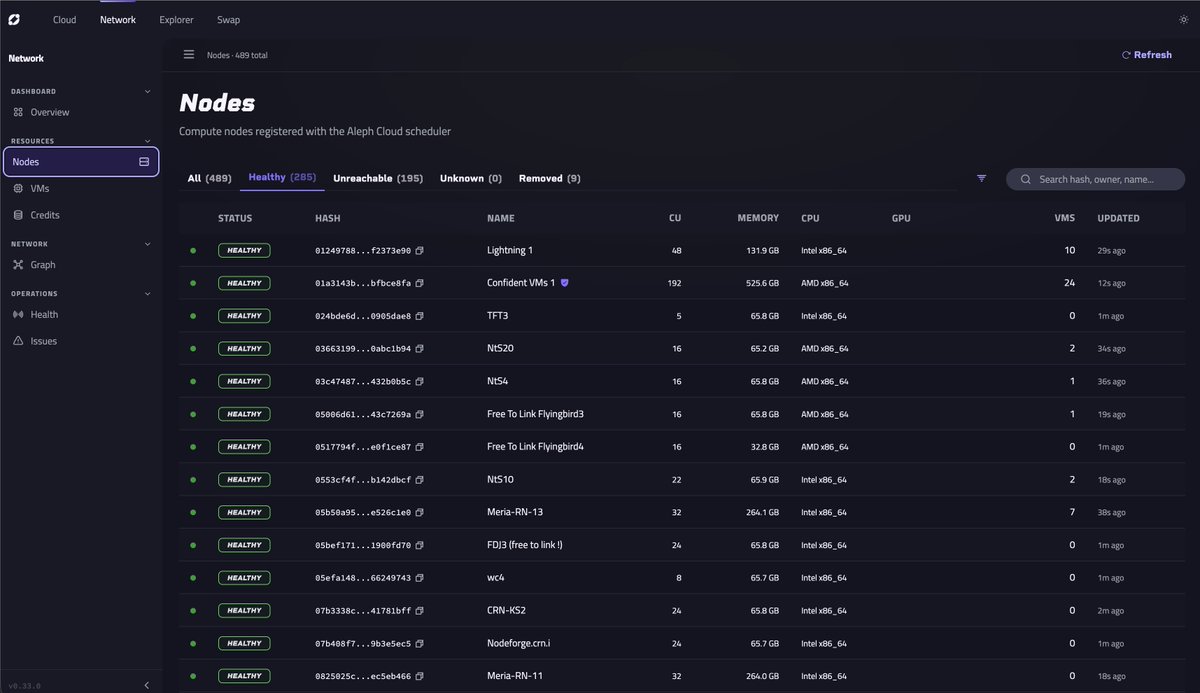
We are redesigning emission-funded node rewards with a usage-based revenue share model.
95% of customer credit payments now flow directly to CRN operators and stakers. 🧵
Europe's cloud sovereignty debate should treat architecture as part of the assessment.
Moshe's thread lays out the questions we think every critical cloud assessment should ask:
Who can stop the workload?
Who can inspect it?
How can anyone verify the answers?
The EU cloud sovereignty debate is moving quickly after the Cloud and AI Development Act (CADA).
The useful question is simple: when a critical workload depends on a cloud provider, who can actually stop it, inspect it, or change the conditions under which it runs?
The EU cloud sovereignty debate is moving quickly after the Cloud and AI Development Act (CADA).
The useful question is simple: when a critical workload depends on a cloud provider, who can actually stop it, inspect it, or change the conditions under which it runs?
Still bitching about Fable and how you lost access? This is why Aleph cloud and LibertAI exist.
We protect you from this. Just use Aleph Cloud. Just use LibertAI.
- Moshe
@sezorock Gercek merkeziyetsizlik @aleph_im ve onun icinde kosan @Libertai_DAI@LiberClaw gibi projelerdir. Bu isin teknik kismiyla ilgilenmeyenler maalesef yuksek market degerli ama temel olarak cogu node u AWS uzerinde calisan projelere yoneliyorlar.
🎙️ TTS is live on LibertAI.
Text to speech that keeps your data secret.
The specs:
• Model: kokoro-82m
• Voices: 20+
• Speed: 0.25x–4.0x
• Output: WAV
OpenAI-compatible API. Drop your existing OpenAI SDK calls and swap the base URL. Done.
Docs: https://t.co/Kk62Ydlh7b
Let's make some noise. 🔊
Aleph Cloud CLI v0.13.0 is out!
Main features:
- You can now create encrypted local accounts (EVM keystore v3), ideal for when you want to keep the convenience of a hot wallet in a world where agents casually access your filesystem.
- Integration with @ophisfi to swap ETH or USDC to ALEPH.
In a TEE-based cloud, the rule is simple: never give one machine all the keys.
We use MPC, secret sharding, short‑lived session keys, and voting schemes so no single TEE ever stores long‑lived secrets, even as new hardware vulns are discovered.
The first credit distribution has been done today. It is now the standard payment solution across all products and services and set the foundations for Aleph v2.
https://t.co/icqqlniYr7
In a TEE-based cloud, the rule is simple: never give one machine all the keys.
We use MPC, secret sharding, short‑lived session keys, and voting schemes so no single TEE ever stores long‑lived secrets, even as new hardware vulns are discovered.
Watch @ODesenfans talk on Aleph V2:
Schedulers are consensus-based nodes that monitor cluster health and migrate VMs away from failing machines, following user-defined policies for what can move where.
@daoism_systems@AskVenice@LiberClaw AI agents on Liberclaw use Qwen3.6 and 3.5, with fine tuned souls and skills. LiberClaw specifically uses confidential VMs. Fully decentralized architecture with possibility to chose from classic servers or TEE based.
Watch @ODesenfans talk on Aleph V2:
Schedulers are consensus-based nodes that monitor cluster health and migrate VMs away from failing machines, following user-defined policies for what can move where.