Executives commonly use the terms organizational climate & organizational culture interchangeably. OB scholars & i/o psychologists usually don't. Climate is easier to change. https://t.co/d6aFPwxm3J From the archives.
@nick_coatsworth Time to train policy makers in critical appraisal. Relying on a single study, especially one that is not trustworthy, is not #evidence-based practice.
This short article (and responses) shed light on why evidence-based practice is not difficult to understand but very hard to do in practice.
Though about evidence-based #medicine points made apply also to #Management#HR#iopsych.
https://t.co/lPZI7zmTC9
Odd how few organizations adopt this multi-method approach to forecasting.
There is no perfect method.
So why not embrace methods that have offsetting strengths and weaknesses—that let you see the world from different angles?
Simple methods of extracting wisdom from crowds—like averaging—tamp down noise.
Complex methods—like Bayesian aggregators & prediction markets—also reduce bias & improve signal detection
Satopää's BIN framework lets us model these underlying mechanisms.
Ville Satopää does lovely work on foundational questions.
Think of the people whose judgment you trust.
Do you know how skillful they are at suppressing bias & noise--and at spotting signals?
Are they closer to Category-B or to messy mixes of, say, Categories D and F?
1. The pandemic has highlighted the need to improve our evidence support systems for citizens, practitioners & policy makers. I strongly encourage you to join one of the launch seminars for Global Commission on Evidence to Address Societal Challenges report this week.
More people noticing #BlueMonday is not A Thing. But there are many Things that on closer inspection don't really seem to be A Thing. Here's a few more. What's your favourite Thing-that-isn't-A-Thing?
Organizational culture
Employee engagement
Personality types
Learning styles
Do researchers update their beliefs about findings following replication success or failure? This excellent study suggests that the answer is yes, just not as much as Bayesian models would expect.
Paper: https://t.co/3fIPhfjK2z
Green OA: https://t.co/dtKkf31zIE
@Rob_Briner Lots of course content is not evidence-based, just take a look at management text books. Not a lot of trustworthy evidence to support principles taught. Fads, fashions, and claimed ‘best practice’ over ‘best evidence’!
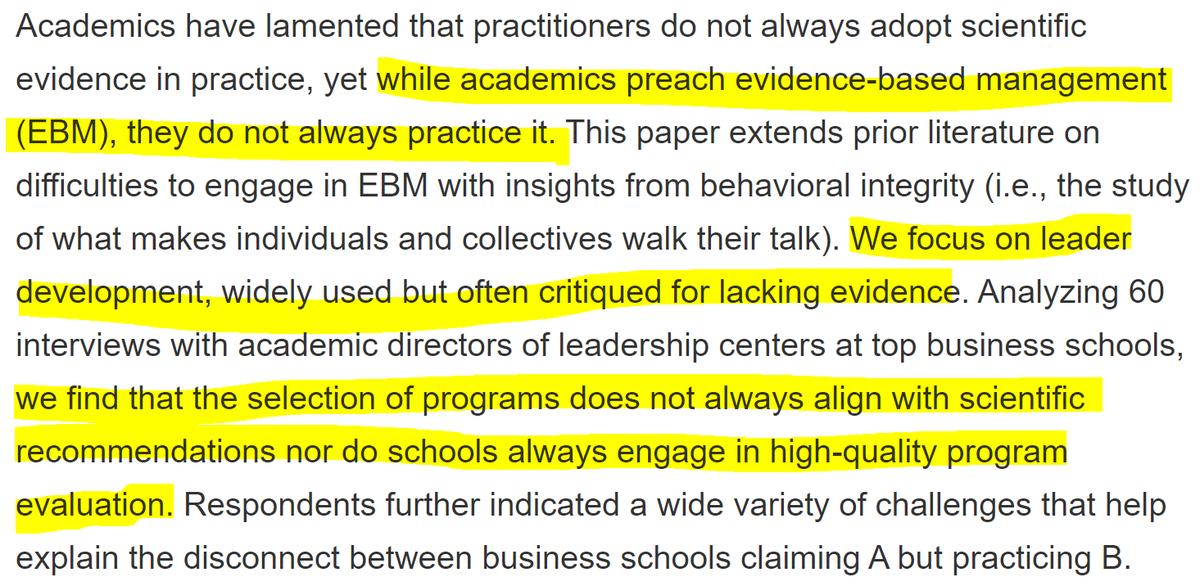
Do academics adopt an evidence-based practice approach to their own practice in research or teaching?
Not so much.
Here's a nice example examining how #businessschool teach #LeadershipDevelopment.
https://t.co/QC4cXmCwAU
#openaccess
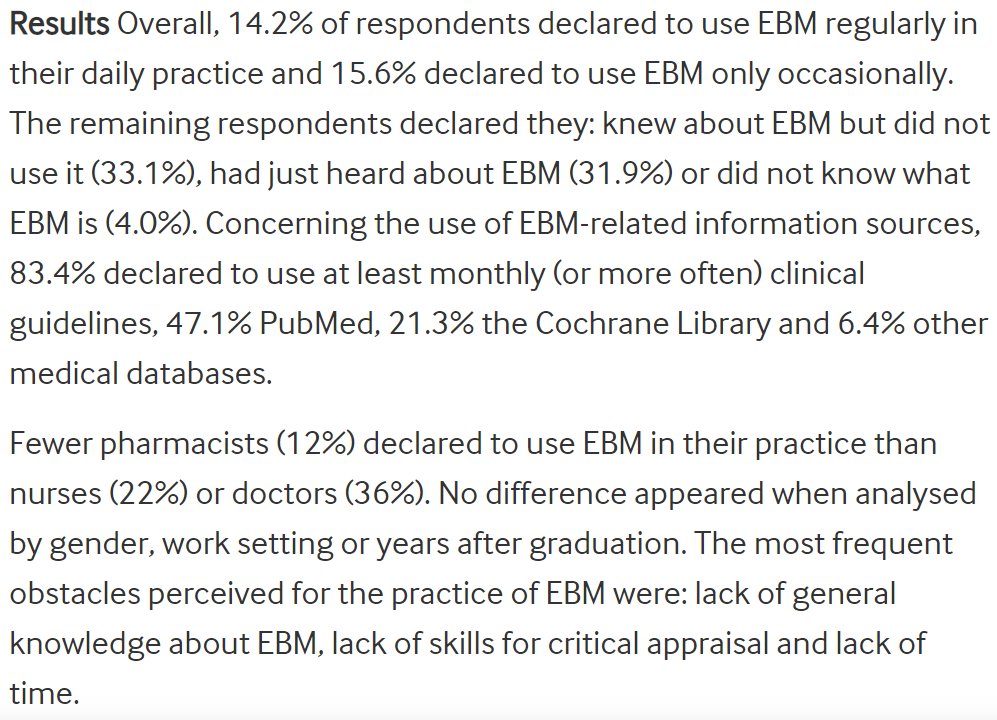
Evidence-based practice got going in medicine around 30 years ago but even here it's not necessarily that widely used. So perhaps fields like #HR and #IOPsych aren't doing that badly.
https://t.co/FRHxcjd2oD