El Comité del Premio Nobel anunció hoy que el Premio Nobel de Economía 2025 fue otorgado a Joel Mokyr, Philippe Aghion y Peter Howitt, “por haber explicado el crecimiento económico impulsado por la innovación.”
La mitad del premio corresponde a Joel Mokyr, “por haber identificado los prerrequisitos para el crecimiento sostenido a través del progreso tecnológico,” y la otra mitad conjuntamente a Philippe Aghion y Peter Howitt, “por la teoría del crecimiento sostenido a través de la destrucción creativa.” Amplía esta información en @unamglobal > https://t.co/cJS4n4FoBi
¿No se pudieron conectar a nuestro #Webinar? Pásenle que aquí está completito.👇🏽
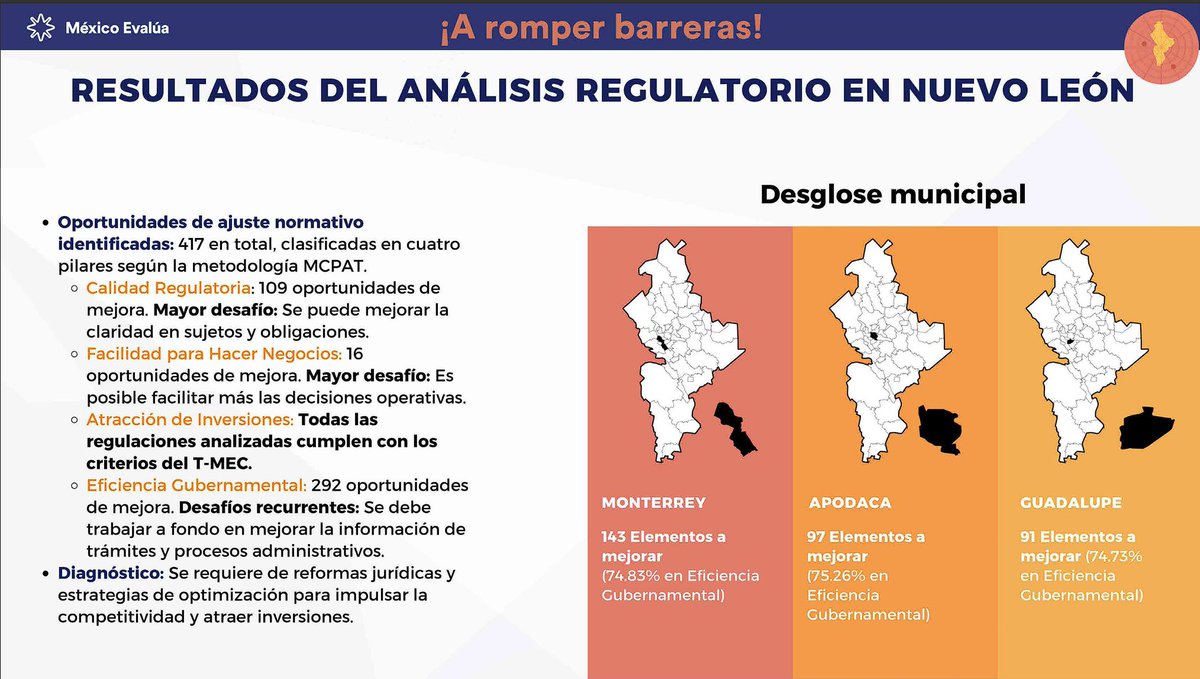
Con @analiliamoreno, @viviana_paal y el equipo de @mexevalua revisamos las oportunidades que tiene #NL para romper sus barreras regulatorias y detonar la inversión🚀a través de reglas fáciles de cumplir.
Más de 400 oportunidades de ajuste normativo 🤯identificadas por el estudio que hicimos ... aquí les dejo los hallazgos
https://t.co/MnbdacAKv4
🗣️ "La implementación más allá de la implementación"
El Dr. Mauricio I. Dussauge Laguna (@maudussauge), profesor-investigador y coordinador de Investigación en la #FLACSOMéxico, dictará esta conferencia magistral en el marco del II Coloquio Internacional de las Organizaciones de la Administración Pública y la Implementación de Programas.
🗓️ 18 de marzo · 10:00 h (MX)
📍 Auditorio K001, UAM Azcapotzalco
📹 #EnVivo aquí 👉 https://t.co/JJ8kjHV1iH
Invita el Área Académica de Gestión e Intervención en Organizaciones e Instituciones de la @UAMAzcOficial.
¿Quieres desarrollar un proyecto de investigación sólido? En este curso del Programa de Estudios Avanzados en Métodos (#PEAM), obtendrás las bases teóricas y conceptuales esenciales para el proceso de investigación científica.
Imparte: Marietha Pérez Arellano, FLACSO México
🗓️ Elige la edición que más te convenga:
☑️ Primera edición: 21 al 25 de abril, 2025 | 9:00 - 12:00 h (CDMX)
☑️ Segunda edición: 20 al 24 de octubre, 2025 | 18:00 - 21:00 h (CDMX)
🔗 Más información: https://t.co/ZtqIxA0Ohw
✍️ Inscripciones: https://t.co/wEyIc02ooY
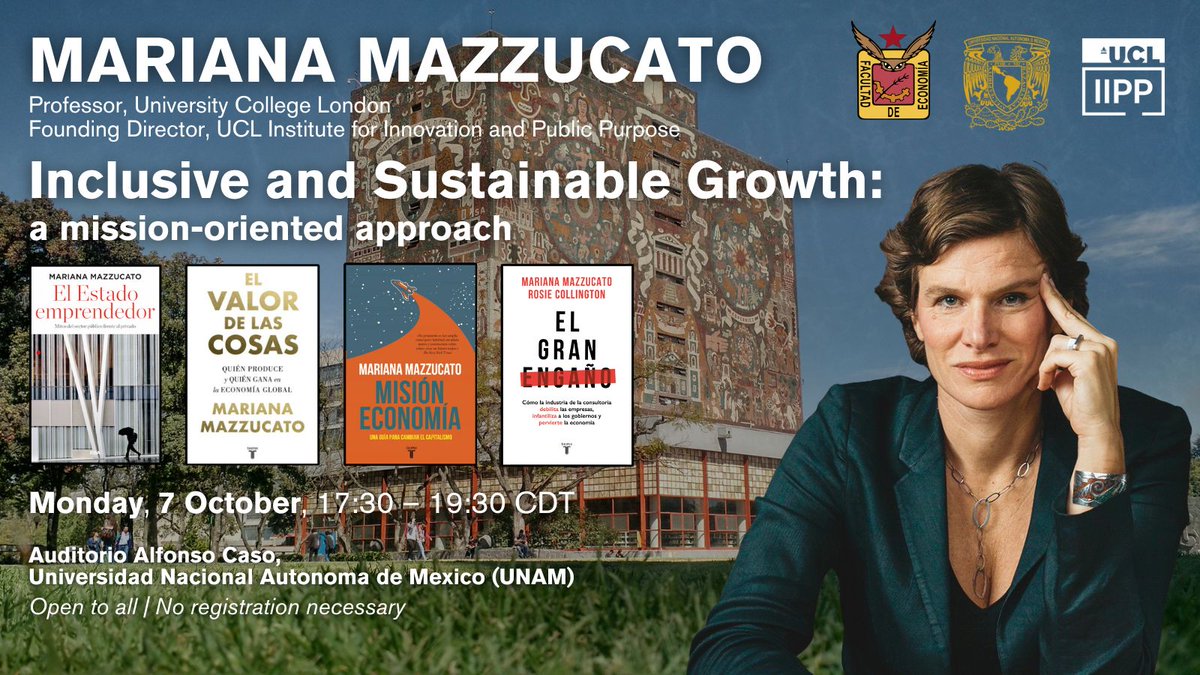
Join me at @UNAM_MX in Mexico City for a public lecture on "Inclusive and Sustainable Growth: a mission-oriented approach" at the Alfonso Caso Auditorium. I'll discuss how strategic public investment can catalyse cross-sectoral innovation, shape markets, and drive sustainable economic transformation.
Hybrid | Oct 7 | 17:30-19:30 CDT | Open to all
ESZ presente en el Clúster Automotriz de Sonora 2024 🚗🙌🏼
El día de hoy, el Estado de #Sonora con el apoyo de #ProIntegridad de @USAIDMX y diversos sectores, lanzaron un nuevo Clúster para fortalecer el sector automotriz en la región fronteriza. @JeneCT2023 @tonoastiazaran 💪🏼🚙
Este Clúster aprovechará el #nearshoring y atraerá inversiones estratégicas que potenciarán proveedores locales y consolidarán a Sonora como un destino atractivo para la inversión extranjera. 🏭🌎
Nosotros destacamos:👇🏼
Los objetivos del Clúster:
💡 Fomentar la innovación en la industria automotriz.
💰 Crear un ambiente favorable para la inversión extranjera y fortalecer la cadena de valor.
Las estrategia y enfoques:
💸 Aprovechar el nearshoring y retener inversiones estratégicas.
🚚 Promover el crecimiento de proveedores locales.
🛣️ Implementar políticas públicas que mejoren la infraestructura y la economía regional.
La relación sólida entre México y Estados Unidos, es clave para el crecimiento económico y la expansión de mercados. 🚀🇺🇸🫱🏼🫲🏽
Principal Component Analysis (PCA) is the gold standard in dimensionality reduction with uses in business. In 5 minutes, I'll teach you what took me 5 weeks. Let's go!
1. What is PCA?: PCA is a statistical technique used in data analysis, mainly for dimensionality reduction. It's beneficial when dealing with large datasets with many variables, and it helps simplify the data's complexity while retaining as much variability as possible.
2. How PCA Works: PCA has 5 steps; Standardization, Covariance Matrix Computation, Eigen Vector Calculation, Choosing Principal Components, and Transforming the data.
3. Standardization: The first step in PCA is to standardize the data. Since the scale of the data influences PCA, standardizing the data (giving it mean of 0 and variance of 1) ensures that the analysis is not biased towards variables with greater magnitude.
4. Covariance Matrix Computation: PCA looks at the variance and the covariance of the data. Variance is a measure of the variability of a single feature, and covariance is a measure of how much two features change together. The covariance matrix is a table where each element represents the covariance between two features.
5. Eigenvalue and Eigenvector Calculation: From the covariance matrix, eigenvalues and eigenvectors are calculated. Eigenvectors are the directions of the axes where there is the most variance (i.e., the principal components), and eigenvalues are coefficients attached to eigenvectors that give the amount of variance carried in each Principal Component.
6. Choosing Principal Components: The eigenvectors are sorted by their eigenvalues in descending order. This gives the components in order of significance. Here, you decide how many principal components to keep. This is often based on the cumulative explained variance ratio, which is the amount of variance explained by each of the selected components.
7. Transforming Data: Finally, the original data is projected onto the principal components (eigenvectors) to transform the data into a new space. This results in a new dataset where the variables are uncorrelated and where the first few variables retain most of the variability of the original data.
8. Evaluation: Each PCA component accounts for a certain amount of the total variance in a dataset. The cumulative proportion of variance explained is just the cumulative sum of each PCA's variance explained.
There you have it- my top 6 concepts on PCA. The next problem you'll face is how to apply data science to business.
I'd like to help.
I’ve spent 100 hours consolidating my learnings into a free 5-day course, How to Solve Business Problems with Data Science. It comes with:
300+ lines of R and Python code
2 systematic frameworks
1 complete roadmap to avoid mistakes and start solving business problems with data science, TODAY.
👉 Here it is for free: https://t.co/YXG4pL97ZN
Hace uno días se cumplió el 6to aniversario de la publicación de la Ley General de Mejora Regulatoria #LGMR
Se consolidó:
- Estrategia Nacional
- Observatorio de Mejora Regulatoria
- Catálogo Nacional
- 32 Edos alinearon sus Leyes a la #LGMR
- Más de 80 Mpios cuentan con Reglamentos de Mejora
Sin embargo, México todavía enfrenta desafíos en la consolidación de la #MejoraRegulatoria como la resistencia al cambio de las áreas gubernamentales, la necesidad de mayor capacitación y recursos, y la importancia de asegurar la continuidad de estas políticas.
Por ejemplo, dentro de los temas relevantes quedó pendiente:
- Lineamientos para instrumentar el #AnálisisdeImpactoRegulatorio AIR
- Implementación de un #ExpedienteÚnico
- Diseño y adopción de un #ProgramaDeMejoraRegulatoria que elimine la regulación obsoleta
Es crucial continuar con estos esfuerzos para asegurar un entorno regulatorio que favorezca el desarrollo económico y social del país.
¿Cómo retomar el impulso de una política tan necesaria? Lo primero es poner las bases:
¿qué es y en qué consiste dicha política?
Escribí sobre ese tema al respecto 👇🏽
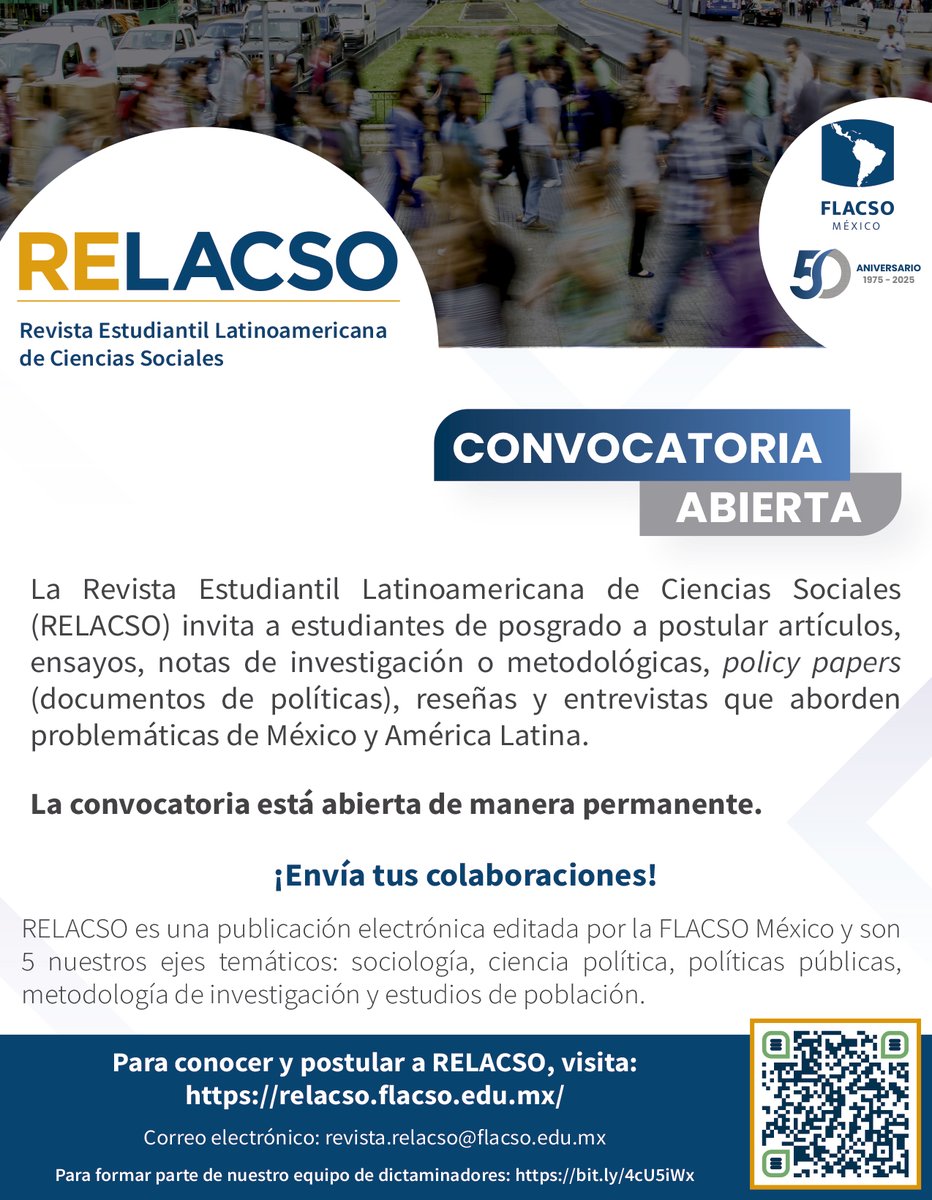
📢 #CallForPapers. ¿Ya revisaste la convocatoria del @CLEPSO_FLACSO?
Aprovecha estos días para leerla y definir en qué modalidad y eje temático participarás.
🌐 https://t.co/36wiZzhyKA
¡Ya está aquí! Nuestra 4a edición de la revista #SmartCitiESZ, así como nuestro #RankingNacional 2023 de #GobiernosInteligentes.
¿Quieres saber cuáles son los Gob que mejor han aprovechado la #Tech📲, impulsado la #MejoraRegulatoria ⚙️ y han promovido Reglas claras y un Edo de Derecho sólido🔏?
Échale un ojo! 👇🏽
Severe water scarcity affects 4 billion people for at least one month each year. Over 2 billion live with inadequate water supply. We urgently need to rethink how we govern this vital common good.
New paper with @ZaqoutMariam ➡️ https://t.co/PSdvxwG3GJ
@watercommongood
Case studies like US CHIPS Act & others show how governments can set a clear green direction & attach socially beneficial conditions to contracts with the private sector. Time to design new wave of industrial strategy w public value at the center.
https://t.co/SQCViFJMH1