We’re rolling out changes to make Fable 5’s safeguards for frontier LLM development visible.
Starting this week, flagged requests will visibly fall back to Opus 4.8—the same as our safeguards for cyber and bio. You will see this every time it happens. On the API, any flagged requests will return a reason for their refusal (coming to server-side fallback in the next few days).
We wanted to deploy Fable 5 to our users quickly and safely. Visible safeguards can be probed, so they have to be robust, which takes time to get right. Invisible safeguards can be targeted more narrowly, allowing us to ship quickly with very few false positives. We went with invisible safeguards for this reason—and that was the wrong tradeoff. You should have visibility into the safeguards we have in place, and why. We’re sorry for not getting the balance right.
Making the safeguards visible makes them easier to work around, so keeping them robust to jailbreaks will unfortunately mean more false positives while we improve the classifiers. We're also tuning our bio and cyber classifiers to trigger less often on harmless requests. We know this is frustrating and we’ll do our best to keep this period as short as possible.
If you think a request has been mistakenly flagged: run /feedback in Claude Code, click thumbs-down on the fallback in https://t.co/LtktniD5HY or Cowork, or file the safeguard appeal form for API requests. Your reports help us tune these classifiers and we appreciate your feedback.
https://t.co/TDAAYRGqDt
Today I'm publishing a new essay, Policy on the AI Exponential. AI is progressing extremely fast—much faster than the policy process was built to handle. The essay lays out where I think the technology is now, and the action needed to close the gap: https://t.co/Lh6PWae178
We've reset usage limits across our products!
For those just starting to test Fable, here's four tips for using it more effectively:
1. Give it bigger, more ambitious tasks than what previous models could handle.
2. Use xhigh/high effort as your default for best performance, med for faster interactive sessions.
3. Rework your skills and CLAUDE.mds. Instructions written for prior models anchor Fable to stale patterns, let it use its own judgment first.
4. Move from providing tasks to providing objectives. Describe what done looks like and how to verify it, then let Fable find the path (/loop and /goal are built for this)
I've been at Anthropic through every model launch. There's been a few cases I can remember of a launch that stands out and marks a step-change in how we use models:
- Claude Opus 3
- Claude Sonnet 3.5
- Claude Opus 4.5
And now Claude Fable 5.
With Fable, the model stopped feeling like a tool I direct and started feeling more like something I collaborate with.
Introducing Claude Fable 5: a Mythos-class model that we’ve made safe for general use.
Its capabilities exceed those of any model we’ve ever made generally available.
Releasing a model this capable comes with risks. Without safeguards, Fable 5’s capabilities in areas like cybersecurity could be misused to cause serious damage.
Queries on a narrow range of topics will instead receive a response from our next-most-capable model, Opus 4.8.
We just published internal data on how much of Claude's development is already being done by Claude:
- Over 80% of all code merged into our codebase is now written by Claude
- It's been months since many researchers at Anthropic hand-wrote code
- The typical Anthropic engineer ships 8x as much code as they did in 2024
- On the most open-ended engineering tasks, Claude's success rate jumped from ~26% to 76% in 6 months
- When research sessions went off-track, Claude proposed a better next step than the human took 64% of the time
We're not at recursive self-improvement yet, but it could come sooner than most expect. I highly recommend reading the full blog post.
Our internal data shows Claude is accelerating AI development—a possible path to recursive self-improvement, or AI autonomously building a more capable successor.
It’s happening faster than we thought, and the implications deserve greater attention. https://t.co/OVVPJO7VQx
We've reset 5-hour and weekly rate limits for all users on Pro and Max plans.
We fixed an issue that caused some Claude Code sessions to spawn excessive parallel subagents, burning through usage faster than expected.
We put a lot of work into calibrating thinking effort for Opus 4.8.
As you're trying out the model, if you do run into any examples of it still over/under thinking, please flag it to us!
Excited to release Opus 4.8 today! We heard your feedback on 4.7 and have made many fixes for 4.8.
4.8 understands nuances better, feels much more natural to talk to, and is overall a stronger collaborator on everything from coding to knowledge work.
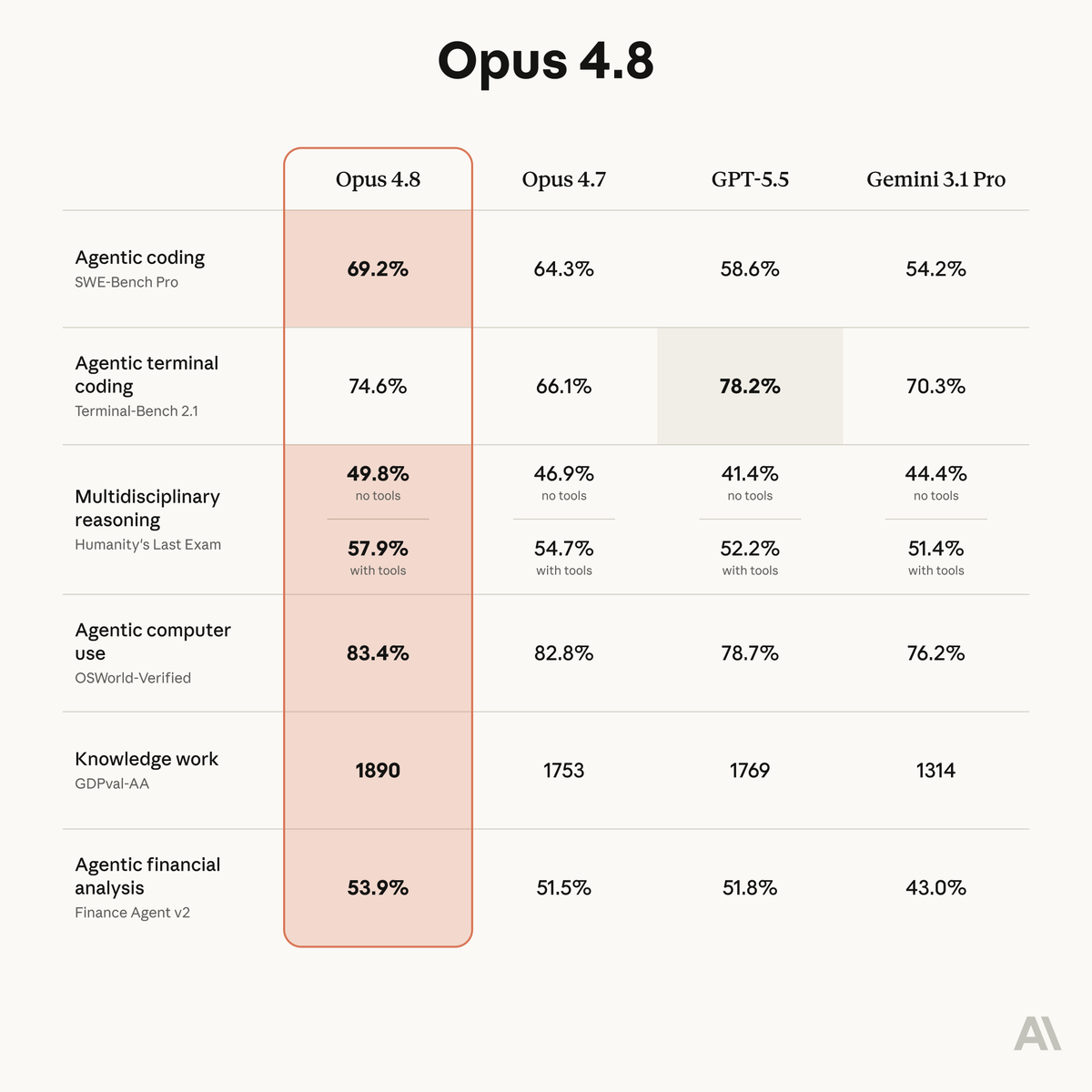
Introducing Claude Opus 4.8: it builds on Opus 4.7 with sharper judgment, more honesty about its own progress, and the ability to work independently for longer than its predecessors.
Available today at the same price.
Fast mode for Opus 4.8 is much more affordable now.
Try it out in Claude Code, I've found it changes how I use Claude. Fast mode for interactive work where I want rapid responses, normal mode for longer async tasks where I don't need results right away.
Fast mode is available for Opus 4.8. It's the same model at roughly 2.5x the speed, and we've made it three times cheaper than before.
Turn it on with /fast in Claude Code. On the API, contact your account manager to request access or join the waitlist: https://t.co/5SLFF77Whn