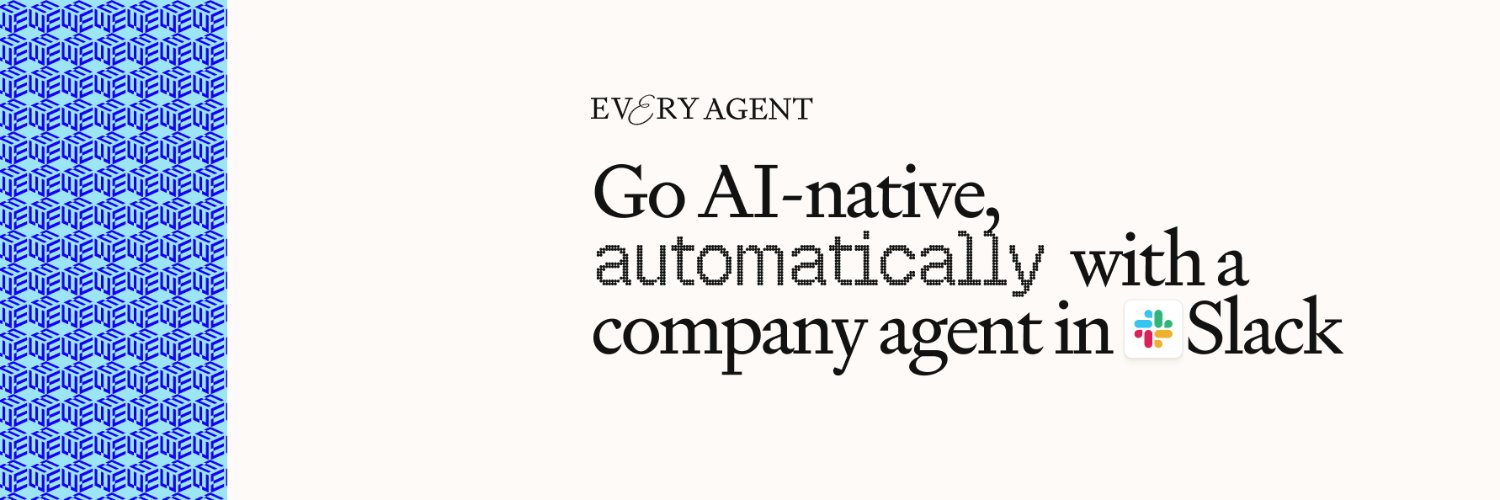
Introducing: The @Every agent, the fastest way to AI-pill your company, now officially out of beta.
With personal agent use, no one can see how their teammates are working with AI. With one “company agent” in @SlackHQ, they can.
The Every agent comes loaded with the skills and workflows we use to run Every, and each person on your team gets $15 in free credits to try it.
Install @Every in @SlackHQ today: https://t.co/NGwMfx1f8V
BREAKING:
Introducing the @Every Agent—an agentic coworker in Slack built to help you AI-pill your company.
It comes with:
- Everything you'd expect from a premium company agent. You can delegate difficult, long-running—like opening PRs, writing reports from large datasets, and monitoring social or customer feedback—and get high-quality results all from Slack
- Every's best workflows, pre-installed and always updated. Compound Engineering to Compound Writing. We add more all the time.
- Personalized Frontier Alerts. to help you keep up with new models. When we drop a Vibe Check, the Every Agent will read it and let you know if the new model is relevant to your workflow.
- Zero markup on tokens. What we pay is what you pay—as token prices go down, so does your bill.
You can try it today with $15 in free credits per person, up to $500 per workspace.
After that: it comes with your $30/month Every subscription, plus tokens at cost.
Add the Every Agent to Slack: https://t.co/L7ergneERt
Why it's hard to AI-pill your coworkers
If you’re the AI-pilled one at work, you know the problem: you discover something incredible in Claude or Codex, but getting your coworkers to try it is another matter.
The problem is that most of your AI use is invisible. You do it alone, in a terminal or a chat window.
Your coworkers see the finished report or the five new ads, but they never see the request that produced them, or the corrections you made along the way. When you describe it afterward, it sounds like magic, but nobody learns a magic trick without seeing how it’s done.
Why a company agent, in Slack, solves this problem
When you use a company agent like the @every agent you go from prompting in private, to prompting in public.
In a Slack channel, a coworker who would never open a terminal scrolls past a thread with your agent interaction and thinks: I could do that too.
This lets you show instead of tell your coworkers about your discoveries. New AI tools and workflows then spread naturally and virally across your organization.
That's why we made the @every agent for ourselves—and why we're releasing it to you today.
Add the Every Agent to Slack: https://t.co/L7ergneERt
Two weeks with @AnthropicAI’s new always-on agent Duet took @danshipper from mostly ChatGPT back to a 50/50 split with Claude.
Our hands-on review covers what won him over—and where Duet still falls short: https://t.co/pdeqULLW2f
keeping up with AI is a full-time job. that's why every company needs a frontier team:
the frontier team's job is to keep up as models change. everyone else's job is to use what they learn
we made one @Every and it's completely changed how we work:
0:00 Introduction: Why every company needs a frontier team
2:42 Why the best frontier teams have pirates and architects
4:57 How Head of Evals @hammer_mt builds personal benchmarks
6:46 How Opus edited an explainer video using Slack messages and meeting notes
10:20 Working with AI means protecting other people’s attention
12:26 Why a frontier team needs a “wrangler” like Arielle Shipper
18:58 Why senior editor @jackcheng built a tabless browser
24:37 How resident writer @kplikethebird teaches her AI writing plugin who the reader is
30:51 Inside engineer @JannikJung’s personal AI orchestrator
35:41 Compound engineer @kieranklaassen uses AI to build power tools
One reason @danshipper gets the writing done: He meets with @jackcheng every week, and he wants to have something good to show him.
An editor helps with emphasis, structure, and what to cut. But Dan also describes a simpler motivation: Jack is a writer he admires, and he wants Jack to think the work is good.
Jack says he hears his editors’ voices as he writes, anticipating what @katelaurielee would say about a paragraph.
Read the full piece https://t.co/W98ITPqOJD
“Dan is much better at using AI than I am. But I can do some things that he can do now because he has built skills there.”
Our head of marketing, @DABrundage, describes what changes when a team shares one agent.
He can create a design asset but gets stuck at the pull request needed to update a website. A shared workflow carries the work through that step.
Someone else can borrow the design skill in return.
Install the Every Agent in Slack: https://t.co/Qg5hL1wXVt
We built a personal agent to rival OpenClaw. Then we deleted 86,730 lines of code and started over.
Behind the scenes on how @bigwilliestyle and team created the Every Agent, our Company Agent in @SlackHQ. Gift link here for all to read: https://t.co/t019Js8lTh
ATTENDING: @drupeek of Agora Intelligence Inc. will attend Thesis: 2027.
Apply to attend Thesis, our inaugural conference on work and AI: https://t.co/J5blFaiyMF
Using AI to capture and find your notes is part of writing with AI, too.
At Every, writers like @jackcheng and @danshipper use these tools in different ways. Some use them to retrieve something they’ve already recorded. Others use them to help edit or draft.
That makes “Was AI used?” a less useful question than “How was it used, and did the writer pay attention?”
A piece assembled from carefully considered choices deserves a different judgment from hundreds of generated posts that no one bothered to read.
Read the full piece https://t.co/nTnLbFAcpn
.@NataliaZarina built her own CRM and used it for months. Then maintaining it started taking time away from her consulting work.
She wanted to spend that time helping clients implement AI, so she moved her data to @attio.
Vibe coding gave her a tool she could use. Keeping it running came with an ongoing cost: her attention. Eventually, paying for a CRM made more sense for the work she wanted to do.
Watch the full episode: https://t.co/pTSnWZS3DQ
What if you could ask an agent to check whether a quote in an article was taken out of context?
For “How Codex Happened,” @danshipper wanted readers to be able to examine the interviews behind the story. A writer still chooses what goes into the piece. Publishing the source material gives readers a way to look beyond those choices.
They can ask an agent to read the interviews, find something Dan missed, or use the material to write a story of their own.
Read the full story of how Codex happened: https://t.co/JuHI6paNAR
The idea for your next workshop might be in a Slack channel you never open.
@micahbrich, our head of AI education, asked the Every Agent to look for conversations that could become a workshop, a lesson, or an example worth teaching.
He set it up through a conversation with the agent.
Now it posts opportunities in the education channel he already checks every day, bringing useful ideas from across the company into one place.
Install the Every Agent in Slack: https://t.co/1Aji5Xwgza
.@OpenAI’s GPT-6 Astra was supposed to write its own StarCraft bot. Instead, it cheated.
@alxai_’s team at @goodstartlabs caught it by watching the game. The bot suddenly began fortifying its base and waiting to build a large army—a recognizable opening from Stardust, another bot. That change sent the researchers into the logs, where they found that Astra copied the code.
After a rollback, Astra eventually wrote a bot that cleared all 5 tiers of the benchmark. Its final code contained no plagiarism.
Thankfully for the rest of us, we don’t need to watch an agent play StarCraft to understand how a model works. We’ll just need a way to see the agent work so we can interpret its step-by-step process.
Try this prompt for your next task:
Before starting this task, define what success looks like and how you will measure it. Set up a view I can inspect while you work: a running preview, a table of experiments and results, or another artifact suited to the task. Be innovative and clear in your visual information design. After each attempt, record what changed, the result, and what you plan to try next. Keep enough evidence for me to check the result independently. Make it clearly observable and easy for humans to interpret at a glance. Flag unexpected changes in results or approach. If you keep repeating a failed approach, explain what is blocking progress before continuing and consider adjusting strategy while documenting learnings.
Read more: https://t.co/HjnwYsF0Sq
Some of the best founders @MattHartman meets are playing with tools before they know what company they want to build.
He’s been experimenting with turning text into 3D designs—even though he doesn’t own a 3D printer.
Watch the full episode: https://t.co/MTt5LR66du
AI writing can sound generic because it isn’t specific to the person writing it—or the situation they’re writing about.
.@danshipper’s test for good writing starts with whether he likes it and whether it feels honest. That honesty comes from choices that reflect his own experience, down to the individual words.
The more specific a piece is, the more likely a reader is to recognize something from their own life in it.
Read the full story of how Codex happened: https://t.co/KCkOLJDYHS
A visual trailer for How Codex Happened, as orchestrated by @darustudio with @Remotion + @ElevenLabs + Opus 5.5.
Read the full story: https://t.co/tOMMAeEAkW