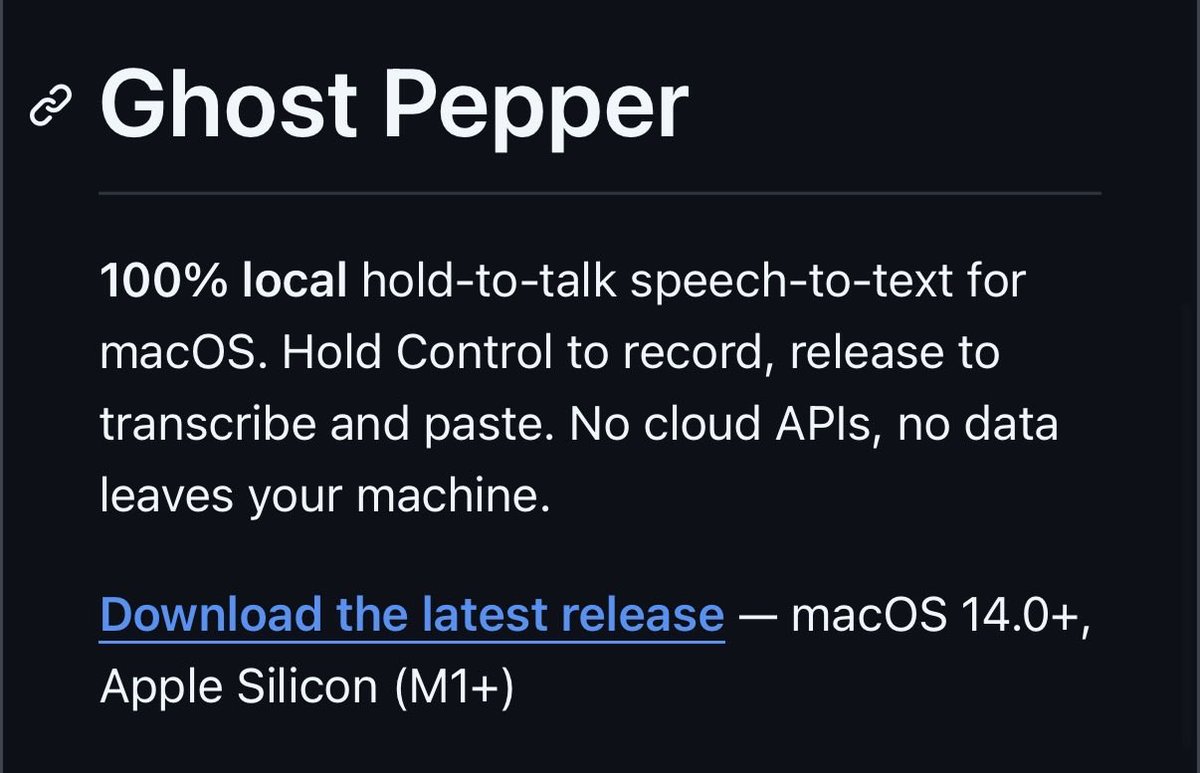
I’m releasing 🌶️ Ghost Pepper open-source. All models used are also open source (ty @huggingface)
If you like voice to text on Mac but want 100% privacy, try the alpha here https://t.co/kla0Cuo0Hl
Very excited for @GabriCorso and team at boltz to continue to build toward their vision of enabling scientists to go from a therapeutic hypothesis to a human-ready molecule without leaving their computer.
We’ve raised $110M to bring AI-powered biomolecular design to every scientist!
Boltz’s Series A is led by @BessemerVP, following 50-fold growth in molecular token usage from our users since June and partnerships with 6 of the world’s 20 largest pharma companies.
Wouldn’t this only be true to the extent that companies *need* the capital? From what I’m seeing most are raising opportunistically vs because they “need” the cash (with some clear exceptions). So I’d expect it to slow down the speed of new rounds (to the extent that they’re unappealing to founders) but not necessarily lead to down rounds, particularly for companies where the revenue growth and scale actually makes their valuations not look surprisingly high, they are just surprisingly big businesses.
been trying it out for 2 months and honestly, it has been a game changer in the way I interact with my laptop. big thanks to @MattHartman for building it and making it free.
Robotics will soon get bitter lesson'd by Claude, Astra, Gemini Argon, etc.
Just as custom coding models, embedding models, text-to-SQL models, computer-use models, etc., have been bitter-lesson'd over the past ~4 years, the same will happen to custom-trained robotics models, VLAs, world models, etc.
More than 2 years ago, we wrote a piece questioning the “extinction of venture capital” on the basis of capital concentration to the largest platform firms
This dynamic is accelerating forcing an innovate or die mentality across the early stage / emerging manager ecosystem
We’ve pivoted Oboe. The first version, which we spent the past two years building, didn’t work. No excuses. Here’s the full story, culminating in what comes next: an all-new Oboe, available today.
We launched Oboe with a mission to make humanity smarter. That mission is core to who we are, and it hasn’t changed. The first way we thought to achieve it was by leveraging frontier models to offer everyone personalized tutoring.
But through many iterations over the past two years, it became clear that we built the wrong product. First, we’d made strategic decisions that left us undifferentiated in the age of LLMs. Second, by focusing on utility above all else, there was little organic incentive for people to return to the platform. And most importantly, no matter how great our product was, not many people were motivated to actively learn every day.
Despite our best efforts to serve everyone on the planet, we landed on a small, loyal user base that loved a product which wasn’t growing fast enough.
So we took a step back: How else could we serve everyone on the planet and still achieve our mission?
We decided instead to focus on a motivation everyone has: to have fun. Every day, billions of people entertain themselves on their mobile devices, filling countless minutes with mindless scrolling and brainrot that doesn’t make us smarter. In many cases, it actually makes us stupider.
What if we could replace scrolling that makes us stupider with scrolling that is both fun and makes us smarter? That’s the new Oboe.
It’s a fully personalized feed of dynamically generated, interactive, anti-brainrot challenges. Every scroll is designed specifically for you, to help you get smarter in a few minutes every single day.
We’ve been blown away by usage from our thousands of beta users. The differences in engagement and retention between this and the original version are stark. The product is working. It’s already clear that this new direction taps into a universal need that none of our previous iterations did.
For all of those people out there like me who feel like doomscrolling wastes their precious time, who enjoy feeling fulfilled, and who wish there was a better alternative: this one’s for you.
We can’t wait to see what you think.
WHOOP: $199/year to tell you that you didn't move
Reachy Mini Hoverboard: $149, once, and your robot is free to roam
and it's all open-source: plug in your favorite Opus / Qwen / Gemini
Can someone @openai help me understand why I'm getting the 429 error (rate limit exceeded) in Codex while also seeing no token usage and when I do a usage reset it says I don't need it yet?
Not many people realize that you can already run quantum programs on actual quantum hardware.
Exciting to see @qbraid_official partner with @nvidia to run quantum computers as a service
We launched qBraid OS today with @nvidia.
It lets quantum hardware companies run their systems as a service, with setup and operations designed to be handled by AI agents. Access, scheduling and billing built in, GPUs alongside the QPU via CUDA-Q.
https://t.co/U3SbZpA2h8