NEW:
Spiral 4.0—a writing partner for you and your agent by @every
-> Stylometry: we built a new Style Engine based on the principles of stylometry to extract you and your brand's voice and produce great writing every time, based on examples of your past work
-> MCP and CLI: Spiral is now built to be used by your agent like Codex, Claude Code, OpenClaw and more so you can get great writing automatically
we use it every day internally to write landing pages, tweets, podcasts, marketing emails and more and to make sure it's ALL on-brand across our entire 30 person team @every
@noahlt@m1shti “Narrative” really works as a counter-construct because narrative meaning is the sum of experiences across any kind of phenomena, and narrative is a threading of that whole onto some kind of structured intention.
@noahlt@m1shti Yeah - this emerged from “platform defined forms” where a user’s role was the production of the contents of the platform. All media is content + form + channel, this made that relationship transactionally defined and permissioned.
At @every, we've been supporting exec teams for a while. Those getting value from AI all run the same loop:
1- Get fluent: build something yourself first
2- Assign an owner
3- Automate one narrow, painful workflow (to start)
4- Build it to 95% (running evals & QA)
5- Scale the wins so other teams benefit
It's slower saying you 'automated your company' but it actually works.
Ultimately, implementing AI is all about the people. That's the best part!
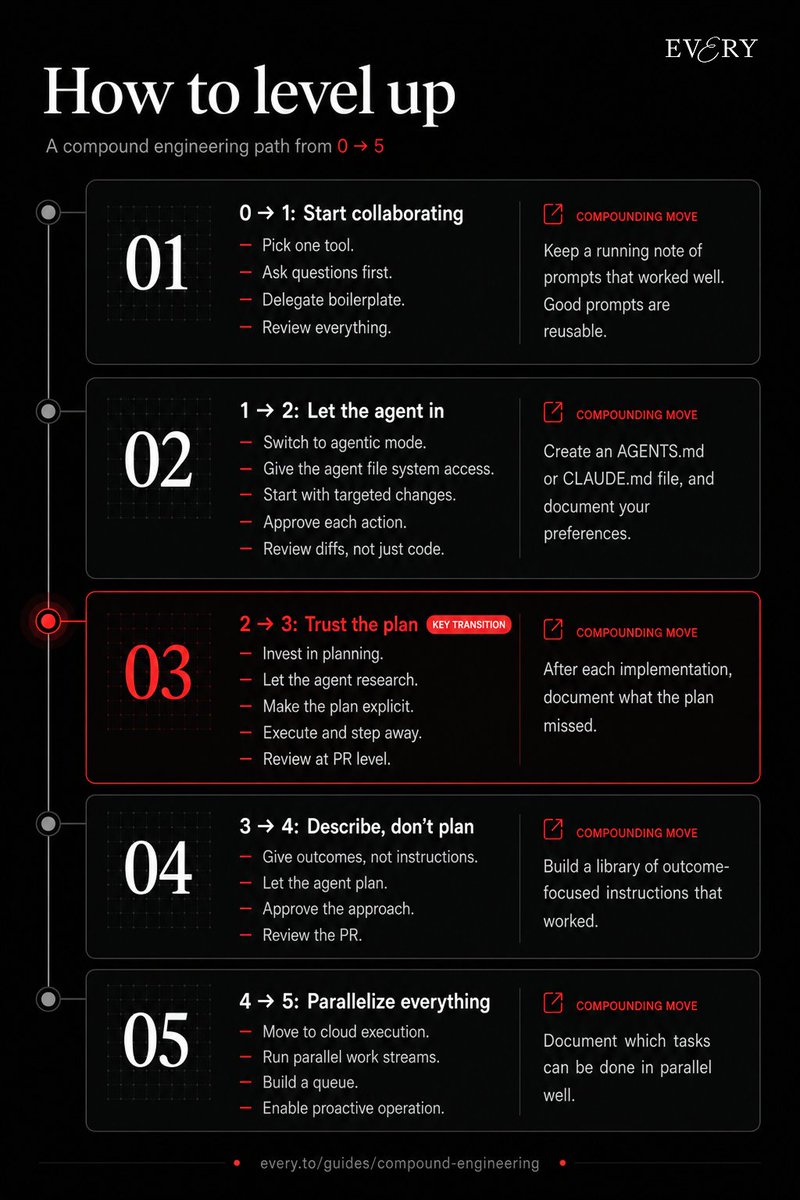
Inside Every, improving our skills with compound engineering is how we do better work across engineering, GTM, operations, everything.
If you're spending your weekend building, follow these steps from @kieranklaassen and @trevin to level up.
WINDOWS // NYC
For the past five years, I've immersed myself in a photographic, typological study of the illuminated windows of New York City at night. On June 16th, we invite you to build a new world with us, a multilayered, interconnected city of light and shadow, powered by @TransientLabs Studio.
This has been my biggest undertaking to date, and is the extension of my lifelong interest in photographic patterns and generative photography. This interest was crystalized in 2021 with my project DRIVE and continued in 2022 with Drip Drop.
Over the years, I've learned so much about the conceptual world of typologies, about the intersection of photographic technologies and blockchain as immutable records of consensus and truth, and of course, about how the constant evolution of technology broadens the scope of what is possible for us artists- revealing new ways to create and connect with the people who seek to do the same.
The process of creating WINDOWS // NYC has been the best sort of challenge, and as always, the incredible minds at @TransientLabs have taken my ideas and built technological frameworks that have elevated this project beyond my wildest dreams. I cannot wait to show you more, but for now, drop a comment if you want to connect, hear what we've built, and for information on how to participate and get involved.
I love this world. I love looking at it in intricate detail and making photographs so that others can look at it that way too. And this pattern of windows and grids is one of my favorite ways to see.
Sign up at windows dot davekrugman dot com, or via link in the comments below!
BREAKING:
Anthropic just dropped Opus 4.8—and it is a MONSTER
We've been testing for about a week @every and our verdict is they could've just called it Opus 5, it's that good.
Here's our vibe check:
- Beats GPT-5.5 on Senior Engineer bench. On our toughest benchmark Opus 4.8 scores a 63—a hair higher than GPT-5.5's score of 62, and a full 30 points higher than Opus 4.7. It tackled a ground-up rewrite of a production codebase, and actually built something that works.
HOWEVER: Coding performance varied a lot at different reasoning levels. We recommend using it on xhigh for best results.
- Incredibly good writer. Opus 4.8 scored a 79.6 on our writing benchmark—measuring models on real-world writing tasks we do all of the time like essay writing, promo email writing, and more. It beats GPT-5.5 by 6 points. It produces well-written prose with fewer "AI-isms". It's also very good at writing in your voice given the right context.
HOWEVER: Writing performance also varied with reasoning levels. Medium reasoning had higher incidence of AI-isms—we found best results with high.
- Beast at knowledge work. Opus 4.8 is very good at general knowledge work tasks like report creation, research and more. It produced the best PowerPoint one-shot we've ever seen on our deck generation benchmark.
- Emotionally intelligent, willing to question the frame. I've also found it to be quite good at talking through psychological or interpersonal issues. It has a high EQ, and it's also good at not glazing and helping to expand your perspective. Its thought process feels extremely rich and dynamic.
THE BAD:
These days a model is only as good as its harness, and Codex is still a far superior harness to the Claude Desktop app. This has kept me using Codex + GPT-5.5 as my daily driver, but I am flipping back and forth a lot more between Codex and Claude.
Anthropic is back baby!
Read the rest on @every:
https://t.co/vuORiDXkxX
my favorite engineering skills for AI:
- Compound Engineering: https://t.co/BM7tA2RAHf
- Ryan Singer's shaping skills: https://t.co/yaWg0nI7Vm
- Matt Pocock's skills: https://t.co/0WtRqce6x5
I switched from Superpowers to Compound Engineering as they perfected the plugin over time, and I'm pretty sure I still only use like 10% of it
My biggest takeaways from @danshipper:
1. The future of work will happen inside Codex or Claude Code. Instead of putting AI into your SaaS tool, you’ll use your SaaS tools inside your favorite AI agents' in-app browser. Dan spends all his time in Codex now—writing documents, managing email, doing research, everything. He's using Google Docs, PostHog, and everything he needs within the agent's in-app browser. The agent can see what he’s doing, and has all of his context, so he and his agent collaborate quickly and super effectively.
2. Automation is a lie—every automation needs a human. Dan's company doubled in size this year despite being incredibly AI-forward. Why? Because in order to make automation work well, you need humans making sure everything keeps working. This is why benchmarks are misleading—they measure AI on problems we’ve already framed and can score, but there’s always a higher frame.
3. PMs will win the AI era. Marcus, a former PM who previously ran Axios’s writing product, joined Every after getting super AI-pilled. Now he runs their product Spiral, and ships faster than anyone on the team. He pairs technical knowledge with spiky product sense, deep user empathy, and an eye for what matters. Dan thinks any PM who gets really AI-native will be incredibly dangerous because the building is done for you—what matters is figuring out what to build and if it’s great.
4. Full-stack designers are becoming superheroes. Designers used to make beautiful interactions that engineers didn’t want to build or couldn’t execute properly. Now designers don’t need to hand things off; they can build it themselves. Designers are naturally creative people, and AI is the perfect tool for them because it lets them bring their vision to life without the traditional bottlenecks.
5. SaaS is not dead. In fact, Dan is bullish on SaaS stocks. When users bring their own AI (via Codex or Claude Code) to use SaaS products, the user—not the SaaS company—pays for tokens. This saves SaaS company’s margins. Since the agents need their own seats, Dan predicts that agents will create massive new demand for SaaS because there will be tons of agents using these products at high volume.
6. Every company will have one “super-agent” inside their Slack that every employee will use. Dan initially thought every employee would have their personal work agent, like a shadow AI org chart, but he’s completely flipped his view. He realized agents need humans who care about them. When someone gets tired of maintaining their personal agent, it becomes useless. The winning model is one forward-deployed engineer or AI-savvy person who maintains a company-wide agent (like Shopify’s River or Viktor), and then it trickles down to more specialized team agents as models improve and become less fiddly.
7. The AI job apocalypse is not happening, but you do need to evolve to stay relevant. Models make yesterday’s human competence cheap. But because everyone uses the same models, it all looks the same if you use it the default way; it becomes commoditized slop. Humans then take that frozen competence and use it to make something new and interesting for their specific situation. The key: “ride the models”—use them for everything you do, try new models when they drop, keep turning over rocks.
8. We will read way more AI-generated writing, and we will like it. Human writing is incredibly important for things that matter, but for internal docs, planning, and email, AI-generated is often better because most people are bad at writing strategy documents.
9. Build software for humans and agents to use together. The current model is building a CLI that an agent uses independently. Instead, you and your agent should be using the app together. This creates new design challenges—agents can make a billion requests in three seconds, so you need approval flows, inboxes that summarize what happened, logs, and easy rollback.
10. Forward-deployed engineers are the new most essential role. The big model companies have teams of people managing their internal agents, and those teams aren’t going away. It’s different from traditional software building, and certain engineers love it. As models get better, this role will evolve—you’ll be managing more agents doing more things.