Tracking market narratives, flows, and sector rotation. 10+ years trading the gap between headlines and expectations. I follow the buzz, but let price decide.
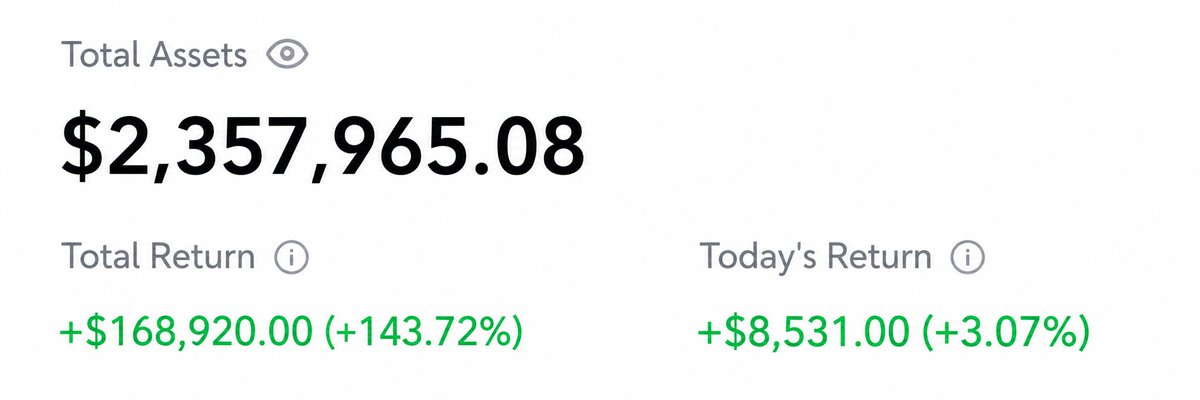
I have 20 years of trading experience, and my wife and I have been trading stocks full-time for 15 years. We have grown our capital from an initial $80,000 to $2.35 million. It wasn't until our portfolio reached the $1 million mark that I truly mastered the rhythm of the market, and our returns began to stabilize🔥
✅Over the years, I have distilled five principles of stock trading; though concise, they are highly practical. If you are feeling lost on your trading journey, I hope these insights prove helpful to you.
5.
Waiting for the perfect entry can mean years on the sidelines. Invest regularly through rallies and selloffs, with money you can leave invested. A set plan gives compounding time to work without requiring you to guess the next market turning point
I have 20 years of trading experience, and my wife and I have been trading stocks full-time for 15 years. We have grown our capital from an initial $80,000 to $2.35 million. It wasn't until our portfolio reached the $1 million mark that I truly mastered the rhythm of the market, and our returns began to stabilize🔥
✅Over the years, I have distilled five principles of stock trading; though concise, they are highly practical. If you are feeling lost on your trading journey, I hope these insights prove helpful to you.
4.
Build a repeatable process instead of chasing spectacular returns. Reasonable gains compounded over many years can matter more than a few wins. Keep costs and risk in check, reinvest when possible, and measure progress over years rather than headlines.
3.
Choose holdings for their strength, not to fill a long list. A focused portfolio is easier to research, but concentration adds risk. Favor durable businesses with a record of growing payouts, and diversify enough that one mistake cannot derail your plans.
2.
While working, let dividends buy more shares. In retirement, the payouts can help cover expenses and reduce the need to sell holdings. Reinvesting gives compounding time to work, but income can change, so leave room for dividend cuts and unexpected expenses.
1.
Buy businesses you can describe in plain English. When prices fall, understanding helps you judge whether the business is damaged or the stock is simply cheaper. Keep a manageable watchlist, do your own research and build conviction before putting money to work
Never invest in anything you can't explain to your grandchild.
✅Don't understand → panic sell when drops. And you WILL panic sell, everything drops sometime.
Lost almost half first 3 years following gurus, buying what didn't understand. Dropped → no conviction → sold at bottom.
✅Now own 12 stocks. Every one explain in 2 min. Drop 20% → don't panic. Understand business, know if buying opportunity or real problem.
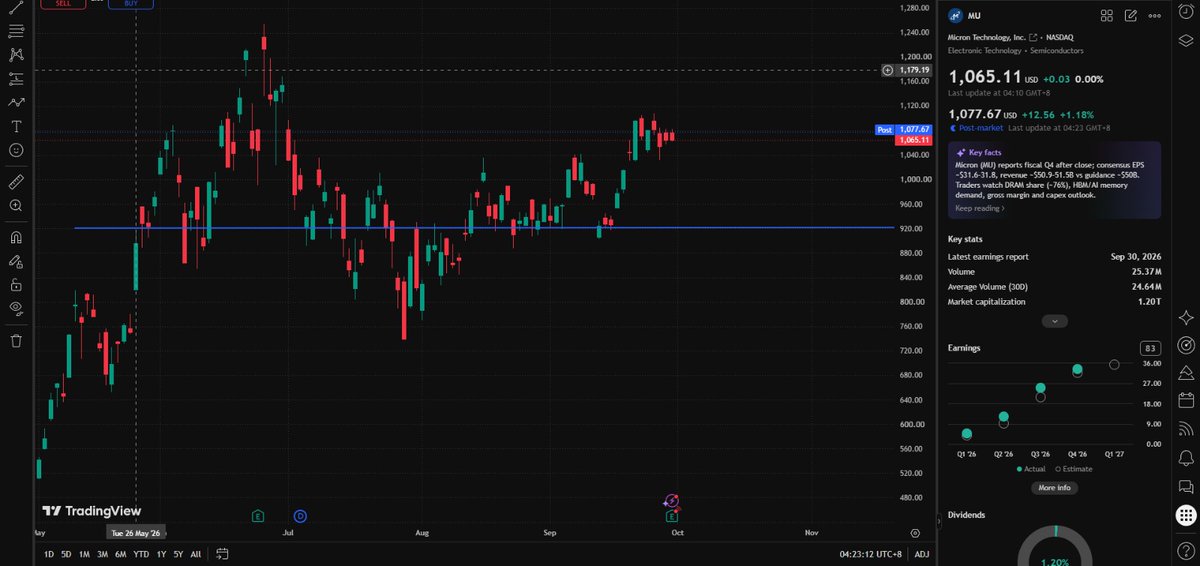
Micron ($MU ) beat Q4 expectations, driven by strong demand for AI memory chips:
Adjusted EPS: $33.42 vs. $31.16 expected.
Revenue: $54.23B vs. $50.45B expected.
Adjusted gross margin: 87.0%, up from 84.9% last quarter.
CEO Sanjay Mehrotra expects an even stronger fiscal 2027 following a record fiscal 2026, supported by growing AI demand and strategic customer agreements.
#MU #AI #DataCenters #Cloud #StockMarket
@EconguyRosie After more than a decade of trading, I’ve finally realized that no method works in every market condition.
A trading system must clearly define not only when to enter, but also when to stop.
Only by recognizing the limits of a method can you use it effectively.
@LukeGromen After more than a decade of trading, I’ve finally realized that no method works in every market condition.
A trading system must clearly define not only when to enter, but also when to stop.
Only by recognizing the limits of a method can you use it effectively.
@SantiagoAuFund After more than a decade of trading, I’ve finally realized that no method works in every market condition.
A trading system must clearly define not only when to enter, but also when to stop.
Only by recognizing the limits of a method can you use it effectively.
@AndreasSteno After more than a decade of trading, I’ve finally realized that no method works in every market condition.
A trading system must clearly define not only when to enter, but also when to stop.
Only by recognizing the limits of a method can you use it effectively.
@michaeljburry After more than a decade of trading, I’ve finally realized that no method works in every market condition.
A trading system must clearly define not only when to enter, but also when to stop.
Only by recognizing the limits of a method can you use it effectively.
In September, dozens of recommended stocks posted double-digit gains; furthermore, more than 15 stocks have risen by over 100% since their initial selection.
Here are some highlights from September:
👇👇👇👇👇👇👇👇👇
🟢Cirsa Enterprises ($CIRSA) rose 38.42%🔥🔥
🟢Ultrajaya Milk ($ULTJ) rose 36% 🔥🔥
🟢🟢Codan ($CDA) rose 30.77%🔥🔥
🟢Soitec ($SOI) rose 28.95%🔥🔥
🟢Omnia ($OMN) rose 24.86%🔥🔥
🟢Kier Group ($KIE) rose 23.32%🔥🔥
🟢OVH ($OVH) rose 21.7%🔥🔥
👉👉Our exclusive member promotion is now live. Please send me a private message to get the stock tickers.���https://t.co/4v4DT45jMC
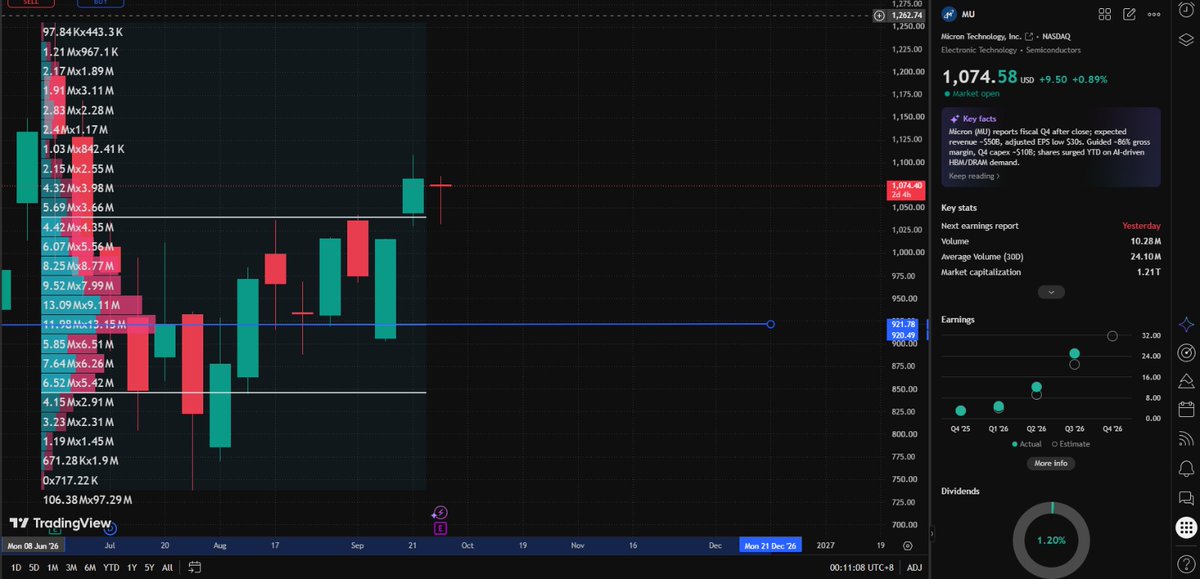
Micron ($MU ) reports earnings after the close today. Alex Carter has opened a long position, betting on growing memory demand from AI agents.🔥🔥🔥🔥
⚡️Its analyst argues that longer-running, CPU-based AI workloads will benefit Micron, projecting an aggressive $525 billion in revenue and an 80% gross margin for 2028.🔥🔥🔥
🌈The key focus: whether quarterly guidance supports expectations for sustained AI-driven memory demand🔥🔥🔥
@vip92226041 The longer I trade, the more I say, “I don’t know.”
I can’t predict every move, but I can plan scenarios, manage risk, and wait for the right setup.
Sharing thoughts on stocks, probabilities, and trading psychology.
You don’t need certainty to make a sound decision.
@JonErlichman The longer I trade, the more I say, “I don’t know.”
I can’t predict every move, but I can plan scenarios, manage risk, and wait for the right setup.
Sharing thoughts on stocks, probabilities, and trading psychology.
You don’t need certainty to make a sound decision.
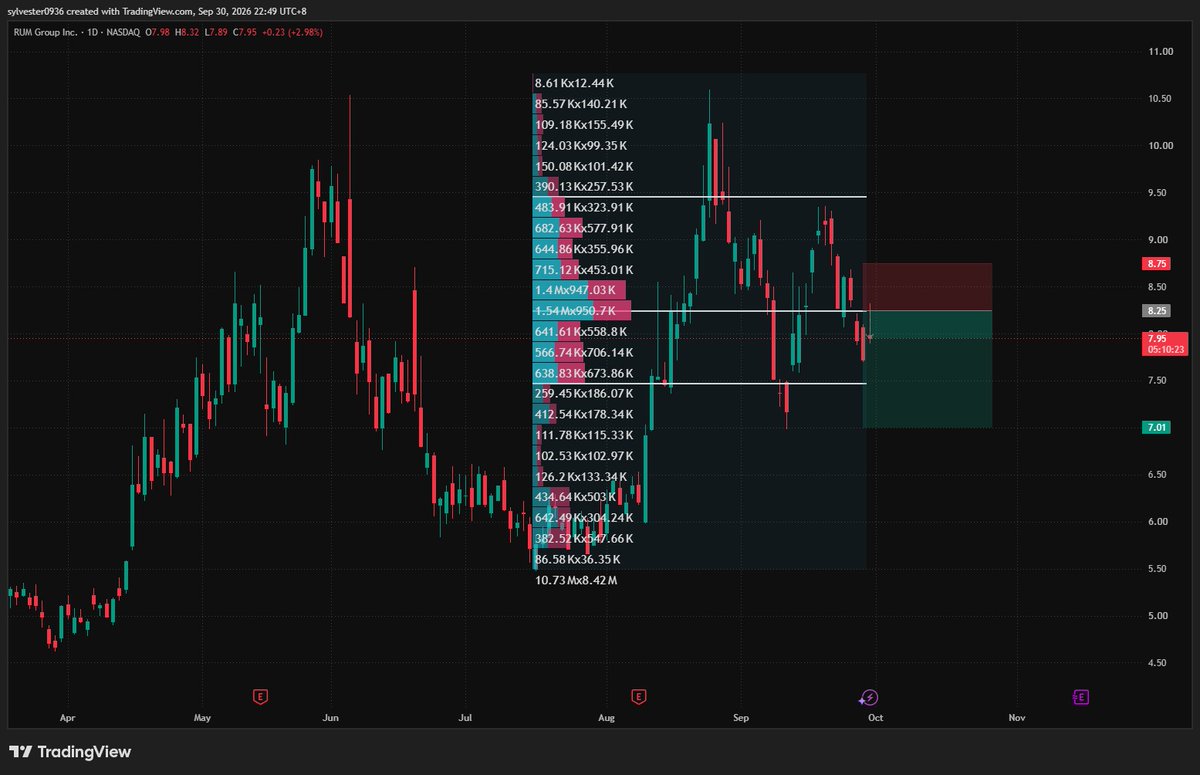
$RUM Daily Strategy: Short-term bearish bias. Wait for a bounce and rejection. Price is around $7.95 on the chart, below the $8.25–8.50 high-volume zone, a key potential resistance area.
⚡️Entry: Consider a small short position near $8.25 if the bounce stalls and price fails to hold that level. Avoid chasing the decline here.
⚡️Stop-loss: $8.75, as marked on the chart. Size the position according to the stop distance.
⚡️Targets: Take partial profits at $7.50. If that level breaks, target $7.01.
⚡️Reward-to-risk: An $8.25 entry, $8.75 stop, and $7.01 target offer approximately 2.5:1, excluding costs.
⚡️Invalidation: Cancel pending short entries if price closes above $8.50 and holds a retest. A further break above $8.75 puts resistance near $9.45 in focus.
🌈High-volume zones show where trading was concentrated historically; they don’t prove selling pressure. Wait for price rejection to confirm the entry.