@politiekedummie@ryanveeman Omdat je buurman huishoudelijk geweld pleegt hoef jij toch ook niet uit jouw woning gezet te worden ondanks dat je in hetzelfde blok woont. Van mij mogen ze ook allemaal weg, maar liever alleen die vervelende buurman dan die mensen die daadwerkelijk steentje bij willen dragen
@MvRooijen@Stas_Financien@NUnl Oprecht is er een wet geweest die zo vaak heen en weer is aangepast en bijgespijkerd? Dit kan toch nooit doorgaan zo, klopt aan alle kanten niet
We’ve been saying we’re building.
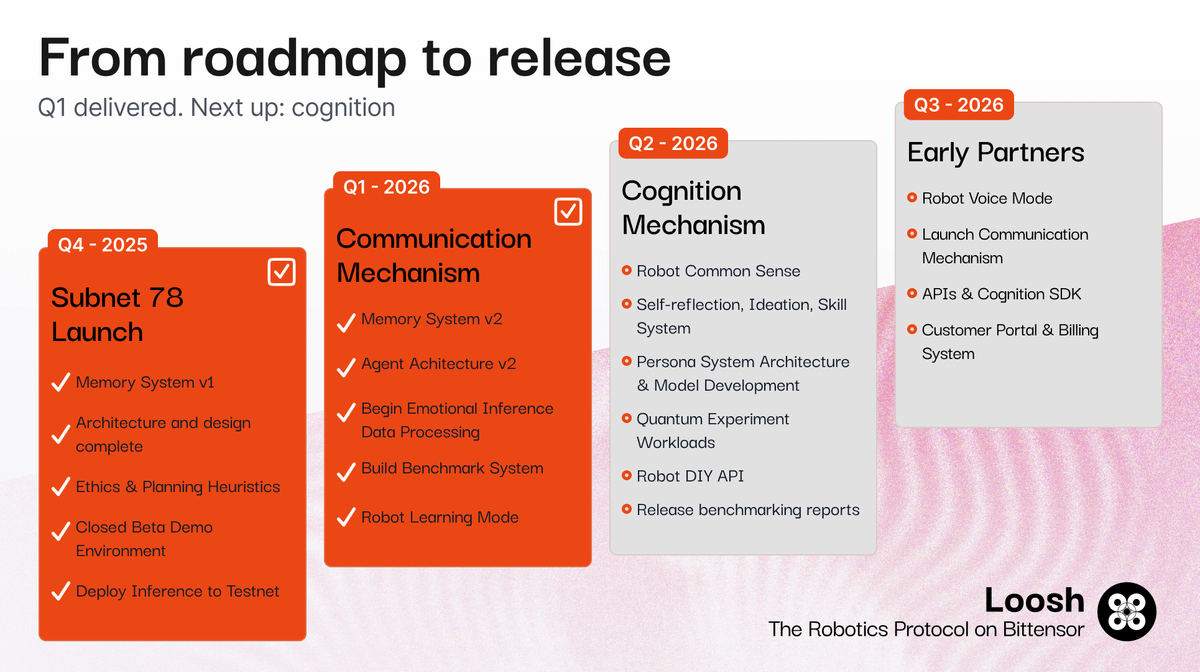
As we step into April, it’s time to tick off Q1: memory, agent architecture, and core systems in place.
From here, the system starts to expand into personas, inference, and cognition.
Step by step, it’s coming together.
->End product: Our cognition layer extends the judgment, memory, and human-facing capabilities of humanoid robotic systems without replacing the existing stack.
As middleware, Loosh governs model behavior through adaptive policy, ethics, and behavioral rulesets based on the client's use case and deployment geography.
We address repeated instructions, lost multi-session tasks, high exception rate, high operator time - reducing training time, lowering supervision overhead, improving task continuity, and increasing deployment reliability in real-world environments.
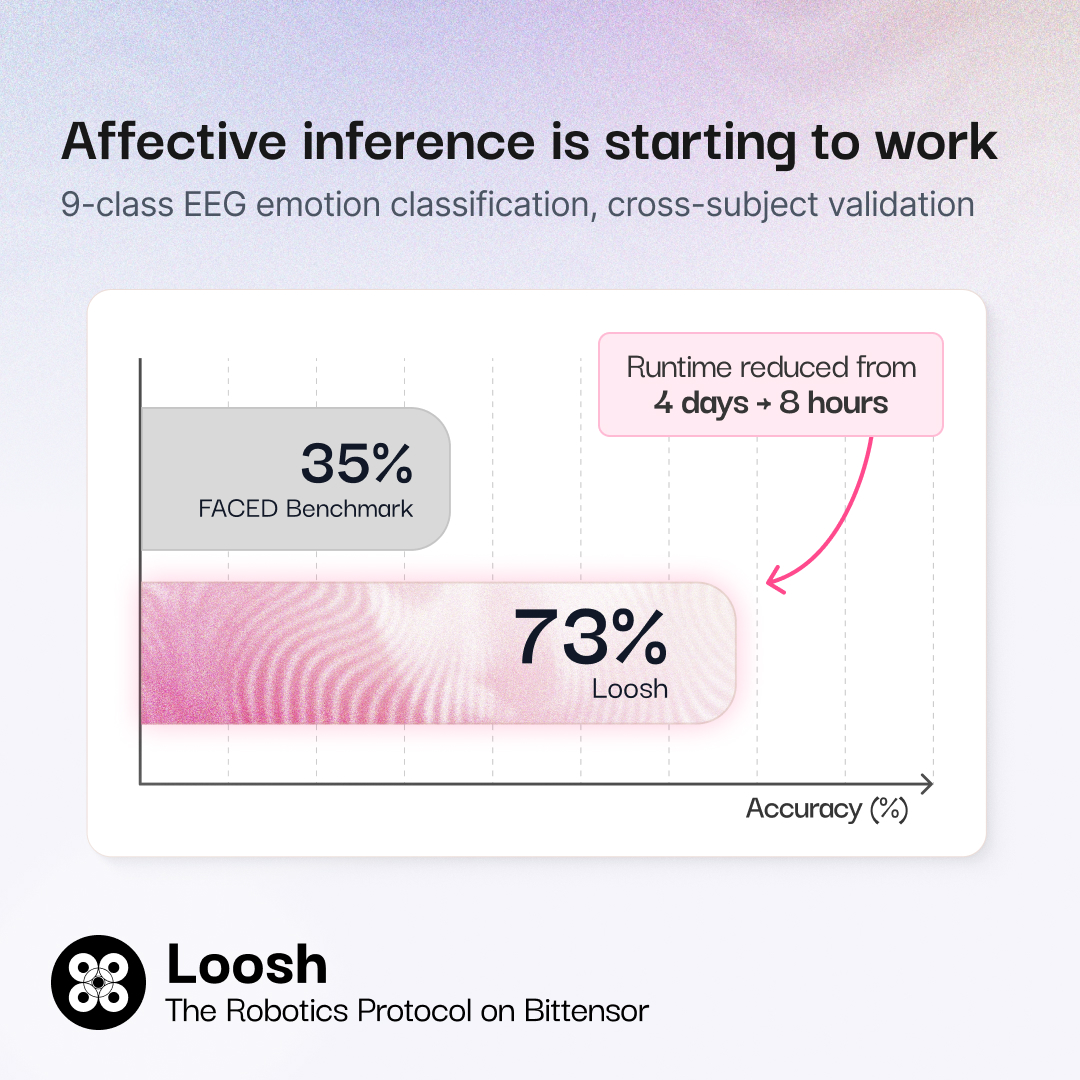
We integrate real-time emotional inference and achieved 73% mean cross-subject accuracy on 9-class emotion classification across 100+ subjects using CCNN, surpassing the FACED benchmark of 35%.
- For robotics, this means robots that adapt faster, remain effective across longer tasks, and interact more intelligently with people in complex real-world settings.
->Who pays for it: there’s three types of customers -
White label for Robotics companies: they’ve built hardware and are running an NVIDIA world model/ROS2/OpenVLA - these companies would integrate Loosh to be able to deploy their robotics into human environments. ie deploying American vs British vs Middle East humanoid robots are going to be different in their speech, behaviours, and reactivity - our middleware control this.
White label - Agentic companies: customer service AI agents aren’t currently able to understand human emotion or remember what they said last time they called, Loosh integration remembers, translates negative/positive customer interactions into business actions
Subscription for OS : we’re in touch with open source builders excited about building their own humanoid robotics. We were early Kscale supporters, we are collaborating with Asimov builders, and we are watching what’s happening in Shenzen. These builders are assembling hardware - they need software to make it capable of interacting with people otherwise it’s another Unitree teleoperated robot.
-> Alpha token: Revenue flows back into the protocol. Buybacks are one mechanism. We are whiteboarding how to reward the Top 100 Alpha holders ie they are given early product access — Personas is shipping later this year, meaning you’d be installing your Persona onto hardware like an Asimov build. Utility + economics, not speculation.
First pilots targeting Q3 2026
Hey Bittensor,
We know where we stand on the deregistration list. We know people want a response. We will be at Breakout tomorrow in person to get more people to understand what Loosh is building.
In the meantime, we moved fast and executed an OTC deal with a third party to inject additional TAO into the pool at a critical moment. We are grateful to the party involved, who chose to remain anonymous.
It has been a hard stretch, but we are still here and still building.
We are actively reviewing the subnet incentive mechanism to make it more robust. V2 is already in testing, and our ROS2 roadmap is waiting on that code because it materially improves model output.
We have also been in discussion with several high profile robotics companies around a potential pilot. One is currently waiting on benchmarking data.
We are evaluating next steps carefully, but every serious path keeps bringing us back to the same place.
We believe in Bittensor.
We believe in decentralized intelligence.
We are still here.
We are still building.
We are not leaving.
Subnet 78
Loosh achieves 73% cross-subject accuracy on 9-class EEG emotion classification (100+ subjects) vs 35% FACED benchmark.
At the same time, runtime has reduced from 4 days (CPU) → 8 hours (GPU).
All of which means lowered costs of iteration and development, and robots that can adapt faster, stay effective over longer tasks, and interact more intelligently in the real world.
🔥 Subnet Summer AMA - Subnet 78 @Loosh_ai 🔥
In this episode, we sit down with the team behind Subnet 78 Loosh, a subnet building a decentralised cognition layer for AI agents on the Bittensor ecosystem.
Loosh focuses on moving beyond traditional AI outputs by enabling systems to reason over time, retain persistent memory, and execute tasks more reliably. Through decentralised competition, miners contribute to inference, memory, and planning capabilities, while validators score outputs based on quality, coherence, and real-world usefulness.
During the AMA, we explore how Loosh is tackling one of AI’s biggest bottlenecks - turning models that can talk into systems that can actually think, remember, and act.
We cover:
• The core problem Loosh is solving and its ideal first customers
• Why Bittensor is the right network and what makes Loosh’s approach unique
• Persistent memory, dynamic execution, and improving agent reliability
• Sybil resistance, weighted routing, and subnet quality improvements
• Key metrics to watch over the next 6-12 months
• Benchmarking, proving performance, and differentiation vs base models
• New features, behind-the-scenes progress, and lessons from running a live subnet
If you're interested in agent-based AI, reasoning systems, and how decentralised networks can unlock the next generation of intelligent machines, this episode is for you.
https://t.co/wvw6QePCyt
Been quiet. Not inactive.
We have been heads down shipping across five major areas:
1. Winner takes more - We are introducing weighted challenge routing to reward the inference behavior we actually want. Higher quality miners get more flow. Sybils get less, or none.
2. Miner DDoS hardening - We are adding comprehensive DDoS protection to the miner codebase to improve resilience under hostile conditions.
3. User Memory - We are building per user memory across the agent stack with strong protections against cross user leakage and data contamination.
4. Benchmarking - We are building a dynamic benchmarking engine to run prompt batteries over time and compare performance against base models and prior system states.
5. Dynamic Execution - We are adding a new cognitive mode built around dynamic plan generation and narrow task-specific subflows. The goal is lower hallucination rates and more reliable execution.
What to look forward to:
Better subnet quality
Stronger Sybil resistance
More resilient miner infrastructure
Persistent user memory with tighter safety boundaries
Clearer performance benchmarking over time
More reliable agent execution
We are not slowing down. We are tightening the system. Preparing for conversations with customers.
I’m hoping that @Loosh_ai’s ethical, conscientious robots are the ones powering the future of telehealth.
https://t.co/JRXZHZ3D62
Credits 🎥@Tensor_Flow_
Do you want agents and robots to act in a predictable, intelligent, and moral way?
@Loosh_ai (SN78) is developing the backbone for the cognition, ethics, and emotional intelligence of machine consciousness.
The bottleneck isn’t hardware anymore, it’s cognition.
@Loosh_ai is positioning itself exactly where the real unlock is: reasoning under ambiguity.
Factories were the easy mode.
The real market is human environments.
And that requires memory, context, and emotional inference… not just better arms and sensors.
This is where things get very bullish.
Where has attention been flowing lately across Bittensor subnets?
One name is starting to stand out…
@Loosh_ai
Subnet 78: Loosh ..is next up.
Not just another subnet, but one pushing into memory, cognition, and machine awareness for AI agents.
Definitely one to watch.⚡👇👇
Team is locked in
We just pushed another update to the validators:
- DDoS mitigation
- Validator IP tracking
- Challenge API auth
https://t.co/gbRu8LfWc0
AMA tomorrow. pull up