Overhead "No one is losing their jobs to AI at [this company]", but they may lose them to cyborg engineers using LLMs to outstrip capacity for slinging PRs.
LOC metrics are a worse signal than ever now....
E.g. why is Claude's active context not phrased in terms of memories, history, etc. _and_ vice-versa, why are knowledge bases not phrased in terms of contextual value?
I'm thinking more and more that the graduated graph of context should have better layers of abstraction that reduce the representational discrepancy across domains of consideration.
And what about keeping track of all the paths not taken?
When I backtrack and go down a different road, how can our "tracing" format let us keep our whole journey for later reflection? I think talking about how we got here should be the goal.
More open formats for tool interop is a great idea.
To move toward general support and away from being too conversational IDE centric, we'll want to iterate.
We're proposing an open standard for tracing agent conversations to the code they generate. It's interoperable with any coding agent or interface.
https://t.co/jO4DIoIl6A
Next I'd love this to play nice with non-AI tooling that doesn't speak in "conversations".
When Claude Code writes, formatter squishes, and I refine it for PR, I want _all_ those steps preserved in full fidelity.
How can this let me "ignore" the formatter squishing at blame?
First thing I'd love to see is to move to representing diffs instead of just flat spans.
Right now, Agent Trace describes code as generated, not as updated/changed/transformed. Code isn't static.
If I'm generating a "trace" from my git repo, I want to know how things evolved.
There needs to be a name for the prompt and context that "runs" an Agent/LLM -- Promptware, Thoughtware, Vibeware?
We now have many different "applications" running on the same models; different Vibeware running on Claude or Llama = different behavior = a different application.
Billion dollar idea: stand up a marketplace on top of Replicated or something which lets people set up a "virtual cloud" that runs other people's jobs in their own env to leverage non-transferable cloud credits.
"Aggregated cloud as a service as a service"
ACaaSaaS
Software engineering is building with sand. Nothing is permanent. Code is change.
Like buddhist mandalas, there's an ephemerality to the art that must be acknowledged to be accepted.
As AI codegen gets better, code review is becoming an even _more_ important "basic" skill for engineers still mucking in code-land.
If you can't immediately find what's wrong in generated code, you're going to struggle to keep up.
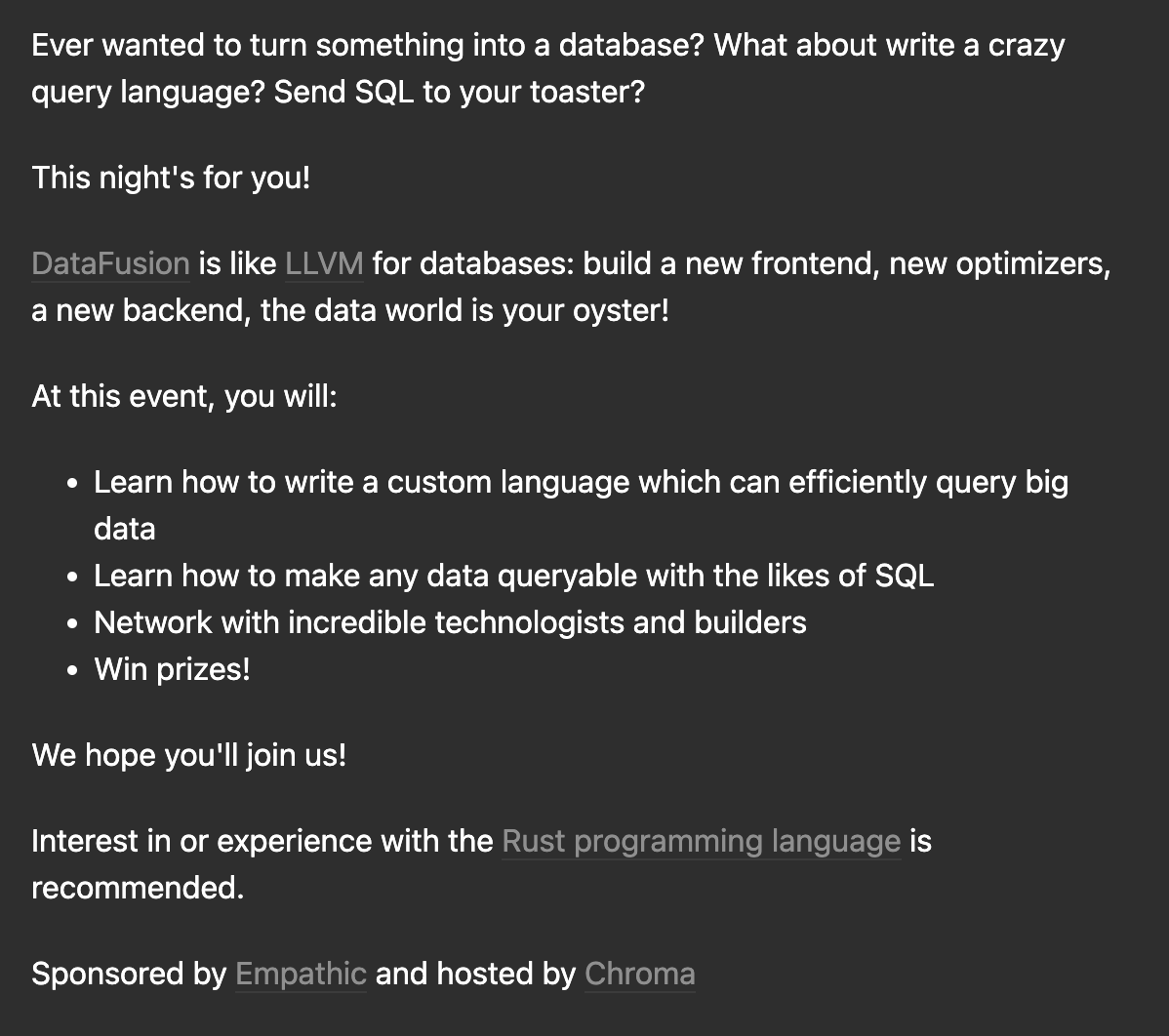
Ever wanted to make a database out of something or query a DB with your own custom language? In SF March 19th?
I'm hosting a hackathon just for you.
Come get weird with DataFusion!
https://t.co/3ybvw9HiWx
The Kesling Criteria (informally) --
A system is a database if:
1) You can ask questions of it
2) It returns data
As presented in my @papers_we_love talk last week https://t.co/NfekC4Aj4Z